
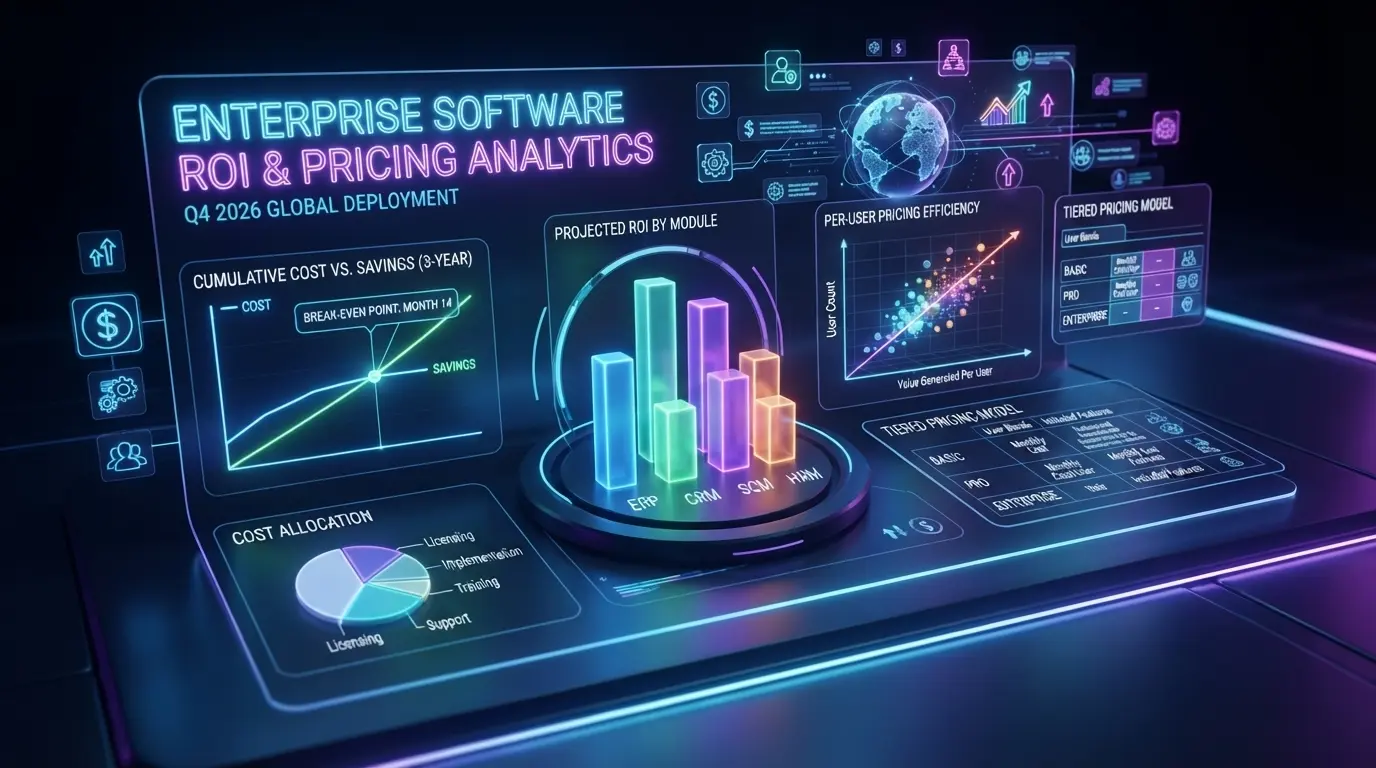
Evaluating the true financial return on investment (ROI) for enterprise software in 2026 requires moving far beyond traditional licensing and subscription metrics. As global organizations continue to scale their digital infrastructure, implementing complex enterprise resource planning (ERP) suites—such as Oracle NetSuite, SAP S/4HANA, and Odoo—demands a rigorous financial framework. Modern executives must account for cloud migration efficiencies, automated operational workflows, multi-region tax compliance, and the total cost of ownership (TCO) over a multi-year lifecycle.
1. The Evolving Landscape of Enterprise Software Investments
The enterprise software market has undergone a dramatic transformation. Legacy on-premise systems characterized by massive upfront capital expenditures (CapEx) have been almost entirely replaced by agile, cloud-native subscription models (SaaS). While this shift lowers the barrier to entry, it introduces new financial complexities regarding long-term operational expenditures (OpEx).
Organizations often underestimate the hidden expenses associated with cloud deployment, custom API integrations, user training, and continuous system maintenance. To achieve a positive ROI in 2026, decision-makers must treat software implementation not merely as an IT upgrade, but as a core business transformation initiative.
| Cost Component | Traditional On-Premise | Modern Cloud Enterprise (2026) |
| Initial Deployment | High CapEx (Servers, Hardware) | Moderate OpEx (Subscription, Setup) |
| Scalability | Rigid, requires hardware replacement | Elastic, instant resource adjustment |
| Maintenance & Updates | Manual internal IT patches | Automated vendor updates |
| Security & Compliance | Managed internally (higher risk) | Enterprise-grade cloud security |
2. Core Drivers of Enterprise Software ROI
Maximizing the return on enterprise software investments relies on identifying and optimizing specific value creation levers across the organization. The primary drivers include:
-
Reduced Implementation Timelines: Utilizing modern deployment methodologies and pre-built connectors minimizes initial operational downtime and accelerates user adoption across international teams.
-
Automated Compliance & Financial Auditing: Handling complex multi-region tax structures, global currency conversions, and automated reporting reduces manual auditing errors and administrative overhead.
-
Process Automation & Workforce Efficiency: Eliminating redundant data entry through integrated CRM, ERP, and supply chain modules allows skilled personnel to focus on high-value strategic initiatives.
-
Data-Driven Decision Making: Centralizing business intelligence through advanced analytics dashboards provides real-time visibility into inventory, cash flow, and project performance.
3. Comprehensive Formula and Framework for Calculating Net ROI
Calculating the true net ROI of an enterprise software deployment involves balancing total financial returns against total accumulated costs over a defined evaluation period, typically three to five years.
Executive Deep-Dive
Scaling Beyond Traffic to Revenue
Most enterprises fail because they chase clicks instead of trust. While building your global presence, ensure your EEAT 3.0 signals are synchronized across all regions.
Recommended for you:
→ The Shift from Traffic to Trust: A New KPI for Enterprise SEONet ROI (%) = [ (Total Financial Benefits - Total Cost of Ownership) / Total Cost of Ownership ] * 100
When calculating the Total Cost of Ownership (TCO), organizations must aggregate:
-
Software licensing or SaaS subscription fees.
-
Implementation consulting and customization fees.
-
Internal resource allocation (employee hours dedicated to training and migration).
-
Ongoing support, maintenance, and potential third-party integration costs.
Conversely, Total Financial Benefits encompass direct cost savings (such as reduced inventory holding costs or lower headcount growth for administrative tasks) alongside revenue enhancements driven by faster time-to-market and improved customer retention.
4. Mitigating Risks to Protect Software ROI
Even the most sophisticated ERP or cloud software architecture can fail to deliver expected returns if mismanaged during execution. Common pitfalls include scope creep, inadequate employee training, and poor change management. To safeguard enterprise ROI, management teams should:
-
Establish clear, measurable Key Performance Indicators (KPIs) prior to vendor selection.
-
Enforce rigorous change management protocols to drive high user adoption rates across all departments.
-
Partner with certified implementation specialists who understand industry-specific compliance and workflow requirements.
-
Continuously audit system utilization to identify underused modules and optimize license counts.
5. Conclusion
Achieving exceptional enterprise software ROI in 2026 is a deliberate process that combines strategic tool selection, disciplined financial modeling, and proactive change management. By focusing on long-term operational efficiency, automation, and scalable cloud architectures, businesses can transform their software investments into powerful engines for sustainable global growth.
Exclusive Early Access: Q1 2026
The Global SEO Blueprint for C-Suite
We are finalizing an exclusive strategic framework for global enterprise scaling. Join the elite waitlist for early-bird pricing.
Secure Your Priority Spot