
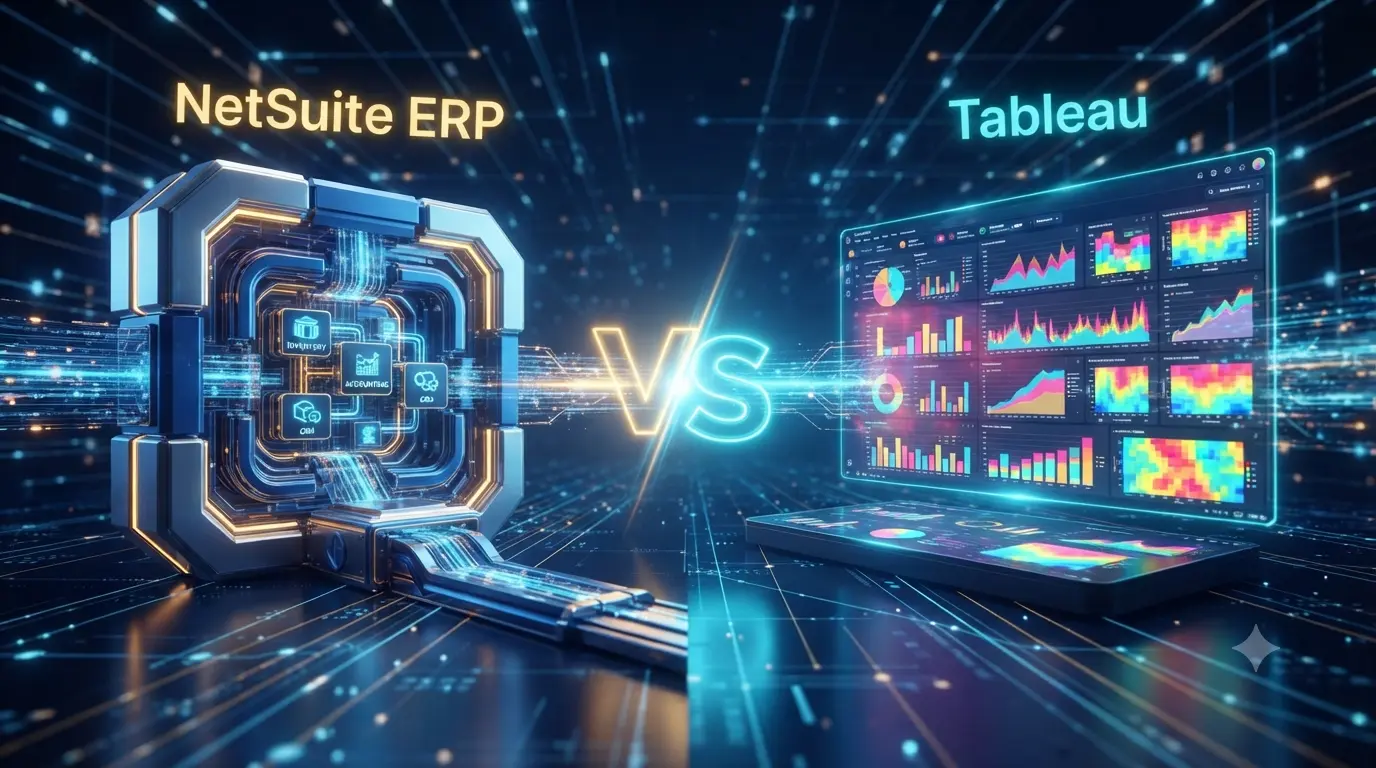
NetSuite vs Tableau
*Updated for 2026
2026 Update: The landscape of business intelligence has shifted. While Tableau remains a powerhouse for deep data visualization, NetSuite’s native Analytics Warehouse has closed the gap for businesses already in the Oracle ecosystem. In 2026, the real question isn’t just about “features,” but about integration speed. If your global operations require real-time ERP data syncing without third-party connectors, NetSuite’s evolving BI tools are now a formidable challenger to Tableau’s dominance.
In 2026, choosing between NetSuite’s ERP capabilities and Tableau’s analytics is crucial for global scale.
For a global enterprise scaling toward a $1M per month revenue milestone by 2030, the primary challenge isn’t the lack of data—it is the Clarity of Insight. As a CEO or CFO, you cannot navigate a complex global market using static spreadsheets. To reach the 2M per month potential, your “Organic Performance” must be backed by “Visual Intelligence” that allows for split-second strategic pivots.
If your organization is already anchored in Oracle NetSuite, you face a critical architectural decision: Should you rely on the native NetSuite SuiteAnalytics, or should you integrate a dedicated, world-class BI powerhouse like Tableau?
Executive Deep-Dive
Scaling Beyond Traffic to Revenue
Most enterprises fail because they chase clicks instead of trust. While building your global presence, ensure your EEAT 3.0 signals are synchronized across all regions.
Recommended for you:
→ The Shift from Traffic to Trust: A New KPI for Enterprise SEOThis guide provides the urgent, technical, and strategic clarity required to choose the right analytical engine for your 2030 vision.
The Strategic Divide: Embedded Reporting vs. Deep Data Exploration
To lead effectively, executives must distinguish between “Operational Visibility” and “Strategic Discovery.”
Oracle NetSuite SuiteAnalytics is an embedded toolset designed for real-time visibility within the ERP. It excels at showing you what is happening now across your sales, inventory, and finance modules. It is the “Dashboard of the Present.”
Tableau is a “Best-of-Breed” Business Intelligence (BI) platform. It is designed for deep, multi-dimensional data exploration and storytelling. It doesn’t just show you what is happening; it allows you to ask “Why” through intuitive, visual interaction. It is the “Canvas of the Future.”
1. Data Complexity and Multi-Source Orchestration
Reaching high-ticket revenue goals often requires analyzing data from multiple “planets” in your tech stack.
-
Tableau’s Mastery: This is where Tableau is untouchable. It is built to blend data from hundreds of sources—NetSuite, Salesforce, Google Analytics, AWS, and legacy SQL databases—into a single, unified visualization. For a CEO, this means seeing the direct impact of SEO organic performance on the balance sheet in one cohesive view.
-
NetSuite Native: SuiteAnalytics is brilliant for data residing inside NetSuite. However, pulling in external, non-ERP data for a holistic “Command Center” view often requires complex SuiteTalk API work or expensive data warehouse connectors.
2. Visual Storytelling and Executive Adoption
In the C-suite, time is the scarcest resource. A dashboard is only valuable if it communicates an insight in under five seconds.
-
The Tableau Experience: Tableau is the gold standard for visual aesthetics and interactivity. It allows for “Guided Analytics,” where a CFO can click on a global map and instantly drill down into the SKU-level profitability of a specific London subsidiary. The level of “Visual Polish” in Tableau is built for Board-level presentations.
-
NetSuite Native: NetSuite has made massive leaps with its Workbook and Pivot features. It is functional, clean, and audit-ready. However, it remains primarily a “tabular-first” environment. For leaders who require highly customized, visionary visualizations, Tableau offers a superior creative frontier.
3. Technical Integration: The “Data Silk Road”
For a CIO, the priority is “Data Integrity.” Does adding Tableau create a fragmented data silo?
-
The Integration Strategy: Tableau features a robust NetSuite Connector (often via a Snowflake or BigQuery data warehouse layer for enterprise scale). This creates a high-speed “Data Silk Road.”
-
The ROI of Integration: NetSuite remains the “Engine of Record” (The Past), while Tableau becomes the “Engine of Vision” (The Future). By separating the transactional burden from the analytical burden, your ERP stays fast and your insights stay deep.
4. Operational Efficiency: Speed to Insight
To hit the $1M/month milestone, you need a lean, elite team. You cannot scale if your analysts spend 40 hours a week manually updating reports.
-
Tableau Automation: Once a Tableau dashboard is built, it refreshes automatically. It features “Ask Data” (NLP), allowing a CEO to type, “Show me revenue by region for the last 3 years,” and receive an instant visualization. This “Self-Service BI” liberates your finance team from mundane report generation.
-
NetSuite Experience: Staying within the NetSuite ecosystem reduces the need for new security protocols and a separate BI budget. However, for complex cross-functional analysis, the time-to-insight in Tableau is often 3x faster once the initial setup is complete.
Strategic Verdict: Which Engine Fits Your Vision?
Choose NetSuite SuiteAnalytics if:
-
Your analytical needs are primarily focused on ERP-native data (Finance, CRM, Inventory).
-
You want a single-vendor cloud ecosystem with zero integration overhead.
-
You prefer a “Unified Suite” for a lower IT footprint and simplified user management.
Choose Tableau + NetSuite if:
-
You are a complex global enterprise with data spread across multiple platforms (CRM, Marketing, Web).
-
You require “Board-Ready” visualizations and deep, multi-dimensional data discovery.
-
You want to empower your C-level team with AI-driven, self-service analytics to drive the 2030 vision.
Conclusion for DMS Global
In the pursuit of global digital dominance, your visual intelligence must be as sharp as your organic growth strategy. For the C-level visionary, the decision isn’t just about software; it’s about Clarity. By integrating Tableau’s visual power with NetSuite’s operational data, you create a foundation that is audit-ready, visionary, and built for the elite tiers of the global market.
Related Resources:
Reliable resources for your business growth
Last Updated on 1 week ago by dudung
Exclusive Early Access: Q1 2026
The Global SEO Blueprint for C-Suite
We are finalizing an exclusive strategic framework for global enterprise scaling. Join the elite waitlist for early-bird pricing.
Secure Your Priority Spot