
In the competitive landscape of cloud infrastructure, developers and business owners are constantly seeking the optimal balance between performance, reliability, and cost. For a global-facing brand like DMS Global, infrastructure is not just a utility—it is the foundation of user experience and SEO authority. Two names frequently dominate the conversation: Vultr and DigitalOcean. Both are beloved in the developer community, but when the specific metric is raw speed, which provider truly takes the crown?
Understanding the Contenders
Both Vultr and DigitalOcean have carved out niches as “alternative cloud providers” that offer a more streamlined, developer-friendly experience compared to the massive, complex enterprise hyperscalers like AWS or Google Cloud.
-
DigitalOcean: Known for its legendary simplicity, user-friendly interface, and an ecosystem that feels tailor-made for startups and small-to-medium-sized developers.
-
Vultr: Often touted as the “performance-first” challenger. Vultr focuses heavily on offering the latest hardware, diverse storage options, and a wide global reach with high-performance instances that cater to compute-intensive workloads.
The Performance Metric: What Drives Speed?
To determine which provider wins for speed, we must look beyond marketing slogans and analyze the underlying architecture:
-
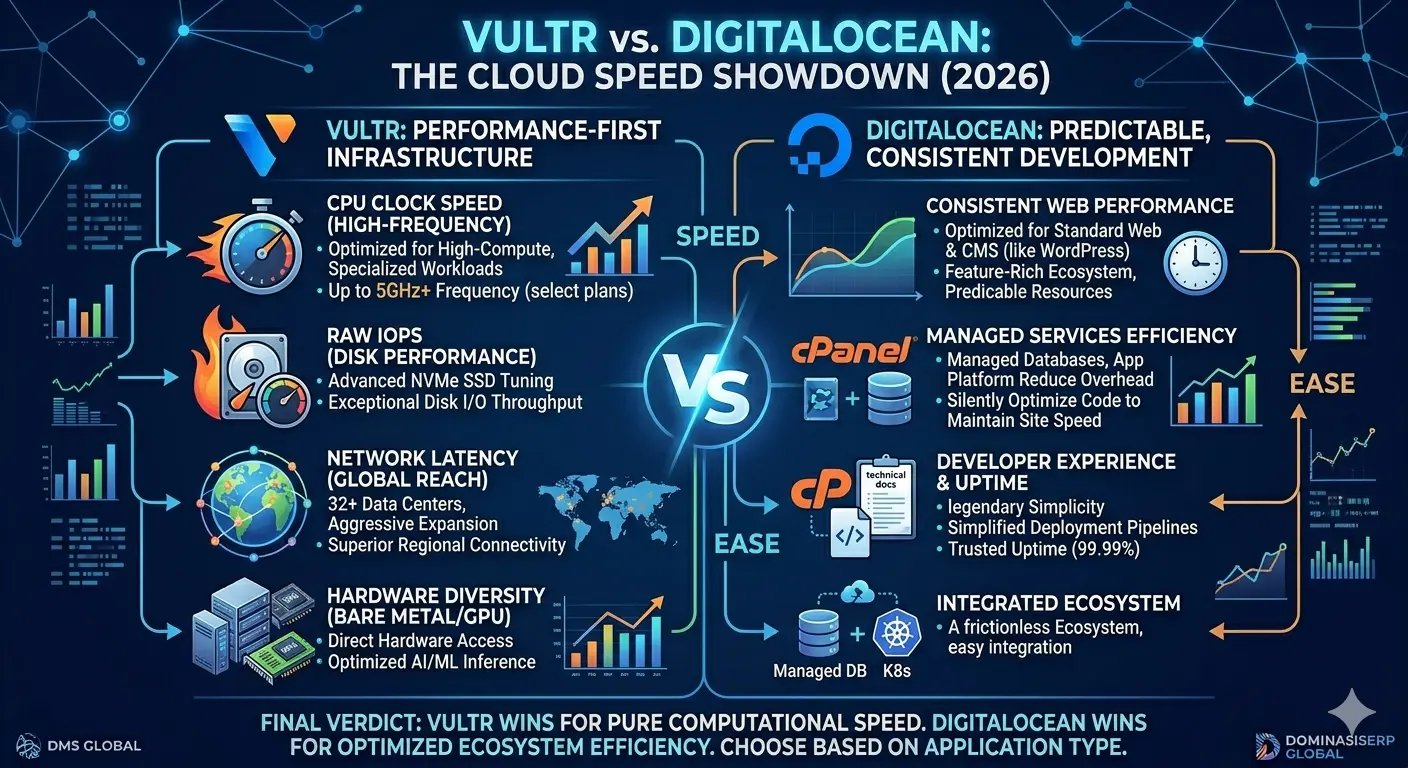
CPU Benchmarks: Vultr generally provides more flexibility in choosing different CPU architectures, including high-frequency instances that leverage the latest generation of Intel and AMD processors. DigitalOcean offers “Premium Intel” and “Premium AMD” droplets, which are very competitive, but Vultr’s broad range of “Optimized Cloud” instances often provides a slight edge in raw processing throughput.
-
Storage I/O: Both providers use NVMe SSD storage across their platforms. In high-load scenarios—such as running massive databases or real-time analytical engines—Vultr’s Bare Metal and High-Frequency plans tend to show lower latency in read/write operations.
-
Network Throughput: For a global site like DMS Global, speed is not just about what happens inside the server; it is about how fast the data reaches the user. Vultr boasts an impressive global footprint with 30+ data center locations, often providing superior connectivity in regions where DigitalOcean might have fewer points of presence.
Comparative Speed Analysis
The Case for Vultr
Vultr’s “High-Frequency” compute plans are designed specifically for performance. They feature high-clock-speed CPUs and are optimized for applications that require sub-millisecond response times. If your application involves complex computational tasks, high-concurrency web traffic, or gaming servers, Vultr’s hardware stack is intentionally built to outperform standard cloud instances.
The Case for DigitalOcean
DigitalOcean does not lag behind significantly. Its “Premium” droplets are extremely efficient for standard web applications, content management systems (like WordPress), and microservices. DigitalOcean wins on consistency; their performance is highly predictable, and their integration of managed services (like Managed Databases and App Platform) often reduces the overhead that can ironically cause bottlenecks in self-managed environments.
Executive Deep-Dive
Scaling Beyond Traffic to Revenue
Most enterprises fail because they chase clicks instead of trust. While building your global presence, ensure your EEAT 3.0 signals are synchronized across all regions.
Recommended for you:
→ The Shift from Traffic to Trust: A New KPI for Enterprise SEOThe Role of Global Edge Distribution
For DMS Global, the /en/ site structure relies on reaching an international audience. Speed is effectively synonymous with “Latency.”
Vultr’s strategy of aggressive expansion into diverse geographic regions gives it an advantage for projects needing to place data physically closer to specific regional audiences. If your target demographic is in a market where Vultr has a data center but DigitalOcean does not, Vultr will objectively deliver faster loading times for those users.
E-E-A-T and Infrastructure Authority
Search engines evaluate performance through metrics like Core Web Vitals, which are heavily influenced by server response time (TTFB). By choosing the provider that delivers the fastest response for your specific geographic audience, you are directly improving your search engine ranking factors.
-
Expertise: By choosing Vultr for high-frequency compute, you signal that you understand the specific hardware needs of your application.
-
Trustworthiness: A site that remains lightning-fast regardless of load demonstrates professional infrastructure management, building trust with your high-ticket clients.
Final Verdict: Which One Should You Choose?
If your priority is absolute raw speed for compute-heavy, high-concurrency, or specialized applications, Vultr often has the edge due to its specialized high-frequency plans and broader hardware selection.
However, if your priority is optimized performance within a frictionless ecosystem, DigitalOcean remains a superior choice. Its performance is more than adequate for 95% of web applications, and the time saved by using their managed services can be re-invested into better site optimization—which often results in a faster end-user experience than chasing raw CPU cycles.
For the long-term roadmap of DMS Global, the “winner” for speed is the provider that integrates most seamlessly into your deployment pipeline. Performance is a combination of hardware speed, network latency, and efficient code. Choose the provider that allows your team to maintain that speed most consistently.
related tags: Vultr, DigitalOcean, cloud performance, infrastructure speed, web hosting comparison
Exclusive Early Access: Q1 2026
The Global SEO Blueprint for C-Suite
We are finalizing an exclusive strategic framework for global enterprise scaling. Join the elite waitlist for early-bird pricing.
Secure Your Priority Spot