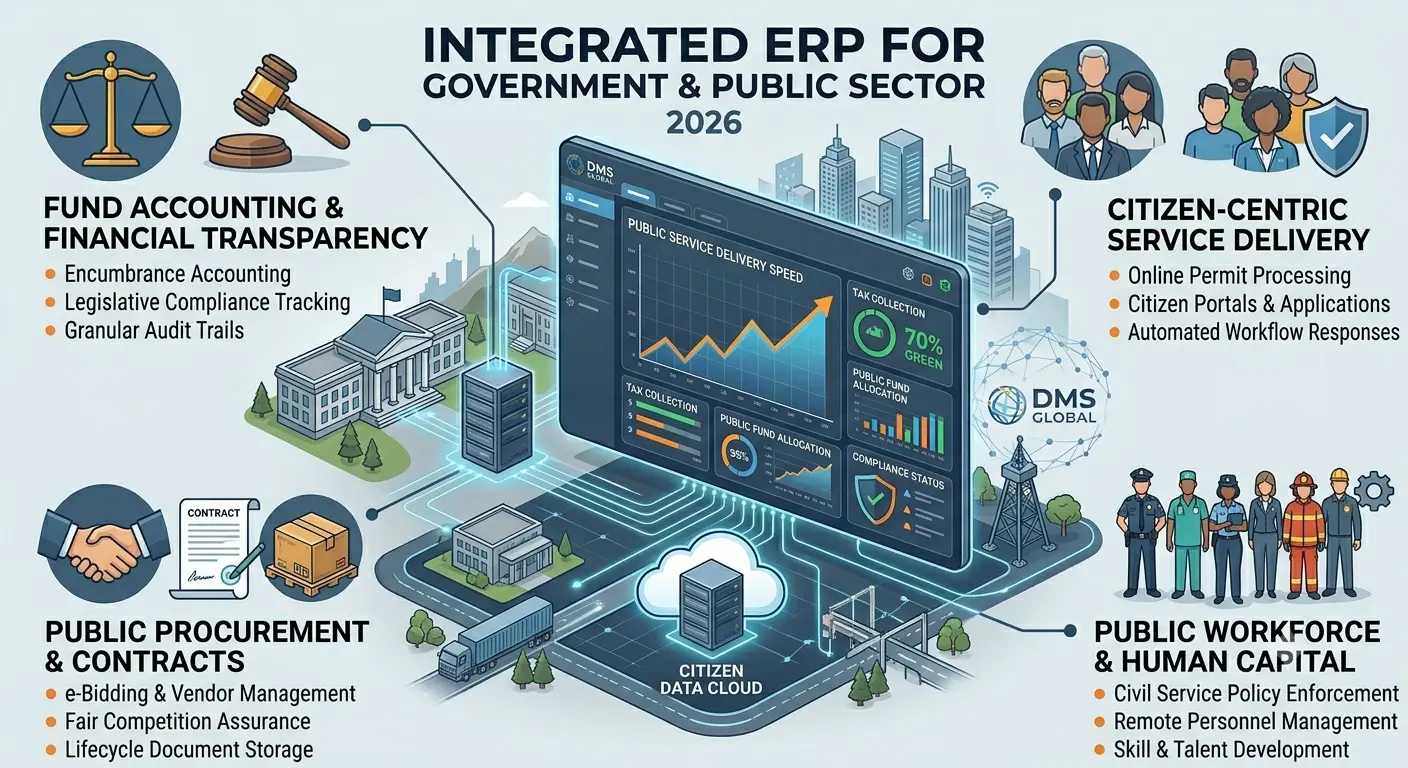
In the complex landscape of public administration, the demand for modernization has never been greater. As we navigate through 2026, government agencies and public sector organizations are facing increased pressure to deliver services faster, manage taxpayer funds with absolute transparency, and ensure total regulatory compliance. Implementing a specialized ERP for Government and Public Sector is the foundational strategy for transforming bureaucratic operations into streamlined, data-driven, and highly accountable digital ecosystems.
The Strategic Importance of ERP in the Public Sector
Public sector organizations operate under a unique set of constraints that do not exist in the private sector. They must manage public funds with extreme scrutiny, adhere to strict legislative requirements, and provide services that impact millions of citizens daily. A general-purpose ERP is often insufficient to meet these rigorous needs.
A dedicated government ERP acts as the central intelligence for public administration. It integrates disparate departments—such as finance, human resources, procurement, asset management, and citizen-facing service portals—into a unified digital architecture. By replacing siloed, legacy systems with a secure, cloud-based ERP, agencies can eliminate procedural redundancies, prevent financial mismanagement, and significantly increase the speed of service delivery to the public.
Reliable resources for your business growth
Strategic Pillars of Government ERP Excellence
When evaluating ERP solutions for the public sector, decision-makers must prioritize functionality that guarantees public trust and operational efficiency. The following pillars are essential for any agency aiming for excellence in 2026:
1. Fund Accounting and Financial Transparency
Unlike private enterprise accounting, public sector finance relies heavily on fund accounting to ensure that taxpayer money is used strictly for its designated purposes. An ERP for government must provide robust encumbrance accounting, grant management, and granular audit trails. This transparency is vital for public accountability and ensures that every cent is accounted for in accordance with legislative mandates.
2. Streamlined Public Procurement
Government procurement processes are often criticized for being slow and opaque. Modern ERP systems digitize the entire procurement lifecycle—from vendor registration and e-bidding to contract management and payment processing. This increases competition, ensures fair vendor treatment, and prevents corruption by creating an immutable digital record of every procurement action.
3. Integrated Human Capital Management
Public sector workforces are large, diverse, and governed by complex labor regulations. A government-grade ERP manages everything from position control and recruitment to payroll and performance evaluations, all while adhering to civil service policies and union agreements. This automation reduces administrative overhead and ensures that talent is deployed where it is most needed.
4. Citizen-Centric Service Delivery
Modern governments are shifting toward a “citizen-first” model. An integrated ERP allows agencies to bridge the gap between back-office operations and public portals. By automating workflows, citizens can apply for permits, pay fees, and access services online, dramatically improving public satisfaction and reducing the workload for government staff.
🚀 Deep Dive Enterprise Resources
If you're evaluating Enterprise Resource Planning, leverage our technical ROI breakdowns and performance benchmarks:
- 👉 Odoo Enterprise Pricing 2026: The Ultimate Guide
- 👉 SAP to Odoo Migration: Risks & Benefits
- 👉 Maximizing ROI with Oracle NetSuite Implementation
*Verified for 2026 Enterprise Standards.
DMS Global AuthorityBuilding Authority and Capturing High-Value Traffic
The government and public sector technology niche is an incredibly high-authority, high-impact area. It attracts top-tier decision-makers, including city managers, public sector CIOs, government agency directors, and procurement specialists. These professionals are actively searching for expert guidance on how to modernize operations without compromising public trust or security.
By providing deep-dive insights into how ERP implementation solves specific bureaucratic bottlenecks, you position your website as an indispensable resource. This high-intent traffic is exceptionally valuable. When you consistently provide technical value that solves real-world pain points, you cultivate a premium digital environment. Because your content is tailored to business-critical public sector decisions, your site becomes high-value real estate for premium advertisers, setting the stage for consistent, high-paying AdSense revenue.
Reliable resources for your business growth
🚀 Deep Dive Enterprise Resources
If you're evaluating Enterprise Resource Planning, leverage our technical ROI breakdowns and performance benchmarks:
- 👉 Odoo Enterprise Pricing 2026: The Ultimate Guide
- 👉 SAP to Odoo Migration: Risks & Benefits
- 👉 Maximizing ROI with Oracle NetSuite Implementation
*Verified for 2026 Enterprise Standards.
DMS Global AuthorityReliable resources for your business growth
Driving Consistent Financial Results Through Digital Authority
Achieving monthly AdSense payouts is the direct result of building a helpful, authoritative ecosystem that public sector experts rely on. The E-E-A-T (Experience, Expertise, Authoritativeness, and Trustworthiness) standards are paramount here. By focusing on the specific hurdles of government operations—such as managing multi-year budget cycles or ensuring data privacy in public records—you build a loyal, recurring readership.
As your site becomes the “go-to” guide for government technology, decision-makers will visit more frequently, read your articles in depth, and interact with the professional advertisements strategically placed throughout your content. This level of engagement is the primary engine of your monthly AdSense income. When your content helps a public official solve a complex administrative issue, they engage with your platform, and the quality of that engagement directly reflects in your AdSense performance.
Reliable resources for your business growth
Strategic Roadmap for 2026 and Beyond
The public sector is rapidly moving toward more digitized, autonomous, and transparent governance. Agencies that adopt comprehensive, cloud-native ERP solutions today will be the ones that effectively serve the citizens of tomorrow.
If you are beginning your digital transformation, start by auditing your most significant operational bottlenecks. Is it the lack of transparency in procurement? Is it the difficulty of managing dispersed HR records across different offices? Choose a modular approach—implement the core ERP functions that address your immediate risks, then scale the platform as your agency expands its digital reach.
By blending the precision of an enterprise-grade ERP with a data-driven content strategy, you turn your digital presence into a powerful, revenue-generating asset. Stay analytical, maintain absolute data integrity in your articles, and continue building your platform with the same professional rigor you apply to your public service operations. Your path to operational excellence and sustainable financial growth starts right here. By establishing yourself as the voice of authority in government tech, you are building a digital business that works as effectively as the public sector systems you write about.