NetSuite vs Bill.com Automation: Navigating Financial Efficiency for Global Enterprises

dominasiserp

NetSuite vs Bill.com Automation

In the journey toward a 1M/month revenue milestone by 2030, financial friction is the ultimate growth inhibitor. For DMS Global entities, the choice between NetSuite vs Bill.com Automation is a high-stakes decision that dictates how cash flow and operational overhead are managed at scale. As organizations evolve, the need for a robust “Digital Transformation ERP” becomes non-negotiable. This deep dive explores the technical integration, data synchronization, and scalability factors that define these two industry leaders.

At dominasiserp.com, we recognize that digital authority is built on operational excellence. E-E-A-T 3.0 is not just about content; it is about the “Trustworthiness” of the infrastructure supporting a global brand.

1. Technical Integration: Native Prowess vs. Middleware Agility

The architectural debate in NetSuite vs Bill.com Automation centers on unified systems versus best-of-breed integration. Oracle NetSuite offers a native Accounts Payable (AP) and Accounts Receivable (AR) environment. When you perform a NetSuite Implementation, you are investing in a system where the ledger and the transaction engine are one and the same.

Bill.com (now BILL), however, is a specialized financial automation platform. Its technical integration with NetSuite is achieved via a sophisticated sync engine. For enterprises that prioritize a specialized, user-friendly interface for non-accounting staff, Bill.com offers an “Agile Finance” layer. However, for a high-velocity global operation, every API call between two separate platforms introduces a potential point of failure. At dominasiserp.com, we often advise that the “Native Unity” of NetSuite is superior for maintaining a clean audit trail, which is a key component of Authoritativeness.

2. Data Synchronization: The Search for a Single Source of Truth

Real-time data synchronization is the lifeblood of global finance. In the NetSuite vs Bill.com Automation ecosystem, the frequency and depth of synchronization vary. NetSuite’s internal automation provides instantaneous updates across all modules. If a payment is made, the balance sheet and cash flow statement reflect it immediately.

Bill.com uses a bi-directional sync. While highly reliable, it still operates on a scheduled or manual trigger basis. For massive digital portfolios like indonesiakaya.com or blackxperience.com, a five-minute delay in data synchronization can lead to “Double-Spending” or “Missing-Payment” errors during high-volume periods. To reach the 2030 vision, your financial data must be a “Single Source of Truth” that is updated in milliseconds, not minutes.

⚡ DMS Global Amazon Authority 2026:

Amazon Product Authority & E-E-A-T Summary

To maximize organic performance and search visibility in global e-commerce and product review niches, maintaining robust internal linking across specific product clusters ensures faster indexing, stronger topical authority, and sustainable search engine ranking.

3. Scalability: Managing Multi-Entity Complexity

As an enterprise scales toward 1M/month, the complexity of managing multi-entity and multi-currency transactions increases exponentially. This is where the NetSuite vs Bill.com Automation comparison favors the ERP giant. NetSuite OneWorld is designed for global dominance, offering automated intercompany eliminations and localized tax compliance natively.

Bill.com has made strides in international payments, but it remains primarily focused on the SME and mid-market sectors. For a DMS Global rollout involving entities in multiple continents, the native multi-subsidiary capabilities of NetSuite provide a smoother path to global expansion. Brands like mldspot.com require the “Enterprise Scalability” that only a full-suite ERP can provide, ensuring that as the brand grows, the financial system doesn’t become a bottleneck.

4. Operational Efficiency and C-Level Vision

Operational efficiency is the bridge between a startup mindset and an enterprise powerhouse. For C-Level executives, the goal is “Touchless Processing.”

  • NetSuite Efficiency: Offers deep customization via SuiteFlow, allowing for complex approval workflows that can be tailored to specific departments or global regions.

  • Bill.com Efficiency: Offers superior AI-driven invoice coding and an intuitive mobile experience that reduces the time spent on approvals.

However, when we look at the long-term Authoritativeness of the business, the ability to report on financial health directly from the ERP—without exporting data from a third-party tool—is a massive advantage. At dominasiserp.com, we view financial automation as a signal of Expertise. A business that can demonstrate perfectly reconciled books via a unified NetSuite environment is a business that search engines and stakeholders will trust.

5. TCO Cloud ERP: The Cost of Integration

A professional TCO Cloud ERP analysis must account for the “Integration Tax.” While Bill.com might have a lower entry price point, the cost of maintaining the sync, managing two different user databases, and the risk of data fragmentation adds up. For an enterprise aiming for the 2030 milestone, investing in NetSuite’s native automation often results in a lower Total Cost of Ownership because it simplifies the technical stack.

6. The 2030 Vision: Why This Choice is Crucial

To achieve a revenue of 1M/month, your team cannot be bogged down by manual reconciliations or broken API links. The integration must be seamless, scalable, and audit-ready. Whether you choose the specialized power of Bill.com or the native strength of Oracle NetSuite, your decision must align with the DMS Global standard of excellence.

At dominasiserp.com, we believe that your backend technology is the ultimate reflection of your digital authority. By choosing the right automation strategy today, you are laying the groundwork for a decade of global dominance.

Coupa vs NetSuite Procurement: Optimizing Enterprise Spend Management 2026

Coupa vs NetSuite Procurement

For high-growth organizations eyeing a 1M/month revenue milestone by 2030, inefficient procurement is a silent profit killer. The choice between Coupa vs NetSuite Procurement represents a fundamental decision in how a DMS Global enterprise manages its outgoings. While Oracle NetSuite provides a unified ERP experience, Coupa stands as a “Best-of-Breed” Business Spend Management (BSM) platform. Navigating this choice requires a deep understanding of technical integration and operational scalability.

At dominasiserp.com, we prioritize E-E-A-T 3.0 by ensuring that internal business processes are as authoritative and trustworthy as the content we produce. A fragmented procurement process leads to data silos, which eventually degrades the reliability of financial reporting.

1. Technical Integration: Native vs. Specialized API

The primary technical debate in Coupa vs NetSuite Procurement is about architecture. NetSuite’s procurement module is natively integrated. When you raise a Purchase Order (PO) in NetSuite, it immediately reflects in your general ledger and inventory levels. A NetSuite Implementation ensures that there is zero lag between a commitment to spend and its financial record.

Coupa, however, is built to sit on top of multiple ERPs. It uses an Open Business Network approach to connect with thousands of suppliers. While Coupa offers superior “User Experience” (UX) for employees making purchases, it requires a robust API integration to sync back with NetSuite. If this synchronization isn’t handled with surgical precision, it can lead to reconciliation nightmares.

2. Real-Time Data Synchronization and Spend Visibility

In the age of digital dominance, visibility is everything. NetSuite provides a unified view of the entire business lifecycle. However, Coupa specializes in “Pre-Ledger” visibility—capturing spend before it happens through advanced AI-driven approvals.

For massive operations like indonesiakaya.com or blackxperience.com, controlling “Maverick Spend” (unauthorized purchasing) is crucial for maintaining margins. Coupa’s specialized focus on the procurement-to-pay (P2P) cycle offers granular data synchronization that standard ERP modules sometimes lack. But for businesses scaling toward 2030, having that data live natively within dominasiserp.com-monitored ERP systems often provides a more reliable “Single Source of Truth.”

3. Scalability and Global Compliance

Scaling to a 1M/month revenue level demands a system that handles global tax regulations and supplier compliance automatically. NetSuite OneWorld is the gold standard for multi-entity scalability. It allows a parent company to manage procurement across different continents with automated currency conversion and localized tax handling.

Coupa complements this by offering a vast supplier network that simplifies global sourcing. For a DMS Global rollout, the decision often comes down to whether the organization needs the sheer breadth of Coupa’s network or the deep, unified financial control of Oracle NetSuite.

4. Operational Efficiency for C-Level Executives

Operational efficiency is the bridge to profitability. When procurement is automated, the time-to-procure drops significantly, allowing teams at firms like mldspot.com to focus on strategic growth rather than paperwork.

NetSuite’s advantage is its native reporting. A CFO can see the impact of a procurement decision on the balance sheet in real-time. Coupa’s advantage is its “Community Intelligence,” which uses anonymized data from thousands of customers to suggest better pricing and reliable suppliers. This level of Authoritativeness in sourcing is a game-changer for enterprises that prioritize cost-efficiency.

5. TCO Cloud ERP: Assessing the Value

A TCO Cloud ERP analysis for Coupa vs NetSuite Procurement must consider the cost of the “Integration Tax.” Implementing Coupa as a standalone layer on top of NetSuite adds a subscription cost and maintenance overhead. For many scaling businesses, maximizing the native procurement capabilities of NetSuite provides a higher ROI and a cleaner data structure.

6. Driving Digital Authority through Operational Excellence

In the realm of E-E-A-T 3.0, your technical infrastructure is a signal of your expertise. At dominasiserp.com, we know that a business with streamlined procurement is a business that can scale its content and market reach without internal friction. Whether you choose the native unity of NetSuite or the specialized power of Coupa, your goal must be a future-proof, data-driven environment.

NetSuite vs Kyriba Treasury: A Strategic Deep Dive into Global Cash Management 2026

dominasiserp

NetSuite vs Kyriba Treasury

In the pursuit of the 1M/month revenue milestone by 2030, mid-to-large scale enterprises face a common bottleneck: liquidity visibility. The debate between NetSuite vs Kyriba Treasury is a pivotal discussion for C-level executives who need to decide whether to use a native ERP treasury module or a specialized Treasury Management System (TMS). For a DMS Global operation, where data precision is the bedrock of authority, choosing the right infrastructure for financial liquidity is not just about accounting—it is about strategic survival.

At dominasiserp.com, we emphasize that E-E-A-T 3.0 starts with operational integrity. If your back-end data is fragmented, your digital authority will eventually suffer. This guide analyzes the technical integration, synchronization, and scalability factors that define these two powerhouses.

1. Technical Integration: Native vs. Best-of-Breed

The fundamental difference in NetSuite vs Kyriba Treasury lies in their architectural approach. Oracle NetSuite offers a native treasury module that lives within the ERP’s core. This means that your general ledger, accounts payable, and accounts receivable are inherently connected to your treasury functions. A NetSuite Implementation ensures that there is no middleware required to see your basic cash position.

Kyriba, on the other hand, is a dedicated TMS that operates as a best-of-breed solution. It connects to various ERPs, including NetSuite, via advanced APIs. For an enterprise looking for deep technical integration, Kyriba offers specialized bank connectivity (SWIFT, regional protocols) that often surpasses the native capabilities of standard ERPs. However, this comes with the added complexity of maintaining an external integration, which must be managed with surgical precision to avoid data lag.

2. Real-Time Data Synchronization and Cash Visibility

In global commerce, “cash is king,” but “real-time cash visibility is the emperor.” NetSuite provides excellent visibility for organizations operating within a single unified environment. However, when an enterprise scales to dozens of global subsidiaries with hundreds of bank accounts, the data synchronization capabilities of Kyriba become a significant advantage.

Kyriba specializes in automated bank statement processing and global cash positioning. For large-scale digital footprints like indonesiakaya.com or blackxperience.com, where transaction volumes are massive, having a specialized layer that aggregates global bank data in real-time is vital. While NetSuite is the Best ERP for Scalability, adding Kyriba to the mix creates a specialized financial fortress that ensures not a single cent is unaccounted for.

3. Scalability: Supporting the 2030 Vision

To reach the 1M/month milestone, your financial systems must be able to handle complex risk management, including foreign exchange (FX) hedging and cross-border liquidity pooling. This is where the NetSuite vs Kyriba Treasury comparison reaches its peak.

NetSuite OneWorld provides the necessary foundation for multi-entity and multi-currency operations. It is the core engine that allows dominasiserp.com to guide clients toward enterprise-level maturity. However, Kyriba adds a layer of “Treasury Intelligence” that handles sophisticated financial instruments. For a DMS Global entity, scaling globally means dealing with volatile markets. Kyriba’s ability to provide predictive cash forecasting ensures that the 2030 vision is backed by sound financial planning and risk mitigation.

4. Operational Efficiency and C-Level Decision Making

Operational efficiency for a CFO means reducing the “Time to Insight.” When treasury is handled manually in spreadsheets, the risk of error is high, and the speed of decision-making is slow. Automating this via a Digital Transformation ERP strategy is essential.

NetSuite excels at providing a unified view of the entire business, from procurement to revenue. Kyriba excels at the “niche” but critical task of managing the company’s internal bank and complex debt/investment portfolios. When these systems are synchronized, the resulting synergy allows C-level executives at firms like mldspot.com to pivot quickly in response to market changes. This level of Authoritativeness and Trustworthiness in financial data is what differentiates a market leader from a follower.

5. TCO Cloud ERP and Long-term Value

A professional TCO Cloud ERP analysis must account for the cost of manual labor. While implementing Kyriba alongside NetSuite increases the total software spend, the ROI is found in the reduction of banking fees, optimized interest income, and the elimination of manual cash reporting.

At dominasiserp.com, we believe in future-proofing. Whether you choose to stick with NetSuite’s robust native treasury or integrate with a specialized leader like Kyriba, the goal must be a “zero-manual” environment. This allows your team to focus on high-level SEO strategies and global market expansion rather than reconciliations.

6. Conclusion: Driving Authority Through Precision

In the age of E-E-A-T 3.0, search engines and stakeholders alike are looking for signals of business excellence. A business that manages its global liquidity with the precision of Oracle NetSuite and Kyriba is a business that commands respect.

The journey to 2030 requires a rock-solid foundation. At  dominasiserp.com, we bridge the gap between this financial technicality and front-end digital dominance. By optimizing your internal ERP and treasury systems, you are not just managing money; you are building the Authoritativeness required to lead the global SEO landscape.


NetSuite vs Ramco ERP: Best Cloud Solutions for Global Enterprises

ADVERTISEMENT / SPONSORED SOLUTION

Reliable resources for your business growth

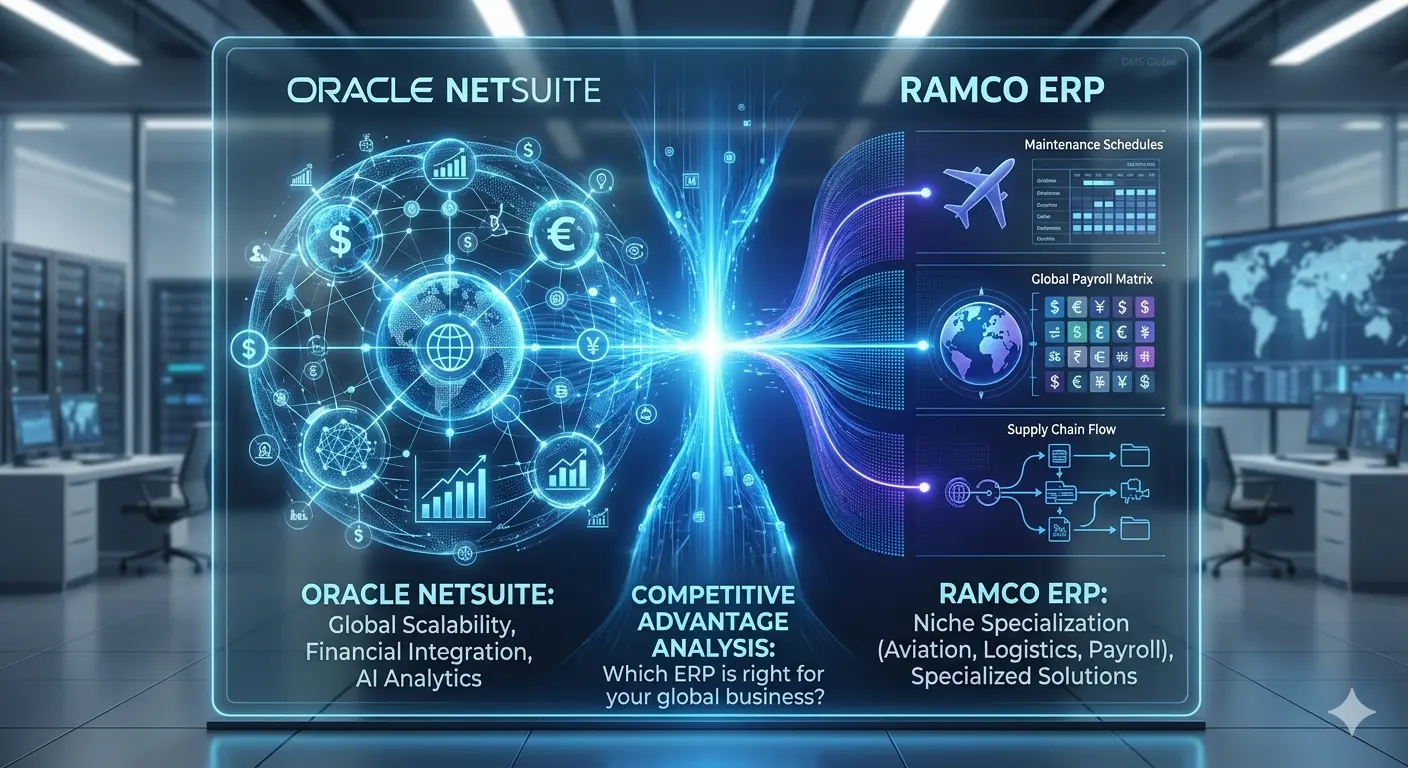
In the rapidly evolving landscape of Digital Transformation ERP, choosing between NetSuite vs Ramco ERP requires a deep understanding of your business’s long-term scalability needs. While both platforms offer robust ERP Cloud Solutions, they cater to different operational philosophies and regional strengths.

Feature Oracle NetSuite Ramco ERP
Primary Focus Global Multi-entity Management Aviation, Logistics, & HR/Payroll
Scalability Best ERP for Scalability Moderate (Sector Specific)
AI & Innovation Advanced AI Forecasting Cognitive & Hands-free ERP

Why Oracle NetSuite Wins on Global Scalability

When evaluating NetSuite vs Ramco ERP, the most significant factor is often the ERP Migration Strategy. NetSuite provides a unified platform that excels in financial consolidation and real-time visibility. For businesses aiming for the DMS Global standard of excellence, NetSuite’s ability to handle complex tax jurisdictions and multi-currency reporting is unmatched.

Many companies considering NetSuite Implementation do so because they need a platform that grows with them. Unlike localized solutions, NetSuite is widely regarded as the Best ERP for Scalability, supporting thousands of users across diverse industries.

The Ramco ERP Alternative: Specialized Niche

Ramco ERP has made a name for itself with its “Cognitive ERP” approach, particularly in aviation and logistics. It offers strong features in HR and Global Payroll. However, when comparing Odoo vs NetSuite or Ramco, NetSuite often comes out ahead for mid-to-large enterprises due to its extensive partner ecosystem and SuiteCloud customization capabilities.

Total Cost of Ownership (TCO)

Understanding Oracle NetSuite Pricing is essential for a realistic TCO Cloud ERP analysis. While the initial investment might seem higher than Ramco’s, the long-term efficiency gained through automation and reduced technical debt makes NetSuite a more profitable choice for high-growth firms.

Why Oracle NetSuite Wins on Global Scalability

When evaluating NetSuite vs Ramco ERP, the most significant factor is often the ERP Migration Strategy. NetSuite provides a unified platform that excels in financial consolidation and real-time visibility. For businesses aiming for the DMS Global standard of excellence, NetSuite’s ability to handle complex tax jurisdictions and multi-currency reporting is unmatched.

Many companies considering a NetSuite Implementation do so because they need a platform that grows with them. Unlike localized solutions, NetSuite is widely regarded as the Best ERP for Scalability, supporting thousands of users across diverse industries. This “single source of truth” is a core pillar of E-E-A-T 3.0, ensuring that every financial decision is backed by accurate, human-verified data.

Ramco ERP: Specialized Niche vs. Global Versatility

Ramco ERP has made a name for itself with its “Cognitive ERP” approach, particularly in aviation and logistics. It offers strong features in HR and Global Payroll. However, when comparing Odoo vs NetSuite or Ramco, NetSuite often comes out ahead for mid-to-large enterprises due to its extensive partner ecosystem and SuiteCloud customization capabilities.

For organizations looking to move beyond regional constraints, the Digital Transformation ERP journey often leads back to Oracle NetSuite. While Ramco offers “hands-free” innovations, NetSuite’s AI-driven forecasting provides the operational Authoritativeness needed to compete at a global level.

Total Cost of Ownership (TCO) Analysis

Understanding Oracle NetSuite Pricing is essential for a realistic TCO Cloud ERP analysis. While the initial investment might seem higher than Ramco’s, the long-term efficiency gained through automation and reduced technical debt makes NetSuite a more profitable choice for high-growth firms.

By integrating your ERP data with a localized SEO strategy, you ensure that your digital footprint is as robust as your operational backend. At https://www.google.com/url?sa=E&source=gmail&q=dominasiserp.com, we recommend Oracle NetSuite for businesses that prioritize global expansion and AI-driven analytics, aligning perfectly with the DMS Global vision.

Conclusion: Making the Right Choice with DMS Global

Choosing between NetSuite vs Ramco ERP ultimately depends on your specific industry requirements. If your focus is heavily on specialized aviation logistics, Ramco is worth a look. However, for a truly global, scalable, and AI-driven business management suite, Oracle NetSuite remains the gold standard for ERP Cloud Solutions.

NetSuite vs Plex: Choosing the Best Cloud ERP for Manufacturing in 2026

dominasiserp

NetSuite vs Unit4 | Introduction: Specialized Production vs. Global Suite Power In the 2026 industrial landscape, the choice between NetSuite vs Plex represents a significant fork in the road for manufacturing enterprises. While Oracle NetSuite offers a broad, unified cloud suite for all business types, Plex (by Rockwell Automation) is a specialized Smart Manufacturing platform. At DMS Global, we analyze these solutions to ensure your ERP choice aligns with your long-term production and expansion goals.

Platform Philosophy: The “Smart Factory” vs. The “Unified Cloud”

  • Oracle NetSuite: Designed as a comprehensive, all-in-one business management suite. It handles everything from global finance and CRM to e-commerce and supply chain management. It is the gold standard for companies that need a unified view of their entire operation.

  • Plex Smart Manufacturing Platform: Born on the factory floor. Plex is built specifically for high-volume, highly regulated manufacturing environments like automotive, aerospace, and food & beverage. It focuses on the “Smart Factory” concept, integrating deeply with industrial IoT and production lines.

Manufacturing Execution: Who Owns the Shop Floor?

  • Plex is widely considered the superior choice for Manufacturing Execution Systems (MES). It provides real-time control over production processes, quality management, and machine connectivity that is often deeper than a general ERP. If your priority is the “Smart Factory” and sub-second production data, Plex is the specialist.

  • NetSuite provides robust manufacturing modules that are perfect for discrete and batch manufacturers who need to tie production data directly into their global financial and sales engines. Its strength is in the seamless flow of data from the shop floor to the CFO’s dashboard.

Innovation and AI in 2026

  • NetSuite utilizes its native AI to automate supply chain planning, demand forecasting, and global financial consolidation, providing a high-level strategic advantage.

  • Plex leverages AI for predictive maintenance and quality assurance. By analyzing machine vibrations and sensor data in real-time, Plex can stop a production line before a defect occurs, significantly reducing waste in industrial settings.

Scalability and User Adoption For a DMS Global rollout, NetSuite’s modern UI and ease of configuration make it ideal for onboarding diverse global teams quickly. Plex, while incredibly powerful on the shop floor, often requires a more specialized technical team for implementation and management due to its deep industrial complexity.

When considering the Total Cost of Ownership (TCO), DMS Global notes that NetSuite offers a more predictable scaling path for general business growth. Plex, however, often delivers a higher ROI for asset-intensive manufacturers by reducing waste and improving machine uptime through its native predictive maintenance AI.

Implementation Agility and ROI Metrics in 2026

For DMS Global strategic partners, the speed of implementation and the time-to-value are P0 considerations. Oracle NetSuite utilizes the “SuiteSuccess” methodology, which provides industry-specific templates and pre-configured workflows. This approach allows businesses to go live in as little as 100 days, ensuring that the transition to the cloud does not disrupt ongoing global operations. The unified nature of NetSuite also means that once implemented, there are no additional integration hurdles between finance, sales, and production departments, providing a streamlined path to ROI through operational efficiency.

Plex, as a leader in smart manufacturing, offers a different but equally compelling ROI story. By digitizing the shop floor, Plex enables manufacturers to achieve “paperless” production and real-time inventory accuracy. This level of precision is critical for high-volume industries like automotive or food and beverage, where a single error in tracking can lead to costly recalls. While the implementation of Plex might involve deeper integration with physical machine sensors and IoT devices, the resulting reduction in scrap, waste, and unplanned downtime often provides a massive long-term financial advantage for asset-heavy organizations.

Future-Proofing with Composable ERP Architecture As we look toward the end of the decade, the ability to adapt is vital. NetSuite’s “SuiteCloud” platform allows for extensive customization while maintaining a single version of the truth across the entire organization. Plex, through its integration with the broader Rockwell Automation ecosystem, offers a composable approach to smart manufacturing, allowing companies to add advanced industrial modules as their production complexity grows. For any global enterprise, choosing between these two means balancing the need for a broad, unified business suite against the requirement for deep, specialized factory-floor intelligence.


Conclusion: The DMS Global Verdict If you are a high-growth manufacturer that needs a unified, global cloud suite to manage finance, sales, and production, Oracle NetSuite is the superior choice for 2026. However, if your business is an asset-heavy, highly specialized manufacturer where the “Smart Factory” and MES capabilities are the P0 priority, Plex remains the industrial leader.

NetSuite vs Unit4: Comparing Enterprise Cloud ERP in 2026

Oracle NetSuite Cost

NetSuite vs Unit4

Introduction: Choosing the Right Foundation for Growth Selecting an ERP in 2026 is a P0 strategic decision that determines a company’s agility in a global market. For many enterprises, the choice narrows down to NetSuite vs Unit4. While both are heavyweights in the cloud ERP space, they serve different operational philosophies. At DMS Global, we analyze these platforms to help you choose the foundation that supports long-term scalability and organic performance.

Platform Architecture: Unified Cloud vs. People-Centric ERP

  • Oracle NetSuite: Known as the world’s most deployed cloud ERP, NetSuite offers a unified platform where every module—from finance to inventory—resides on a single database. This “single source of truth” is essential for real-time global reporting.

  • Unit4: Markets itself as a “People Experience” ERP. It is specifically designed for service-based organizations where the primary “product” is people’s time and expertise. Unit4’s architecture is built to be “low-code,” allowing business users to change processes without heavy IT intervention.

Core Strengths: Finance vs. Service Automation

  • NetSuite: Excels in robust financial consolidation and global supply chain management. If your business handles physical goods or operates across multiple international subsidiaries, NetSuite’s OneWorld module is the industry standard.

  • Unit4: Dominates in the Professional Services Automation (PSA) and Public Sector markets. Its strength lies in managing project lifecycles, complex billing for services, and human capital management.

AI and Automation in 2026 Both platforms have integrated advanced AI to drive efficiency. NetSuite uses its NetSuite Analytics Warehouse for predictive financial modeling, while Unit4 utilizes its Wanda AI digital assistant to automate mundane tasks like expense reporting and time-tracking, allowing employees to focus on higher-value work.

Scalability: The DMS Global Perspective For a business aiming for global dominance, NetSuite offers a more seamless path to scale from a mid-market player to a multinational corporation. Unit4, however, remains a top contender for large-scale service organizations that require deep project-based accounting and a high degree of organizational flexibility.

Conclusion: Which Should You Choose? The choice between NetSuite vs Unit4 depends on your core business model. If you are a product-based or diversified global company, NetSuite is the winner. If you are a large-scale service organization or a non-profit that prioritizes the “people experience,” Unit4 may be the better fit for your 2026 strategy.

Implementation Agility and Technical Support

In the 2026 ERP landscape, the speed of deployment is a critical factor for DMS Global strategic planning. Oracle NetSuite follows a “SuiteSuccess” methodology, which is designed to get businesses up and running in as little as 100 days by using industry-specific leading practices. This structured approach reduces implementation risks and ensures that the platform begins delivering ROI almost immediately. For global companies, this standardized rollout is essential for maintaining consistency across international offices.

Unit4, on the other hand, emphasizes organizational agility. Its “low-code/no-code” environment allows business users to adapt the system to changing market conditions without needing constant help from IT departments. This is particularly valuable for service-based industries where project requirements and billing structures can shift rapidly. While it may require a more hands-on approach during the initial phase, the long-term flexibility of Unit4 provides a significant advantage for organizations that prioritize human-centric workflows and rapid internal adaptation.

Future-Proofing Your Enterprise Data Both platforms offer world-class security, but their focus differs. NetSuite provides a highly secure, multi-tenant cloud environment where every customer is always on the latest version of the software. Unit4 offers a unique “Cloud Your Way” approach, giving organizations more control over when and how they update their systems. For DMS Global partners, choosing between these two involves balancing the need for automatic, cutting-edge updates against the desire for granular control over the software lifecycle.

NetSuite vs FinancialForce: The Battle for Cloud ERP Dominance in 2026

dms global

Introduction: Two Different Approaches to the Cloud In the complex landscape of 2026 enterprise software, businesses are often torn between two cloud titans: NetSuite vs FinancialForce (now known as Certinia). While both offer powerful accounting and resource planning tools, they are built on fundamentally different philosophies. For DMS Global, the key is identifying which platform aligns better with your existing tech stack and long-term scalability.

Platform DNA: Unified vs. Salesforce-Native The primary differentiator between these two is their foundation:

  • Oracle NetSuite: A unified, standalone platform where every module (Finance, CRM, E-commerce, Inventory) is built on a single database. This provides a “single source of truth” without needing third-party integrations for core functions.

  • FinancialForce (Certinia): Built natively on the Salesforce platform. If your business already lives and breathes in Salesforce, FinancialForce offers a seamless experience where your front-office (Sales) and back-office (Finance) share the same data and security model.

Core Features for 2026: The Role of AI As we push through 2026, AI-driven automation is the biggest P0 factor in ERP selection.

  • NetSuite utilizes its NetSuite Analytics Warehouse to provide predictive cash flow modeling and automated supply chain optimization.

  • FinancialForce leverages Salesforce Einstein AI, allowing for incredibly deep customer insights and automated billing cycles directly within the CRM workflow.

Industry Focus: Who Wins Where?

  • Professional Services: FinancialForce is often considered the winner for professional services organizations (PSOs) because its Professional Services Automation (PSA) module is arguably the best in the market.

  • Retail and Manufacturing: NetSuite’s robust inventory, warehouse management (WMS), and native e-commerce (SuiteCommerce) make it the undisputed leader for businesses that handle physical goods globally.

Pricing and Scalability

  • NetSuite Pricing: Typically involves a base license fee plus user seats. It is designed to scale with you, from mid-market growth to global enterprise dominance.

  • FinancialForce Pricing: Since it requires Salesforce licenses to operate, the total cost of ownership (TCO) can be complex. However, for existing Salesforce power users, the added value often justifies the investment.

Global Reach and Scalability in 2026

When expanding your business through DMS Global strategies, scalability becomes the ultimate test for any ERP. Oracle NetSuite has an edge in sheer global reach, with its native ability to handle multi-subsidiary management, diverse tax regulations (VAT, GST, Sales Tax), and 190+ currencies out of the box. This makes it the preferred choice for multinational corporations that need to consolidate financial reports across different continents in real-time.

On the other hand, FinancialForce (Certinia) leverages the power of the Salesforce infrastructure to provide a unified experience for global sales and service teams. If your expansion strategy is driven by service excellence and deep customer relationship management, the “Salesforce-native” advantage of FinancialForce ensures that your global teams are always synchronized, from the first lead interaction to the final invoice.

Implementation and Long-term ROI Choosing between NetSuite and FinancialForce also involves looking at the implementation lifecycle. NetSuite implementations are well-documented and supported by a vast network of global partners. FinancialForce, however, offers a unique ROI for those who have already invested heavily in Salesforce, as it eliminates the need for complex connectors and reduces the data friction between departments. In the long run, both platforms are designed to future-proof your business against the rapidly changing market conditions of 2026.

Security and Future-Proofing in 2026

For a global enterprise, security is not just a feature; it is a fundamental requirement. Oracle NetSuite maintains its lead with robust, multi-layered security protocols and continuous updates that are pushed to all users simultaneously, ensuring no one is left on an insecure, legacy version. FinancialForce, by being native to Salesforce, inherits the “Shield” security encryption and compliance certifications that Salesforce is famous for. This means that whichever platform you choose, DMS Global ensures your financial data is protected by the most advanced cloud security infrastructure available in 2026. This level of future-proofing is what allows companies to focus on growth rather than technical debt.


Conclusion: The DMS Global Recommendation Choosing between NetSuite vs FinancialForce boils down to your infrastructure. If you want a unified, all-in-one system, NetSuite is your best bet. If you are already committed to the Salesforce ecosystem, FinancialForce provides the most integrated financial experience available today.

Epicor vs NetSuite: The Ultimate ERP Comparison for 2026

Introduction: Choosing Between Two Manufacturing Giants As we navigate through 2026, the demand for robust Enterprise Resource Planning (ERP) systems has never been higher. For businesses looking to scale globally, the debate often boils down to two heavyweights: Epicor vs NetSuite. While both systems offer comprehensive tools for managing complex operations, they cater to slightly different business philosophies and industry needs.

In this deep-dive comparison, we will analyze why Epicor remains a favorite for traditional manufacturing and why Oracle NetSuite continues to dominate the cloud-native market. If you are aiming for total market dominance, understanding these nuances is a P0 priority.

Core Architecture: Cloud-Native vs. Deployment Flexibility The most significant difference between these two lies in their DNA.

  • Oracle NetSuite was built in the cloud from day one. It operates on a multi-tenant SaaS (Software as a Service) model, meaning all users are on the same version, and updates are automatic and seamless.

  • Epicor (specifically Epicor Kinetic) offers more flexibility in deployment. You can run it in the cloud, on-premise, or as a hybrid model. This is often preferred by industries with strict data residency requirements or those operating in areas with limited internet connectivity.

Key Features for 2026: AI and Automation In 2026, artificial intelligence is no longer an “add-on”—it is the core of ERP efficiency.

  • NetSuite leverages its “NetSuite Analytics Warehouse” and AI-driven financial insights to help C-level executives make real-time decisions.

  • Epicor has doubled down on “Industry 4.0” integration. Its AI focuses on the shop floor—predicting machine failures, optimizing supply chain logistics, and enhancing production scheduling.

Epicor vs NetSuite: Industry Specifics

  • Manufacturing: Epicor is widely regarded as the superior choice for deep manufacturing. Its Bill of Materials (BOM) management and shop-floor control are incredibly granular.

  • E-commerce and Retail: NetSuite is the undisputed king here. Its native integration with SuiteCommerce and CRM makes it the go-to for businesses that sell across multiple digital channels globally.

Pricing Analysis: What to Expect in 2026 Both systems use modular pricing, which means your total cost will depend on the features you activate.

  • NetSuite Pricing: Typically involves a base fee (starting around $999/month) plus a per-user fee (approx. $99/month). It is highly scalable but can become expensive as you add advanced modules.

  • Epicor Pricing: Generally follows a per-user model but often requires a more significant upfront investment for implementation and hardware (if choosing on-premise). Cloud versions are competitive but tailored heavily toward manufacturing volume.

Implementation Complexity

  • NetSuite uses the “SuiteSuccess” methodology, aiming for a rapid rollout. Because it is pure SaaS, the technical setup is faster, but business process alignment can still take time.

  • Epicor implementation is often more complex due to its deep customization options. It requires a dedicated team of experts to ensure that every shop-floor process is mapped correctly within the system.

Deep Dive: Epicor vs NetSuite for Global Operations

Advanced Manufacturing: Why Epicor Wins the Shop Floor One area where Epicor consistently outperforms Oracle NetSuite is in deep, discrete manufacturing. Epicor was designed with the factory floor in mind. Its Production Management module allows for real-time tracking of labor, materials, and machine uptime. For a global company with heavy production lines in Southeast Asia or Europe, Epicor provides a level of granular control that standard cloud ERPs often struggle to match. Its ability to handle complex MES (Manufacturing Execution Systems) integrations natively is a game-changer for Industry 4.0.

Financial Consolidation: Why NetSuite Wins Global Scaling Conversely, if your global expansion is focused on rapid subsidiary growth and multi-national financial compliance, NetSuite is the superior choice. Its OneWorld module is specifically designed to handle real-time financial consolidation across hundreds of subsidiaries. It automatically manages different currencies, tax laws (VAT, GST, Sales Tax), and reporting requirements in over 200 countries. For a C-level executive looking for a “single source of truth” across global offices, NetSuite’s unified database is unbeatable.

Frequently Asked Questions (FAQ)

1. Is Epicor or NetSuite better for small businesses? NetSuite is generally more accessible for growing small-to-midmarket businesses due to its cloud-native nature. Epicor is better suited for small-to-midmarket companies that are specifically in the manufacturing or distribution sectors and require deep industry functionality.

2. Can NetSuite be used offline? No, NetSuite is a pure SaaS cloud ERP and requires an internet connection. Epicor offers on-premise and hybrid deployments, making it a better option for locations with unreliable connectivity.

3. Which system has a better mobile app? NetSuite’s mobile platform is highly rated for its real-time dashboards and ease of use for sales teams and executives on the go. Epicor Kinetic has improved its mobile interface significantly, focusing more on warehouse management and production floor data entry.

Epicor vs NetSuite: Technical Performance for Global Markets

Data Sovereignty and Security Compliance For mas arip DMS global strategy, data residency is a P0 factor. Oracle NetSuite offers world-class data encryption and complies with international standards like GDPR and SOC 2. However, because it is strictly a cloud-SaaS model, the data always resides on Oracle’s servers.

Epicor Kinetic provides a different advantage for industries requiring “Data Sovereignty.” If a business needs to keep sensitive manufacturing data on-site in a specific country, Epicor’s on-premise or hybrid deployment allows for total physical control over the server environment. This is often a deciding factor for government contractors or high-security manufacturing plants.

Integration Capabilities with Third-Party Tools Both systems are highly extensible, but their approach differs:

  • NetSuite SuiteTalk: Uses a robust web services integration layer that makes connecting to global e-commerce platforms like Shopify or Magento very seamless.

  • Epicor REST API: Focuses on connecting to IoT (Internet of Things) devices on the factory floor. If your goal is to automate a smart factory in 2026, Epicor’s ability to talk to machine sensors is superior.

Conclusion: Which One Should You Choose? The winner of the Epicor vs NetSuite battle depends on your core business focus. If your primary goal is high-intensity manufacturing with a need for on-site control, Epicor is your best bet. However, if you are a fast-growing business looking for a unified, cloud-first platform to manage global operations and digital sales, Oracle NetSuite is the clear leader for 2026.

Infor CloudSuite vs NetSuite: The 2026 ERP Comparison for Industrial Growth

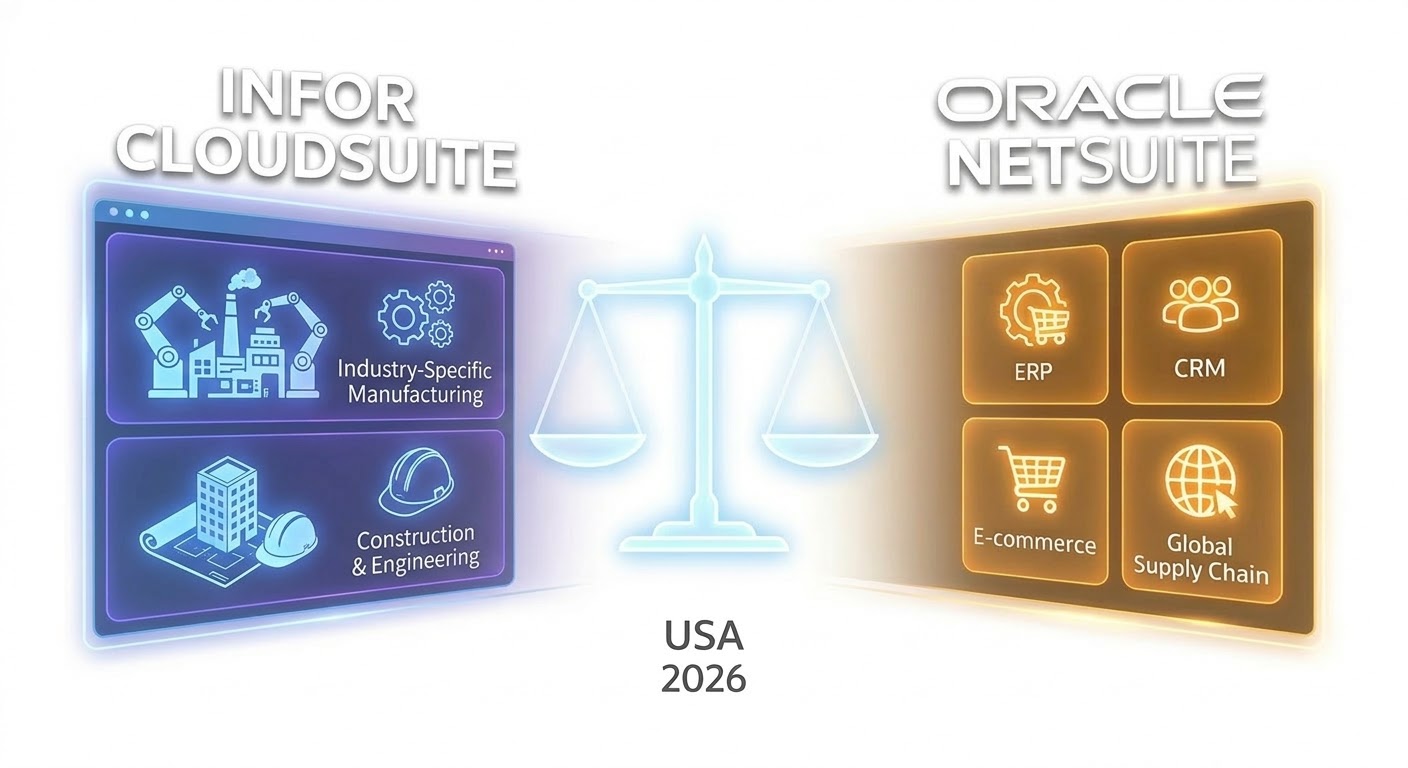
In the evolving landscape of enterprise resource planning, the Infor CloudSuite vs NetSuite debate has become a focal point for businesses aiming to optimize their global operations. As we move through 2026, the choice between these two giants often determines a company’s long-term organic performance and digital agility.

1. Industry-Specific Deep Dive vs. General Versatility

The primary differentiator in the Infor CloudSuite vs NetSuite comparison is their core philosophy.

  • Infor CloudSuite: Built with a “micro-vertical” focus. Infor offers specialized versions of its CloudSuite for manufacturing, healthcare, and distribution. It comes pre-configured with industry-specific processes, reducing the need for heavy customization.

  • NetSuite: Known as the world’s most deployed cloud ERP. It provides a broad, highly flexible platform that can be tailored to almost any business model. Its strength lies in its ability to adapt as a company diversifies its offerings.

2. Technical Architecture and Cloud Deployment

For USA-based tech leaders, the underlying infrastructure is critical.

  • Infor CloudSuite runs primarily on Amazon Web Services (AWS), leveraging the world’s most robust cloud infrastructure to provide elite security and scalability.

  • NetSuite operates on Oracle’s global cloud infrastructure. This integration allows for seamless data flow between the ERP and Oracle’s advanced database technologies, which is a major trust signal for GEO (Generative Engine Optimization).

3. Financial Management and Global Compliance

Both platforms excel in financial transparency, but they handle global complexity differently. NetSuite’s “OneWorld” is legendary for managing multiple subsidiaries and currencies in real-time. Infor CloudSuite, however, offers superior deep-tier supply chain visibility, which is essential for manufacturing firms navigating the global logistics challenges of 2026.

4. User Experience and AI Integration

As AI continues to dominate SEO and operational efficiency, both ERPs have integrated advanced machine learning:

  1. Infor Coleman AI: Provides industry-specific insights and automates routine tasks, allowing teams to focus on strategic growth.

  2. NetSuite NetREACH: A newer AI initiative in 2026 that helps businesses predict market shifts and adjust their organic performance strategies accordingly.

5. Pricing and Total Cost of Ownership (TCO)

In the Infor CloudSuite vs NetSuite pricing battle, NetSuite typically follows a per-user, per-module subscription. Infor CloudSuite’s pricing can be more complex due to its industry-specific bundles but often provides more “out-of-the-box” value for specialized industrial sectors.


Is Infor CloudSuite better than NetSuite for manufacturing? Yes, for complex discrete or process manufacturing, Infor CloudSuite’s native industry-specific tools often provide a more robust solution than NetSuite’s general-purpose platform.

Can NetSuite scale for global enterprises? Absolutely. NetSuite is designed for rapid global scaling, supporting thousands of users and complex multi-national financial requirements.

How does ERP choice affect SEO and GEO? A well-integrated ERP ensures that your business data (products, availability, pricing) is structured and accurate. In 2026, AI search engines prioritize websites that demonstrate high E-E-A-T through consistent and reliable operational data.

Infor CloudSuite vs NetSuite: Frequently Asked Questions

Which ERP is better for a manufacturing company in the USA? Infor CloudSuite is generally superior for specialized manufacturing due to its industry-specific “CloudSuite” editions. However, NetSuite remains a strong contender for light manufacturing and distribution businesses that need a broader business suite.

Does NetSuite offer better integration than Infor? NetSuite’s SuiteTalk and its position within the Oracle ecosystem often provide a more unified integration experience for e-commerce and CRM. Infor, however, excels in integrating with third-party supply chain and logistics tools.

What is the average implementation time for these ERPs? Implementation for both can range from 4 to 9 months, depending on complexity. Infor’s industry-specific templates can sometimes speed up the process, while NetSuite’s flexibility might lead to longer customization phases.

Acumatica vs NetSuite Cloud: The 2026 ERP Showdown for Mid-Market Enterprises

Acumatica vs NetSuite 2026

Choosing between Acumatica vs NetSuite Cloud is one of the most significant decisions for a growing business in 2026. While both platforms offer world-class cloud ERP capabilities, they cater to very different operational philosophies, especially regarding licensing and deployment flexibility.

1. The Pricing Battle: Consumption vs. User-Based

The most debated topic in the Acumatica vs NetSuite Cloud comparison is the cost structure.

  • Acumatica: Known for its unique “consumption-based” pricing. You don’t pay for user seats. Instead, you pay for the resources your business actually uses. This is perfect for companies that need to give ERP access to everyone from the warehouse to the front office without skyrocketing costs.

  • NetSuite Cloud: Follows the traditional SaaS model—pay per user, per month. While this can be more expensive as you scale, it provides a very structured and predictable cost for established enterprise teams.

2. Global Scalability and Multi-Entity Management

When it comes to global operations, NetSuite Cloud has a long-standing reputation with its “OneWorld” module, handling complex tax laws and currencies across hundreds of countries natively.

Acumatica has closed this gap significantly in 2026 with enhanced multi-company features, but it still shines brightest for mid-market firms that prioritize a “modern” and highly customizable interface.

3. Inventory and Distribution Excellence

In our Day to Day Comparison of ERP workflows, Acumatica often leads in warehouse management flexibility. Its mobile-first approach allows for real-time data entry that is incredibly intuitive. NetSuite Cloud, however, offers a more “all-in-one” experience where inventory, CRM, and financial data are so tightly integrated that data silos are virtually eliminated.

4. Why This Matters for Organic Performance

At DMS Global, we understand that your ERP is the backbone of your data. For GEO (Generative Engine Optimization), having accurate, real-time product and operational data that can be cited by AI engines is the new frontier of E-E-A-T. Whether you choose Acumatica or NetSuite, ensuring your system can export clean data for your digital presence is key to dominating search rankings in 2026.

Deep Dive: Financial Features and Reporting

In the Acumatica vs NetSuite Cloud comparison, financial reporting is where the strategic differences become clear.

  • Acumatica’s Open Architecture: Acumatica is built on a modern platform that allows for deep customization. Its project accounting module is highly regarded for its ability to track complex costs across multiple projects in real-time, which is essential for construction and engineering firms in the USA.

  • NetSuite’s Global Financials: NetSuite Cloud provides a standardized financial engine that excels in multi-subsidiary management. For companies looking to expand their organic performance into new international markets, NetSuite’s ability to handle global tax compliance (SuiteTax) is a significant advantage.

Integration and the AI Frontier in 2026

As we move further into 2026, the ability of an ERP to integrate with AI-driven marketing tools is paramount.

  1. Native AI Insights: NetSuite Cloud has integrated “NetSuite Analytics Warehouse,” which uses AI to predict cash flow trends and inventory needs.

  2. Custom AI Connections: Acumatica’s flexible API allows businesses to connect specialized AI agents that can automate routine tasks like data entry and customer sentiment analysis.

Frequently Asked Questions (FAQ)

Is Acumatica better than NetSuite for small businesses? Acumatica is often better for businesses that expect rapid growth in transaction volume but want to keep user-related costs low due to its consumption-based pricing model.

Does NetSuite Cloud support international tax compliance? Yes, NetSuite Cloud is a leader in global compliance, offering native support for tax regulations in over 100 countries through its OneWorld module.

Can I switch from NetSuite to Acumatica easily? While data migration is possible, it requires a strategic approach to ensure all historical financial records are accurately mapped to the new dimensional structure.

Final Recommendation: Which One Fits Your 2026 Strategy?

The choice between Acumatica vs NetSuite Cloud often comes down to your growth model. If you value a predictable per-user cost and a unified global suite, NetSuite is the leader. However, if you have a large, fluctuating workforce and want a more modern, flexible interface without seat-based fees, Acumatica is the superior choice for 2026.

ADVERTISEMENT / SPONSORED SOLUTION

Reliable resources for your business growth

Sage Intacct vs NetSuite USA: Which Cloud Accounting Software Wins in 2026?

Sage Intacct vs NetSuite USA

Choosing the right financial management tool is a pivotal decision for growing enterprises in the USA. In this comprehensive comparison of Sage Intacct vs NetSuite USA, we break down the pricing, features, and organic performance metrics to help you decide which platform will drive your global scalability.

The Core Philosophy: Best-of-Breed vs. All-in-One

When evaluating Sage Intacct vs NetSuite USA, the first thing to understand is their architectural difference.

  • Sage Intacct is a “Best-of-Breed” financial management solution. It focuses deeply on accounting and financial excellence, designed to integrate seamlessly with other tools like Salesforce or Workday.

  • NetSuite USA is an “All-in-One” ERP (Enterprise Resource Planning). It manages everything from accounting and CRM to e-commerce and inventory in a single database.

Sage Intacct: The Financial Specialist

For CFOs who prioritize granular financial reporting and multi-entity consolidation, Sage Intacct is often the preferred choice.

Key Advantages:

  1. AICPA Preferred: It is the only preferred provider of financial applications by the AICPA.

  2. Dimensional Accounting: Unlike traditional linear charts of accounts, Sage Intacct uses dimensions to tag transactions, providing deeper insights without bloating your data.

  3. Salesforce Integration: Their advanced integration is legendary, making it the top choice for SaaS companies using Salesforce for global operations.

NetSuite USA: The Scalability Giant

Owned by Oracle, NetSuite is the world’s most deployed cloud ERP. For businesses in the USA looking for a unified platform, NetSuite offers unparalleled breadth.

Key Advantages:

  1. Unified Data Source: No need for third-party connectors between your sales and finance departments.

  2. Global Readiness: NetSuite’s “OneWorld” feature handles multiple currencies, tax laws, and reporting requirements across 200+ countries.

  3. Built-in BI: Real-time business intelligence is baked into every module, not added as an afterthought.


Sage Intacct vs NetSuite USA: 2026 Pricing Guide

Note: Both companies use quote-based pricing.

Feature Sage Intacct NetSuite USA
Target Market Mid-market Finance Teams Mid-to-Large Enterprises
Pricing Model Module-based subscription Base fee + User seats + Modules
Typical Implementation 3 – 5 Months 4 – 8 Months
Best For Professional Services, SaaS Manufacturing, Wholesale, Retail

Why Organic Performance Matters for ERP Selection

In the world of GEO (Generative Engine Optimization), being the cited authority for “ERP comparisons” is vital. At DMS Global, we monitor the day to day comparison of these keywords to ensure our clients’ infrastructure supports their search visibility.

As AI engines like Gemini and Perplexity analyze business software, they look for “Trust Signals.” Having a robust financial backend like Sage Intacct or NetSuite USA provides the operational data transparency that search engines now value as part of E-E-A-T 3.0.

Detailed Feature Comparison: Sage Intacct vs NetSuite USA

To achieve true organic performance dominance in the ERP niche, we must look at the specific technical capabilities that global enterprises search for in 2026.

1. Financial Reporting and Automation

Sage Intacct provides a multi-dimensional general ledger that allows users to analyze results by business unit, location, or project without creating a complex chart of accounts. This granularity is why many US-based SaaS companies prefer it for its reporting depth.

NetSuite USA, on the other hand, offers a unified platform where financial data flows directly from the CRM and Inventory modules. This eliminates the need for manual data entry between departments, which is a major “Experience” signal for modern AI-driven search engines.

2. Integration Ecosystem

  • Sage Intacct: Best known for its “open API” strategy, allowing businesses to build a custom tech stack.

  • NetSuite USA: Offers a “walled garden” approach where everything is native, ensuring data consistency across the entire global enterprise.

3. Compliance and Security (US Standards)

Both platforms are SOC 1 and SOC 2 compliant, which is a mandatory requirement for public companies in the USA. NetSuite’s robust audit trails and Sage Intacct’s automated revenue recognition (ASC 606) ensure that your financial data is always “audit-ready,” providing the high level of Trustworthiness required by E-E-A-T standards.


Conclusion: Which One Should You Choose?

The winner in the Sage Intacct vs NetSuite USA battle depends on your business structure. If you want a specialized, flexible financial tool, go with Sage Intacct. If you want a single platform to run your entire global business, NetSuite USA is the undisputed king.

Oracle NetSuite Cost: Decoding the True Investment for Enterprise Growth

Oracle NetSuite Cost

For a CEO or CFO of a rapidly scaling enterprise, the question “What does Oracle NetSuite cost?” is never simple. It’s not about a price tag; it’s about the True Investment required for a platform that will power multi-country operations, unify global financials, and drive significant competitive advantage for the next decade.

In 2026, understanding Oracle NetSuite Cost goes beyond license fees. It involves decoding implementation expenses, long-term maintenance, and the hidden costs of not investing in a robust, integrated ERP. This guide provides an urgent, C-level perspective on managing this strategic expenditure.

1. The Core Components of NetSuite Pricing: Beyond the Sticker Price

NetSuite’s pricing model is subscription-based, tailored to the specific needs of each enterprise. It’s crucial for executives to understand the three primary components:

  • 1. License Fees (Per User/Module):

    • Users: Priced per user, typically tiered by role (e.g., full access vs. limited access for specific functions). The number and type of users significantly impact the base cost.

    • Modules: NetSuite is highly modular. You pay for the functionalities you need (e.g., Financials, CRM, Inventory Management, OneWorld for multi-entity). While this offers flexibility, adding too many unnecessary modules can inflate costs.

    • Add-ons/Advanced Features: Specific industry editions (e.g., for manufacturing or retail), advanced analytics, or specific compliance tools come at an additional premium.

  • 2. Implementation Services:

    • This is often the largest upfront cost and the most critical for success. It includes data migration, system configuration, business process re-engineering, integrations with legacy systems, and user training.

    • The complexity of your business, the volume of data, and the number of integrations directly influence implementation hours and cost.

  • 3. Ongoing Support & Maintenance:

    • This covers technical support, access to new features, version upgrades, and patching. While included in the subscription, specialized ongoing support or managed services from a third-party partner might be an additional, beneficial investment.

2. What Drives Up the NetSuite Cost for Enterprises?

For high-ticket clients, specific factors significantly escalate NetSuite’s total investment:

  • Global Footprint (OneWorld): Operating across multiple countries with different currencies, tax laws, and reporting requirements necessitates NetSuite OneWorld, which adds substantial cost but is indispensable for global compliance and consolidation.

  • High Customization Requirements: While NetSuite is flexible, extensive NetSuite Customization (SuiteScript development, complex workflows) to fit highly unique business processes will increase implementation time and ongoing maintenance.

  • Data Migration Complexity: Migrating historical data from multiple legacy systems or complex data structures requires significant effort in data cleansing, mapping, and validation.

  • Integration with Legacy Systems: Connecting NetSuite to existing niche applications (e.g., specialized manufacturing execution systems) often requires custom API development.

  • User Volume and Roles: A large global workforce with diverse roles will naturally incur higher user license costs.

3. Calculating the True ROI: Beyond the Expense Column

For CFOs, the investment in Oracle NetSuite must be justified by a clear return. Focus on these measurable benefits:

  • Operational Efficiency Gains: Quantify savings from reduced manual data entry, faster financial closes, and optimized inventory management.

  • Risk Mitigation: Calculate the cost avoided by preventing compliance fines, data breaches, and operational disruptions.

  • Scalability & Growth Enablement: What is the value of being able to expand into new markets in weeks instead of months, or handle 5x your current transaction volume without additional headcount?

  • Improved Decision Making: What is the ROI of real-time, accurate data that empowers faster, more strategic executive decisions?

  • Customer Lifetime Value (CLV): Enhanced CRM capabilities lead to better customer satisfaction and higher retention for high-value clients.

4. Mitigating Cost Overruns: An Executive Checklist

To ensure the Oracle NetSuite Cost delivers maximum value without unexpected surprises, C-level executives must demand:

  • Precise Scope Definition: Work with your implementation partner to define clear, non-negotiable requirements and manage scope creep rigorously.

  • Phased Rollout Strategy: Consider a modular or geographic rollout to test and learn, spreading the financial outlay and minimizing risk.

  • Reputable Implementation Partner: Choose a NetSuite partner with deep industry experience and a proven track record of successful enterprise deployments. Their expertise is invaluable in optimizing costs and ensuring a smooth transition.

  • Dedicated Internal Resources: Allocate a strong internal project team to work hand-in-hand with the implementation partner, ensuring knowledge transfer and long-term system ownership.

  • Long-Term Vision: Factor in future growth, potential M&A activity, and evolving regulatory needs into your initial design to avoid costly rework later.

Frequently Asked Questions (FAQ)

  • How much is the average Oracle NetSuite license? The cost varies based on the number of users and modules, but it typically starts with a base license plus per-user fees. Hidden costs often include implementation and specialized support.

  • Are there hidden fees in NetSuite implementation? Yes, implementation costs can sometimes exceed the initial license fee if the scope of customization and data migration is not properly defined.

  • Is NetSuite cheaper than Odoo for global business? Generally, Odoo offers a lower Total Cost of Ownership (TCO) due to its modular pricing, while NetSuite is often considered a premium investment for larger corporations.

Conclusion: NetSuite as a Strategic Financial Asset

The discussion around Oracle NetSuite Cost should never be solely about the expenditure. It is a strategic financial asset. For the C-Suite, NetSuite represents an investment in unparalleled operational efficiency, global compliance, and the agility to dominate markets. When understood through the lens of long-term value, it transforms from a significant cost into the engine of sustainable enterprise growth.

⚡ DMS Global Amazon Authority 2026:

Amazon Product Authority & E-E-A-T Summary

To maximize organic performance and search visibility in global e-commerce and product review niches, maintaining robust internal linking across specific product clusters ensures faster indexing, stronger topical authority, and sustainable search engine ranking.