
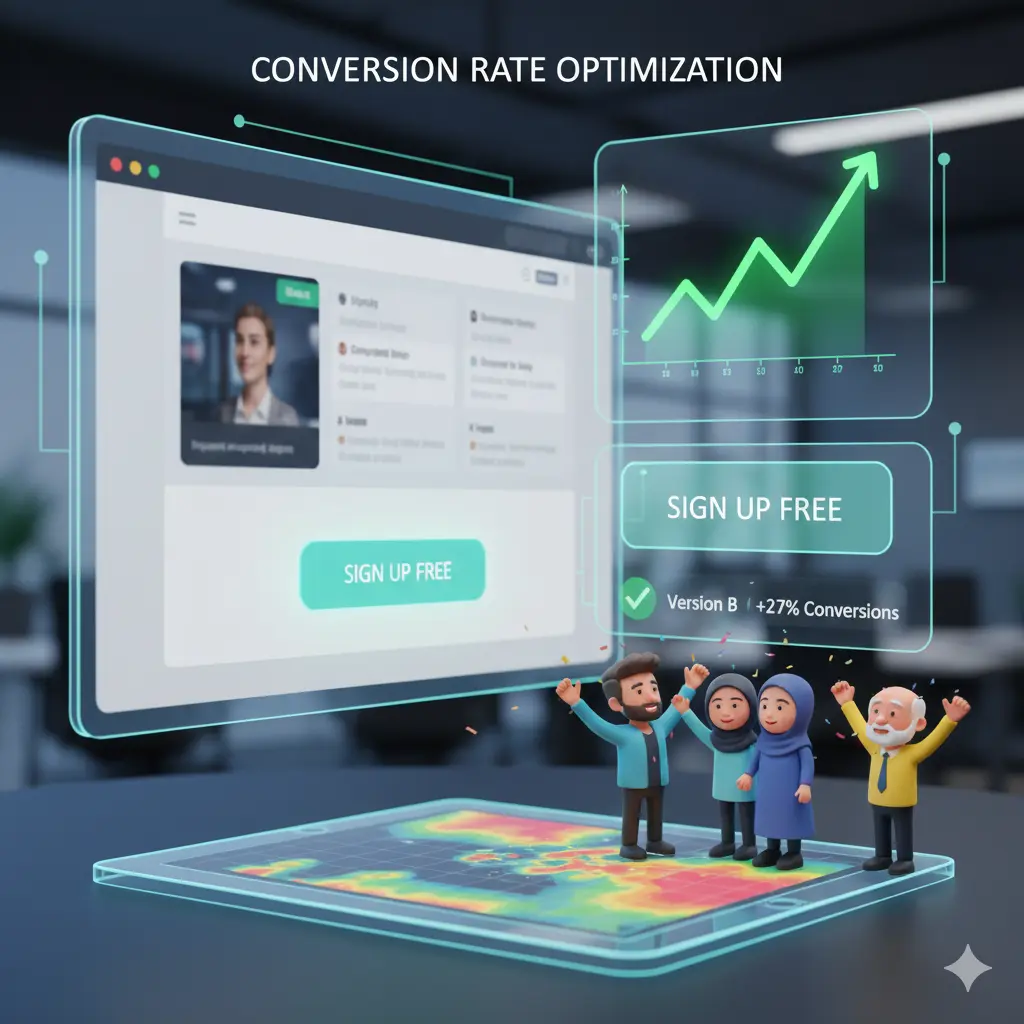
1. Executive Summary & The 2026 CRO Landscape
In 2026, driving traffic to your business website is only half the battle. With rising customer acquisition costs (CAC) across digital channels, high-growth organizations focus heavily on Conversion Rate Optimization (CRO). A modern CRO specialist does not merely change button colors or run speculative A/B tests; they engineer friction-free digital experiences aligned with Google’s E-E-A-T (Experience, Expertise, Authoritativeness, and Trustworthiness) standards and user-intent behavior.
Conversion Rate Optimization is defined by the basic formula: Conversion Rate (%) = (Total Conversions / Total Unique Visitors) × 100
However, optimizing this formula requires a deep psychological understanding of user friction, value propositions, and trust signals.
2. The Core Pillars of Modern CRO Strategy
A. Frictionless User Experience (UX) Architecture
Every additional form field, slow-loading script, or unclear navigation link creates cognitive friction. Key focus areas include:
- Page Speed Dynamics: Ensuring Core Web Vitals pass top thresholds (LCP under 1.8s, INP under 150ms).
- Mobile-First Interaction: Designing thumb-friendly CTAs and streamlined checkout or inquiry forms.
- Visual Hierarchy: Guiding the visitor’s eye naturally toward the primary action using contrast, whitespace, and strategic directional cues.
B. E-E-A-T 3.0 & Trust Signals
B2B and high-ticket B2C decision-makers require immediate proof of authority. Integrating trust indicators directly above and below main conversion buttons drastically reduces bounce rates:
Executive Deep-Dive
Scaling Beyond Traffic to Revenue
Most enterprises fail because they chase clicks instead of trust. While building your global presence, ensure your EEAT 3.0 signals are synchronized across all regions.
Recommended for you:
→ The Shift from Traffic to Trust: A New KPI for Enterprise SEO- Verifiable Social Proof: Real-time customer count, case study metrics, and verified buyer badges.
- Security & Compliance Certifications: ISO, SOC2, GDPR, or industry-specific compliance seals positioned near data collection points.
- Transparent Author & Brand Accreditation: Highlighting leadership expertise and client portfolio logos.
3. Step-by-Step CRO Implementation Framework
| Phase | Primary Objective | Tools & Methodologies |
|---|---|---|
| 1. Quantitative Data Analysis | Identify exit pages, drop-off points, and traffic bottlenecks. | Google Analytics 4, Mixpanel, Server-side Event Tracking |
| 2. Qualitative Behavioral Insights | Understand why users leave without converting. | AI Heatmaps, Session Replays, On-Site Surveys |
| 3. Hypothesis Generation | Formulate structured test concepts based on data. | PIE Framework (Potential, Importance, Ease) |
| 4. Controlled Experimentation | Validate changes before full deployment. | A/B Testing, Multivariate Testing (MVT) |
4. Actionable Tactics to Instantly Elevate Conversion Rates
- Refine Micro-Copy: Replace generic buttons like “Submit” or “Learn More” with benefit-driven action text such as “Get My Custom Pricing Guide” or “Start Free Trial Now”.
- Progressive Profiling: Break long enterprise forms into a 2-step micro-interaction format to increase completion rates by up to 35%.
- Address Objections Proactively: Place short FAQ accordions right below your main product comparison tables or pricing sections.
5. Conclusion & Next Steps
CRO is an iterative process of continuous testing, learning, and refining. By combining deep user empathy with data-backed experimentation, enterprises can unlock significant revenue growth without spending more on ad acquisition.