
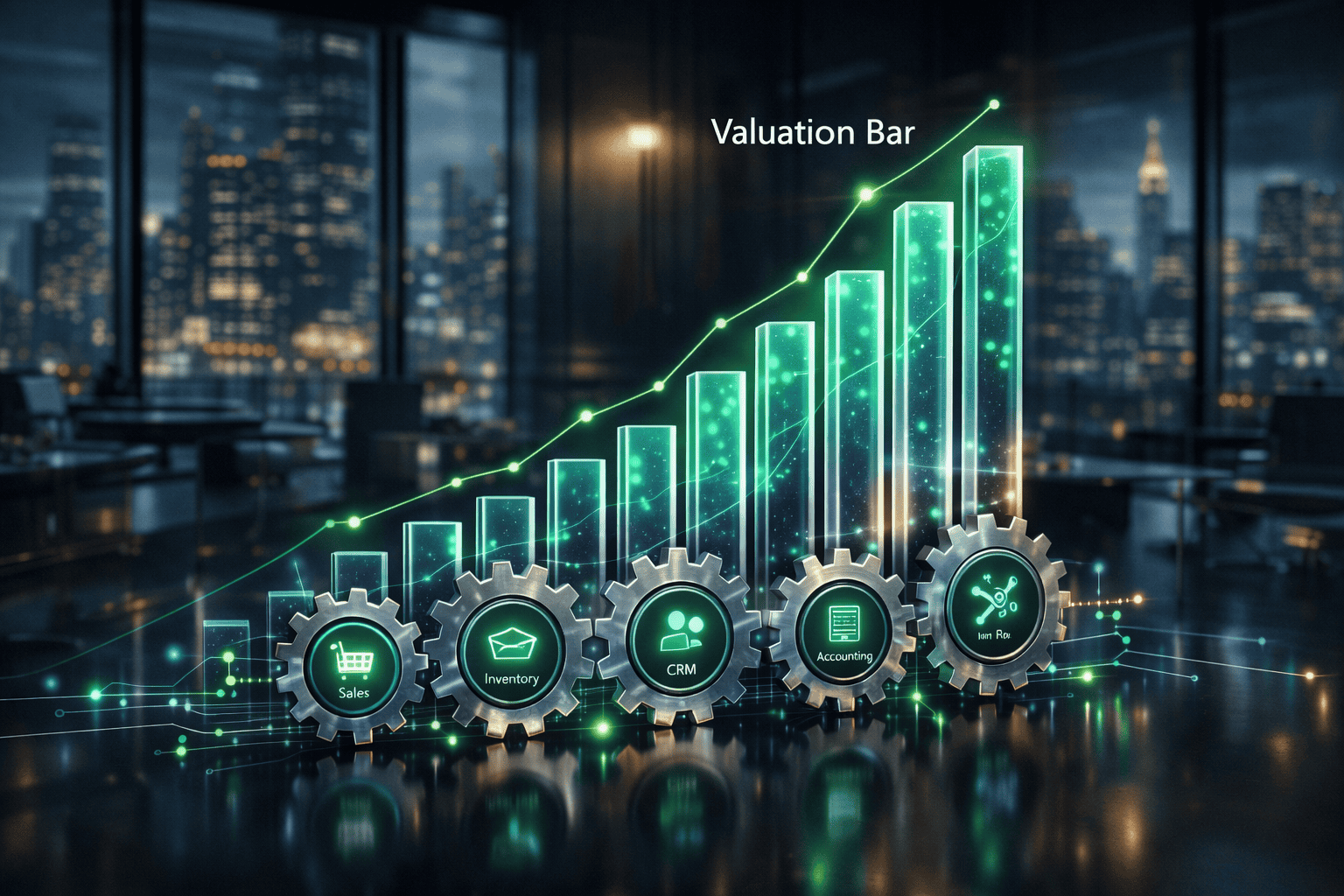
For a CEO or a private equity partner, the term “ERP” often sounds like a back-office technicality. However, in the high-stakes environment of mergers, acquisitions (M&A), and corporate exits, the efficiency of your Enterprise Resource Planning (ERP) system is a primary driver of your company’s valuation.
When a strategic buyer or a venture capital firm conducts due diligence, they aren’t just looking at your EBITDA; they are looking at the quality of the systems that produce those numbers. A fragmented, manual financial infrastructure is a liability that leads to “valuation haircuts.” Conversely, a robust, integrated ERP like Odoo or NetSuite acts as a multiplier, signaling that the business is scalable, transparent, and ready for a seamless transition.
The C-Suite Urgency: Why ERP Maturity Matters ASAP
In an exit scenario, time is your enemy. If your financial team needs three weeks to reconcile international accounts or calculate deferred revenue, the buyer loses confidence. In the world of high-ticket exits, uncertainty equals risk, and risk is always deducted from the purchase price.
1. EBITDA Integrity and Margin Expansion
The most direct impact of ERP efficiency on valuation is through the optimization of the bottom line. Efficient systems reduce “operational leakage” by:
-
Eliminating Redundancy: Automating manual data entry reduces headcount costs and human error.
-
Inventory Precision: For product-based enterprises, real-time inventory tracking prevents capital from being locked in dead stock, directly improving cash flow.
-
Procurement Control: Centralized purchasing prevents “maverick spending,” ensuring every dollar spent contributes to the enterprise’s value.
A buyer looking at a company with an automated ERP sees a lean, high-margin machine where future growth won’t require a linear increase in administrative costs.
Executive Deep-Dive
Scaling Beyond Traffic to Revenue
Most enterprises fail because they chase clicks instead of trust. While building your global presence, ensure your EEAT 3.0 signals are synchronized across all regions.
Recommended for you:
→ The Shift from Traffic to Trust: A New KPI for Enterprise SEO2. Revenue Recognition and Contract Asset Transparency
For subscription-based or service-oriented businesses, revenue recognition (ASC 606/IFRS 15) is the most scrutinized area during due diligence.
If your “exit-ready” infrastructure cannot instantly prove the difference between booked sales and recognized revenue, you jeopardize the entire deal. A robust financial ERP automates this complexity. It provides an “Audit-Ready” environment where every cent on the Income Statement is linked to a verifiable contract or delivery milestone. This level of transparency creates Trust, which is the currency of high-valuation exits.
3. The “Scalability Moat”
Strategic buyers often buy a company not just for what it is today, but for what it can become in their hands. They are looking for a “Scalability Moat.”
If your current operations are held together by “heroic” manual efforts from your finance team, the business is not scalable. It is dependent on individuals, not systems. An efficient ERP demonstrates that the business can double or triple in size without the back-office breaking. This “plug-and-play” nature makes your company a much more attractive acquisition target for global conglomerates.
4. Reducing Integration Risk (The Post-Merger Reality)
One of the biggest fears for an acquiring CEO is “Integration Risk.” How hard will it be to merge the new acquisition into the parent company’s reporting?
Companies running on modern, API-friendly, and modular ERP systems are significantly easier to integrate. By having a clean data structure and standardized processes, you reduce the buyer’s future “integration cost.” Smart founders know that if they make the buyer’s life easier after the deal, they can demand a higher premium during the negotiation.
💡 Strategic ERP Insights for Executives
Beyond understanding TCO, choosing the right platform is critical for long-term ROI. Explore our high-stakes comparisons:
- 🚀 Odoo vs NetSuite: Strategic Comparison for Global Scaling
- 📊 The 2026 ERP Selection Framework: Avoiding Hidden Implementation Costs
*Optimized for high-ticket decision making and ROI analysis.
Strategic Implementation for the Final Countdown
If you are 12 to 24 months away from a planned exit or a funding round, your ERP efficiency should be a top boardroom priority.
-
Audit Your Data Today: Don’t wait for the buyer’s auditors to find the gaps.
-
Consolidate Silos: Move away from disparate “best-of-breed” tools that don’t talk to each other and migrate toward a unified single source of truth.
-
Focus on Real-Time Reporting: If you can’t see your global cash position on a mobile dashboard, your system is outdated for a modern exit.
Conclusion: ERP as a Strategic Asset
Your ERP is not a cost center; it is a Valuation Engine. In the eyes of a C-level executive at a multi-national firm, an efficient system represents a de-risked asset.
As you prepare your exit strategy, remember that the “Internal Health” of your financial data is just as important as your “External Growth.” Build a system that proves your company is worth every penny of the premium you are asking for. Scale with precision, exit with power.
Last Updated on 5 months ago by dudung
Exclusive Early Access: Q1 2026
The Global SEO Blueprint for C-Suite
We are finalizing an exclusive strategic framework for global enterprise scaling. Join the elite waitlist for early-bird pricing.
Secure Your Priority Spot