
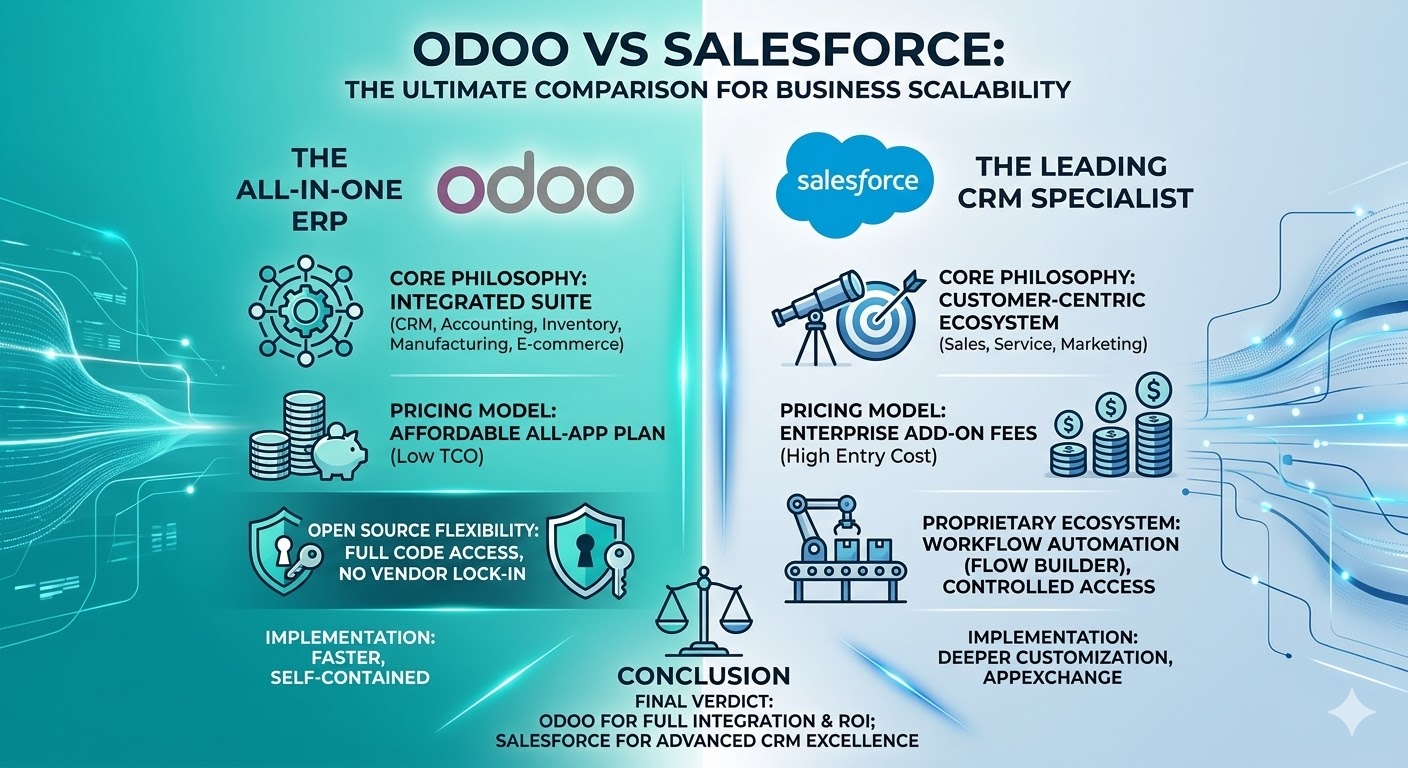
Odoo vs Salesforce | In the rapidly evolving landscape of enterprise software, choosing the right platform to manage your business operations is a critical strategic decision. Two names consistently dominate the conversation: Odoo and Salesforce. While both tools aim to streamline business processes, they cater to different philosophies, budgets, and operational needs. This guide provides an in-depth analysis to help you decide which powerhouse is the right fit for your organization.
Reliable resources for your business growth
1. The Core Philosophy: ERP vs. CRM
The most fundamental difference between the two lies in their DNA.
Odoo was built as an Integrated ERP (Enterprise Resource Planning) system. Its modular architecture allows businesses to start with one app (like CRM) and seamlessly add others (like Inventory, Manufacturing, Accounting, or HR) as they grow. Since every module is built by the same core team, data flows perfectly between a sales order, a warehouse picking list, and an accounting invoice without any complex integration.
Executive Deep-Dive
Scaling Beyond Traffic to Revenue
Most enterprises fail because they chase clicks instead of trust. While building your global presence, ensure your EEAT 3.0 signals are synchronized across all regions.
Recommended for you:
→ The Shift from Traffic to Trust: A New KPI for Enterprise SEOSalesforce, conversely, is a “Cloud-First” CRM specialist. It was designed from the ground up to be the ultimate tool for sales teams. Over the decades, it has expanded into Marketing, Service, and Analytics. However, at its heart, Salesforce remains a customer-centric platform. If you need full ERP functionality—such as managing a factory floor or complex double-entry accounting—you generally have to look for third-party apps on the Salesforce AppExchange or integrate it with a separate ERP like SAP or Oracle.
2. Features and Functional Depth
Salesforce Excellence: Salesforce is widely considered the gold standard for Sales Force Automation (SFA). Its features for lead scoring, opportunity management, and forecasting are incredibly sophisticated. The Einstein AI provides predictive insights that help sales leaders make data-driven decisions. If your business depends on a high-volume, aggressive sales cycle, Salesforce’s depth in this specific area is hard to beat.
Odoo Versatility: Odoo’s strength is its breadth. In a single interface, you can manage your website (CMS), sell products (e-commerce), track your fleet, manage employee appraisals, and run your project management. For a 360-degree view of the entire business—not just the sales pipeline—Odoo offers a more holistic solution. The 2026 version of Odoo has also introduced advanced AI features for automated bill recognition and smart marketing automation, closing the gap with Salesforce’s high-end tech.
3. Customization and The Open Source Advantage
One of the biggest pain points in enterprise software is “Vendor Lock-in.”
Odoo is Open Source. This means the source code is accessible. If your business has a highly unique process that no software supports out-of-the-box, you can hire a developer to modify Odoo’s code directly. This flexibility ensures that the software adapts to your business, not the other way around. Furthermore, you can host Odoo on your own servers, on Cloudways, or on Odoo’s cloud.
Salesforce uses a proprietary language called Apex. While highly customizable through its “Flow Builder” (a low-code tool), deep architectural changes are restricted by the platform’s multi-tenant cloud nature. You are also strictly tied to Salesforce’s hosting and infrastructure. While this ensures high security and uptime, it limits your control over the underlying environment.
4. The Cost of Ownership (TCO)
When analyzing organic performance and business ROI, the cost is often the deciding factor.
-
Salesforce Pricing: Often involves a complex web of costs. You pay per user, per month, but many essential features (like advanced reporting or higher levels of support) require “add-on” fees. Additionally, because the platform is complex, the cost of hiring a Salesforce Consultant or Administrator is significantly higher.
-
Odoo Pricing: Known for its disruptive pricing model. Their “All-in-One” plan usually provides access to every single module for a flat fee per user. This transparency makes it much easier for SMEs and growing enterprises to forecast their IT spend without hidden surprises.
5. User Experience (UX) and Adoption
Software is only effective if your team actually uses it. Salesforce has spent billions on UX research, resulting in “Lightning Experience,” which is sleek and modern. However, because it has so many features, it can be overwhelming for new users, requiring extensive training.
Odoo has made massive strides in UX. Its interface is clean, resembling a smartphone with various “apps” on the home screen. This makes the learning curve much shallower for employees who are not tech-savvy. The ability to toggle features on and off ensures the interface remains uncluttered.
6. Integration and Ecosystem
Salesforce boasts the AppExchange, the world’s largest enterprise app marketplace. If there is a tool you use (Slack, Mailchimp, QuickBooks), there is almost certainly a pre-built Salesforce integration for it.
Odoo has its own App Store with over 40,000 community-developed modules. While it might not have the “brand name” integrations of Salesforce, it offers a functional equivalent for almost every business need, often for free or a fraction of the cost of a Salesforce add-on.
- 🚀 Amazon Review: Bentgo Kids Lunch Box Review
- 📊 Product Comparison: Best Lunch Boxes for Kids
- ⚔️ Gear Selection: Cute Lunch Boxes Aesthetic Choices
- 🏢 Top Insulated: Top Insulated Bento Box
- 💡 Daily Commutes: Insulated Lunch Box Options
- 💰 Brand Alternatives: Lunch Boxes Target Alternatives
- 🔍 Shopping Guide: Bento Boxes Online Deals
- 📈 Food Ideas: Creative Bento Box Lunch Ideas
- ⚙️ Kids Gear: Stylish Lunch Boxes for Girls
Amazon Product Authority & E-E-A-T Summary
To maximize organic performance and search visibility in global e-commerce and product review niches, maintaining robust internal linking across specific product clusters ensures faster indexing, stronger topical authority, and sustainable search engine ranking.
Final Verdict: Making the Choice
-
Choose Salesforce if: You are a large enterprise with a massive sales team that requires the most sophisticated CRM tools on the planet and you have the budget to support a dedicated Salesforce team.
-
Choose Odoo if: You want a single source of truth for your entire business. If you want your sales, inventory, and accounting to talk to each other without expensive integrations, Odoo is the clear winner for efficiency and ROI.
Last Updated on 1 month ago by dudung
Exclusive Early Access: Q1 2026
The Global SEO Blueprint for C-Suite
We are finalizing an exclusive strategic framework for global enterprise scaling. Join the elite waitlist for early-bird pricing.
Secure Your Priority Spot