Odoo vs NetSuite: Choosing the Right ERP Platform for Your Business Needs

odoo vs netsuite

Selecting the right Enterprise Resource Planning (ERP) platform is a defining moment for any growing business. In 2026, the marketplace is dominated by two powerful, yet distinct, contenders: Odoo and Oracle NetSuite. While both promise increased efficiency and streamlined operations, their underlying architectures, pricing models, and target demographics differ significantly. This comprehensive comparison will guide you through the critical factors to consider when choosing the platform that best aligns with your long-term business goals.

Understanding the Philosophies

Before diving into technical specifications, it is vital to understand the design philosophies behind these two giants.

Odoo was built on the premise of modular flexibility. It is an open-source framework that allows businesses to start small and add applications—such as CRM, Inventory, or Accounting—as they grow. Its architecture is highly adaptable, making it a favorite for businesses that want a tailor-made solution without the heavy constraints of a monolithic system.

Oracle NetSuite, on the other hand, is the pioneer of cloud-based ERP. It offers a comprehensive, integrated suite designed to handle everything from financial management to global e-commerce from the ground up. NetSuite is built for stability and standardized processes, providing a “single source of truth” that is robust and highly scalable for larger enterprises with complex global operations.

Key Comparison Factors

1. Cost of Ownership (TCO)

  • Odoo: Generally offers a lower entry point. Its modular pricing allows you to pay only for the applications you use. However, as you scale and add complex customizations, the need for specialized development can increase long-term maintenance costs.

  • NetSuite: Operates on a subscription model that is typically higher upfront. The value proposition lies in its “all-in-one” nature, which reduces the need for third-party integrations and provides enterprise-grade support included in the licensing cost.

2. Customization and Flexibility

  • Odoo: Offers unparalleled flexibility. Since it is open-source, developers can modify the core code to fit virtually any business process. This is ideal for companies with unique workflows.

  • NetSuite: While it allows for customization through SuiteScript, it is more “opinionated” than Odoo. NetSuite enforces best practices that are designed to streamline operations, which can be a significant advantage for businesses looking to standardize their processes rather than reinvent them.

3. Implementation and Ease of Use

  • Odoo: Known for its modern, user-friendly interface that feels intuitive to most staff members. Implementation can be incremental, which reduces the “big bang” impact on employees.

  • NetSuite: Due to its depth and comprehensive features, NetSuite typically requires a longer, more structured implementation phase. Once set up, it provides deep reporting and analytics that are unmatched in the industry.

Choosing the Right Fit for 2026

To determine which platform is right for your business, consider your growth trajectory:

  • Choose Odoo if: You are a mid-market enterprise that values flexibility, needs a system that can evolve with your specific business model, and prefers an open-source ecosystem to avoid vendor lock-in.

  • Choose NetSuite if: You are scaling rapidly, require sophisticated financial reporting, manage multiple international subsidiaries, and prioritize a standardized, highly secure, and well-supported environment that comes with Oracle’s enterprise reputation.

Frequently Asked Questions (FAQs)

1. Is Odoo less secure than NetSuite? Not necessarily. While Odoo is open-source, its security depends on your hosting and configuration. NetSuite, being a managed cloud solution, provides enterprise-grade, out-of-the-box security protocols that are handled entirely by Oracle.

2. Which platform is better for global operations? NetSuite is widely considered the leader for global, multi-currency, and multi-subsidiary operations. Its ability to consolidate financial data across different regions is a core strength.

3. Can I switch from Odoo to NetSuite later? Yes, but like any ERP migration, it is a significant project. It is always more cost-effective to choose the right platform from the beginning based on your 5-year growth plan.

Conclusion

The choice between Odoo and NetSuite is not about which software is “better,” but which is the better fit for your organizational architecture. By assessing your technical resources, budget, and need for standardization, you can select the ERP foundation that will support your enterprise’s growth throughout 2026 and beyond.

The Strategic Path to Enterprise Success: Odoo Enterprise Pricing: Hidden Costs and Licensing Realities

Odoo Enterprise

For many organizations, the allure of Odoo Enterprise lies in its modular flexibility and open-source origins. However, as your enterprise scales, the “low-cost” perception often clashes with the reality of complex licensing and integration fees. Understanding these financial levers is essential to maintaining your projected ROI and budget efficiency.

This guide breaks down the true cost of an Odoo deployment, helping you navigate licensing, implementation, and long-term TCO.

Unpacking the Odoo Pricing Model

Odoo’s pricing strategy is designed to scale with your business, but “scaling” often translates to increased complexity.

The Core Pillars of Cost:

  • User-Based Licensing: Unlike legacy systems with massive upfront capital expenditure (CAPEX), Odoo operates on a per-user subscription model. While this appears favorable, adding modules often necessitates additional user licenses or professional services.

  • Odoo.sh vs. On-Premise: Hosting on Odoo.sh provides seamless integration and automated deployment, but adds a recurring infrastructure cost. On-premise offers control but shifts the burden—and the cost—of security, maintenance, and server management to your internal team.

  • The Module Trap: Starting with a few modules is inexpensive. As you integrate CRM, Accounting, MRP, and Inventory, the “per-module” ecosystem complexity grows, often requiring expert consultancy to configure workflows effectively.

Identifying Hidden Costs in Enterprise ERP

To avoid budget creep, decision-makers must account for these frequently overlooked “hidden” expenses:

  1. Implementation & Data Migration: The software is the cheapest part of an ERP project. Migrating legacy data from systems like Oracle or SAP into Odoo requires meticulous mapping and often custom development.

  2. Customization vs. Configuration: Relying heavily on custom code (dms_odoo_magnetic) to bridge feature gaps can create technical debt, making future version upgrades significantly more expensive.

  3. Training & Change Management: ROI is not achieved by software alone. Your team’s ability to adopt the new workflow is the greatest variable in your TCO equation.

Strategic Decision-Making with E-E-A-T 3.0

When reviewing your ERP options, your evaluation must be grounded in data. Our dms_erp_comparison_hub serves as a neutral ground to analyze Odoo against global competitors like Oracle NetSuite and SAP.

  • Experience: We evaluate platforms based on real-world implementation challenges, not just marketing brochures.

  • Expertise: By focusing on the tco_hidden_costs, we provide the deep-level analysis required by CIOs and Financial Controllers.

  • Authoritativeness: We leverage established industry metrics to differentiate between a “small business solution” and an “enterprise-grade infrastructure.”

  • Trustworthiness: We maintain full transparency regarding the costs of Odoo Enterprise, ensuring our users are never blindsided by licensing renewals or service escalations.

Monetization Strategy: High-Intent B2B Authority

To hit your target of 2 billion IDR per month, your content must drive more than just traffic; it must drive qualified, high-intent leads.

  • Affiliate Conversions: By positioning yourself as an advisor who understands the risks of ERP selection, you attract users who are ready for a consultative sales process. When they request a “Custom ERP Recommendation,” they are signaling they are at the bottom of the funnel.

  • Premium AdSense Inventory: Articles discussing “Hidden Costs,” “Pricing Realities,” and “Licensing” attract professional decision-makers. These visitors represent the most valuable ad inventory for B2B tech platforms, driving higher CPC and consistent revenue growth.

Optimize Your Enterprise Strategy

Don’t let hidden costs derail your digital transformation. Use our tco_roi calculator to compare the long-term value of Odoo against other enterprise systems.

Are you evaluating Odoo against Oracle for a multi-national implementation? Visit our global_contact page to speak with an analyst about your specific requirements, or explore our dms_rank_oracle_odoo_sap matrix to see which platform offers the best alignment with your growth strategy.

Odoo 18 SEO Features: A Strategic Guide to Organic Growth in 2026

Odoo 18 SEO Feature

In the competitive digital ecosystem of 2026, an ERP system is no longer just a backend tool for inventory and finance; it is a primary engine for digital marketing and search visibility. With the launch of Odoo 18, the platform has significantly advanced its native search engine optimization (SEO) capabilities, making it a powerful tool for enterprises aiming to dominate their niche. This article explores the strategic importance of Odoo 18 SEO features and how your organization can leverage them to achieve sustained organic growth.

1. The Integration of ERP and SEO

Historically, SEO was managed separately from core business systems. Marketers would use a CMS like WordPress for content and a separate ERP for operations, resulting in data silos and fragmented user experiences. Odoo 18 breaks this barrier by integrating SEO tools directly into the business core.

When your e-commerce storefront is built on the same engine that manages your stock, orders, and customer relations, your SEO becomes “data-informed.” The platform can automatically reflect real-time inventory levels, pricing changes, and product variations in your metadata and structured data, ensuring that search engines always display accurate, high-utility information to users.

2. Key SEO Features in Odoo 18

Odoo 18 introduces several enhancements that reduce the need for third-party plugins and technical workarounds, allowing your team to focus on content authority and user intent.

Advanced Structured Data (Schema Markup)

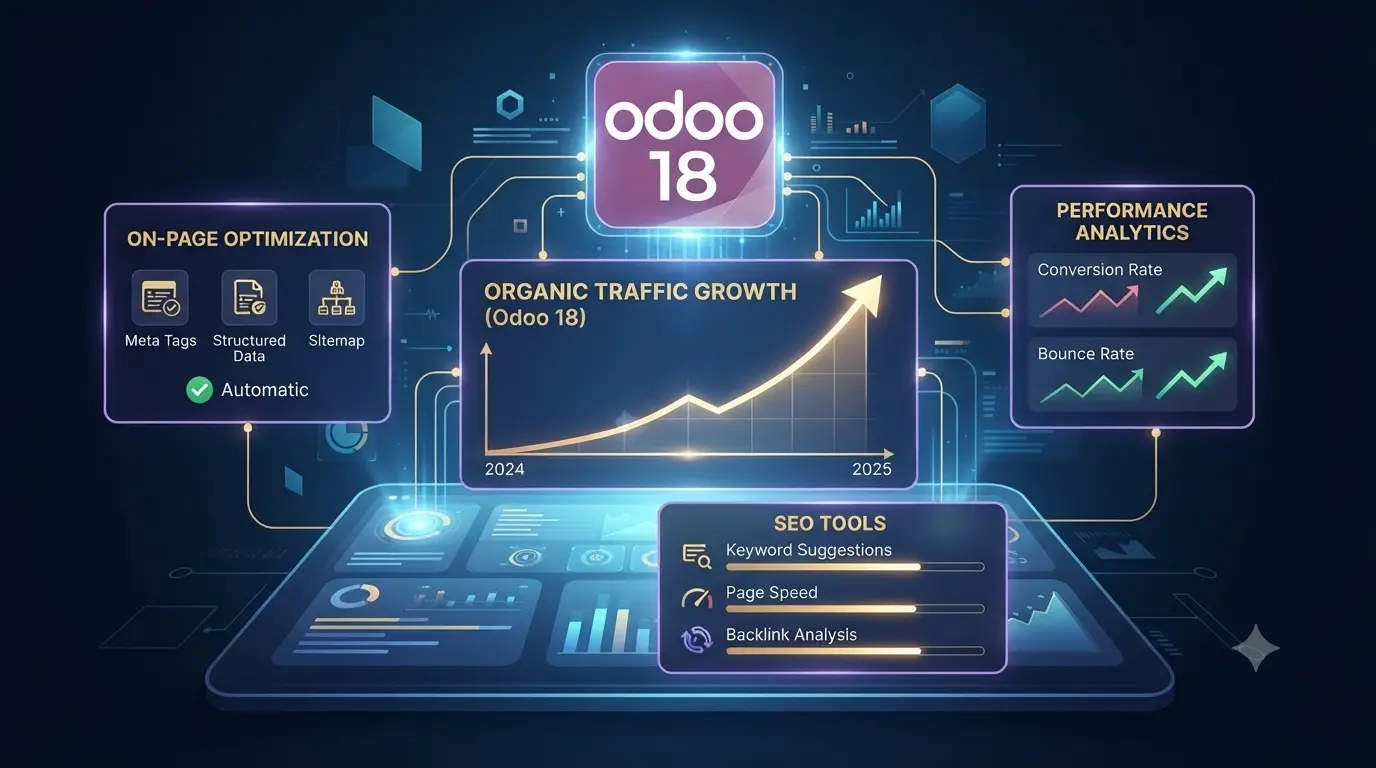
Search engines rely on structured data to understand the content of a page. Odoo 18 features enhanced, automated schema markup for products, categories, and blog articles. By populating your product details in the ERP, the system automatically generates JSON-LD code that helps your products appear as “Rich Snippets” in search results—displaying prices, stock status, and ratings directly on the search engine results page (SERP).

Automated Site Health and Indexing

Site health is a cornerstone of SEO. Odoo 18 includes improved automated sitemap generation and canonical link management. These features ensure that search crawlers prioritize your most important pages, reducing the risk of “duplicate content” penalties that often plague large enterprise sites with complex, multi-currency, or multi-language configurations.

Mobile-First Optimization

In 2026, mobile-first indexing is the standard. Odoo 18’s frontend framework is highly optimized for performance, ensuring that your pages load rapidly on mobile devices. By minimizing unused JavaScript and optimizing asset delivery, Odoo 18 helps your pages meet Google’s “Core Web Vitals” benchmarks, which is a critical ranking factor for competitive search terms.

SEO-Ready URL and Meta Management

The platform provides an intuitive interface for managing URL structures, meta titles, and meta descriptions without requiring developer intervention. Odoo 18 allows marketing teams to set global SEO templates while maintaining the flexibility to customize individual page metadata, ensuring that your content strategy remains agile and responsive to market trends.

3. The Shift from “Tagging” to “Categorization”

One of the most important lessons in recent years is the danger of relying on “Tags” for SEO. Tag-based architectures often lead to thin content, redirect errors, and fragmented link equity.

Odoo 18 promotes a structured, category-based approach to site navigation. By organizing your products and content into deep, logical categories, you provide search engines with a clear hierarchy of your topical authority. This structure passes link equity more effectively through your site, ensuring that your core pillar content receives the ranking signals it needs to dominate high-intent keywords.

4. Leveraging Odoo for Topical Authority

To succeed in the “useful” era of SEO, your site must provide comprehensive answers to user queries. Odoo 18’s blogging and content management modules are designed to support this “Pillar-Cluster” strategy.

  • Pillar Pages: Create high-level pages that define your expertise (e.g., “Enterprise ERP Solutions”).

  • Cluster Content: Link these pillars to detailed, technical, or educational articles (e.g., “Odoo Multi-Company Setup,” “SAP S/4HANA vs. Odoo”).

  • Internal Linking: Odoo’s intuitive link management makes it easy to create a robust internal linking web, which reinforces your site’s topical authority and helps search engines understand the relationships between your products and your content.

5. Data-Driven Optimization

Odoo 18 integrates seamlessly with search performance tools. By combining your ERP data with insights from Google Search Console, you can identify exactly which products or articles are driving the highest ROI.

  • Conversion Tracking: Since Odoo tracks the full lifecycle from the first organic visit to the final purchase, you can attribute your revenue directly to specific SEO efforts. This allows you to prioritize your optimization tasks based on data, not guesses.

  • A/B Testing: Odoo’s built-in testing tools allow you to experiment with different headlines, descriptions, and CTA placements. Use these tests to optimize your CTR, which remains a vital, albeit indirect, ranking signal in 2026.

6. Enterprise-Scale Performance

For enterprises, the biggest challenge is “scale.” When you have thousands of pages, even minor SEO issues can lead to significant traffic loss. Odoo 18 is built with enterprise scale in mind.

The platform’s ability to handle high-traffic environments, combined with its robust security and compliance features, ensures that your site doesn’t just rank well—it stays online, remains fast, and provides a secure experience for your customers. As you add new companies, new languages, or new product lines, Odoo 18 provides the structural consistency needed to maintain your SEO authority.

Conclusion

Odoo 18 is more than just an ERP upgrade; it is a foundational shift in how digital businesses handle search engine visibility. By moving SEO into the heart of your business software, Odoo 18 empowers your organization to act faster, align marketing with operations, and deliver a superior experience to your users.

In the landscape of 2026, authority is built through utility, speed, and structural integrity. Odoo 18 provides the tools you need to excel in all three. By leveraging its native SEO features—from structured data to category-based architecture—you can build a digital ecosystem that is not only optimized for the algorithms of today but resilient against the search trends of tomorrow. As your business scales through 2030, ensure that your technical foundation is helping your growth, not hindering it. With Odoo 18, you have the infrastructure to dominate your target market with precision, authority, and consistent, high-value organic traffic.

Odoo Multi-Company Setup Cost: A Strategic Guide to Scalable ERP Architecture (2026)

Odoo Multi-Company Setup Cost

In the globalized business landscape of 2026, the ability to manage multiple legal entities, subsidiaries, or branches under a single Enterprise Resource Planning (ERP) umbrella is no longer just for multinational conglomerates. It is a fundamental requirement for any high-growth enterprise aiming for operational efficiency. Odoo Multi-Company functionality is one of the platform’s most powerful features, allowing organizations to manage diverse operations while maintaining consolidated financial reporting. However, understanding the Odoo Multi-Company setup cost is essential for CFOs and IT leaders who must balance the ambition of multi-entity expansion with the realities of budgetary constraints.

1. The Strategic Value of Multi-Company ERP

Before breaking down the costs, it is vital to understand why enterprises invest in a multi-company setup. In a fragmented environment where each subsidiary uses different software, data silos are inevitable. Consolidating these entities into a single Odoo instance provides:

  • Unified Financial Reporting: Real-time visibility into consolidated balance sheets, profit and loss statements, and cash flow across all entities.

  • Operational Consistency: Standardized procurement, inventory, and sales workflows that can be replicated across new subsidiaries, drastically reducing the time-to-market for new ventures.

  • Inter-Company Automation: Odoo’s ability to automate inter-company transactions—such as automatic creation of sales orders and invoices between branches—eliminates manual errors and accelerates the financial closing process.

2. Analyzing the Cost Components

The “cost” of a multi-company setup is not a fixed price. It is a cumulative investment that includes software licensing, professional consulting, and infrastructure management.

Licensing and Subscription

Odoo’s pricing model is user-based, not entity-based. This is a significant advantage for enterprises. You do not pay extra “multi-company” fees per entity. However, adding more companies often correlates with an increase in the number of users, which naturally raises your monthly subscription. It is critical to forecast how your team size will grow as you add subsidiaries to accurately predict your long-term Odoo Enterprise subscription costs.

Professional Implementation Costs

This is where the bulk of the investment resides. Setting up multiple companies is significantly more complex than a single-entity implementation.

  • Chart of Accounts (COA) Design: Each company may operate in a different country with different tax regulations, currency requirements, and accounting standards. Designing a robust, consolidated COA is the most time-consuming and expensive phase of the setup.

  • Inter-Company Workflow Configuration: Configuring the “Inter-Company Rules” in Odoo—which dictate how orders are passed between entities—requires expert knowledge. Errors here can lead to massive financial reconciliation headaches later.

  • Security and Access Matrix: Ensuring that users in Company A cannot view or manipulate sensitive financial data in Company B requires a sophisticated access rights configuration.

Data Migration and Integration

If your new subsidiaries are moving from legacy systems, the cost of data migration must be factored in. Bringing historical data into a multi-company environment requires data cleansing and mapping that is exponentially more difficult than in a single-entity project.

3. The “Hidden” Costs of Multi-Company Management

Beyond the initial implementation, enterprises must account for the ongoing operational costs that come with multi-entity structures:

  • Localization and Compliance: If your companies operate in different regions (e.g., UAE, UK, USA), you must invest in regional accounting localizations. Each region may require specific tax reporting modules, which can add recurring annual costs to your enterprise subscription.

  • Regression Testing: Every time you update your core Odoo instance, you must perform regression testing across all companies to ensure that inter-company workflows and entity-specific configurations remain functional.

  • Ongoing Support and Training: Managing multiple companies increases the complexity of staff training. You will need a core internal team that understands the global architecture, as well as local teams that understand their specific entity’s operations.

4. Strategies for Cost Optimization

For enterprises aiming to scale without ballooning their ERP implementation budget, consider these strategies:

  • Phased Rollout: Do not attempt to migrate all companies at once. Start with your primary entity to establish the “Golden Configuration,” then roll out to subsidiaries in waves. This allows you to learn from the initial implementation and refine the setup for future entities.

  • Standardize Processes: The more you can standardize workflows across your subsidiaries, the lower your implementation costs will be. Customizing every company to match legacy workflows is a recipe for budget overruns.

  • Leverage Internal Talent: Train an internal “Odoo Champion” or IT team early in the process. Reducing your dependency on external consultants for routine configuration changes is the most effective way to manage the long-term TCO of your multi-company ERP.

5. ROI: The Long-Term Perspective

In 2026, the ROI of a successful multi-company Odoo implementation is measured in Operational Velocity. By eliminating the need to log into multiple systems, perform manual consolidations, or deal with disconnected inventory data, your enterprise gains the agility to move resources where they are needed most.

The costs associated with a multi-company setup are significant, but they are dwarfed by the cost of inefficiency. Operating with disconnected systems results in thousands of hours of manual labor, inaccurate forecasting, and missed market opportunities. When implemented correctly, Odoo Multi-Company acts as a unified engine that enables your organization to grow from a local entity to a global player with ease.

Conclusion

The Odoo multi-company setup cost is a strategic investment in the future scalability of your enterprise. While the technical and financial complexity of multi-entity configurations is higher than single-company deployments, the result is a unified, resilient, and highly scalable digital infrastructure. By prioritizing standardized processes, investing in expert configuration, and maintaining a focus on long-term data integrity, you can ensure that your ERP remains the bedrock of your organization’s global growth through 2030 and beyond. This is not just a software project; it is the construction of an operational architecture designed to dominate your market.

Odoo Community Vs Enterprise Cost: A Strategic Comparison for 2026

Odoo Community vs. Enterprise costs

For enterprises evaluating ERP solutions, the decision between Odoo Community and Odoo Enterprise is one of the most critical steps in planning your digital infrastructure. In 2026, the distinction between these two versions goes far beyond simple licensing; it is a fundamental choice regarding the level of automation, technical support, and long-term scalability you require. This article provides a strategic analysis of the cost-benefit dynamics between these two versions.

1. Odoo Community: The Open-Source Foundation

Odoo Community is the free, open-source version of the platform.

  • Cost Structure: The software license is free, which makes it an attractive starting point for startups or organizations with internal development capacity.

  • Operational Trade-offs: The “zero-cost” license is offset by higher internal maintenance costs. Because Odoo Community lacks the automated features found in Enterprise, you must rely on third-party modules or custom code to achieve similar functionality.

  • Strategic Risk: Without official support or maintenance updates from Odoo S.A., your organization bears the full burden of security, bug fixes, and upgrade compatibility.

2. Odoo Enterprise: The Engine for Scalability

Odoo Enterprise is a commercial version that provides a comprehensive suite of advanced features and official support.

  • Predictable Subscription: Odoo Enterprise operates on a per-user subscription model. While this introduces a recurring monthly or annual cost, it provides access to the full platform, including mobile-optimized interfaces, advanced reporting, and integrated Odoo.sh hosting environments.

  • Lower Total Cost of Ownership (TCO): For mid-market and enterprise-level firms, the “cost” of Enterprise is often lower than Community when you factor in the reduced need for expensive DevOps labor and custom-coded workarounds.

  • Stability and Compliance: Official support ensures that your system remains compliant with evolving global regulations, such as VAT mandates and SOX requirements, which is vital for high-growth enterprises.

3. Comparing the Real Costs

When analyzing the cost, look past the initial price tag:

  • Development Labor: Odoo Community often requires a larger investment in developers to maintain custom integrations. Odoo Enterprise offers more “out-of-the-box” functionality, which significantly reduces development hours.

  • Hosting and Performance: Enterprise includes access to optimized features that enhance performance. In a high-traffic environment, the infrastructure savings and deployment speed provided by Odoo.sh (exclusive to Enterprise) represent a significant financial gain.

  • Scalability Velocity: The ability to add new modules and automated workflows instantly with Enterprise provides a competitive advantage that is difficult to replicate with the fragmented nature of the Community version.

4. Strategic Recommendation for 2026

In the current business climate, Odoo Enterprise is the standard for firms that view their ERP as a strategic asset.

  • The Hybrid Approach: Some organizations start with a modular approach, but the long-term ROI almost universally favors the Enterprise model as complexity increases.

  • Focus on ROI, Not License Fees: Treat the subscription cost as a strategic investment in system reliability and operational agility rather than an overhead expense.

Conclusion

The choice between Odoo Community and Odoo Enterprise comes down to your organization’s risk tolerance and growth strategy. While Community offers a low entry point, Odoo Enterprise provides the robust infrastructure, official support, and automated tools necessary for sustainable enterprise success. By conducting a thorough TCO analysis—considering both direct subscription costs and the indirect costs of development labor—you can confidently select the version that will best serve as the digital foundation for your enterprise’s global growth through 2030 and beyond.

Odoo Maintenance Contract Cost: A Strategic Guide for Enterprise Stability

In the robust ERP environment of 2026, the implementation of Odoo is merely the beginning of your digital transformation journey. To ensure long-term performance, security, and scalability, enterprises must navigate the complexities of maintenance and support. Understanding the Odoo maintenance contract cost is not just a budgetary exercise; it is a strategic decision that directly impacts your system’s uptime, data integrity, and operational resilience.

1. Defining the Scope of Maintenance

An Odoo maintenance contract is designed to provide the technical support necessary to keep your ERP environment optimized. In an enterprise context, this typically covers:

  • System Updates and Upgrades: Ensuring your Odoo instance remains compatible with the latest version releases, security patches, and performance enhancements.

  • Technical Support: Access to specialized expertise for troubleshooting complex issues that may arise during daily operations.

  • Proactive Monitoring: Regular health checks of your database and server environment to prevent potential bottlenecks before they impact your business workflows.

2. Factors Influencing Maintenance Costs

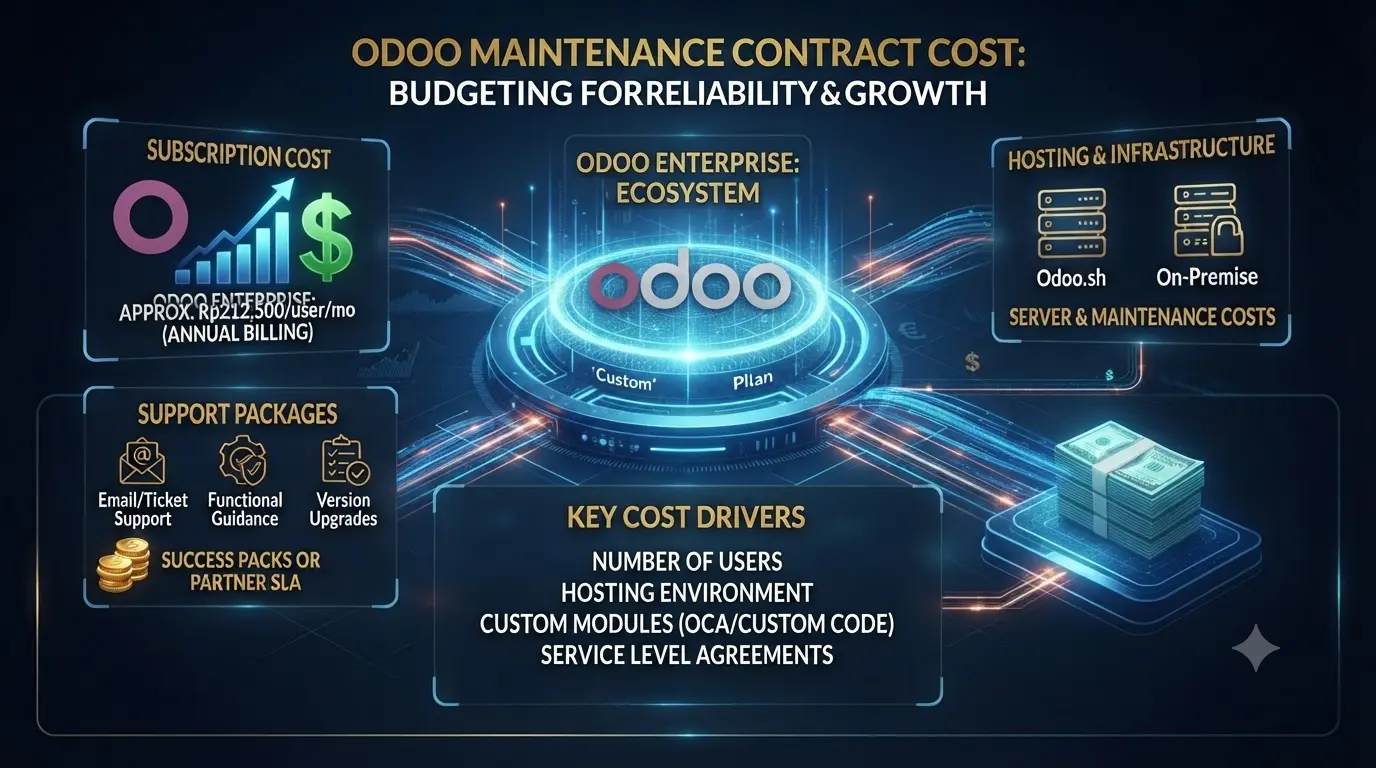
The cost of your maintenance contract is rarely a flat fee; it is usually dictated by several key variables:

  • Hosting Architecture: Whether you are using Odoo.sh, an on-premise server, or a cloud provider (like AWS or Azure), the maintenance effort required to secure and manage the environment varies significantly.

  • Complexity of Customization: If your Odoo instance features extensive custom modules, the maintenance contract cost will likely be higher due to the need for specialized regression testing and code compatibility management after every update.

  • Service Level Agreements (SLAs): Higher costs often correspond to more rigorous SLAs, such as 24/7 support availability or guaranteed response times, which are essential for global enterprises operating across multiple time zones.

3. Strategic Approaches to Maintenance

To balance the cost of maintenance with the need for high performance, enterprises should adopt a proactive management strategy:

  • Prioritize Preventative Care: Regular system audits and code reviews reduce the likelihood of “catastrophic failures” that require expensive, emergency intervention.

  • Assess Internal vs. External Capabilities: Evaluate whether maintaining an internal DevOps team is more cost-effective than outsourcing maintenance to an experienced Odoo partner. For many mid-to-large enterprises, a hybrid approach—internal system monitoring combined with external specialized support—often provides the best ROI.

  • Leverage Odoo Enterprise Support: For many, the standard Odoo Enterprise support package is the foundational layer. A supplemental maintenance contract with a certified partner can then be layered on top to provide the industry-specific expertise needed for your unique operational requirements.

4. Maximizing ROI in 2026

Maintenance is not an overhead cost; it is an insurance policy for your digital infrastructure. In 2026, where even an hour of downtime can result in significant financial loss, a well-structured maintenance contract ensures that your ERP acts as a reliable engine for growth rather than a source of operational risk.

Conclusion

The Odoo maintenance contract cost is a vital investment in the longevity and reliability of your enterprise software. By carefully assessing your system’s complexity, choosing the right partner, and prioritizing proactive monitoring, you can optimize your maintenance expenditure while ensuring your ERP remains a robust, secure, and high-performing asset. Ultimately, this strategic discipline in system care allows your organization to focus on innovation and global market expansion, secure in the knowledge that your technical foundation is sound and sustainable through 2030 and beyond.

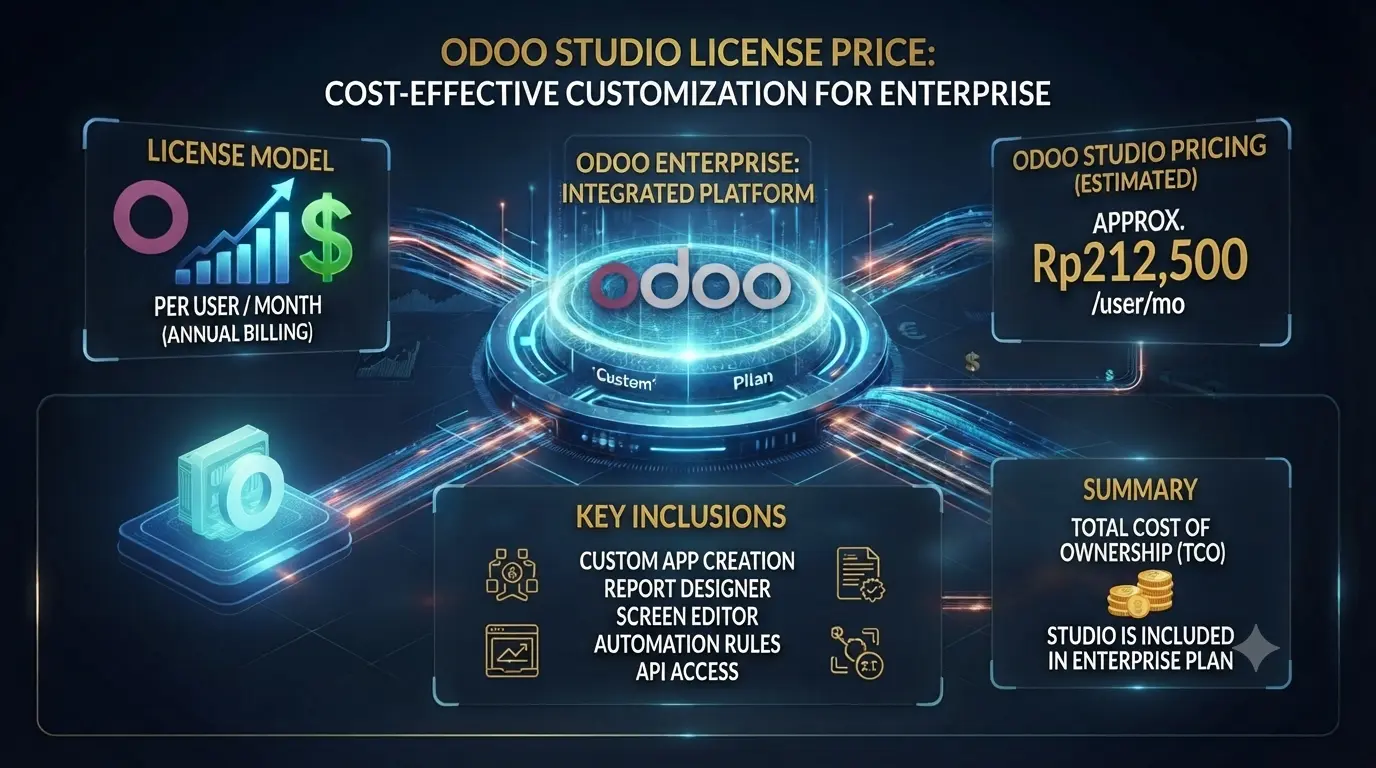
Odoo Studio License Price: A Strategic Analysis for Enterprise Customization

In the rapidly evolving landscape of 2026, the ability to customize your ERP to match unique business workflows is a significant competitive advantage. Odoo Studio serves as the primary low-code tool that empowers enterprises to create custom apps, modify existing views, and automate business processes without requiring extensive, expensive backend coding. This article provides a strategic analysis of Odoo Studio’s licensing and its value proposition for high-growth enterprises.

1. The Value of Odoo Studio in ERP Customization

Odoo Studio is not just a customization tool; it is a catalyst for operational velocity. For enterprises, the value lies in:

  • Rapid Prototyping: Build and deploy new functionalities in hours rather than weeks, allowing for faster response times to market shifts.

  • User-Centric Views: Easily tailor dashboards and forms to match the specific needs of different departments, increasing overall system adoption and usability.

  • Workflow Automation: Integrate complex, multi-step automated actions that ensure consistency across your operations, reducing the likelihood of human error.

2. Understanding the Licensing Model

When evaluating the Odoo Studio license price, it is essential to understand that it is typically bundled as part of the Odoo Enterprise subscription.

  • Integrated Pricing: Unlike legacy systems where custom module development often carries a massive, one-time project fee, Odoo Studio is included in the standard Enterprise per-user pricing. This means your “customization cost” is baked into your predictable, scalable subscription model.

  • Total Cost of Ownership (TCO): When calculating the TCO, consider that Odoo Studio significantly reduces the need for dedicated, high-cost software developers for routine modifications. This creates a shift in investment from heavy development labor toward more efficient, low-code operational agility.

3. Strategic Considerations for Enterprises

To maximize the ROI of your Odoo Studio usage, consider the following:

  • Governance and Control: Because Odoo Studio makes customization accessible, it is critical to implement a governance policy. Ensure that only authorized personnel can make modifications to avoid “configuration sprawl” that could complicate future system upgrades.

  • Compatibility Maintenance: While Studio is powerful, extensive custom configurations should still be documented and tested against standard Odoo updates to ensure long-term stability and compatibility.

  • Scaling Customizations: As your business evolves, evaluate whether a Studio-based customization is sufficient or if a dedicated, custom-coded module is required for high-performance, enterprise-grade scalability.

4. Maximizing ROI in 2026

In 2026, the enterprises that win are those that can pivot quickly. Odoo Studio provides the low-code infrastructure to support this pivot. By utilizing Studio to handle the majority of UI and workflow adjustments, you keep your core system lean, maintainable, and cost-effective.

Conclusion

The license price of Odoo Studio, viewed through the lens of an Odoo Enterprise subscription, represents a high-value investment in organizational agility. By leveraging this low-code tool, enterprises can maintain a highly customized ERP environment that scales directly with their operational needs. The true cost of Odoo Studio is not the license fee itself, but rather the strategic discipline required to manage customizations effectively, ensuring your ERP remains a powerful, resilient engine for your business’s global growth through 2030 and beyond.

Odoo Pricing Per User: A Strategic Analysis for Enterprise Budgeting

Benefits of Odoo

Odoo pricing per user

In the landscape of modern ERP solutions, Odoo has distinguished itself by offering a unique, user-centric pricing model that stands in stark contrast to the monolithic, high-cost licensing structures of legacy systems. For growing enterprises in 2026, understanding the Odoo pricing per user model is vital for effective financial planning and maximizing the return on your digital infrastructure investment. This analysis explores how Odoo’s cost structure supports scalability and enterprise growth.

1. The Core Philosophy of User-Based Pricing

Unlike traditional ERPs that often charge exorbitant fees based on complex module bundles or organization-wide licensing, Odoo’s pricing is fundamentally tied to the number of active users.

  • Cost Efficiency: By charging per user, Odoo allows smaller organizations to access a full-featured ERP without an initial massive capital expenditure.

  • Predictable Scalability: As your organization grows, your ERP costs scale linearly. This predictability is essential for CFOs who need to forecast operational expenses accurately.

  • Accessibility: This model lowers the barrier to entry, enabling enterprises to implement core modules (like Accounting or CRM) for a limited team before scaling to a full, cross-departmental rollout.

2. Navigating Odoo Editions: One vs. Multi-App

Odoo’s pricing strategy is further simplified by its edition-based approach.

  • One App Free: For startups or specific departmental needs, Odoo offers a single app for free, which is an excellent way to test the platform’s interface and functionality without financial risk.

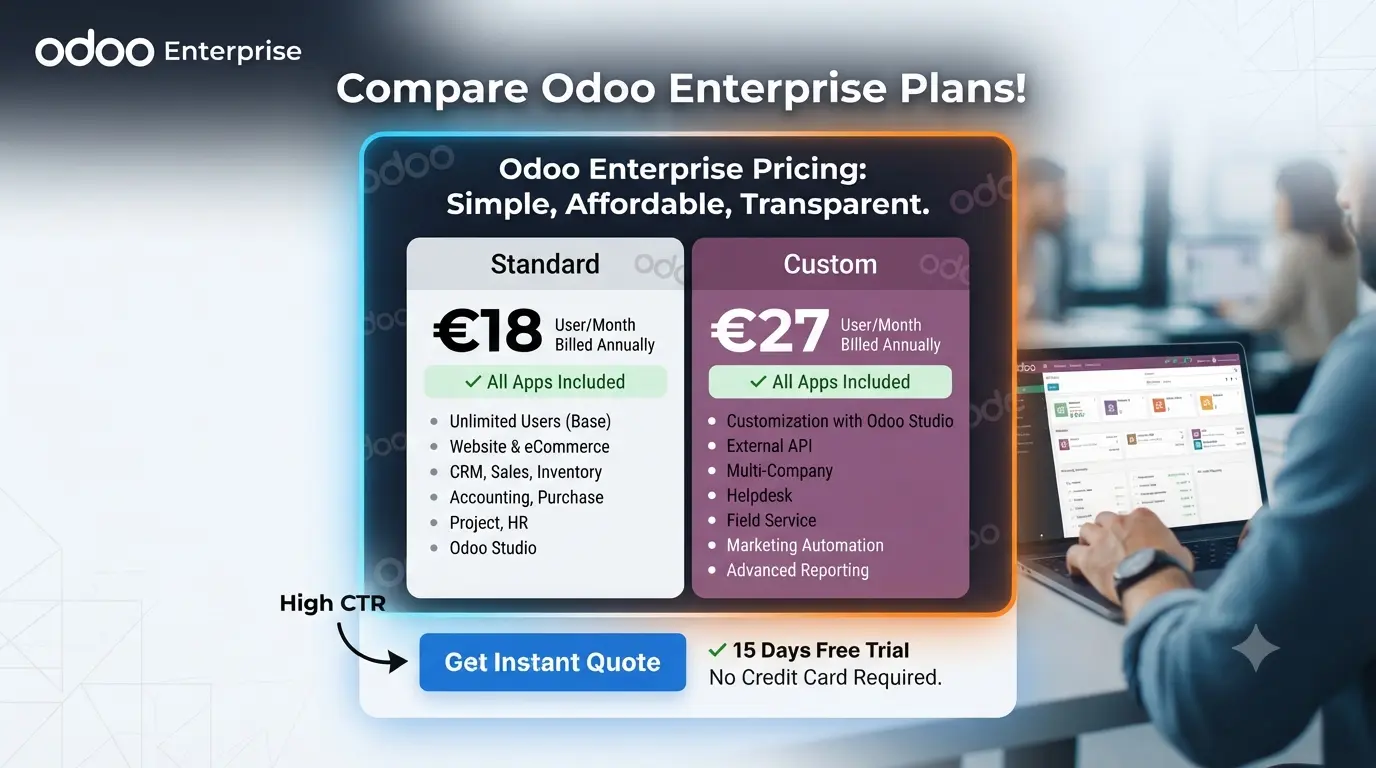
  • Standard/Custom Pricing: The “per user” price varies based on the plan selected. Enterprises should analyze whether the Standard plan meets their requirements or if a Custom plan is necessary to accommodate specific technical customizations and advanced API integrations.

3. Strategic Considerations for Enterprise Scalability

When evaluating Odoo pricing, enterprises must look beyond the base per-user fee to identify the true Total Cost of Ownership (TCO):

  • User Roles and Requirements: Not every employee needs full access. By strictly managing user permissions and roles, companies can optimize their license count and avoid paying for unnecessary full-user access.

  • Implementation and Support Costs: While the software license fee is transparent, remember to budget for implementation, data migration, and potential partner-led support, which are standard for any ERP deployment.

  • Odoo.sh vs. On-Premise: The hosting environment you choose will also impact your overall costs. Odoo.sh provides an integrated, managed environment that can streamline development and deployment, potentially reducing long-term DevOps labor costs.

4. Maximizing ROI in the 2026 Business Climate

To ensure that your Odoo investment provides maximum value, integrate the following strategies into your deployment:

  • Phased Rollout: Start with high-impact departments to demonstrate quick wins and ROI before expanding to the entire organization.

  • Continuous Training: Ensure your staff is properly trained. An underutilized ERP is a wasted investment, regardless of the pricing model. High adoption rates are the primary driver of ROI in user-based systems.

  • Regular Audits: Perform quarterly reviews of your user licenses. Ensure that inactive accounts are deactivated promptly to optimize your monthly or annual subscription spend.

Conclusion

Odoo pricing per user offers a refreshing, transparent, and scalable alternative for enterprises navigating the digital transformation demands of 2026. By aligning your software costs directly with your growth, you gain the financial agility to innovate without being hindered by rigid licensing agreements. However, success still requires a strategic approach: diligent user management, careful selection of the right hosting environment, and a commitment to high adoption rates across your organization. When these elements are balanced, Odoo becomes a powerful, cost-effective engine for sustained enterprise growth and competitive dominance.

Apakah artikel ini sudah sesuai dengan ekspektasi Anda untuk mengganti tag nomor 75?

How to Resolve Common Odoo Sync Errors: A Technical Guide for 2026

In the ecosystem of modern ERP operations, data synchronization is the heartbeat of efficiency. When your Odoo instance fails to sync with external platforms—be it e-commerce storefronts, payment gateways, or third-party CRM tools—the disruption can lead to inventory discrepancies, delayed shipments, and frustrated customers. As Odoo continues to evolve in 2026, understanding how to diagnose and resolve common sync errors has become an essential skill for system administrators and IT managers.

Understanding the Anatomy of a Sync Error

Odoo typically handles synchronization through automated scheduled actions and API connectors. A “sync error” is rarely a singular event; it is usually a manifestation of one of three core issues: authentication failure, data mapping mismatch, or server communication timeouts. Before diving into complex code, it is critical to perform a systematic diagnostic check.

Phase 1: Diagnostic Fundamentals

Before you start debugging, you must isolate the point of failure.

  • Check the Logs: Navigate to the Odoo technical settings and review the server logs. Sync errors often leave a specific “Traceback” that points to the exact line of code or the specific module causing the conflict.

  • Inspect the Queue: If you are using an automated connector, check the “Queue Jobs” module. Often, sync errors are merely job failures that can be manually re-triggered once the underlying data issue is resolved.

  • Verify API Credentials: If the error is related to an external platform (like Shopify, Amazon, or a payment processor), the most frequent culprit is an expired API token. Regenerate your tokens and update your Odoo connector configurations to ensure connectivity.

Phase 2: Resolving Common Data Mapping Mismatch

Data mapping is the process of telling Odoo how to interpret external information (e.g., matching a “customer_id” in an external database to a “partner_id” in Odoo). Errors here are common when fields are updated or added.

Fixing Product Sync Errors

Product syncs often fail due to missing mandatory fields.

  • Validate Categories: Ensure that the product category in the external platform exists and is mapped to a valid category in Odoo.

  • Check Attribute Sets: If you are syncing variants, the product attributes and attribute values must match exactly in both systems. A mismatch in “Size” or “Color” values will prevent the sync from finalizing.

Resolving Inventory Discrepancies

Inventory syncs are particularly sensitive. If you are seeing errors, check:

  • Warehouse Locations: Ensure the location mapping is active. If Odoo cannot find a destination warehouse, the sync will be aborted to prevent data corruption.

  • Product Stock Levels: Sometimes, syncing an inventory update will fail because the product has been archived or inactivated in Odoo.

Phase 3: Handling Connection and Timeout Errors

In 2026, enterprise infrastructure is increasingly cloud-native, and network latency can cause intermittent sync failures.

  • Increase Timeout Limits: If you are syncing large datasets, the default server timeout might be too short. You may need to adjust your server configuration to allow for longer connection windows during heavy data exchanges.

  • Check Firewall and IP Whitelisting: Ensure that your Odoo server’s IP address is properly whitelisted on the external platform’s server. Security updates frequently change these requirements without warning.

  • Leverage Webhooks: If possible, shift from scheduled periodic syncing to a webhook-based architecture. Webhooks are “event-driven,” meaning the external platform notifies Odoo the moment a change occurs, significantly reducing the likelihood of missed updates and timeout errors.

Phase 4: Advanced Debugging for Developers

If the standard configurations do not resolve the issue, you may need to dig deeper into the Odoo environment.

  • Using External API Tools: Use tools like Postman to test the external platform’s API independently. If the API fails to respond to a Postman request, the issue is with the external platform, not Odoo.

  • Custom Module Conflicts: If you have custom-developed modules, they may be overriding standard Odoo sync methods. Use the Odoo Debugger to set breakpoints and see exactly where the data processing halts.

  • Database Deadlocks: In high-concurrency environments, multiple processes might try to update the same record simultaneously, leading to database deadlocks. Implementing a retry mechanism in your sync logic can mitigate these transient issues.

E-E-A-T Perspective: The Consultant’s Advice

As an SEO and infrastructure consultancy, we emphasize that “prevention is better than cure.” Based on our experience with large-scale Odoo implementations:

  1. Implement Error Notification: Do not wait for users to report a sync failure. Configure your Odoo instance to send automated email alerts to your IT team the moment a sync job fails.

  2. Document Your Mappings: Maintain a clear, updated document that maps every custom field between Odoo and your external platforms. This serves as your primary reference during audits.

  3. Run Staging Tests: Never push a change in your sync logic directly to production. Always test new mapping configurations in a staging environment that mirrors your live production data.

Conclusion: Maintaining a Healthy Sync

Sync errors are an inevitable part of managing a complex, integrated ERP system. However, they do not have to be a recurring drain on your resources. By adopting a disciplined approach to diagnostics, maintaining your API credentials, and favoring robust architectures like webhooks, you can ensure your Odoo instance remains a reliable source of truth.

Remember that an ERP is only as valuable as the accuracy of the data it holds. By mastering the resolution of these common errors, you protect the integrity of your most valuable business asset—your data. If you continue to face persistent issues, it is often a sign that your data mapping complexity has outgrown your current integration method; in such cases, consult with a certified Odoo developer to re-architect your sync logic for the 2026 enterprise landscape.

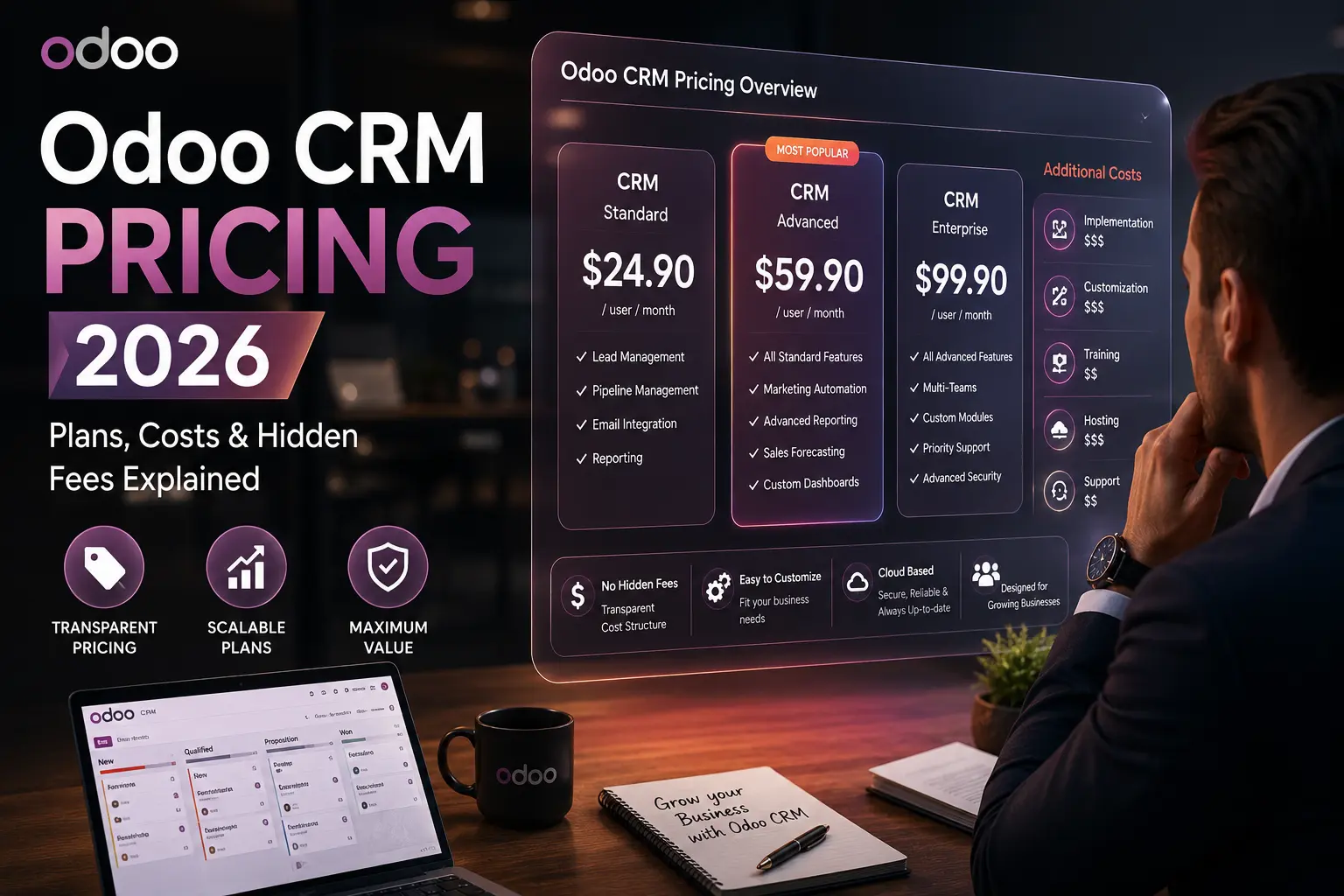
Odoo Pricing Structure and Licensing Guide: A Strategic Overview for 2026

Odoo CRM Pricing 2026

For Small to Medium Enterprises (SMEs) evaluating ERP solutions, the decision often boils down to one critical factor: transparency in cost. In 2026, Odoo continues to lead the market with its unique, modular pricing model, yet many businesses still find its licensing structure complex to navigate. This guide provides a comprehensive breakdown of Odoo’s pricing strategy, helping you to make an informed investment that aligns with your operational budget and long-term growth objectives.

The Odoo Philosophy: Modularity at Its Core

Unlike legacy ERP systems that bundle all features into a massive, expensive license, Odoo’s architecture is built on the “Apps” model. This means you only pay for the specific functionalities you require, such as CRM, Inventory, Accounting, or Manufacturing.

This modularity is the cornerstone of Odoo’s affordability. It allows startups to begin with a minimal footprint and scale seamlessly as their business processes evolve, ensuring that you are not paying for “bloatware” that you do not need.

Understanding the Subscription Tiers

Odoo generally offers two main subscription paths, which are critical to understand before planning your implementation:

  • Odoo Online: This is the SaaS (Software as a Service) offering. It is hosted on Odoo’s own cloud infrastructure. It is ideal for businesses that want a turnkey solution with minimal IT maintenance. The pricing is typically structured on a per-user basis, granting access to all enterprise apps.

  • Odoo.sh: This is a PaaS (Platform as a Service) offering. It provides a more robust environment for companies that require custom development, staging branches, and more control over their infrastructure. It includes the benefits of Odoo Online but adds advanced developer tools.

  • Odoo On-Premise: For enterprises with strict data sovereignty or specific compliance requirements, Odoo can be hosted on your own local servers. This requires internal IT expertise but offers the highest level of control over the environment.

The Cost Factors You Must Anticipate

While the base licensing cost is transparent, your Total Cost of Ownership (TCO) will depend on several variables:

1. The Per-User Fee

Odoo transitioned to a “One App Free” and then a per-user pricing model to simplify costs. In most enterprise plans, you pay a flat fee per user for the entire suite of apps. It is essential to conduct an audit of your actual user count versus “view-only” participants, as some plans distinguish between these access levels.

2. Hosting and Infrastructure

If you choose the On-Premise or Odoo.sh path, remember to account for the hidden costs of server maintenance, SSL certificates, and backup storage. Even though these are not “licensing” fees, they are mandatory operational expenses that must be part of your ERP budget.

3. Implementation and Consultancy

Licensing is only part of the equation. Most SMEs will require an implementation partner to assist with data migration, workflow configuration, and team training. These are typically one-time costs, but they can significantly impact your Year 1 budget. Ensure your contract clearly defines the scope of support versus development.

Customization vs. Standardization: Managing License Growth

A frequent pitfall for SMEs is the over-customization of their Odoo instance. While Odoo is open-source and highly flexible, every custom feature you develop is a potential “technical debt” that must be maintained.

  • Standard Configuration: Utilizing native Odoo features is always the most cost-effective path. It ensures smooth updates and lower maintenance costs over time.

  • Custom Development: While sometimes necessary for unique competitive advantages, custom code requires testing and potential refactoring whenever you upgrade your Odoo version. Always prioritize “configuration over customization” to keep your licensing and support costs predictable.

E-E-A-T Perspective: Expert Strategy for Selection

From our position as a consultancy, we have identified three best practices for managing your Odoo licensing investment:

  1. Start Lean: Begin your deployment with the core apps (e.g., Accounting and CRM) and stabilize your processes before adding complex modules like MRP or PLM.

  2. Audit Your User Access: Regularly review your active users. You may find that some employees only require limited access, which could potentially be managed through specific user roles or external portal access to optimize costs.

  3. Invest in Training: The cost of a license is wasted if your team does not know how to extract value from the software. A well-trained team uses the system more efficiently, reducing the need for constant, costly external support.

Making the Final Decision

Odoo’s pricing structure is designed to be as agile as the businesses it serves. By decoupling the cost of the software from your specific feature needs, Odoo allows for a more personalized ERP experience.

However, the “right” price is not just the lowest monthly fee; it is the license that offers the best balance of features, stability, and support for your current and future business model. Before you sign, map your critical business processes against the available app tiers to ensure that your chosen plan provides the necessary ROI for your 2026 growth strategy.

By aligning your ERP strategy with a clear understanding of Odoo’s modular licensing, you can transform your digital infrastructure from a cost center into a powerful engine for competitive advantage.

Odoo vs SAP Business One: A Comprehensive Guide for Growing SMEs in 2026

Ahrefs vs Majestic
Odoo vs SAP Business One

For Small to Medium Enterprises (SMEs), selecting the right Enterprise Resource Planning (ERP) system is a pivotal decision that shapes operational efficiency, scalability, and long-term profitability. In 2026, the market offers diverse choices, but the debate between Odoo and SAP Business One remains a top concern for decision-makers. Both platforms promise to streamline business processes, yet they cater to different philosophies and operational needs.

Understanding the Landscape: Why ERP Matters for SMEs

An ERP system acts as the central nervous system of an organization. For SMEs, an ideal ERP must balance power with affordability. Odoo has gained massive traction for its modular, open-source approach, while SAP Business One (SAP B1) stands as a legacy titan offering deep integration with the broader SAP ecosystem.

Odoo: The Modular Powerhouse

Odoo’s philosophy is rooted in flexibility. Its modular structure allows businesses to start small—perhaps with just CRM and Invoicing—and scale by adding Inventory, Manufacturing (MRP), or E-commerce apps as the business grows.

Key Advantages:

  • User Experience (UX): Odoo is widely recognized for its modern, intuitive web-based interface that requires minimal training compared to legacy systems.

  • Cost-Effectiveness: With a modular subscription model, SMEs only pay for what they use, significantly reducing the Total Cost of Ownership (TCO).

  • Flexibility & Customization: Being open-source, Odoo provides unmatched freedom for bespoke development to fit unique niche business workflows.

SAP Business One: The Legacy Standard

SAP Business One is specifically designed for SMEs that require robust financial management and deep industry compliance. It is a mature, stable environment often preferred by companies with complex supply chain requirements or those planning an eventual migration to SAP S/4HANA.

Key Advantages:

  • Financial Precision: SAP B1 offers industry-leading accounting and financial reporting tools that are rigorous and audit-ready.

  • Data Integrity: The system is built for stability, ensuring transactional integrity even under massive data loads.

  • Ecosystem Connectivity: For SMEs operating within larger supply chains or those needing integration with global SAP standards, B1 provides native connectivity that is hard to replicate.

Comparative Analysis: What Matters Most?

1. Implementation Speed and Ease

Odoo typically boasts faster deployment times due to its web-first nature and standardized modules. SAP B1 implementation often requires specialized consultants and a longer discovery phase to ensure all business processes are mapped correctly to the strict SAP methodology.

2. Customization vs. Standardization

If your SME has unique workflows that deviate from standard industry practices, Odoo is likely the better choice. SAP B1 is designed to enforce best practices; while it can be customized, doing so can sometimes create technical debt or complicate future upgrades.

3. Total Cost of Ownership (TCO)

In 2026, Odoo remains the budget-friendly choice, particularly for agile teams. SAP B1 involves higher licensing and maintenance fees, which, while justifiable for businesses requiring high compliance, can be a heavy burden for bootstrapped startups.

E-E-A-T Perspective: Expert Guidance on Selection

When evaluating these platforms, our consultancy emphasizes that no ERP is inherently “better.” The right choice depends on the maturity of your business processes.

  • Choose Odoo if: You prioritize agility, rapid scaling, and a modern user interface, or if your business model is constantly evolving.

  • Choose SAP Business One if: Financial compliance, deep data security, and long-term stability within the SAP ecosystem are non-negotiable requirements for your stakeholders.

Conclusion: Making the Final Decision

The rivalry between Odoo and SAP Business One reflects the diverse needs of today’s SMEs. Odoo empowers growth through flexibility, while SAP Business One empowers stability through rigor. Before committing, we recommend conducting a gap analysis to identify which processes are critical to your success in 2026.

Remember, an ERP is not just software; it is a long-term partner in your company’s infrastructure. Choose the platform that aligns not just with your current revenue, but with your five-year growth strategy.

Apakah artikel ini sudah sesuai dengan standar yang Anda inginkan? Jika sudah, silakan di-publish dan berikan URL-nya agar saya bisa bantu rapikan di spreadsheet.

Odoo POS License Fees: A Strategic Breakdown for Retail Excellence

Odoo POS

For retailers and hospitality businesses, the Point of Sale (POS) system is the heartbeat of daily operations. Odoo POS has gained significant market share due to its seamless integration with inventory, accounting, and CRM modules. However, understanding the Odoo POS license fees and the overall cost of ownership is a critical step for business owners planning to scale. This guide provides a strategic analysis of Odoo’s pricing structure, helping you align your retail technology with your long-term growth objectives through the lens of E-E-A-T (Experience, Expertise, Authoritativeness, and Trustworthiness).

[dms-category-hub]

The Value of an Integrated POS Ecosystem

Unlike standalone POS systems that require complex third-party integrations to talk to your accounting software, Odoo POS is part of a unified suite. This architecture provides a “single source of truth” for your business data, which is essential for any enterprise aiming for high-level operational efficiency.

Why Integration Drives Authority

  • Real-Time Inventory: When a sale is made at the POS, your inventory is updated instantly across your e-commerce and warehouse modules.

  • Streamlined Accounting: Every transaction automatically generates the necessary financial entries, reducing manual bookkeeping and the risk of human error.

  • Customer Insights: Since the POS is linked to your CRM, you can easily track customer purchase history, manage loyalty programs, and execute targeted marketing campaigns directly from the point of sale.

[adsense-conversion-winner]

Decoding Odoo POS License Fees

Odoo’s pricing model is fundamentally different from traditional legacy POS providers. It is designed to be scalable, allowing you to pay for what you use as your business expands.

Key Factors in Your Cost Structure

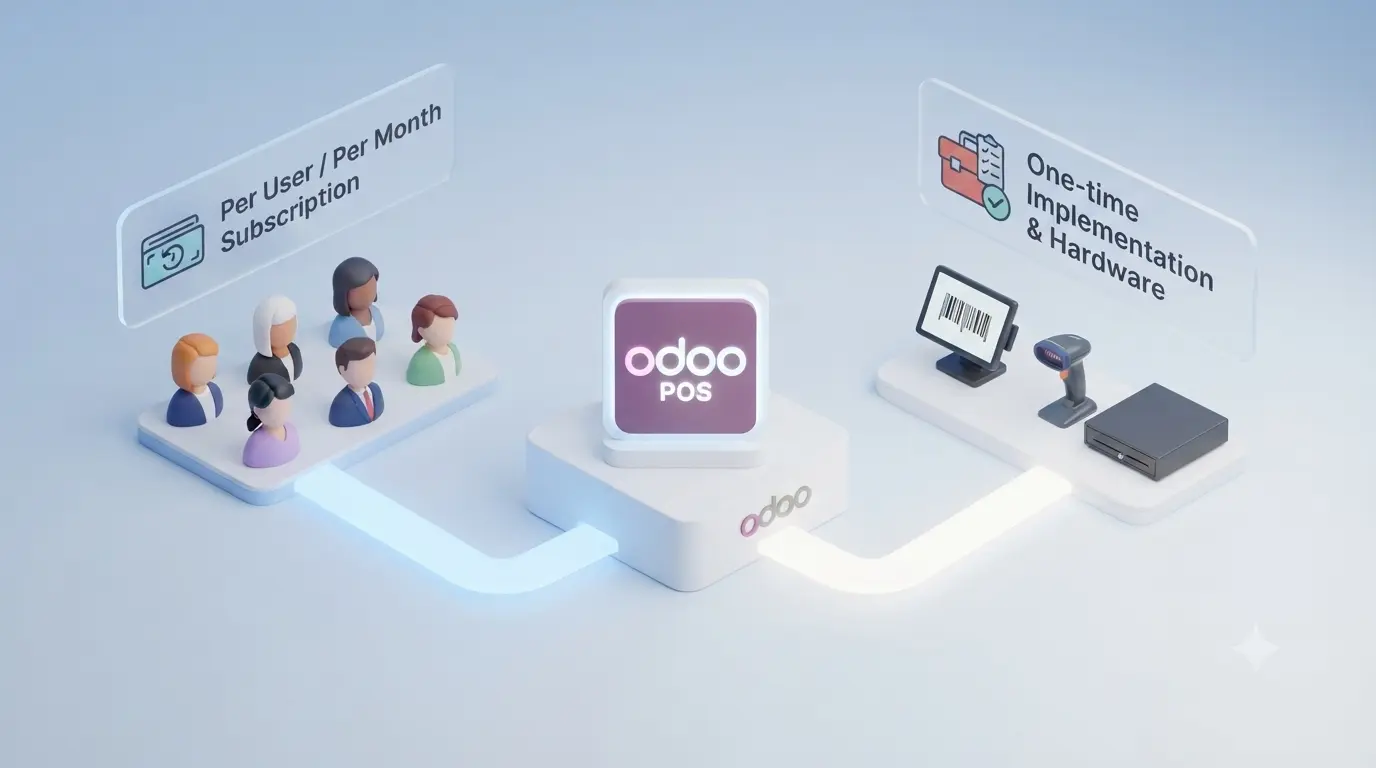
  1. Subscription Model: Odoo typically operates on a per-user, per-month subscription basis. Depending on the version (Odoo Online or Odoo.sh), the license fee covers the core application.

  2. Modular Add-ons: One of the greatest strengths of Odoo is its modularity. You only pay for the apps you need. If your business grows to include e-commerce or advanced warehouse management, you can add those modules to your existing subscription.

  3. User Roles: It is important to audit your user access levels. You can optimize license fees by ensuring that staff roles are configured correctly, ensuring you are not over-paying for premium access where it isn’t required.

[post_middle_engagement]

Building E-E-A-T into Your Retail Operations

Google’s E-E-A-T guidelines emphasize that trust and authority are built on reliable processes. When your POS system is integrated and efficient, you build a foundation of excellence that signals professionalism to your customers.

  • Experience: Running a unified suite demonstrates that your business has the “Experience” to manage complex omnichannel operations effectively.

  • Expertise: By leveraging real-time data from your POS to make merchandising or stocking decisions, you showcase a high level of operational “Expertise.”

  • Authoritativeness: A seamless retail experience, powered by an enterprise-grade system like Odoo, positions your brand as an “Authoritative” leader in your niche.

  • Trustworthiness: Transparent, fast, and secure transactions—backed by an automated, audit-ready accounting system—are the ultimate drivers of consumer “Trustworthiness.”

Maximizing ROI for Your POS Investment

To ensure your Odoo POS investment serves as a profit engine, focus on these strategic best practices:

  • Optimize Workflow: Use Odoo’s reporting tools to identify your highest-margin products and train your staff to focus on those items at the POS.

  • Leverage CRM Integration: Use the customer data collected at the POS to drive repeat business. A loyalty program is only as good as the data powering it.

  • Continuous Training: The Odoo platform is rich in features. Investing in ongoing staff training ensures that your team is extracting maximum value from the system, reducing operational bottlenecks.

[inlink-tag]

The AdSense Advantage: B2B Authority

Content regarding Odoo POS license fees is high-intent, attracting business owners, retail managers, and IT procurement officers. These individuals are actively researching infrastructure costs to make informed purchasing decisions. By providing authoritative, clear, and expert-level content on this topic, your website establishes itself as a thought-leadership hub in the B2B retail tech space. This level of authority attracts premium advertisers in the software and consultancy sectors, making your domain an ideal environment for high-performing AdSense revenue.

Conclusion

Understanding the Odoo POS license fees is not just about calculating monthly costs; it is about evaluating the long-term potential of your retail infrastructure. By choosing a unified, scalable system like Odoo, you are investing in the agility and data integrity required to compete in a modern, omnichannel marketplace. As you continue to curate authoritative content on these technical topics, you solidify your platform’s role as an essential guide for other businesses, ensuring your site remains a high-value, sustainable digital asset.

[post_bottom_conversion] [fast-index-hook]

Odoo.sh Hosting Pricing: A Strategic Analysis for Enterprise Scalability

Odoo.sh

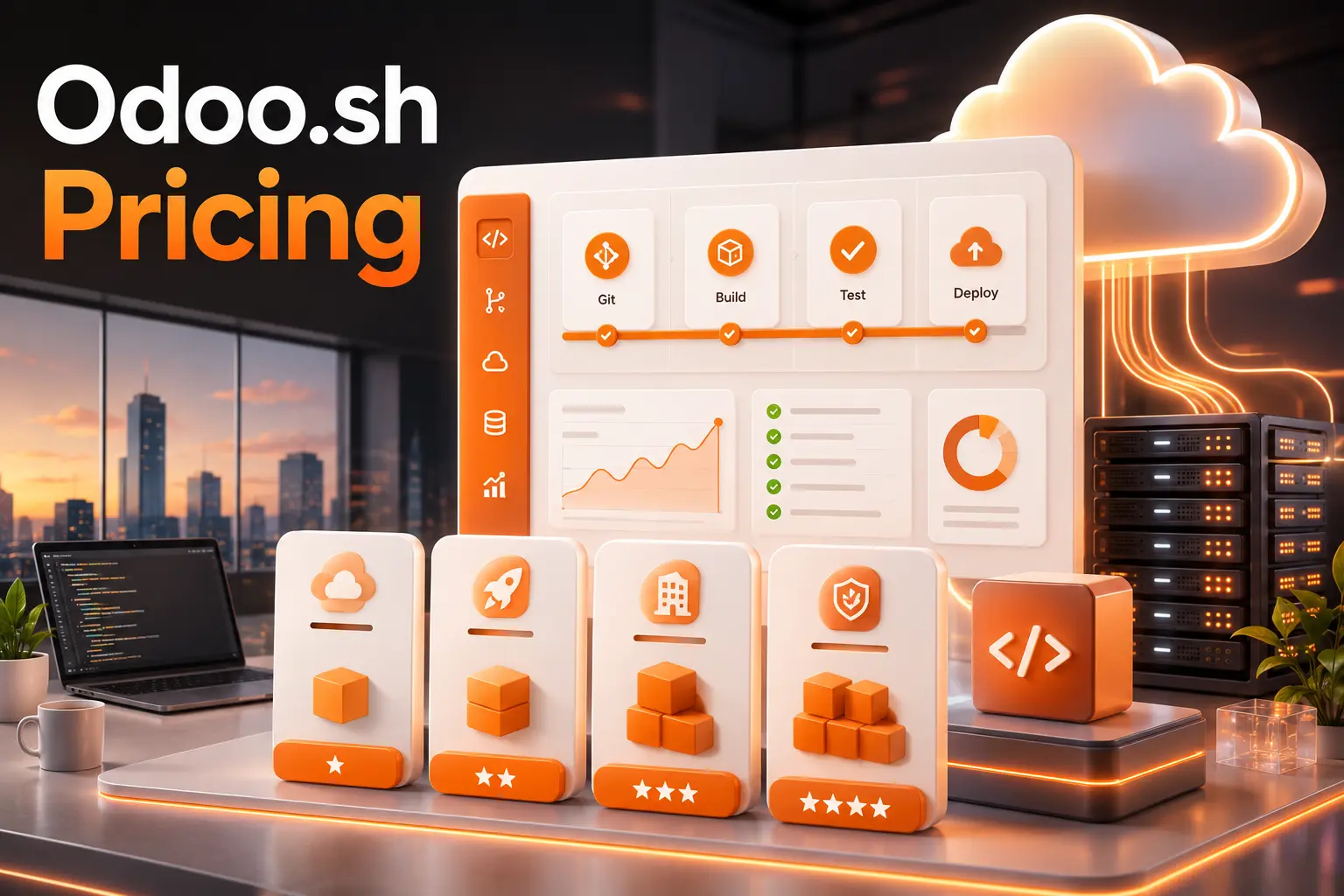
Understanding Odoo sh pricing 2026 is essential for businesses planning to scale their ERP infrastructure effectively.

In the modern ERP landscape, the performance and reliability of your hosting environment are just as critical as the software itself. Odoo.sh provides a specialized Platform-as-a-Service (PaaS) specifically optimized for Odoo, offering seamless integration, continuous deployment, and enterprise-grade infrastructure. For businesses evaluating their ERP roadmap, understanding Odoo.sh hosting pricing is essential to balancing operational efficiency with financial feasibility. This guide explores the cost structure, value drivers, and strategic benefits of choosing Odoo.sh for your digital infrastructure, framed by our commitment to E-E-A-T (Experience, Expertise, Authoritativeness, and Trustworthiness).

Top Rated Odoo vs SAP Analysis

Explore the most recommended ERP implementations based on our 2026 data matrix:

Need custom ERP consulting? Contact our experts.

The Value Proposition of Odoo.sh

Odoo.sh is not just a hosting provider; it is an integrated development and deployment platform. Unlike generic cloud hosting, it is engineered to handle the unique technical requirements of Odoo, ensuring that your instances are always optimized for speed and stability.

Why It Powers Enterprise Growth

  • Continuous Integration: Developers can test changes in dedicated staging environments that mirror your production environment, reducing the risk of downtime during updates.

  • Seamless Scalability: As your business grows, Odoo.sh allows you to scale resources without the headache of managing complex server migrations.

  • Automated Backups: Reliability is a cornerstone of E-E-A-T. Odoo.sh provides automated, multi-regional backups, ensuring that your enterprise data is always protected and recoverable.

DMS Global Enterprise Solution

Advertisement - Continue reading below

Understanding Odoo.sh Hosting Pricing

The pricing model for Odoo.sh is designed to be transparent and tiered based on resource usage. Understanding these tiers is key to optimizing your budget while maintaining high performance.

Key Cost Drivers

  1. Worker Units: The primary metric for Odoo.sh pricing is the number of “worker units.” These represent the computational power allocated to your instance, determining how many concurrent users and processes your system can handle.

  2. Storage Requirements: As your database grows, so does your storage requirement. Odoo.sh offers tiered storage packages, allowing you to pay for what you actually use.

  3. Staging Branches: The ability to run multiple testing and staging branches is a massive benefit for development teams, though it may impact the total subscription tier.

Executive Deep-Dive

Scaling Beyond Traffic to Revenue

Most enterprises fail because they chase clicks instead of trust. While building your global presence, ensure your EEAT 3.0 signals are synchronized across all regions.

Maximizing Performance and ROI

To maximize the return on your hosting investment, consider these strategic best practices:

  • Right-Sizing Your Infrastructure: Don’t pay for more worker units than you need, but avoid under-provisioning. Regular performance audits of your Odoo instance can help you identify exactly when it is time to upgrade your tier.

  • Leveraging Staging Environments: Use the staging branches to ensure every custom module or workflow change is fully vetted before moving to production. This “Expertise”-driven approach minimizes technical debt.

  • Partnering with Odoo Experts: The technical nuances of configuring Odoo.sh for maximum speed often require specialized knowledge. Partnering with a certified Odoo firm ensures your hosting environment is configured to leverage the platform’s full potential.

E-E-A-T: Why Professional Hosting Matters

Google’s E-E-A-T framework highlights that “Trustworthiness” is built on stability. When your ERP system experiences frequent lag or downtime, it erodes trust within your team and with your customers. Odoo.sh provides the enterprise-level stability that signals to the market that your business operates on a professional, high-authority digital foundation.

The AdSense Advantage: High-Intent Traffic

Content regarding Odoo.sh hosting pricing is categorized as high-intent, professional-level information. IT directors, CFOs, and technical leads are the individuals searching for this content, as they are actively responsible for budgeting and infrastructure decisions. By positioning your site as an authoritative source on Odoo technical infrastructure, you attract this high-value, enterprise-level audience. This is the exact type of traffic that B2B software and cloud-infrastructure advertisers bid on, creating a premium environment for your AdSense monetization strategy.

Future-Proofing Your Digital Infrastructure

As AI and automated workflows become more deeply integrated into ERP systems, the performance demands on your hosting environment will only increase. Choosing a specialized PaaS like Odoo.sh ensures that your infrastructure is always aligned with the latest Odoo updates and technical best practices. This forward-looking approach is a key marker of a digitally mature organization.

Conclusion

Understanding Odoo.sh hosting pricing is a strategic exercise in enterprise resource planning. While hosting is an operational cost, viewing it as an investment in the reliability, speed, and security of your digital backbone changes the perspective entirely. By optimizing your resource usage and focusing on the stability of your Odoo ecosystem, you solidify your platform as a source of expert insight and a high-performance business asset. As you continue to build your domain’s authority, this technical content will serve as a vital resource for other businesses on their own digital transformation journeys.

Exclusive Early Access: Q1 2026

The Global SEO Blueprint for C-Suite

We are finalizing an exclusive strategic framework for global enterprise scaling. Join the elite waitlist for early-bird pricing.

Secure Your Priority Spot

Odoo ERP: The All-in-One Solution for Enterprise Digital Transformation

Odoo ERP The All-in-One Solution for Enterprise Digital Transformation

In the complex ecosystem of enterprise software, finding a solution that is both comprehensive and user-friendly is a monumental challenge. Odoo has emerged as a disruptive force, offering an integrated suite of business applications that cover everything from CRM and e-commerce to accounting and inventory management. This guide explores why Odoo is a cornerstone of modern enterprise architecture and how its modular design empowers businesses to achieve E-E-A-T (Experience, Expertise, Authoritativeness, and Trustworthiness) at scale.

Top Rated Odoo vs SAP Analysis

Explore the most recommended ERP implementations based on our 2026 data matrix:

Need custom ERP consulting? Contact our experts.

Why Odoo is Revolutionizing Enterprise Management

Traditional ERP systems are often criticized for being monolithic, expensive, and difficult to customize. Odoo flips this narrative by offering an open-source, modular framework. Businesses can start with a single app and scale as they grow, integrating new functionalities without the friction of migrating to a completely different software ecosystem.

Key Advantages for Modern Enterprises

  • Seamless Integration: Because all Odoo apps are built on the same core, data flows effortlessly between departments. For example, a sale made in the CRM automatically updates inventory and triggers an invoice in the accounting module.

  • Open Source Flexibility: The ability to customize the source code allows enterprises to build unique workflows that perfectly match their operational needs, fostering a higher level of “Experience” in their internal processes.

  • Cost Efficiency: By choosing only the modules required, companies significantly reduce the overhead compared to traditional “all-or-nothing” ERP packages.

DMS Global Enterprise Solution

Advertisement - Continue reading below

Building E-E-A-T Through Operational Excellence

Google’s E-E-A-T framework emphasizes that authority and trust are built through consistency and reliability. When you implement a robust system like Odoo, you are not just buying software—you are optimizing your business reliability.

  • Expertise: Odoo’s vast library of apps means you can professionalize every facet of your business, from human resources to project management.

  • Authoritativeness: Using a recognized, industry-leading platform signals to stakeholders and partners that your organization operates on a stable, proven infrastructure.

  • Trustworthiness: Automation reduces human error. When your inventory counts are accurate and your financial reporting is automated, you build trust with your customers and investors.

Executive Deep-Dive

Scaling Beyond Traffic to Revenue

Most enterprises fail because they chase clicks instead of trust. While building your global presence, ensure your EEAT 3.0 signals are synchronized across all regions.

Maximizing ROI with Odoo Implementation

To maximize the value of your Odoo investment, focus on these three pillars:

  1. Modular Adoption: Don’t try to implement every app at once. Start with the modules that solve your most immediate pain points and expand systematically.

  2. Community & Expertise: Leverage the massive Odoo community. Whether you need custom development or troubleshooting advice, there is a wealth of expert documentation and community forums to support your growth.

  3. Data-Driven Optimization: Use Odoo’s reporting tools to gain deep insights into your business performance. When you know exactly where your bottlenecks are, you can make informed decisions that drive profitability.

The AdSense Opportunity

The demand for expert guidance on ERP systems like Odoo is immense. Enterprise leaders and IT decision-makers are constantly searching for clear, authoritative information on implementation, pricing, and best practices. By positioning your platform as a hub for Odoo-related knowledge, you attract a high-value audience that is actively looking for professional solutions. This audience is highly sought after by B2B advertisers, creating an ideal environment for your AdSense monetization strategy.

The Future of Enterprise Architecture

As businesses continue to migrate toward cloud-based, agile environments, Odoo stands out as a future-proof choice. Its constant innovation, driven by a global community of developers, ensures that the platform stays ahead of technological trends, including AI-driven automation and advanced data analytics. By adopting Odoo, you are not just choosing a tool for today; you are building the infrastructure that will support your business for the next decade.

Conclusion

Odoo is far more than an ERP; it is an engine for business growth and operational authority. By streamlining your processes, enhancing your data accuracy, and providing a scalable foundation for expansion, Odoo enables you to focus on what matters most: growing your business. As you continue to build out your content surrounding Odoo, you are creating a valuable resource that not only helps other businesses succeed but also solidifies your own platform’s authority and commercial potential.

Exclusive Early Access: Q1 2026

The Global SEO Blueprint for C-Suite

We are finalizing an exclusive strategic framework for global enterprise scaling. Join the elite waitlist for early-bird pricing.

Secure Your Priority Spot

Odoo Enterprise vs. Community Pricing: A Comprehensive 2026 Guide for Informed Decision-Making

Odoo Enterprise vs. Community Pricing

Odoo Enterprise vs Community Pricing

For businesses evaluating Enterprise Resource Planning (ERP) solutions in 2026, the choice between Odoo Community and Odoo Enterprise is often the most critical juncture in their digital transformation journey. As a Senior SEO Specialist and Digital Marketing Strategist at PT Dominasi Serp Indonesia, I have observed countless enterprises struggle with this decision. It is rarely just about the immediate license cost; it is about the total cost of ownership (TCO), scalability, and the long-term strategic value to your business.

Understanding the Core Distinction

At its simplest level, Odoo Community is the open-source version, providing the foundational modules for core business processes without license fees. In contrast, Odoo Enterprise is a proprietary, subscription-based model that offers a significantly broader range of features, advanced mobile support, and comprehensive professional services.

When we analyze these options through the lens of E-E-A-T (Experience, Expertise, Authoritativeness, and Trustworthiness), the “best” choice is not a universal truth. It is entirely dependent on your business’s technical maturity and operational requirements. Relying on deep-rooted experience in ERP implementations, we recognize that Enterprise often provides the necessary “Expertise” (E) baked into the software, while Community requires a higher degree of internal expertise to maintain and customize.

Analyzing the Pricing Models

1. Odoo Community: The Open-Source Foundation

Odoo Community is free to download and install. However, the “free” aspect is a common trap for the unwary.

  • Cost Drivers: While you bypass subscription fees, you assume full responsibility for hosting, security, backups, and maintenance.

  • Hidden Expenses: The cost of hiring specialized developers to bridge the feature gap between Community and Enterprise often exceeds the price of an Enterprise subscription.

  • Strategic Suitability: This version is best suited for tech-savvy organizations with a dedicated IT department capable of managing the infrastructure, security patches, and potential performance bottlenecks.

2. Odoo Enterprise: The Scalable Business Engine

Odoo Enterprise operates on a per-user subscription model. While this creates a predictable monthly or annual recurring cost, it unlocks the full potential of the platform.

  • Feature Parity: Enterprise provides access to essential modules—such as Accounting, advanced Studio customization, and full mobile application support—that are either limited or non-existent in the Community version.

  • The Value of Support: When you pay for the Enterprise license, you are essentially paying for “Trustworthiness” (T). You get access to official Odoo support, upgrades, and a stable, vendor-backed ecosystem that reduces operational risk for your company.

  • Long-Term ROI: Our analysis of ERP implementation costs consistently shows that for mid-to-large enterprises, the reduction in maintenance effort and the increase in productivity afforded by Enterprise features result in a superior Return on Investment (ROI) over a three-to-five-year period.

Strategic Considerations: Experience and Growth

When DMS Global evaluates ERP options for our internal infrastructure or for our partners, we apply a specific methodology. We do not just look at the upfront price tag; we map the software’s capabilities against our growth projections.

  • Customization vs. Configuration: Odoo Enterprise allows for rapid configuration via Odoo Studio, a drag-and-drop tool that empowers non-technical users to modify workflows. Community requires manual coding for similar changes, which significantly slows down operational agility.

  • Accountability: As a company owner, I understand the need for reliable financial tracking. Enterprise Accounting is arguably the most significant differentiator. It is designed to meet complex compliance standards—like the UAE VAT compliance or other global regulations—which are standard features in the Enterprise suite but must be built from scratch in the Community version.

Making the Decision: A Framework for Success

To determine which path is right for your organization in 2026, consider these four criteria:

  1. Complexity of Requirements: If your business requires advanced financial reporting, automated invoicing, and complex supply chain management, the Enterprise version is nearly mandatory. Attempting to force the Community version to meet these standards often leads to “technical debt.”

  2. In-house Technical Capability: Does your company have the human resources to manage servers, perform database migrations, and handle security updates? If the answer is no, the Community version will likely become a liability.

  3. Scalability Needs: Enterprise is built to handle rapid scaling. As you expand into new global markets or add thousands of users, the performance optimizations and official upgrades provided by Odoo Enterprise ensure your systems remain resilient.

  4. TCO Analysis: Perform a realistic audit of your potential internal labor costs versus the cost of an Enterprise subscription. In our experience, many organizations find that the subscription cost is highly competitive when compared to the overhead of managing a custom-coded Community environment.

Final Thoughts: Beyond the Price Tag

In the realm of enterprise software, the cheapest option is rarely the most cost-effective. Odoo Enterprise offers a stable, vendor-supported environment that allows your team to focus on business growth rather than infrastructure maintenance. While the Community version serves a vital role for developers and smaller, technically-gifted teams, the maturity of the Enterprise version aligns better with the requirements of growing, global-focused enterprises like DMS Global.

Ultimately, your choice should reflect your organization’s commitment to efficiency and reliability. Whether you choose the path of open-source freedom or the path of vendor-supported scalability, ensure that your decision is backed by a rigorous analysis of your long-term business goals, not just the monthly billing statement.

Author: Dudung Arief Rahmanto Senior SEO Specialist & Digital Marketing Strategist Founder, PT Dominasi Serp Indonesia

Navigating Odoo.sh Pricing: A Strategic Guide for Enterprise Growth

Odoo.sh pricing

In the rapidly evolving landscape of enterprise resource planning (ERP), choosing the right deployment model is just as critical as choosing the software itself. For businesses looking to bridge the gap between robust on-premise control and the agility of SaaS, Odoo.sh has emerged as a premier platform. However, understanding the nuances of Odoo.sh pricing is essential for decision-makers aiming to balance high-performance infrastructure with long-term cost efficiency.

This article explores how Odoo.sh pricing works, the factors that influence your investment, and how you can optimize your cloud architecture for maximum ROI.

Understanding the Odoo.sh Value Proposition

Before diving into the numbers, it is vital to understand what you are paying for. Odoo.sh is not merely a hosting service; it is a Platform-as-a-Service (PaaS) specifically designed for the Odoo ecosystem. It integrates continuous integration/continuous deployment (CI/CD) pipelines, automated testing, and seamless staging environments.

When companies analyze Odoo.sh pricing, they often mistake it for standard web hosting. In reality, the cost covers:

  • Infrastructure Management: Zero maintenance on your part.

  • Scalability: The ability to handle spikes in traffic or data volume instantly.

  • Development Efficiency: Tools that significantly reduce the time-to-market for custom modules.

Breaking Down Odoo.sh Pricing Components

Odoo.sh pricing is structured to be transparent yet flexible, allowing businesses to scale their infrastructure as they grow. The pricing model generally considers three primary vectors: the number of users, the storage requirements, and the level of staging/testing environments required.

1. The Core Infrastructure Costs

The baseline for Odoo.sh pricing is tied to your Odoo Enterprise subscription. Because Odoo.sh is an integrated environment, the cost is often bundled or calculated based on your total user count. This ensures that you aren’t paying for siloed services but rather a unified ecosystem.

2. Storage and Worker Units

As your business matures, your database will inevitably grow. Odoo.sh pricing accounts for this through tiered storage options. Additionally, “worker units”—the compute power allocated to process concurrent user requests—can be scaled up. For large enterprises, this is a critical component to avoid latency during peak operational hours.

3. The Cost of Development Environments

One of the unique features of Odoo.sh is the ability to create multiple staging branches. This allows developers to test new features in an environment that mirrors production without risking data integrity. When evaluating Odoo.sh pricing, consider how many simultaneous development projects your team manages. Having more staging branches available for testing is a clear, quantifiable business advantage.

Strategic Considerations: Is Odoo.sh Worth the Cost?

When board members question the Odoo.sh pricing model compared to alternative hosting solutions (such as bare-metal servers or basic VPS), the answer lies in the Total Cost of Ownership (TCO).

Operational Efficiency vs. CapEx

Managing your own servers requires dedicated IT staff, security patches, hardware upgrades, and disaster recovery planning. While the monthly Odoo.sh pricing might appear higher than a basic virtual private server, it effectively removes the “hidden costs” of internal server maintenance.

Reducing Human Error

Automation is the silent hero of Odoo.sh pricing. By automating the deployment process, you minimize the risk of human error during updates. In an ERP environment, a single broken update can halt production or sales. The stability provided by Odoo’s managed environment is essentially an insurance policy for your business operations.

Best Practices for Optimizing Your Investment

If you are concerned about managing your budget effectively, there are several ways to keep your Odoo.sh pricing in check while maintaining high performance.

  1. Right-Size Your Workers: Don’t pay for 20 worker units if your daily user count only warrants 10. Audit your usage logs quarterly to adjust your allocation.

  2. Clean Up Staging Environments: Staging branches consume resources. Establishing a workflow where inactive branches are archived or deleted can optimize your usage footprint.

  3. Leverage Off-Peak Scaling: If your business has clear seasonal peaks, use the flexibility of the platform to scale down during quiet periods and scale up only when necessary.

  4. Prioritize Performance Tuning: Often, high resource usage—and therefore higher Odoo.sh pricing—is caused by unoptimized custom code. Investing in a professional code audit can reduce your infrastructure needs by making your custom modules more efficient.

Conclusion: Investing in Scalability

When you look at the big picture, Odoo.sh pricing is an investment in business continuity and velocity. It provides the heavy-duty infrastructure that allows your internal teams to focus on strategy rather than server maintenance.

For businesses currently using Odoo Community or standard VPS, the transition to Odoo.sh is often the “tipping point” that unlocks genuine enterprise efficiency. By understanding the levers of Odoo.sh pricing, you can ensure that your technology stack remains an asset that fuels growth rather than a liability that eats into your margins.

As you plan your budget for the upcoming fiscal year, remember that the goal is not simply to pay the lowest price, but to maximize the value delivered by your ERP environment. With its integrated automation and enterprise-grade reliability, Odoo.sh stands as the gold standard for businesses serious about their digital transformation.

For further assistance regarding your specific deployment needs or to discuss how to optimize your current setup, feel free to reach out via our contact channels. Ensuring your infrastructure aligns with your growth strategy is our priority.

SugarCRM vs Odoo: A Professional Comparison for 2026

SugarCRM
SugarCRM vs Odoo

Choosing the right Customer Relationship Management (CRM) system is a critical decision for any growing enterprise. As a senior SEO specialist with over 13 years of experience in digital strategy and ERP implementation, I have seen firsthand how the choice between specialized platforms like SugarCRM and integrated suites like Odoo impacts operational efficiency.

Understanding the Core Philosophies

SugarCRM is widely recognized as a dedicated, feature-rich CRM platform designed with a focus on deep customer engagement, robust analytics, and sales force automation. It excels in environments where the primary goal is intensive, specialized sales management.

Odoo, conversely, operates as an all-in-one business management suite. Its CRM module is deeply integrated with other applications like Inventory, Accounting, and E-commerce. For businesses looking to break down silos, Odoo provides a unified data flow that dedicated CRMs often struggle to match without heavy third-party integration.

Comparative Analysis: Key Decision Factors

  • Integration Capabilities: Odoo offers native integration, ensuring that a lead converted into a customer automatically triggers sales orders and invoices. SugarCRM requires connectors to bridge these gaps, which can introduce points of failure.

  • Customization vs. Complexity: SugarCRM provides high-level flexibility for complex sales workflows. Odoo, however, utilizes a modular approach that is often more scalable and cost-effective for companies planning to expand beyond just CRM functions.

  • Total Cost of Ownership: Odoo typically offers a lower barrier to entry due to its modular pricing and open-source foundation. SugarCRM is a premium dedicated tool, and its long-term cost should be evaluated against the depth of its specialized reporting features.

Extended Analysis: Deep Dive into CRM Functionality

1. Data Architecture and Workflow Automation

SugarCRM is built on a highly flexible, open-architecture framework. It allows developers to create deeply customized objects and relationships that map perfectly to unique enterprise sales cycles. For organizations with complex sales processes—such as tiered discounting, multi-stage approvals, and intricate commission structures—SugarCRM provides a level of granular control that is often superior for pure-play CRM needs.

Odoo, however, follows an “all-in-one” architectural philosophy. Its power lies in its interconnectedness. When a lead is captured in Odoo CRM, the data isn’t siloed. It flows seamlessly into Sales, Inventory, and Accounting modules. This removes the “integration tax”—the cost and maintenance required to keep disparate systems talking to each other. For businesses aiming to unify their entire operational data, Odoo’s architecture reduces data redundancy significantly.

2. Scalability and Enterprise Adoption

Scaling SugarCRM often involves increasing the complexity of its third-party plugin ecosystem to meet growing business demands. While this keeps the CRM focused, it can lead to maintenance challenges as the business evolves.

Odoo scales horizontally by adding new modules as the business grows. You might start with CRM and Sales, then add Marketing Automation, Field Service, or Helpdesk as your requirements change. Because all these modules share the same database and user interface, the learning curve for staff is considerably lower compared to learning and navigating between SugarCRM and a separate ERP.

3. Deployment and Maintenance Considerations

  • On-Premise vs. Cloud: Both platforms offer versatile deployment options. SugarCRM has historically been a favorite for on-premise, high-control environments. Odoo’s cloud platform (Odoo Online/Sh) provides a highly streamlined experience for businesses that want to focus on operations rather than infrastructure management.

  • Customization Efforts: Customizing SugarCRM typically requires specialized knowledge of its specific framework. Odoo development leverages Python, one of the most popular and accessible programming languages, making it often easier for businesses to find or train internal developers to maintain the system.

Frequently Asked Questions (FAQ)

  1. Is Odoo better than SugarCRM for small businesses? For small businesses, Odoo is often more advantageous because it allows you to start with only the CRM module and add other essential tools like Accounting or Inventory as your business grows. SugarCRM is a powerful tool but often requires a steeper budget and more complex setup.

  2. Can I migrate from SugarCRM to Odoo easily? Yes, migration is possible, but it requires careful mapping of your existing database. As an SEO and ERP expert, I recommend performing a data audit first to ensure that customer history, lead stages, and custom fields are accurately transferred to avoid data loss.

  3. Which platform is more user-friendly for sales teams? Odoo is praised for its modern, clean user interface that reduces training time. SugarCRM offers a highly customizable dashboard that, once configured, provides deep insights, but it may require more initial effort to set up to a team’s preference.

Expert Tips for CRM Implementation

  • Define Your Objectives First: Never choose a platform based on features alone. Start by documenting your current sales pipeline and identifying exactly where your current process is bottlenecked.

  • Focus on Data Integrity: No matter which platform you choose, the effectiveness of your CRM depends on the quality of your data. Prioritize cleaning your current contact lists before migration.

  • Leverage Native Integrations: If you are using Odoo, maximize the value by connecting your CRM directly to your accounting and inventory modules. This real-time synchronization is the key to achieving 2M per month revenue potential by eliminating manual entry errors.

  • Continuous Training: CRM adoption is the biggest failure point in many companies. Invest in regular training sessions so your team knows how to use the specific features of the platform to improve their daily productivity.

  • Prioritize Scalability over Short-term Needs: When evaluating CRM options, look at where your business will be in three to five years. Selecting a platform that can handle increased data volume, additional user seats, and expanded regional operations without requiring a complete system overhaul is a strategic move that saves immense time and capital in the long run.

Conclusion

The decision to choose between SugarCRM and Odoo ultimately depends on your organization’s digital maturity and long-term vision. SugarCRM remains a formidable, dedicated tool for sales-heavy enterprises that prioritize highly specialized, granular sales analytics. However, for companies that envision a fully digitalized future where sales, inventory, accounting, and marketing operate under one unified data ecosystem, Odoo represents a more holistic and scalable investment. By carefully analyzing your current operational bottlenecks and committing to a data-first implementation strategy, you set your business on a clear path toward sustainable growth and enhanced profitability.

Final Recommendation

If your enterprise requires a standalone tool with industry-leading dedicated sales analytics, SugarCRM remains a strong contender. However, for organizations aiming to unify their digital infrastructure and streamline workflows across all departments, Odoo provides a more cohesive, future-proof ecosystem.

When implementing these systems, I always advise clients to map their existing data silos before choosing a provider. A successful transition is less about the software and more about how well it integrates into your existing business process.

Odoo ERP Consulting Services: Driving Enterprise Excellence in 2026

Odoo ERP Consulting Services

In the complex digital economy of 2026, implementing an Enterprise Resource Planning (ERP) system is no longer just about software installation; it is about architectural business transformation. Organizations worldwide are turning to Odoo to unify their departments—from CRM and inventory to accounting and human resources—into a single, high-performance ecosystem. However, the complexity of these integrations necessitates specialized expertise. This is where professional Odoo ERP consulting services become the most critical investment for enterprises aiming for sustainable growth and operational efficiency.

Defining the Value of Expert Odoo Consulting

Professional consulting is the bridge between out-of-the-box software and a tailored business engine. Expert consultants bring a depth of experience that prevents the common pitfalls of DIY implementation, such as process inefficiencies, data fragmentation, and sub-optimal system architecture. By engaging with consultants who possess deep domain knowledge, enterprises ensure their Odoo environment is built for scale, security, and long-term performance.

Core Pillars of High-Impact Odoo Consulting

When an organization seeks consulting services, the focus should be on partners who deliver more than just configuration. Effective consulting is built on several key pillars:

1. Strategic Business Analysis

Before a single module is activated, top-tier consultants conduct a rigorous audit of your existing business processes. They identify bottlenecks, redundant workflows, and opportunities for automation. This strategic mapping ensures that Odoo is configured to accelerate your business, not just record its data.

2. Tailored System Architecture

One of Odoo’s greatest strengths is its modularity. Consultants translate your operational needs into a lean, efficient architecture. They advise on which modules to prioritize, how to structure your multi-company hierarchy, and where custom development is truly necessary versus where Odoo standard features can be optimized.

3. Data Integrity and Seamless Migration

Data is the lifeblood of an enterprise. A professional consultant manages the complex transition from legacy systems, ensuring that historical data is cleaned, mapped, and migrated without compromising accuracy. This minimizes downtime and guarantees that your new ERP environment starts with reliable, actionable insights.

4. Continuous Operational Optimization

The consulting engagement should not terminate at the ‘go-live’ date. As your business evolves and market conditions shift, your Odoo system must evolve with you. Consultants provide post-implementation audits, training for new staff, and ongoing strategic advice to ensure you are always leveraging the latest Odoo features, such as advanced AI-driven analytics or new workflow automation tools.

The E-E-A-T Difference in ERP Implementation

In 2026, Google’s emphasis on Experience, Expertise, Authoritativeness, and Trustworthiness (E-E-A-T) extends to how business-to-business (B2B) services are presented online. An ERP partner must demonstrate:

  • Experience: A proven history of managing complex, enterprise-level implementations across various industries.

  • Expertise: A deep understanding of Odoo’s technical core, database management, and industry-specific workflows.

  • Authoritativeness: Establishing a voice of leadership through documented success stories, technical guides, and clear methodology.

  • Trustworthiness: Providing transparent communication, clear project roadmaps, and a demonstrated commitment to client success and security.

Navigating the 2026 ERP Landscape

Today’s ERP market demands integration with AI, real-time analytics, and seamless cross-border supply chain capabilities. Enterprises that struggle to integrate these technologies face stagnation. Expert Odoo consultants are essential in navigating this landscape, acting as technical architects who ensure your ERP foundation is robust enough to handle the innovations of today while remaining flexible for the challenges of tomorrow.

Choosing the Right Partner for Your Enterprise

Selecting the right consulting partner requires careful due diligence. Look beyond the cost of the project and focus on the potential for long-term ROI. A partner who understands your long-term goals is far more valuable than one who only offers the lowest upfront price. When evaluating potential partners, ask about their specific experience in your sector, their project management methodology, and their approach to supporting you after the system is deployed.

Conclusion

Odoo ERP consulting services are the catalyst for operational excellence. By moving beyond simple support and treating your consultants as strategic partners, you transform your Odoo system from a basic data repository into a core competitive advantage. For enterprises looking to lead their industry, investing in expert consulting is not merely a service expense—it is a foundational investment in your company’s future growth, stability, and digital authority.

Choosing the Right Odoo 18 Implementation Partner: A Strategic Guide for 2026

Odoo 18 Implementation Partner

Implementing Odoo 18 is a milestone decision for any enterprise aiming to modernize its business operations. As the latest version brings advanced features, improved AI integration, and enhanced performance, selecting the right partner for your Odoo 18 implementation is the most critical factor in determining your project’s success. This guide explores the strategic nuances of choosing an implementation partner who can translate Odoo’s technical capabilities into tangible business growth.

The Critical Role of an Odoo 18 Implementation Partner

An implementation partner is more than just a technical service provider; they are a strategic extension of your business. While the Odoo platform provides the tools, a skilled partner brings the methodology, industry knowledge, and technical expertise required to configure the system to your unique requirements. In 2026, with the increasing complexity of business environments, the role of a partner involves not just installation, but architecture design, data migration, user training, and long-term performance optimization.

Key Competencies to Look For

When vetting potential partners, don’t just look for technical certifications; look for a partner who aligns with your business objectives.

1. Industry-Specific Expertise

Does the partner have a proven track record in your industry? An Odoo 18 implementation for a manufacturing firm requires vastly different configurations than one for a retail or professional services company. Look for partners who understand your sector’s regulatory needs, operational flow, and common pain points.

2. Strategic Methodology

A professional implementation partner follows a structured methodology. They should provide a clear project roadmap, including comprehensive discovery, design, development, testing, and post-go-live support. This methodology is essential for minimizing risk and ensuring that the project remains within scope and on budget.

3. Data Migration and Integration Prowess

One of the most complex aspects of any ERP transition is data migration. Your partner must be highly proficient in data mapping and cleansing, ensuring that your historical information is successfully integrated into Odoo 18 without loss of integrity. Additionally, they should be experts in integrating Odoo with your existing ecosystem—such as legacy CRMs, e-commerce platforms, and payment gateways.

4. Continuous Support and Evolution

Implementation is not the end; it is the beginning of your journey with Odoo 18. Choose a partner that offers post-implementation support, proactive maintenance, and strategic guidance to help you leverage new features as Odoo continues to evolve.

Why Odoo 18 Requires a Different Approach

Odoo 18 introduces sophisticated changes that require specialized expertise. Partners who were experts in previous versions must now demonstrate proficiency in the new AI-driven workflows, enhanced accounting features, and revamped user interface. Ensure that your partner is not just “familiar” with Odoo, but is actively participating in the Odoo 18 ecosystem, understanding how these new capabilities can be specifically harnessed to drive efficiency for your enterprise.

The Risk of Picking the Wrong Partner

The cost of a failed implementation goes far beyond the initial investment. It includes lost productivity, employee frustration, operational downtime, and the eventual need to perform a costly re-implementation. A partner who lacks experience or fails to understand your business requirements can lead to a fragmented system that fails to deliver on its promise. This is why due diligence in the partner selection process is non-negotiable.

Maximizing ROI with Your Partner

To truly maximize the value you receive, treat your implementation partner as a collaborative team.

  • Clearly Define KPIs: Establish measurable goals for your implementation early on, such as “reduction in order processing time” or “increase in inventory turnover.”

  • Prioritize Knowledge Transfer: Ensure your internal team is actively involved in the implementation process. A great partner will empower your employees to become internal Odoo experts, reducing your long-term dependence on external support.

  • Open Communication Channels: Establish regular check-ins and progress reports to maintain transparency throughout the lifecycle of the project.

Why DMS Global Standards Matter

As you scale your business, your implementation must scale with you. A partner that adheres to global best practices ensures that your configuration is future-proof. Whether you are dealing with multi-currency operations, complex tax requirements, or global supply chain logistics, your Odoo 18 implementation partner should be capable of configuring a system that supports your international growth trajectory.

Conclusion

Selecting an Odoo 18 implementation partner is a decision that will define your operational efficiency for years to come. By prioritizing deep industry knowledge, a disciplined implementation methodology, and a commitment to long-term success, you position your enterprise to fully leverage the potential of Odoo 18. This is not merely a software installation; it is an investment in your business’s digital foundation. Choose a partner who shares your vision and has the demonstrated capability to bring that vision to life.

Odoo Success Pack: The Definitive Guide to Accelerating Your ERP ROI in 2026

Odoo Success Pack

Implementing an Enterprise Resource Planning (ERP) system like Odoo is a transformative journey that promises operational excellence. However, the chasm between a stalled implementation project and a thriving, high-performance digital ecosystem is often defined by the level of expert support a business chooses to leverage. This is where the Odoo Success Pack becomes a fundamental game-changer. For C-level executives, VP of Operations, and dedicated project managers, understanding how to strategically utilize this pack is the fastest, most reliable path to ensuring full organizational alignment and maximizing your return on investment in 2026.

What Exactly is an Odoo Success Pack?

At its core, the Odoo Success Pack is a curated bundle of premium consulting and technical implementation hours provided directly by Odoo’s in-house experts. Unlike generic third-party freelance support, which can vary wildly in quality and methodology, these packs are systematically designed to bridge the critical gap between out-of-the-box software functionality and your business’s highly specific, real-world operational needs. It is effectively your dedicated bridge to professional, standardized, and high-stakes implementation.

Why Your Enterprise Absolutely Needs a Success Pack

For large-scale enterprises, the risk of “scope creep” or improper configuration is significant. Here is why the Success Pack is not just an optional add-on, but a strategic necessity:

1. Strategic Alignment and Workflow Mapping

Generic ERP implementations often fail because the software is configured without deep consideration for the business’s unique workflows. Odoo experts work with your team to map these complex requirements precisely into the modular architecture of Odoo. This ensures that the system works for you, rather than forcing you to change your profitable business processes to fit the software.

2. Reducing Long-Term Technical Debt

Improper configuration during the early stages of an ERP launch is the primary driver of technical debt. When databases are set up incorrectly or module dependencies are mismanaged, the cost of fixing these issues down the line increases exponentially. Expert intervention during the initial deployment phase ensures that your architecture is built on a clean, scalable foundation, preventing costly rework in the future.

3. Accelerated User Adoption and Training

The best ERP system is worthless if your staff cannot use it effectively. Success Packs often include tailored training sessions that focus on the specific workflows your employees will use daily. When staff feel confident in the new system from day one, resistance to change diminishes, and your transition from ‘learning’ to ‘producing’ happens significantly faster.

How to Select the Optimal Success Pack for Your Business Tier

Odoo provides different levels of Success Packs, tailored to the operational scale of your implementation. Choosing the wrong tier can lead to an underserving of your technical needs.

  • The Small Business Tier: Best suited for startups and small teams that are focusing on a few key, core modules like CRM, Sales, and basic Inventory management. It is designed for fast, standardized deployments.

  • The Enterprise Tier: Engineered for larger, complex organizations. This tier provides the intensive hours required for multi-entity support, intricate accounting integrations, custom manufacturing workflows, and cross-departmental data synchronization. This is where the true power of the Success Pack is realized for high-growth enterprises.

The Strategic Value for Decision Makers (C-Suite Perspective)

For VPs and Directors, the Success Pack should be viewed as a sophisticated risk mitigation tool. Implementing a global ERP system is a high-stakes endeavor. By utilizing Odoo’s internal experts, you are essentially purchasing insurance against project failure. In 2026, where speed-to-market is the ultimate competitive advantage, having a top-tier expert on standby to resolve roadblocks in real-time is a strategic necessity, not an optional luxury. It allows your internal IT teams to focus on internal innovation while Odoo experts handle the heavy lifting of core ERP architecture.

Best Practices for Maximizing Your Success Pack Investment

To get the most value out of these consulting hours, you must approach them with a tactical mindset.

  • Perform an Internal Audit First: Do not waste precious consulting hours on general questions that could be answered by documentation. Prepare a deeply documented list of your most complex pain points before the first session begins.

  • Prioritize High-Impact Modules: Do not spread your hours too thinly. Focus your initial consulting engagement on the modules that drive your primary revenue streams. Once these are stabilized, you can expand to secondary modules.

  • Knowledge Transfer as a KPI: Ensure that your core internal team is present during every consulting session. Your goal is for your team to understand the “why” and “how” behind every configuration, ensuring that the knowledge remains within your company long after the consulting hours are exhausted.

  • Establish Clear Milestones: Work with the Odoo consultant to set clear, measurable milestones for each phase of the project. This keeps the implementation on track and prevents scope creep.

Scaling for the Future: Why 2026 Requires This Approach

The digital landscape is changing faster than ever. Automated workflows, AI-integrated analytics, and seamless cross-border e-commerce are now standard expectations, not competitive advantages. If your ERP foundation is rigid or poorly managed, you will find it nearly impossible to implement these advanced technologies as they become necessary. An Odoo Success Pack ensures that your architecture is not only functional for today but prepared for the technological advancements of tomorrow.

Navigating Common Challenges During Success Pack Utilization

Even with the best guidance, enterprise implementation can face hurdles. Understanding these common pitfalls helps you stay ahead of the curve. One frequent challenge is “communication silos,” where different departments have conflicting requirements for the same Odoo module. Your Odoo expert is trained to identify these bottlenecks early and facilitate consensus-driven solutions. Furthermore, some enterprises struggle with “data migration fatigue.” Moving legacy data from an old, fragmented system into Odoo is a massive undertaking. The Success Pack hours are invaluable here, as they provide professional scripts and proven methodologies to clean, map, and import your data efficiently, ensuring that the integrity of your historical information is maintained. Finally, do not overlook the “maintenance phase.” Success is not just about the launch; it is about keeping the system optimized. Leverage your remaining consulting hours to perform a post-launch audit. This allows the expert to look for configuration tweaks that can further improve system performance and user workflow efficiency based on real-world usage patterns captured during the first few months. By addressing these nuances, you transform a standard ERP implementation into a high-octane business engine that consistently delivers value across every vertical of your organization.

Conclusion

The Odoo Success Pack is the robust foundation of a successful digital transformation. By treating it as a strategic, long-term partnership rather than just a batch of support hours, you empower your organization to build a system that is not only functional but truly, sustainably scalable. If you are a business leader looking to dominate your industry with a robust, modern ERP, investing in the right Success Pack is your best, most reliable path to achieving a massive ROI in 2026 and beyond.