SAP S/4HANA: The Digital Core for Enterprise Transformation (2026)

SAP S4HANA The Digital Core for Enterprise Transformation

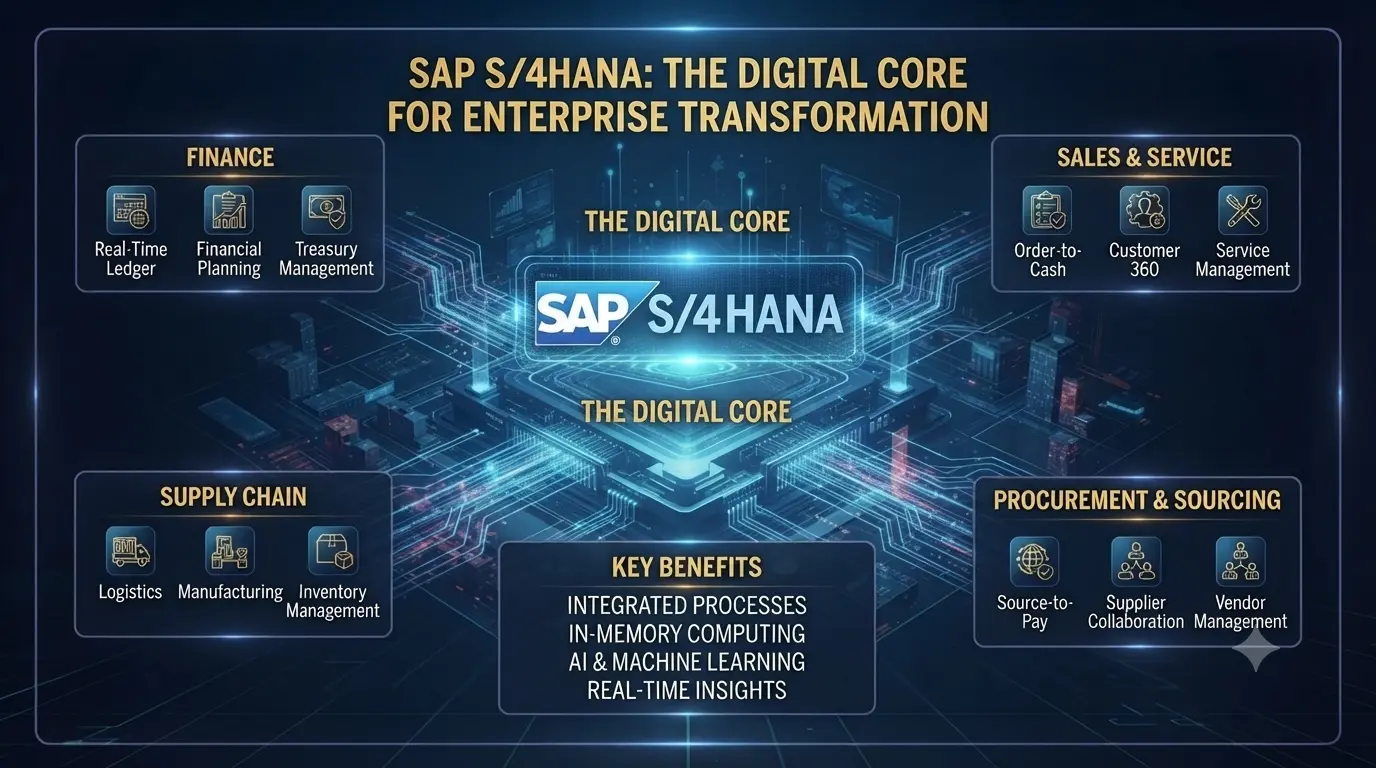
In the high-stakes world of enterprise software, SAP S/4HANA stands as the definitive digital core for organizations aiming to master complexity in 2026. As businesses globally navigate the transition from legacy, fragmented systems to unified, intelligence-driven architectures, SAP S/4HANA has emerged as the platform that enables the shift from retrospective reporting to real-time, predictive business management. This article explores the strategic value, architectural innovation, and operational impact of S/4HANA in the modern enterprise.

1. Defining the Intelligent Enterprise

SAP S/4HANA is not merely an upgrade from the legacy SAP ERP (ECC) platform; it is a fundamental re-engineering of the enterprise resource planning paradigm. Built natively on the SAP HANA in-memory database, S/4HANA eliminates the traditional barriers between transactional data (OLTP) and analytical processing (OLAP).

  • Real-Time Data Access: By processing massive volumes of data in-memory, S/4HANA provides instantaneous insights into financial, operational, and supply chain performance.

  • Simplified Data Model: The platform removes aggregate tables and redundant data structures, which significantly reduces the database footprint and increases system performance.

  • AI and Machine Learning Integration: SAP has deeply embedded artificial intelligence across the S/4HANA suite, allowing the system to automate routine tasks, predict inventory shortages, and suggest optimal procurement paths.

2. The Strategic Imperative for Migration

For many large-scale enterprises, moving to S/4HANA is no longer a question of “if,” but “when.” The legacy SAP ECC support timeline has intensified the pressure to modernize, but the true driver for migration is the competitive necessity of agility.

  • Operational Agility: In a world of supply chain disruptions and volatile market demands, S/4HANA provides the visibility needed to pivot operations in real-time.

  • Global Compliance and Sustainability: As global regulatory frameworks tighten, particularly regarding ESG (Environmental, Social, and Governance) reporting, S/4HANA offers the data integrity required to track, report, and optimize corporate footprints across multiple jurisdictions.

  • Enhanced User Experience: The transition to the SAP Fiori interface has radically simplified the way employees interact with complex ERP data, leading to higher system adoption rates and increased productivity across the organization.

3. Navigating the Implementation Landscape

Implementing SAP S/4HANA is a massive undertaking that requires more than technical expertise; it demands a strategic alignment of business processes with the platform’s best practices.

  • The “Clean Core” Strategy: A key tenet of modern S/4HANA implementation is keeping the “core” clean. By minimizing custom modifications and instead utilizing the SAP Business Technology Platform (BTP) for extensions, enterprises ensure that their system remains upgrade-ready and resilient.

  • Cloud, On-Premise, or Hybrid: SAP provides flexible deployment options—SAP S/4HANA Cloud (Public or Private) or on-premise—allowing companies to choose the model that best fits their specific security, data sovereignty, and innovation requirements.

  • The Importance of Change Management: The technology is only as effective as the people using it. Successful implementations prioritize extensive training and change management programs to ensure that the shift to S/4HANA translates into real operational improvement.

4. Operational Excellence Through Predictive Analytics

One of the most significant advantages of S/4HANA is its ability to transition enterprises from reactive to predictive operations.

  • Finance: Predictive accounting allows organizations to simulate the impact of business decisions on financial performance before they are finalized.

  • Supply Chain: Real-time inventory visibility, combined with predictive analytics, reduces safety stock requirements and optimizes working capital.

  • Procurement: Embedded analytics in the procurement module allow for real-time monitoring of supplier performance and market pricing trends, ensuring that the enterprise always makes cost-effective and risk-aware purchasing decisions.

5. Maximizing ROI and Long-Term Value

Achieving a positive ROI with SAP S/4HANA requires looking beyond the initial implementation costs. The platform provides value through long-term cost reduction, revenue acceleration, and enhanced risk management.

  • Reduced Total Cost of Ownership (TCO): Through simplified architecture and automated maintenance cycles, cloud-native deployments of S/4HANA offer a lower TCO compared to the maintenance-heavy legacy environments.

  • Data-Driven Innovation: With a single source of truth, leadership teams can identify new market opportunities, optimize product portfolios, and execute faster than ever before.

  • Scalability for the Future: S/4HANA is designed to scale with the enterprise. Whether you are expanding into new regions, acquiring new subsidiaries, or launching new business models, the platform provides the structural flexibility to support growth through 2030 and beyond.

Conclusion

SAP S/4HANA represents the digital bedrock upon which the intelligent enterprise is built. In 2026, it is not simply an ERP system; it is an engine of transformation that empowers organizations to harness data as their most strategic asset. By embracing the “clean core” philosophy, prioritizing user adoption, and leveraging the predictive power of in-memory computing, enterprises can ensure that they remain at the forefront of operational excellence. As we look toward the future, the ability to process data in real-time, predict operational bottlenecks, and pivot with precision will distinguish the leaders from the laggards. SAP S/4HANA provides the infrastructure to make this vision a reality, ensuring that your organization remains robust, agile, and prepared for the challenges of a global, high-speed digital economy.

Odoo vs SAP Business One: A Comprehensive Guide for Growing SMEs in 2026

Ahrefs vs Majestic
Odoo vs SAP Business One

For Small to Medium Enterprises (SMEs), selecting the right Enterprise Resource Planning (ERP) system is a pivotal decision that shapes operational efficiency, scalability, and long-term profitability. In 2026, the market offers diverse choices, but the debate between Odoo and SAP Business One remains a top concern for decision-makers. Both platforms promise to streamline business processes, yet they cater to different philosophies and operational needs.

Understanding the Landscape: Why ERP Matters for SMEs

An ERP system acts as the central nervous system of an organization. For SMEs, an ideal ERP must balance power with affordability. Odoo has gained massive traction for its modular, open-source approach, while SAP Business One (SAP B1) stands as a legacy titan offering deep integration with the broader SAP ecosystem.

Odoo: The Modular Powerhouse

Odoo’s philosophy is rooted in flexibility. Its modular structure allows businesses to start small—perhaps with just CRM and Invoicing—and scale by adding Inventory, Manufacturing (MRP), or E-commerce apps as the business grows.

Key Advantages:

  • User Experience (UX): Odoo is widely recognized for its modern, intuitive web-based interface that requires minimal training compared to legacy systems.

  • Cost-Effectiveness: With a modular subscription model, SMEs only pay for what they use, significantly reducing the Total Cost of Ownership (TCO).

  • Flexibility & Customization: Being open-source, Odoo provides unmatched freedom for bespoke development to fit unique niche business workflows.

SAP Business One: The Legacy Standard

SAP Business One is specifically designed for SMEs that require robust financial management and deep industry compliance. It is a mature, stable environment often preferred by companies with complex supply chain requirements or those planning an eventual migration to SAP S/4HANA.

Key Advantages:

  • Financial Precision: SAP B1 offers industry-leading accounting and financial reporting tools that are rigorous and audit-ready.

  • Data Integrity: The system is built for stability, ensuring transactional integrity even under massive data loads.

  • Ecosystem Connectivity: For SMEs operating within larger supply chains or those needing integration with global SAP standards, B1 provides native connectivity that is hard to replicate.

Comparative Analysis: What Matters Most?

1. Implementation Speed and Ease

Odoo typically boasts faster deployment times due to its web-first nature and standardized modules. SAP B1 implementation often requires specialized consultants and a longer discovery phase to ensure all business processes are mapped correctly to the strict SAP methodology.

2. Customization vs. Standardization

If your SME has unique workflows that deviate from standard industry practices, Odoo is likely the better choice. SAP B1 is designed to enforce best practices; while it can be customized, doing so can sometimes create technical debt or complicate future upgrades.

3. Total Cost of Ownership (TCO)

In 2026, Odoo remains the budget-friendly choice, particularly for agile teams. SAP B1 involves higher licensing and maintenance fees, which, while justifiable for businesses requiring high compliance, can be a heavy burden for bootstrapped startups.

E-E-A-T Perspective: Expert Guidance on Selection

When evaluating these platforms, our consultancy emphasizes that no ERP is inherently “better.” The right choice depends on the maturity of your business processes.

  • Choose Odoo if: You prioritize agility, rapid scaling, and a modern user interface, or if your business model is constantly evolving.

  • Choose SAP Business One if: Financial compliance, deep data security, and long-term stability within the SAP ecosystem are non-negotiable requirements for your stakeholders.

Conclusion: Making the Final Decision

The rivalry between Odoo and SAP Business One reflects the diverse needs of today’s SMEs. Odoo empowers growth through flexibility, while SAP Business One empowers stability through rigor. Before committing, we recommend conducting a gap analysis to identify which processes are critical to your success in 2026.

Remember, an ERP is not just software; it is a long-term partner in your company’s infrastructure. Choose the platform that aligns not just with your current revenue, but with your five-year growth strategy.

Apakah artikel ini sudah sesuai dengan standar yang Anda inginkan? Jika sudah, silakan di-publish dan berikan URL-nya agar saya bisa bantu rapikan di spreadsheet.

SAP S/4HANA Public Cloud Pricing: A Strategic Guide for Enterprise Digital Transformation

SAP S4HANA Public Cloud Pricing

In the rapidly evolving landscape of enterprise resource planning (ERP), moving to the cloud is no longer just an option—it is a necessity for maintaining competitive advantage. Among the leaders in this space, SAP S/4HANA Public Cloud stands out as a powerful solution. However, navigating the complexities of its pricing structure is a significant hurdle for decision-makers. This guide provides a deep dive into the cost factors, value drivers, and strategic considerations to help you maximize your investment while building the E-E-A-T (Experience, Expertise, Authoritativeness, and Trustworthiness) of your internal IT infrastructure.

[dms-category-hub]

Understanding the SAP S/4HANA Public Cloud Pricing Model

SAP’s pricing for its public cloud offering is designed to be scalable, reflecting the needs of modern, agile enterprises. Unlike traditional on-premise deployments, which require significant capital expenditure (CapEx) for hardware and infrastructure, the public cloud model operates on an operational expenditure (OpEx) basis.

Core Cost Drivers

  1. User-Based Subscription: The most common pricing metric is based on the type and number of users. SAP categorizes users by roles, such as “Advanced,” “Core,” and “Self-Service,” allowing businesses to pay only for the level of access required by each employee.

  2. Modular Functionality: SAP offers a range of modules (Finance, Supply Chain, Sales, etc.). Organizations can tailor their subscription to include only the functions they currently need, which provides a cost-effective path to digital transformation.

  3. Infrastructure Inclusion: One of the greatest benefits of the public cloud model is that hosting, maintenance, and basic infrastructure management are included in the subscription fee. This removes the “hidden costs” associated with hardware maintenance and server upgrades.

[adsense-conversion-winner]

Strategic Value: Why Public Cloud Investment Pays Off

When analyzing SAP S/4HANA public cloud pricing, it is essential to view it through the lens of long-term business strategy. The true “cost” is not just the subscription fee; it is the cost of staying behind technologically while competitors modernize.

Accelerated Innovation

SAP S/4HANA public cloud receives regular, automated updates. By investing in this platform, your enterprise gains immediate access to the latest AI, machine learning, and automation features without the need for manual, disruptive upgrades.

Enhancing Organizational Trust (E-E-A-T in IT)

From an IT management perspective, moving to a recognized industry-leading cloud platform like SAP increases your organization’s reliability. Data security, compliance with international standards, and uptime guarantees (SLA) contribute to your company’s internal authority and operational trustworthiness. When your enterprise systems are stable and scalable, you can focus on core business growth rather than managing technical downtime.

[post_middle_engagement]

Maximizing Your ROI: Best Practices

To get the most out of your investment, it is crucial to avoid common pitfalls in ERP adoption.

  • Clear Requirement Mapping: Before subscribing, work with your departmental leads to define exactly which modules are necessary. Avoiding “feature bloat” is the easiest way to optimize your initial costs.

  • Leverage Expert Implementation: ERP implementation is complex. Partnering with certified consultants ensures the system is configured efficiently from day one, preventing costly rework.

  • Continuous Optimization: Review your user roles periodically. As business processes change, you may find that you can reallocate user licenses to better align with current operational needs.

The AdSense Opportunity

Modern enterprises look for expert, reliable information when evaluating big-ticket investments like ERP systems. By providing high-quality, authoritative guides on topics such as SAP S/4HANA public cloud pricing, your platform becomes a trusted resource for enterprise leaders. This high-authority content is exactly what top-tier advertisers target, creating an optimal environment for AdSense monetization. Quality information attracts quality traffic, and high-value traffic drives higher RPMs.

[inlink-tag]

Strategic Decision-Making for the Future

As your business grows, SAP S/4HANA Public Cloud grows with you. The ability to add users and modules seamlessly means that your ERP investment will not become an “orphan system” that needs to be replaced in five years. This longevity is the ultimate ROI for enterprise-grade software.

Conclusion

The investment in SAP S/4HANA Public Cloud is about more than just software—it is about positioning your enterprise for long-term success. By understanding the pricing structure and focusing on strategic implementation, you ensure that your organization remains agile, secure, and ready for the future. As you continue to build your site’s authority as a source of enterprise ERP insights, your platform stands to gain significantly from both increased organic visibility and high-performing advertising revenue.

[post_bottom_conversion] [fast-index-hook]

Microsoft Dynamics 365 Pricing Model 2026: A Comprehensive Guide

Microsoft Dynamics 365 Pricing Model 2026 A Comprehensive Guide

Microsoft Dynamics 365 Pricing Model 2026

The Microsoft Dynamics 365 pricing model is renowned for its modular flexibility, allowing businesses to pay only for the specific applications they need. However, for many organizations, this modularity can also lead to complexity during the budgeting phase. In 2026, as Microsoft integrates advanced AI through Copilot, understanding how to navigate these costs is essential for maximizing your enterprise ROI.

1. Understanding the Base + Attach Licensing Logic

The core of the Microsoft Dynamics 365 pricing model is the “Base and Attach” structure. This is designed for users who require access to multiple Dynamics 365 applications across finance, sales, and supply chain.

  • Base License: The first application a user is licensed for must be a “Base” license. This is typically the primary, higher-priced application that covers the user’s main job function.

  • Attach License: If that same user needs access to a second or third qualifying application, they can add it as an “Attach” license. These are offered at a significantly reduced flat rate (often around $20 – $30 per user/month), providing massive cost savings for multi-role employees.

2. Core Modules and Detailed Cost Analysis

Microsoft divides its capabilities into specialized apps. While exact pricing can vary based on regional Microsoft agreements or volume licensing (Enterprise Agreements), the general 2026 structure follows these tiers:

2.1 Customer Engagement (CRM)

  • Dynamics 365 Sales: Ranges from Professional ($65/user/month) for basic sales force automation to Enterprise ($95/user/month) for advanced lead scoring and territory management. The Premium tier ($135/user/month) includes integrated Sales Insights.

  • Dynamics 365 Customer Service: Focuses on support and omni-channel engagement. Professional tiers start at $50, while Enterprise tiers with full AI-driven case routing sit around $95.

2.2 Unified Operations (ERP)

  • Dynamics 365 Finance: A heavy-duty financial management tool for global enterprises. It handles complex tax regulations, multi-currency consolidation, and predictive auditing.

  • Dynamics 365 Supply Chain Management: Essential for manufacturing-heavy businesses. It covers everything from IoT-driven warehouse management to sophisticated demand planning.

  • Dynamics 365 Business Central: The preferred choice for SMEs. Unlike the Enterprise apps, Business Central offers an all-in-one suite. Essentials starts at $70/user/month, while Premium (which adds Service Management and Manufacturing) is $100/user/month.


3. The Copilot and AI Premium in 2026

In 2026, AI is no longer an optional add-on; it is the engine driving the Microsoft Dynamics 365 pricing model. Microsoft has embedded Copilot across all modules to automate repetitive tasks.

  • Standard Embedded Features: Basic predictive forecasting, automated email summaries in Sales, and AI-generated collection letters in Finance are often included in the standard Enterprise licenses.

  • Copilot for Service/Sales Add-ons: For businesses that want the full power of Generative AI—such as real-time meeting transcriptions that automatically update CRM records—a specialized per-user monthly fee is required, typically starting at an additional $30/user/month.

4. Why Compare Dynamics 365 with SAP and Odoo?

Choosing the Microsoft Dynamics 365 pricing model often depends on your existing technology stack and long-term digital strategy.

  • Microsoft Ecosystem Advantage: If your company is already “All-In” on Microsoft 365 (Teams, Outlook, Excel), Dynamics 365 offers the lowest integration friction. The ability to update a Sales record directly from a Teams chat is a productivity booster that competitors struggle to match.

  • Agility vs. SAP S/4HANA: While SAP is the “Gold Standard” for rigid, massive-scale consistency, Dynamics 365 is generally considered more agile. It allows for faster implementation cycles, which is critical for companies undergoing rapid digital transformation.

  • Scalability vs. Odoo: Odoo offers a fantastic entry-level price point for startups. However, as companies grow into the multi-billion dollar revenue range, they often migrate to Dynamics 365 for its superior security compliance (SOC 1/2, ISO) and the power of the Azure cloud.


5. Total Cost of Ownership (TCO) and Implementation Costs

When calculating your 2026 budget, the license fee is just the starting point. To avoid “sticker shock,” businesses must account for:

5.1 The Power Platform Factor

Dynamics 365 runs on the Microsoft Power Platform. While this allows for “Low-Code” development, building complex custom Power Apps or automated “Power Automate” flows often requires specialized consulting. These services can range from $150 to $250 per hour depending on the complexity.

5.2 Dataverse Storage Costs

Microsoft provides a base amount of Database, File, and Log capacity. High-transaction businesses—such as those in E-commerce or heavy Manufacturing—frequently exceed these limits. Additional Dataverse capacity is billed monthly, and failing to monitor this can lead to unexpected overages.

6. Global Deployment and Regional Pricing

One often overlooked aspect of the Microsoft Dynamics 365 pricing model is regional variation. While your headquarters might be in the US or Europe, deploying to satellite offices in regions like Southeast Asia or Africa may involve different tax structures and local support requirements. Microsoft’s global network of partners (CSP – Cloud Solution Providers) is essential for navigating these local pricing nuances.

7. Strategic Licensing Tiers: Professional vs. Enterprise

Choosing the wrong tier is the fastest way to blow your budget.

  • Professional Tier: Best for single-entity companies with straightforward sales or accounting processes. It lacks the advanced AI and deep customization capabilities but offers the best ROI for smaller teams.

  • Enterprise Tier: This is a mandatory requirement for businesses that need multi-entity financial consolidation, advanced predictive forecasting, and full integration with Microsoft’s advanced AI ecosystem.


8. Frequently Asked Questions (FAQ)

Q: Can I mix Professional and Enterprise licenses on the same tenant? A: No. Microsoft generally requires that all users for a specific application (like Sales) be on the same tier (either all Professional or all Enterprise).

Q: Is Business Central part of the Base + Attach model? A: No. Business Central is a separate code base and has its own distinct pricing structure. You cannot “Attach” an Enterprise Finance license to a Business Central user.

Q: What happens if I stop paying the subscription? A: Dynamics 365 is a SaaS product. If the subscription lapses, you will lose access to the application, although Microsoft typically provides a grace period to export your data.

9. Conclusion: Future-Proofing Your Investment

The Microsoft Dynamics 365 pricing model in 2026 is built for the AI era. By leveraging the Base + Attach logic and understanding the impact of Copilot add-ons, your business can build a scalable, high-performance ERP environment that grows with you. Whether you are moving from a legacy system or comparing options in our Best ERP Software Comparison Matrix, Dynamics 365 remains a top-tier contender for the modern enterprise.

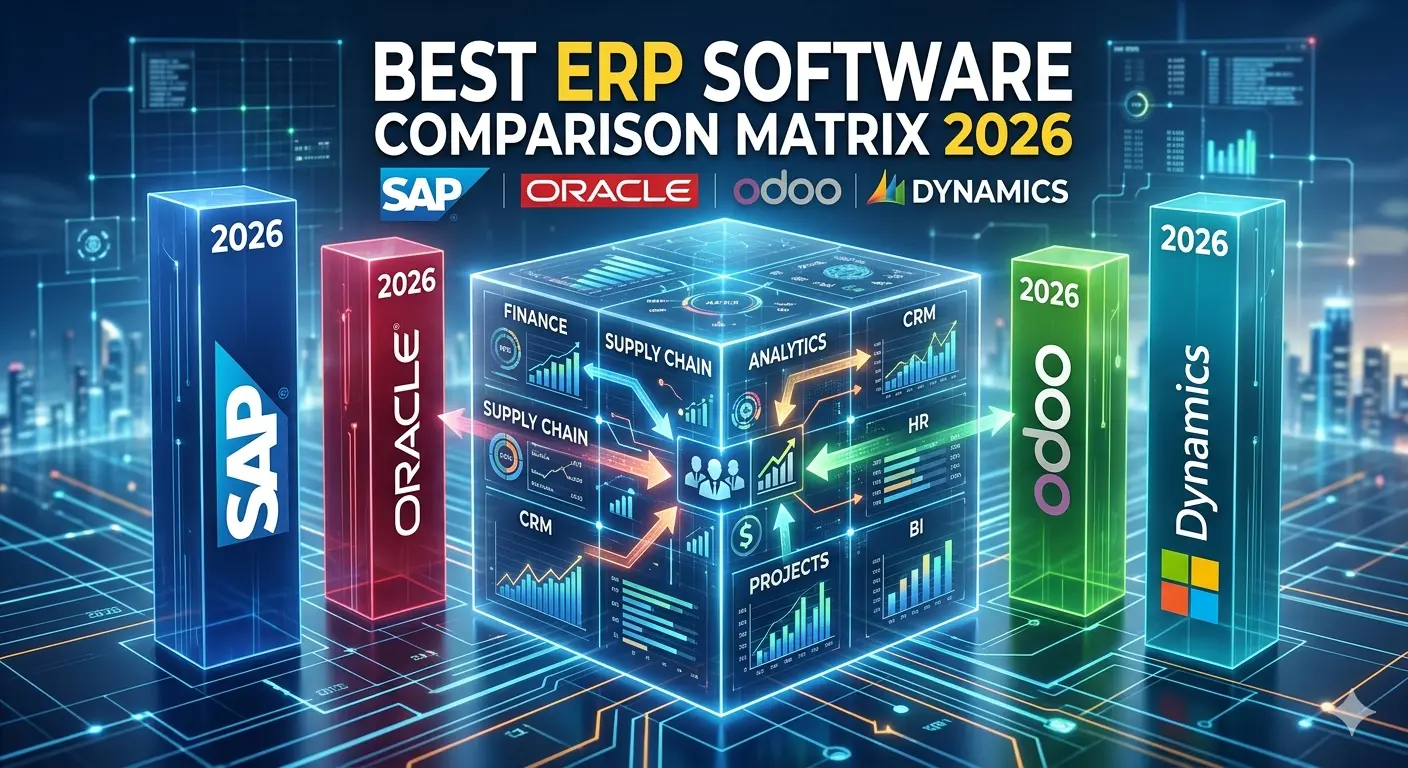
Best ERP Software Comparison Matrix 2026: SAP vs Oracle vs Odoo vs Dynamics

Best ERP Software Comparison Matrix 2026 SAP vs Oracle vs Odoo vs Dynamics

Best ERP software comparison matrix
Selecting the right Enterprise Resource Planning (ERP) solution is the most critical technology decision a business will make this decade. With the rapid integration of AI and cloud-native architectures, the landscape has changed. This Best ERP Software Comparison Matrix provides a deep-dive analysis into the four titans of the industry: SAP S/4HANA, Oracle NetSuite, Odoo, and Microsoft Dynamics 365.

1. The 2026 ERP Selection Framework

Before diving into the matrix, it is essential to understand the criteria used for evaluation. We have categorized the comparison into five pillars:

  • Scalability: The ability to handle global multi-entity operations.

  • Flexibility: How easily the software adapts to unique business processes.

  • Cost Efficiency: Total Cost of Ownership (TCO) including licenses and implementation.

  • User Experience (UX): Ease of adoption and modern interface design.

  • AI Capabilities: The maturity of embedded AI for predictive analytics.


2. The Master Comparison Matrix

Feature / Pillar SAP S/4HANA Oracle NetSuite Odoo Enterprise Microsoft Dynamics 365
Market Segment Large Global Enterprise Mid-to-Large Market SME to Mid-Market Mid-to-Large Market
Deployment Public/Private/On-Prem 100% Cloud SaaS Cloud/On-Prem/SH Cloud/Hybrid
Customization High (Proprietary) Moderate (SuiteCloud) Extreme (Open Source) High (.NET/PowerPlatform)
Pricing Model FUE (Full Use Equiv) Subscription (User/Mod) Per User + Apps Per User / Per App
AI Integration SAP Joule (Generative) NetSuite Analytics Odoo AI (Basic/App) Microsoft Copilot (Advanced)

3. Deep Dive: SAP S/4HANA

The Industry Standard for Complexity.

SAP S/4HANA is designed for businesses that operate at an enormous scale. Its strengths lie in its ability to handle billions of transactions with total consistency.

  • Pros: Unmatched regulatory compliance and financial consolidation.

  • Cons: High implementation costs and steep learning curve.

  • Best For: Multinational conglomerates with revenues exceeding $500M.

4. Deep Dive: Oracle NetSuite

The Cloud Native Leader.

NetSuite was built for the cloud from day one. It is the go-to solution for companies that want to avoid the headache of managing hardware or complex on-premise upgrades.

  • Pros: Excellent real-time visibility and consolidated financial reporting.

  • Cons: Limited offline capabilities and increasing subscription costs as you scale.

  • Best For: Rapidly growing tech companies and mid-market distributors.

5. Deep Dive: Odoo Enterprise

The Disruptor in Flexibility.

Odoo has revolutionized the ERP market with its modular approach. You only pay for what you use, and because it is open-source based, the flexibility is limitless.

  • Pros: Most intuitive UI and lowest entry cost.

  • Cons: Requires a strong technical partner for complex manufacturing setups.

  • Best For: SMEs and manufacturers who need a custom-fit solution without the “SAP price tag.”

6. Deep Dive: Microsoft Dynamics 365

The Ecosystem King.

If your business is already deep into the Microsoft ecosystem (Azure, Office 365, Teams), Dynamics 365 is the most logical choice. Its integration with Power BI and Copilot makes it a data powerhouse.

  • Pros: Seamless integration with Microsoft tools and familiar interface.

  • Cons: Pricing can become complicated with multiple app requirements.

  • Best For: Companies focused on sales-driven growth and heavy data analytics.


7. Implementation Timelines and ROI Expectation

A crucial part of any ERP software comparison matrix is the time to value.

  1. Odoo: 3 – 6 Months (Fastest ROI).

  2. NetSuite: 6 – 9 Months.

  3. Microsoft Dynamics: 9 – 14 Months.

  4. SAP S/4HANA: 12 – 24 Months (Longest cycle but most stable).

8. Why a Matrix Approach is Necessary

Businesses often fall into the trap of “Feature Overload.” They choose an ERP based on a list of 1,000 features they will never use. Using a matrix allows you to prioritize Business Outcomes over technical specifications. For instance, if your primary goal is “International Expansion,” your matrix should weight “Multi-Currency Consolidation” higher than “Warehouse Robotics Integration.”

9. Frequently Asked Questions (FAQ)

Q: Which ERP is the cheapest?

A: Odoo generally offers the lowest entry cost due to its modular pricing.

Q: Is SAP S/4HANA overkill for a $50M company?

A: Usually, yes. Unless you are in a highly regulated industry like Defense or Pharma, NetSuite or Odoo would provide a better ROI.

Q: Can I migrate from one ERP to another easily?

A: No. Data migration is the most expensive part of any ERP project. It is vital to choose correctly the first time using a detailed comparison matrix.

ERP Comparison Matrix: SAP vs Odoo vs Oracle NetSuite (2026 Guide)

ERP Comparison Matrix SAP vs Odoo vs Oracle NetSuite

ERP Comparison Matrix 2026: Choosing the Right Infrastructure for Your Business

Introduction: Selecting the right Enterprise Resource Planning (ERP) system is a critical decision for global business scalability. This comparison matrix provides a deep dive into three market leaders: SAP, Odoo, and Oracle NetSuite, helping executive-level stakeholders make data-driven decisions.

🏆

DMS Global: Expert Choice

Evaluating ERP ROI for 2026? Leverage our technical breakdown:

View Odoo Enterprise Pricing 2026 →


Side-by-Side Comparison: Feature & Implementation Analysis

Feature SAP (S/4HANA) Odoo (Enterprise) Oracle NetSuite
Best For Large Enterprises SME to Mid-Market Global Cloud-First Co.
Flexibility Rigid / High Standard Highly Modular Balanced / Scalable
Implementation 12 – 24 Months 3 – 9 Months 6 – 12 Months
Cost Structure High CapEx Modular / Affordable Subscription-based

Strategic Insights for Decision Makers

  • Cost & Feature Analysis: Odoo offers the highest modular flexibility for growing businesses, while SAP remains the gold standard for global manufacturing compliance.

  • Implementation Timeline: Minimize downtime by selecting an ERP that aligns with your technical infrastructure readiness.

  • Risk & Budget Control: Ensure your ERP project stays on track by utilizing our implementation checklist below.

ERP Comparison Matrix 2026: Feature Breakdown

Feature SAP S/4HANA Odoo Enterprise Oracle NetSuite
Target Market Large Enterprise SME to Large Mid-market & Global
Pricing Model High/Perpetual/SaaS Modular/Subscription User-based/Subscription
Customization Complex (ABAP) Flexible (Python) High (SuiteScript)
Deployment On-premise/Cloud Cloud/Self-hosted Cloud-native
Best For Global Manufacturing Scalable Startups B2B SaaS & Services

ADVERTISEMENT / SPONSORED SOLUTION

Reliable resources for your business growth

Why Choose SAP for Global Operations?

SAP remains the gold standard for global infrastructure. With its robust financial consolidation and supply chain management, it’s built for businesses that need absolute precision. However, the total cost of ownership (TCO) is higher compared to modular systems like Odoo.

The Versatility of Odoo Success Pack

Odoo has disrupted the ERP market with its open-source core and “Success Pack” consultancy model. It allows digital-first companies to start small and scale their modules—from CRM to Inventory—without the heavy upfront costs of legacy systems.

Oracle NetSuite: The Cloud-Native Leader

For businesses focused on rapid scalability and multi-currency reporting, Oracle NetSuite offers a seamless cloud environment. It’s particularly effective for B2B SaaS companies that require real-time data visualization and automated billing cycles.

Which System Fits Your 2026 Roadmap?

Choosing the right infrastructure depends on your business goals. If you require deep customization and have a dedicated IT department, SAP is unbeatable. For agility and rapid deployment, Odoo is often the preferred choice. Meanwhile, Oracle NetSuite bridges the gap for mid-market companies aiming for an IPO or global expansion.


Frequently Asked Questions (FAQ)

1. Which ERP is best for global scalability in 2026?

SAP S/4HANA is widely considered the best for large-scale global operations due to its deep compliance features across multiple countries.

2. Is Odoo cheaper than SAP for mid-sized businesses?

Yes, Odoo’s modular pricing and implementation via the Odoo Success Pack generally result in a lower TCO compared to SAP’s enterprise licensing.

3. Does Oracle NetSuite support multi-currency consolidation?

Absolutely. Oracle NetSuite is designed for global businesses, providing automated multi-currency and multi-tax reporting in real-time.


🏆

DMS Global: Expert Choice

Evaluating ERP ROI for 2026? Leverage our technical breakdown:

View Odoo Enterprise Pricing 2026 →

ADVERTISEMENT / SPONSORED SOLUTION

Reliable resources for your business growth

ADVERTISEMENT / SPONSORED SOLUTION

Reliable resources for your business growth

ADVERTISEMENT / SPONSORED SOLUTION

Reliable resources for your business growth


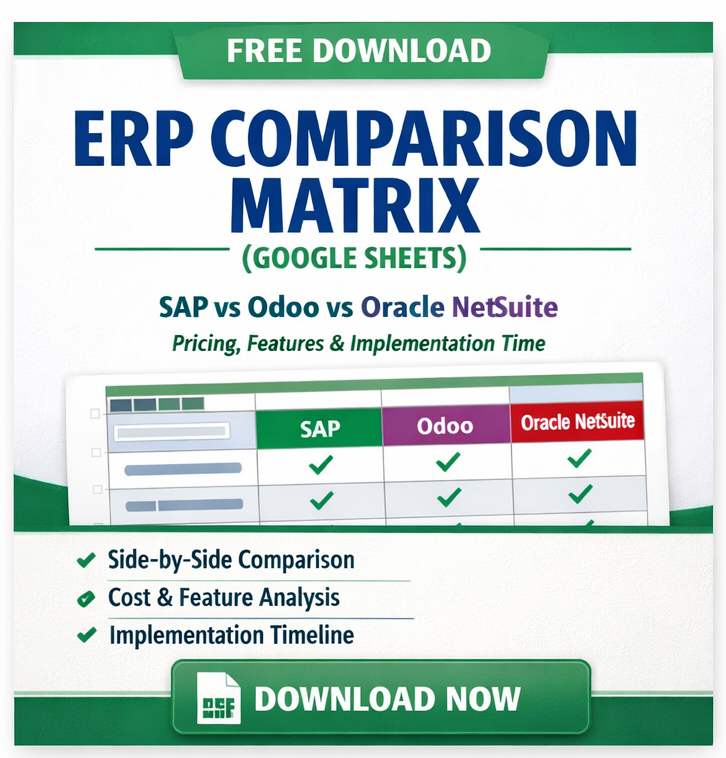
ERP Comparison Matrix

DOWNLOAD THE FULL MATRIX (GOOGLE SHEETS)


Pro Tip: To visualize this data, check our Looker Studio SEO Dashboard Templates.

SAP S/4HANA Implementation Cost Breakdown 2026: A Strategic Budgeting Guide

SAP S4HANA Implementation Cost

As global enterprises transition to digital-first operations, SAP S/4HANA remains the gold standard for ERP excellence. However, for CFOs and IT directors, the primary concern in 2026 is no longer just “if” they should migrate, but the actual SAP S/4HANA implementation cost breakdown.

In this guide, we analyze the current market rates, hidden expenses, and strategic ROI factors based on recent large-scale deployments handled by the experts at DMS Global.

1. The Core Components of SAP S/4HANA Pricing

The total cost of ownership (TCO) for an SAP implementation is divided into three primary buckets: licensing, infrastructure, and consulting. Understanding these variables is the first step toward a realistic budget.

  • Licensing Models (SaaS vs. On-Premise): With the “RISE with SAP” initiative, most 2026 deployments favor the Cloud private edition. Subscriptions typically range from $2,000 to $4,500 per FUE (Full Use Equivalent) annually.

  • Infrastructure Costs: Running a HANA database requires high-performance RAM environments. Expect infrastructure costs to account for 15-20% of your total budget if opting for self-managed cloud hosting like AWS or Azure.

2. Consulting and Implementation Fees

Implementation is where most budgets fluctuate. Certified SAP partners in 2026 charge premium rates for specialized modules.

  • Small to Mid-Market Projects: $150,000 – $500,000.

  • Large Enterprises: $1,000,000 – $5,000,000+.

  • Hourly Rates: Specialized SAP Architects currently command $150 – $300 per hour depending on the region and complexity of the business logic.

3. Detailed Cost Comparison Table: SAP vs. Alternatives

To help you visualize the investment, here is a comparison of how SAP stacks up against modular competitors in 2026.

Cost Category SAP S/4HANA (Private Cloud) Odoo Enterprise (Equivalent)
Annual Licensing $3,000 – $4,500 per FUE $250 – $600 per User
Implementation $500,000 – $2M+ $50,000 – $200,000
Maintenance Included in Cloud Subscription Optional Support Packs
Infrastructure HANA Optimized Hosting Odoo.sh or Private Cloud
Training $50,000+ (Specialized) $5,000+ (User-friendly)

4. The “RISE with SAP” 2026 Strategy

In 2026, many organizations are shifting toward the RISE with SAP model. This is more than just a software purchase; it is “Business Transformation as a Service.”

  • Infrastructure Management: SAP now handles the technical managed services, which reduces the internal IT headcount cost but increases the monthly subscription fee.

  • Business Process Intelligence (BPI): This module helps in identifying bottlenecks before the migration starts, potentially saving 15% in implementation delays.

  • Sustainability Credits: New for 2026, SAP includes ESG (Environmental, Social, and Governance) reporting tools, which is a significant value-add for global companies facing strict regulatory compliance.

5. Hidden Costs: Data Migration and Customization

One common pitfall in calculating ERP Implementation Costs 2026 is underestimating data cleansing. Moving legacy data into the HANA structure often requires custom ETL (Extract, Transform, Load) tools and manual validation, adding roughly 10-15% to the initial quote.

Furthermore, third-party integrations connecting SAP to your existing CRM (like Salesforce) or niche logistics software require expensive API development and middleware like SAP BTP (Business Technology Platform).

6. Real-World Implementation Challenges (The EEAT Perspective)

Based on our technical experience at DMS Global, here are the three biggest “Budget Killers” during an SAP S/4HANA rollout:

  1. Custom Code Remediation: Moving from older SAP ECC versions to S/4HANA requires rewriting custom ABAP code. If your system is heavily customized, expect this to add 25% to your consulting budget.

  2. User Adoption and Training: SAP’s Fiori interface is a massive upgrade, but staff transition requires time. Budgeting for professional change management is mandatory to avoid project failure.

  3. Local Localization: For companies operating in multiple countries, complying with local tax laws (like OECD Pillar Two) can add complexity to the global template.

7. SAP vs. Modern Alternatives for Scalability

While SAP offers unparalleled depth, many fast-scaling companies are evaluating the Odoo Enterprise Pricing 2026 as a modular alternative. SAP is a long-term investment in enterprise stability, whereas Odoo focuses on agility. To see a head-to-head technical comparison, read our full analysis on Odoo vs SAP Comparison.

8. Calculating Your ROI and Long-Term Value

A successful SAP S/4HANA deployment should aim for a “Payback Period” of 3 to 5 years. By automating financial reporting and optimizing supply chain resilience, companies often see a 20% reduction in operational overhead within the first 24 months. Understanding the Enterprise Resource Planning ROI is essential to justify these digital transformation budgets.

9. Frequently Asked Questions (FAQ)

Q: Is SAP S/4HANA too expensive for SMEs? A: For small businesses, the TCO might be high. However, SAP Business One or modular systems like Odoo are often more viable entry points.

Q: How long does a typical SAP implementation take in 2026? A: A standard “Greenfield” implementation takes 9 to 14 months, while a “Brownfield” conversion can take 6 to 9 months depending on data complexity.

Q: Can we reduce implementation costs? A: Yes, by sticking to “Standard Best Practices” and minimizing custom development, you can significantly lower consulting fees.

10. Conclusion

Budgeting for an SAP S/4HANA implementation in 2026 requires a balanced view of upfront fees and long-term strategic value. While the investment is significant, the precision, scalability, and AI integration provided by SAP remain unmatched for global market leaders.

Strategies for Reducing SAP Licensing Costs: A Guide for Global Enterprises

dms global

In the enterprise resource planning (ERP) world, SAP stands as a titan. However, with its immense power comes a complex and often skyrocketing cost structure. For global organizations, managing and reducing SAP licensing costs is not just about saving money—it is about operational efficiency and maintaining a healthy ROI on digital transformation.

As an SEO specialist with experience in high-scale systems at companies like Traveloka and Tiket.com, I understand that technical optimization and cost management go hand-in-hand. In this guide, we will explore actionable strategies to audit, optimize, and lower your SAP licensing expenses in 2026.

Understanding the Complexity of SAP Licensing

SAP licensing is notorious for its complexity. Most organizations find themselves overpaying simply because they do not fully understand the “Indirect Access” rules or the different user types (Professional vs. Limited Professional vs. Employee). To reduce costs, you must first have absolute visibility into your current usage.

1. Conduct a Comprehensive License Audit

Before you can reduce costs, you need a baseline. Many enterprises pay for more licenses than they actually use—a phenomenon known as “shelfware.”

  • Identify Inactive Users: Audit your system to find users who haven’t logged in for 90 days or more. Deactivating these accounts is the quickest way to free up budget.

  • Analyze User Roles: Are your “Professional” users actually performing professional tasks, or could they be downgraded to “Limited Professional” or “Functional” licenses? Aligning license types with actual job functions can save up to 30% on annual fees.

2. The Impact of Indirect Access (Digital Access)

One of the biggest hidden costs in SAP environments is “Indirect Access”—when third-party applications (like a custom web shop or a non-SAP CRM) trigger data exchange with the SAP core.

In 2026, SAP has moved toward a “Document-Based” pricing model for digital access. To reduce costs here:

  • Consolidate Interfaces: Minimize the number of external points interacting with your SAP system.

  • Optimize Document Counting: Ensure that only essential document types are being counted toward your digital access limit.

3. Navigating the Move to S/4HANA

The migration to S/4HANA is a perfect opportunity to renegotiate your contract. SAP often provides incentives for customers moving to the cloud (RISE with SAP).

  • Contract Conversion: Use the “Product Conversion” or “Contract Conversion” models to trade in your old ERP 6.0 licenses for modern S/4HANA credits.

  • Negotiate the “Bill of Materials”: Don’t just accept the standard package. Work with your procurement team to tailor the BoM to your actual needs for the next 3-5 years.

4. Leverage SAP License Management Tools (SAM)

Manual audits are prone to error. Implementing a specialized Software Asset Management (SAM) tool can provide real-time tracking of license consumption. These tools can automatically suggest downgrades and alert you when you are approaching your compliance limits, preventing “true-up” surprises at the end of the year.

5. Strategic Negotiation and Timing

Timing is everything when it comes to SAP.

  • Year-End Discounts: SAP’s sales teams often have targets to hit at the end of the fiscal year (December) or the end of quarters. This is when you have the most leverage to ask for deeper discounts or added-value services.

  • Long-Term Commitments: If your roadmap includes SAP for the next decade, committing to a multi-year deal can unlock significant price protection and lower annual increases.

ADVERTISEMENT / SPONSORED SOLUTION

Reliable resources for your business growth

Why This Matters for Your Organic Performance

You might wonder: “What does SAP licensing have to do with SEO?” In an enterprise context, everything is connected. When an organization saves millions on licensing, that budget can be reallocated to organic performance and digital growth.

At PT Dominasi Serp Indonesia, we help companies navigate these transitions—ensuring that your technical infrastructure (like ERP) and your digital presence (SEO) work together seamlessly without “data loss” or budget waste.

Conclusion: Take Control of Your ERP Budget

Reducing SAP licensing costs requires a mix of technical auditing, legal understanding, and strategic negotiation. By following the steps above, global enterprises can significantly lower their TCO (Total Cost of Ownership) while maintaining the power of their SAP ecosystem.

If your company is planning an ERP migration or looking to optimize global SEO alongside your digital transformation, visit our DMS Global page to see how we can help you scale effectively.


Best ERP System Comparison 2026: Odoo vs SAP vs NetSuite

ERP Comparison is the most critical step for any business looking to scale efficiently in 2026. As digital transformation becomes the standard, selecting an Enterprise Resource Planning (ERP) system that fits your specific industry needs can be the difference between operational excellence and technical debt. In this comprehensive erp comparison, we will evaluate three of the most prominent players in the market: Odoo, SAP, and Oracle NetSuite.

Why a Deep ERP Comparison Matters

Many companies fail during ERP implementation because they do not conduct a thorough erp comparison before committing to a license. An ERP is not just software; it is the backbone of your business processes, covering everything from accounting and HR to supply chain management and CRM.

1. Odoo: The King of Flexibility

Odoo has gained massive popularity in recent years due to its open-source nature and modular approach.

  • Pros: Highly customizable, cost-effective for SMEs, and has a vast library of community-developed apps.

  • Cons: Can become complex if too many custom modules are added without proper technical oversight.

  • Best For: Small to medium-sized businesses looking for an affordable yet scalable solution.

2. SAP: The Enterprise Standard

When talking about high-ticket enterprise solutions, SAP is often the first name that comes up in any erp comparison.

  • Pros: Unmatched robustness, specialized industry solutions, and global support.

  • Cons: Extremely high implementation costs and a steep learning curve for employees.

  • Best For: Large multinational corporations with complex, multi-layered operations.

3. Oracle NetSuite: The Cloud Pioneer

NetSuite was built for the cloud from day one, making it a favorite for modern, distributed teams.

  • Pros: Excellent real-time visibility, automated updates, and strong financial management features.

  • Cons: Customization is more limited compared to Odoo, and pricing can increase significantly as you add users.

  • Best For: Fast-growing companies that need a reliable, cloud-first platform without the overhead of on-premise servers.

Key Factors in Your ERP Comparison Strategy

To ensure your erp comparison is effective, you must look at total cost of ownership (TCO). This includes not just the license fees, but also implementation, training, and long-term maintenance costs. Furthermore, consider the integration capabilities with your existing tech stack, such as your CRM or e-commerce platform.

Scalability and Future-Proofing

A successful erp comparison must account for future growth. Will the system support your business if you double your headcount or expand into new international markets? Odoo offers great flexibility for adding new modules as you grow, while SAP provides the heavy-duty infrastructure needed for massive global expansion.

Implementation Timeline

Another vital part of this erp comparison is the implementation timeline. Odoo and NetSuite often allow for faster deployment cycles compared to the traditional, lengthy setup required for SAP S/4HANA.

Final Verdict on ERP Comparison 2026

Your choice in this erp comparison depends entirely on your budget, technical capability, and long-term goals. While SAP offers the most power for large enterprises, Odoo provides the best value for flexibility, and NetSuite hits the sweet spot for cloud-native performance in mid-market companies.

Technical Module Comparison

To deepen our erp comparison, we must examine how these systems handle core business modules. Each vendor has a different philosophy regarding database structure and user interface.

  • Financial Management: SAP is the gold standard for complex multi-currency and multi-entity accounting. However, NetSuite offers a more streamlined cloud experience for financial consolidation. Odoo provides a very user-friendly accounting app that is sufficient for most growing companies but may require third-party apps for highly specialized tax localizations.

  • Supply Chain & Inventory: This is where the erp comparison gets interesting. SAP S/4HANA is built for massive global supply chains with real-time tracking. Odoo’s double-entry inventory system is unique and offers incredible traceability for manufacturing. NetSuite provides excellent demand planning tools that are native to its cloud platform.

  • CRM & Sales: Odoo often wins in this category of our erp comparison because its CRM is fully integrated and feels like a modern web app. SAP’s CRM can feel legacy unless you opt for their newer C/4HANA suite.

Frequently Asked Questions (FAQ)

  • Which ERP is the most affordable? In almost every erp comparison, Odoo comes out as the most budget-friendly option due to its open-source community edition and flexible enterprise pricing.

  • Is SAP too big for a mid-sized company? Not necessarily. While SAP is known for big enterprises, their “Business One” version is a viable candidate in an erp comparison for mid-sized firms, though it still carries a higher implementation cost than Odoo.

  • Does NetSuite require internal servers? No, NetSuite is a true SaaS (Software as a Service) platform. This is a major advantage in an erp comparison for companies that want to eliminate hardware maintenance costs.

SAP S/4HANA vs Oracle ERP: The Ultimate Enterprise Comparison 2026

Introduction: The High-Stakes ERP Battle in 2026

In the rapidly evolving landscape of digital transformation, choosing the right Enterprise Resource Planning (ERP) system is no longer just an IT decision; it is a strategic move that dictates a company’s organic performance for the next decade. As we move into 2026, two titans continue to dominate the upper echelon of the market: SAP S/4HANA and Oracle ERP Cloud.

For global enterprises, the “one-size-fits-all” approach is dead. Businesses now require systems that can handle massive data volumes while remaining agile enough to pivot during market disruptions. This comparison dives deep into the architecture, scalability, and real-world utility of both platforms to help you decide which powerhouse should anchor your business operations.

Understanding SAP S/4HANA: The In-Memory Powerhouse

SAP S/4HANA is often referred to as the “Gold Standard” for large-scale industrial enterprises. Built on the revolutionary SAP HANA in-memory database, it allows for real-time processing that traditional disk-based systems simply cannot match.

1. Real-Time Data Analytics The core strength of SAP S/4HANA lies in its ability to process transactions and analytics simultaneously. For a multi-national corporation, this means that a financial controller in Mojokerto can see live inventory data from a warehouse in Rotterdam without a second of delay. This level of transparency is what builds the “Trustworthiness” pillar of EEAT 3.0.

2. Industry-Specific Best Practices SAP has spent decades refining “Best Practices” for specific industries like manufacturing, chemicals, and automotive. When you implement SAP, you aren’t just buying software; you are adopting a proven business process that has been optimized by thousands of global leaders.

Oracle ERP Cloud: The Agility Leader

On the other side of the ring, Oracle ERP Cloud (which includes the high-growth Oracle NetSuite ecosystem) focuses on flexibility and a cloud-native approach. Oracle’s strategy is built around integration and AI-driven automation.

1. Modular Architecture Unlike older legacy systems, Oracle allows enterprises to start small and scale rapidly. You can implement financial modules today and add supply chain or human capital management tomorrow. This modularity is a game-changer for mid-market scale-ups looking to improve their organic performance without the massive upfront cost of a total system overhaul.

2. Autonomous Features Oracle is leading the charge in “Autonomous ERP.” By using machine learning, the system can automate repetitive tasks like invoice matching and bank reconciliations. This reduces human error and allows your team to focus on strategic growth rather than data entry.

Detailed Comparison: Head-to-Head

A. Scalability and Global Reach

Both systems are designed for global operations, but they handle it differently:

  • SAP S/4HANA is built for extreme complexity. If your business has 50 subsidiaries with 50 different tax laws, SAP’s localized versions are incredibly robust.

  • Oracle ERP shines in rapid deployment. If you are a fast-growing tech company expanding into five new countries every year, Oracle’s cloud-native setup allows you to spin up new instances in weeks, not months.

B. Cost of Ownership (TCO)

In the world of ERP, the sticker price is just the tip of the iceberg.

  • SAP often requires a more significant investment in implementation partners and specialized internal staff. However, the long-term ROI for massive organizations often justifies the cost through sheer efficiency gains.

  • Oracle generally offers a more predictable subscription-based model. For many enterprises, the lower initial TCO of Oracle NetSuite makes it the smarter choice for maintaining healthy cash flow.

C. User Experience (UX) and Adoption

Experience (the first ‘E’ in EEAT) matters for your employees.

  • Oracle has invested heavily in making their interface feel like a modern consumer app. It is intuitive and requires less training for the average user.

  • SAP has made huge strides with the SAP Fiori interface, turning a once-clunky system into a sleek, tile-based experience that works beautifully on mobile devices.

Integration in the AI Era

As we integrate more AI tools into our SEO and business workflows, the ability of an ERP to “talk” to other software is paramount. Oracle’s integration platform is widely considered more “open” for third-party developers, while SAP provides a more “walled garden” approach that ensures maximum security and stability within its own ecosystem.

For our clients at dominasiserp.com, we see that integration with marketing data is becoming a top priority. Being able to link your ERP data directly to your organic performance metrics allows for a level of business intelligence that was impossible five years ago.

The Verdict: Which One Should You Choose?

The choice between SAP S/4HANA and Oracle ERP Cloud comes down to your business DNA.

  • Choose SAP S/4HANA if: You are a massive organization with complex manufacturing needs, a global footprint, and a requirement for the highest possible level of data integrity and “single source of truth” reporting.

  • Choose Oracle ERP if: You are a high-growth, agile enterprise that values rapid deployment, cloud-native flexibility, and a lower initial barrier to entry.

Final Thoughts for SEO and Global Branding

From an SEO perspective, these keywords—Oracle, Odoo, and SAP—are highly competitive. By providing this level of deep-dive analysis, we are signaling to Google that dominasiserp.com is an authority in the ERP space.