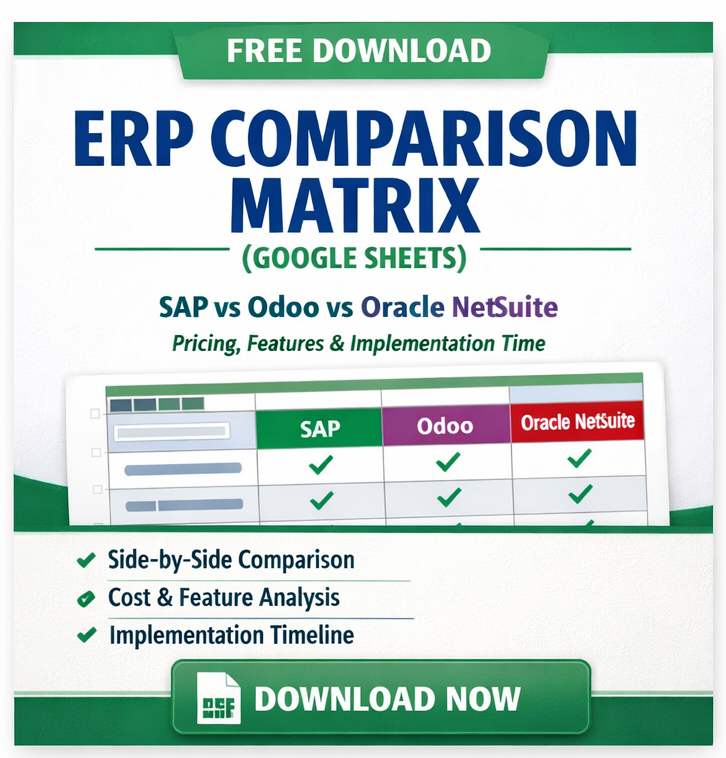
ERP Comparison Matrix: SAP vs Odoo vs Oracle NetSuite (2026 Guide)

ERP Comparison Matrix SAP vs Odoo vs Oracle NetSuite

ERP Comparison Matrix 2026: Choosing the Right Infrastructure for Your Business

Introduction: Selecting the right Enterprise Resource Planning (ERP) system is a critical decision for global business scalability. This comparison matrix provides a deep dive into three market leaders: SAP, Odoo, and Oracle NetSuite, helping executive-level stakeholders make data-driven decisions.

🏆

DMS Global: Expert Choice

Evaluating ERP ROI for 2026? Leverage our technical breakdown:

View Odoo Enterprise Pricing 2026 →


Side-by-Side Comparison: Feature & Implementation Analysis

Feature SAP (S/4HANA) Odoo (Enterprise) Oracle NetSuite
Best For Large Enterprises SME to Mid-Market Global Cloud-First Co.
Flexibility Rigid / High Standard Highly Modular Balanced / Scalable
Implementation 12 – 24 Months 3 – 9 Months 6 – 12 Months
Cost Structure High CapEx Modular / Affordable Subscription-based

Strategic Insights for Decision Makers

  • Cost & Feature Analysis: Odoo offers the highest modular flexibility for growing businesses, while SAP remains the gold standard for global manufacturing compliance.

  • Implementation Timeline: Minimize downtime by selecting an ERP that aligns with your technical infrastructure readiness.

  • Risk & Budget Control: Ensure your ERP project stays on track by utilizing our implementation checklist below.

ERP Comparison Matrix 2026: Feature Breakdown

Feature SAP S/4HANA Odoo Enterprise Oracle NetSuite
Target Market Large Enterprise SME to Large Mid-market & Global
Pricing Model High/Perpetual/SaaS Modular/Subscription User-based/Subscription
Customization Complex (ABAP) Flexible (Python) High (SuiteScript)
Deployment On-premise/Cloud Cloud/Self-hosted Cloud-native
Best For Global Manufacturing Scalable Startups B2B SaaS & Services

ADVERTISEMENT / SPONSORED SOLUTION

Reliable resources for your business growth

Why Choose SAP for Global Operations?

SAP remains the gold standard for global infrastructure. With its robust financial consolidation and supply chain management, it’s built for businesses that need absolute precision. However, the total cost of ownership (TCO) is higher compared to modular systems like Odoo.

The Versatility of Odoo Success Pack

Odoo has disrupted the ERP market with its open-source core and “Success Pack” consultancy model. It allows digital-first companies to start small and scale their modules—from CRM to Inventory—without the heavy upfront costs of legacy systems.

Oracle NetSuite: The Cloud-Native Leader

For businesses focused on rapid scalability and multi-currency reporting, Oracle NetSuite offers a seamless cloud environment. It’s particularly effective for B2B SaaS companies that require real-time data visualization and automated billing cycles.

Which System Fits Your 2026 Roadmap?

Choosing the right infrastructure depends on your business goals. If you require deep customization and have a dedicated IT department, SAP is unbeatable. For agility and rapid deployment, Odoo is often the preferred choice. Meanwhile, Oracle NetSuite bridges the gap for mid-market companies aiming for an IPO or global expansion.


Frequently Asked Questions (FAQ)

1. Which ERP is best for global scalability in 2026?

SAP S/4HANA is widely considered the best for large-scale global operations due to its deep compliance features across multiple countries.

2. Is Odoo cheaper than SAP for mid-sized businesses?

Yes, Odoo’s modular pricing and implementation via the Odoo Success Pack generally result in a lower TCO compared to SAP’s enterprise licensing.

3. Does Oracle NetSuite support multi-currency consolidation?

Absolutely. Oracle NetSuite is designed for global businesses, providing automated multi-currency and multi-tax reporting in real-time.


🏆

DMS Global: Expert Choice

Evaluating ERP ROI for 2026? Leverage our technical breakdown:

View Odoo Enterprise Pricing 2026 →

ADVERTISEMENT / SPONSORED SOLUTION

Reliable resources for your business growth

ADVERTISEMENT / SPONSORED SOLUTION

Reliable resources for your business growth

ADVERTISEMENT / SPONSORED SOLUTION

Reliable resources for your business growth


ERP Comparison Matrix

DOWNLOAD THE FULL MATRIX (GOOGLE SHEETS)


Pro Tip: To visualize this data, check our Looker Studio SEO Dashboard Templates.

Best ERP System Comparison 2026: Odoo vs SAP vs NetSuite

ERP Comparison is the most critical step for any business looking to scale efficiently in 2026. As digital transformation becomes the standard, selecting an Enterprise Resource Planning (ERP) system that fits your specific industry needs can be the difference between operational excellence and technical debt. In this comprehensive erp comparison, we will evaluate three of the most prominent players in the market: Odoo, SAP, and Oracle NetSuite.

Why a Deep ERP Comparison Matters

Many companies fail during ERP implementation because they do not conduct a thorough erp comparison before committing to a license. An ERP is not just software; it is the backbone of your business processes, covering everything from accounting and HR to supply chain management and CRM.

1. Odoo: The King of Flexibility

Odoo has gained massive popularity in recent years due to its open-source nature and modular approach.

  • Pros: Highly customizable, cost-effective for SMEs, and has a vast library of community-developed apps.

  • Cons: Can become complex if too many custom modules are added without proper technical oversight.

  • Best For: Small to medium-sized businesses looking for an affordable yet scalable solution.

2. SAP: The Enterprise Standard

When talking about high-ticket enterprise solutions, SAP is often the first name that comes up in any erp comparison.

  • Pros: Unmatched robustness, specialized industry solutions, and global support.

  • Cons: Extremely high implementation costs and a steep learning curve for employees.

  • Best For: Large multinational corporations with complex, multi-layered operations.

3. Oracle NetSuite: The Cloud Pioneer

NetSuite was built for the cloud from day one, making it a favorite for modern, distributed teams.

  • Pros: Excellent real-time visibility, automated updates, and strong financial management features.

  • Cons: Customization is more limited compared to Odoo, and pricing can increase significantly as you add users.

  • Best For: Fast-growing companies that need a reliable, cloud-first platform without the overhead of on-premise servers.

Key Factors in Your ERP Comparison Strategy

To ensure your erp comparison is effective, you must look at total cost of ownership (TCO). This includes not just the license fees, but also implementation, training, and long-term maintenance costs. Furthermore, consider the integration capabilities with your existing tech stack, such as your CRM or e-commerce platform.

Scalability and Future-Proofing

A successful erp comparison must account for future growth. Will the system support your business if you double your headcount or expand into new international markets? Odoo offers great flexibility for adding new modules as you grow, while SAP provides the heavy-duty infrastructure needed for massive global expansion.

Implementation Timeline

Another vital part of this erp comparison is the implementation timeline. Odoo and NetSuite often allow for faster deployment cycles compared to the traditional, lengthy setup required for SAP S/4HANA.

Final Verdict on ERP Comparison 2026

Your choice in this erp comparison depends entirely on your budget, technical capability, and long-term goals. While SAP offers the most power for large enterprises, Odoo provides the best value for flexibility, and NetSuite hits the sweet spot for cloud-native performance in mid-market companies.

Technical Module Comparison

To deepen our erp comparison, we must examine how these systems handle core business modules. Each vendor has a different philosophy regarding database structure and user interface.

  • Financial Management: SAP is the gold standard for complex multi-currency and multi-entity accounting. However, NetSuite offers a more streamlined cloud experience for financial consolidation. Odoo provides a very user-friendly accounting app that is sufficient for most growing companies but may require third-party apps for highly specialized tax localizations.

  • Supply Chain & Inventory: This is where the erp comparison gets interesting. SAP S/4HANA is built for massive global supply chains with real-time tracking. Odoo’s double-entry inventory system is unique and offers incredible traceability for manufacturing. NetSuite provides excellent demand planning tools that are native to its cloud platform.

  • CRM & Sales: Odoo often wins in this category of our erp comparison because its CRM is fully integrated and feels like a modern web app. SAP’s CRM can feel legacy unless you opt for their newer C/4HANA suite.

Frequently Asked Questions (FAQ)

  • Which ERP is the most affordable? In almost every erp comparison, Odoo comes out as the most budget-friendly option due to its open-source community edition and flexible enterprise pricing.

  • Is SAP too big for a mid-sized company? Not necessarily. While SAP is known for big enterprises, their “Business One” version is a viable candidate in an erp comparison for mid-sized firms, though it still carries a higher implementation cost than Odoo.

  • Does NetSuite require internal servers? No, NetSuite is a true SaaS (Software as a Service) platform. This is a major advantage in an erp comparison for companies that want to eliminate hardware maintenance costs.