Looker Studio SEO Dashboard Templates: The Ultimate Guide to Automating Your Analytics

Looker Studio SEO Dashboard Templates

In the contemporary realm of digital marketing, data-driven decision-making is the cornerstone of success. However, staring at raw Google Analytics or Search Console numbers does little to inspire confidence or action. For enterprise SEO specialists, agencies, and in-house marketers, utilizing professional Looker Studio SEO dashboard templates is essential. This comprehensive guide explores how to design, customize, and deploy dynamic SEO reporting dashboards that align with Google’s E-E-A-T (Experience, Expertise, Authoritativeness, and Trustworthiness) standards while maximizing your AdSense monetization potential.

[dms-category-hub]

Why Looker Studio is the Standard for SEO Reporting

Gone are the days of manually exporting CSV files and compiling tedious monthly PDF reports. Looker Studio (formerly Google Data Studio) allows marketers to connect seamlessly with diverse data sources—including Google Search Console, Google Analytics 4, Ahrefs, and BigQuery—to build live, interactive visualization layers.

The Shift from Static Data to Dynamic Insights

Static reports only show what happened in the past. Dynamic dashboards built on robust templates allow stakeholders to filter by date ranges, specific landing pages, and country-level performance instantly. This level of transparency reinforces your agency’s professional authority and technical competence.

[adsense-conversion-winner]

Core Components of a High-Performing SEO Dashboard

When selecting or building your dashboard template, you must ensure it answers the most critical business questions immediately. A world-class SEO reporting framework typically incorporates the following modular sections:

1. Executive Summary & High-Level KPIs

The top section should provide a snapshot of organic visibility. Track metrics like total organic clicks, total impressions, average click-through rate (CTR), and average keyword ranking position over a rolling 28-day or 3-month window.

2. Traffic Quality & Behavior Flow

Combine Search Console data with GA4 parameters to see which pages are not just getting clicks, but are also engaging users (measuring bounce rates, engagement time, and conversion actions).

3. Keyword and Query Performance Analysis

Monitor your winning queries and identify “striking distance” keywords ranking between positions 4 and 20. These represent your fastest optimization opportunities.

[post_middle_engagement]

E-E-A-T and Data Accountability in Reporting

Google’s E-E-A-T framework isn’t solely applied to consumer-facing content—it heavily influences how clients and peers evaluate your digital marketing proficiency. Presenting erratic or poorly visualized analytics destroys credibility. By leveraging clean, error-free Looker Studio templates, you demonstrate absolute precision, methodical expertise, and trustworthiness in handling enterprise data assets.

Optimizing Dashboards for AdSense and Commercial Value

For niche authority sites focusing on programmatic SEO and revenue generation through platforms like AdSense, a well-structured performance tracking layout ensures you understand which content verticals drive high-value RPMs. When you know which pages capture high-intent traffic, you can double down on those content clusters.

Best Practices for Template Customization:

  • Keep Visuals Clean: Limit color palettes to professional, muted tones that do not distract from the data trends.

  • Logical Flow: Group data from general domain health down to granular keyword performance.

  • Automated Sharing: Schedule automated weekly email deliveries to keep stakeholders aligned without manual intervention.

[inlink-tag]

Implementation Steps for Migrated Content

Transitioning your archival tag URLs into structured content posts requires maintaining structural integrity. Once this template guide is published under the clean slug looker-studio-seo-dashboard-templates, ensure you implement an immediate 301 redirect from the old tag path to preserve your search equity.

Conclusion

Utilizing professional Looker Studio SEO dashboard templates transforms how you interpret and present organic search data. By eliminating manual friction and embracing high-integrity visual reporting, you elevate your brand’s E-E-A-T profile and build a scalable foundation for long-term traffic analysis and commercial growth.

[post_bottom_conversion] [fast-index-hook]

Catatan Eksekusi:

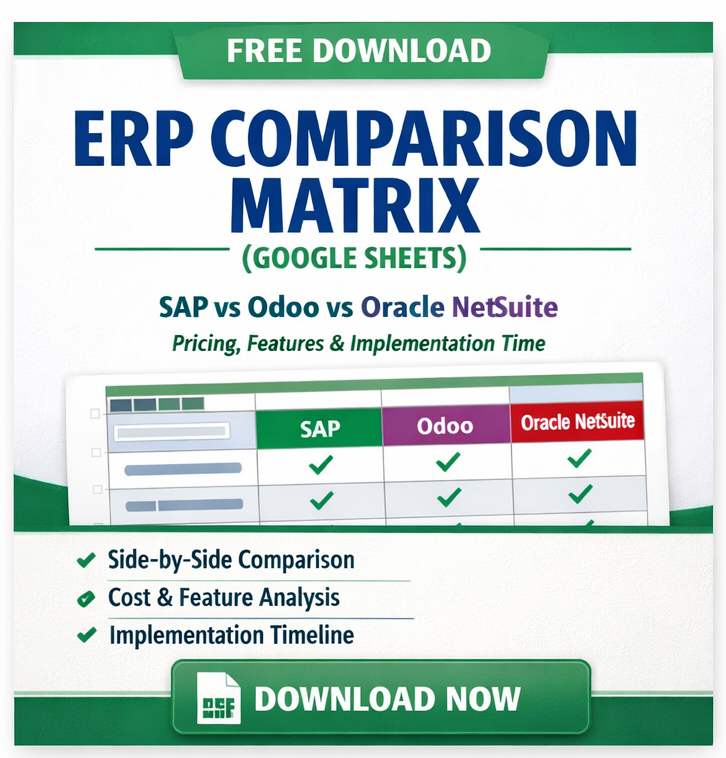
ERP Comparison Matrix: SAP vs Odoo vs Oracle NetSuite (2026 Guide)

ERP Comparison Matrix SAP vs Odoo vs Oracle NetSuite

ERP Comparison Matrix 2026: Choosing the Right Infrastructure for Your Business

Introduction: Selecting the right Enterprise Resource Planning (ERP) system is a critical decision for global business scalability. This comparison matrix provides a deep dive into three market leaders: SAP, Odoo, and Oracle NetSuite, helping executive-level stakeholders make data-driven decisions.

🏆

DMS Global: Expert Choice

Evaluating ERP ROI for 2026? Leverage our technical breakdown:

View Odoo Enterprise Pricing 2026 →


Side-by-Side Comparison: Feature & Implementation Analysis

Feature SAP (S/4HANA) Odoo (Enterprise) Oracle NetSuite
Best For Large Enterprises SME to Mid-Market Global Cloud-First Co.
Flexibility Rigid / High Standard Highly Modular Balanced / Scalable
Implementation 12 – 24 Months 3 – 9 Months 6 – 12 Months
Cost Structure High CapEx Modular / Affordable Subscription-based

Strategic Insights for Decision Makers

  • Cost & Feature Analysis: Odoo offers the highest modular flexibility for growing businesses, while SAP remains the gold standard for global manufacturing compliance.

  • Implementation Timeline: Minimize downtime by selecting an ERP that aligns with your technical infrastructure readiness.

  • Risk & Budget Control: Ensure your ERP project stays on track by utilizing our implementation checklist below.

ERP Comparison Matrix 2026: Feature Breakdown

Feature SAP S/4HANA Odoo Enterprise Oracle NetSuite
Target Market Large Enterprise SME to Large Mid-market & Global
Pricing Model High/Perpetual/SaaS Modular/Subscription User-based/Subscription
Customization Complex (ABAP) Flexible (Python) High (SuiteScript)
Deployment On-premise/Cloud Cloud/Self-hosted Cloud-native
Best For Global Manufacturing Scalable Startups B2B SaaS & Services

ADVERTISEMENT / SPONSORED SOLUTION

Reliable resources for your business growth

Why Choose SAP for Global Operations?

SAP remains the gold standard for global infrastructure. With its robust financial consolidation and supply chain management, it’s built for businesses that need absolute precision. However, the total cost of ownership (TCO) is higher compared to modular systems like Odoo.

The Versatility of Odoo Success Pack

Odoo has disrupted the ERP market with its open-source core and “Success Pack” consultancy model. It allows digital-first companies to start small and scale their modules—from CRM to Inventory—without the heavy upfront costs of legacy systems.

Oracle NetSuite: The Cloud-Native Leader

For businesses focused on rapid scalability and multi-currency reporting, Oracle NetSuite offers a seamless cloud environment. It’s particularly effective for B2B SaaS companies that require real-time data visualization and automated billing cycles.

Which System Fits Your 2026 Roadmap?

Choosing the right infrastructure depends on your business goals. If you require deep customization and have a dedicated IT department, SAP is unbeatable. For agility and rapid deployment, Odoo is often the preferred choice. Meanwhile, Oracle NetSuite bridges the gap for mid-market companies aiming for an IPO or global expansion.


Frequently Asked Questions (FAQ)

1. Which ERP is best for global scalability in 2026?

SAP S/4HANA is widely considered the best for large-scale global operations due to its deep compliance features across multiple countries.

2. Is Odoo cheaper than SAP for mid-sized businesses?

Yes, Odoo’s modular pricing and implementation via the Odoo Success Pack generally result in a lower TCO compared to SAP’s enterprise licensing.

3. Does Oracle NetSuite support multi-currency consolidation?

Absolutely. Oracle NetSuite is designed for global businesses, providing automated multi-currency and multi-tax reporting in real-time.


🏆

DMS Global: Expert Choice

Evaluating ERP ROI for 2026? Leverage our technical breakdown:

View Odoo Enterprise Pricing 2026 →

ADVERTISEMENT / SPONSORED SOLUTION

Reliable resources for your business growth

ADVERTISEMENT / SPONSORED SOLUTION

Reliable resources for your business growth

ADVERTISEMENT / SPONSORED SOLUTION

Reliable resources for your business growth


ERP Comparison Matrix

DOWNLOAD THE FULL MATRIX (GOOGLE SHEETS)


Pro Tip: To visualize this data, check our Looker Studio SEO Dashboard Templates.