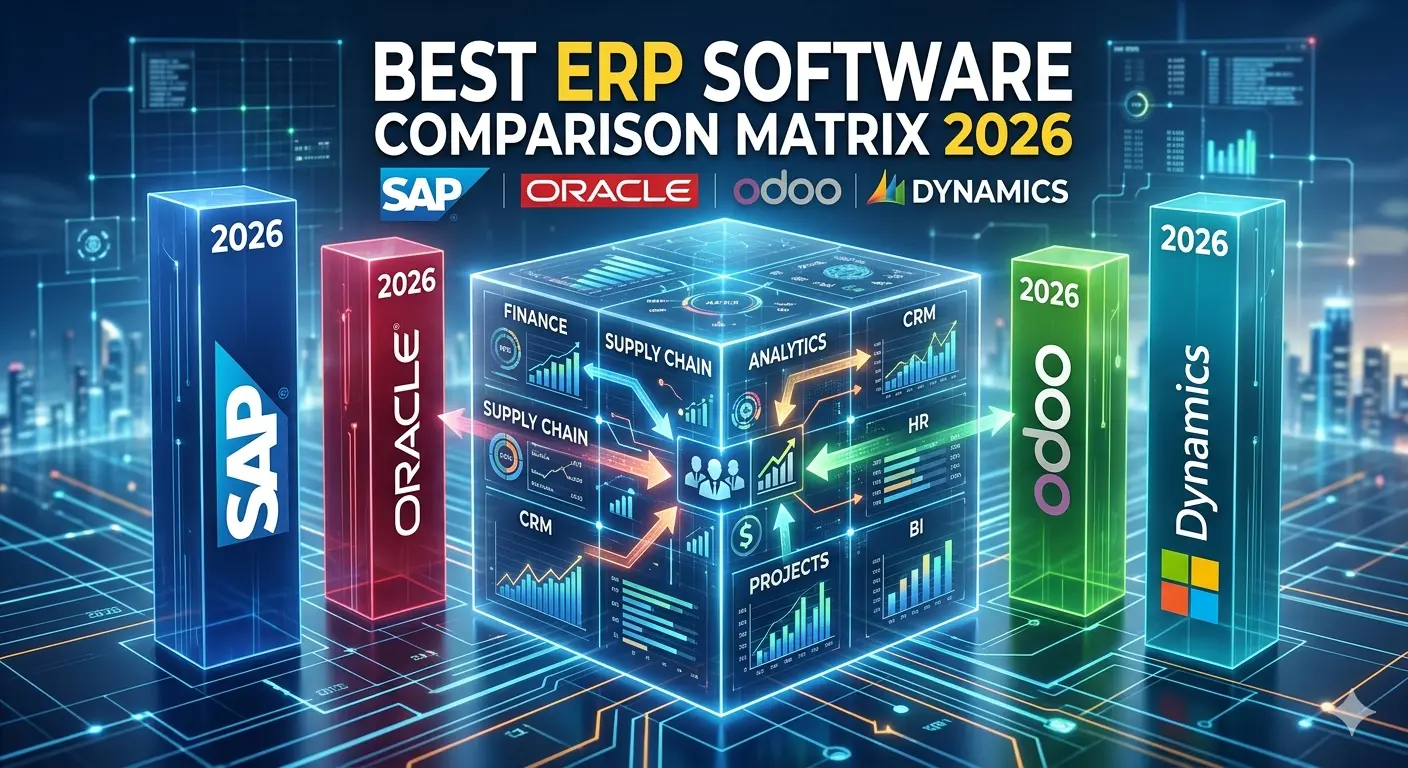
Best ERP Software Comparison Matrix 2026: SAP vs Oracle vs Odoo vs Dynamics

Best ERP Software Comparison Matrix 2026 SAP vs Oracle vs Odoo vs Dynamics

Best ERP software comparison matrix
Selecting the right Enterprise Resource Planning (ERP) solution is the most critical technology decision a business will make this decade. With the rapid integration of AI and cloud-native architectures, the landscape has changed. This Best ERP Software Comparison Matrix provides a deep-dive analysis into the four titans of the industry: SAP S/4HANA, Oracle NetSuite, Odoo, and Microsoft Dynamics 365.

1. The 2026 ERP Selection Framework

Before diving into the matrix, it is essential to understand the criteria used for evaluation. We have categorized the comparison into five pillars:

  • Scalability: The ability to handle global multi-entity operations.

  • Flexibility: How easily the software adapts to unique business processes.

  • Cost Efficiency: Total Cost of Ownership (TCO) including licenses and implementation.

  • User Experience (UX): Ease of adoption and modern interface design.

  • AI Capabilities: The maturity of embedded AI for predictive analytics.


2. The Master Comparison Matrix

Feature / Pillar SAP S/4HANA Oracle NetSuite Odoo Enterprise Microsoft Dynamics 365
Market Segment Large Global Enterprise Mid-to-Large Market SME to Mid-Market Mid-to-Large Market
Deployment Public/Private/On-Prem 100% Cloud SaaS Cloud/On-Prem/SH Cloud/Hybrid
Customization High (Proprietary) Moderate (SuiteCloud) Extreme (Open Source) High (.NET/PowerPlatform)
Pricing Model FUE (Full Use Equiv) Subscription (User/Mod) Per User + Apps Per User / Per App
AI Integration SAP Joule (Generative) NetSuite Analytics Odoo AI (Basic/App) Microsoft Copilot (Advanced)

3. Deep Dive: SAP S/4HANA

The Industry Standard for Complexity.

SAP S/4HANA is designed for businesses that operate at an enormous scale. Its strengths lie in its ability to handle billions of transactions with total consistency.

  • Pros: Unmatched regulatory compliance and financial consolidation.

  • Cons: High implementation costs and steep learning curve.

  • Best For: Multinational conglomerates with revenues exceeding $500M.

4. Deep Dive: Oracle NetSuite

The Cloud Native Leader.

NetSuite was built for the cloud from day one. It is the go-to solution for companies that want to avoid the headache of managing hardware or complex on-premise upgrades.

  • Pros: Excellent real-time visibility and consolidated financial reporting.

  • Cons: Limited offline capabilities and increasing subscription costs as you scale.

  • Best For: Rapidly growing tech companies and mid-market distributors.

5. Deep Dive: Odoo Enterprise

The Disruptor in Flexibility.

Odoo has revolutionized the ERP market with its modular approach. You only pay for what you use, and because it is open-source based, the flexibility is limitless.

  • Pros: Most intuitive UI and lowest entry cost.

  • Cons: Requires a strong technical partner for complex manufacturing setups.

  • Best For: SMEs and manufacturers who need a custom-fit solution without the “SAP price tag.”

6. Deep Dive: Microsoft Dynamics 365

The Ecosystem King.

If your business is already deep into the Microsoft ecosystem (Azure, Office 365, Teams), Dynamics 365 is the most logical choice. Its integration with Power BI and Copilot makes it a data powerhouse.

  • Pros: Seamless integration with Microsoft tools and familiar interface.

  • Cons: Pricing can become complicated with multiple app requirements.

  • Best For: Companies focused on sales-driven growth and heavy data analytics.


7. Implementation Timelines and ROI Expectation

A crucial part of any ERP software comparison matrix is the time to value.

  1. Odoo: 3 – 6 Months (Fastest ROI).

  2. NetSuite: 6 – 9 Months.

  3. Microsoft Dynamics: 9 – 14 Months.

  4. SAP S/4HANA: 12 – 24 Months (Longest cycle but most stable).

8. Why a Matrix Approach is Necessary

Businesses often fall into the trap of “Feature Overload.” They choose an ERP based on a list of 1,000 features they will never use. Using a matrix allows you to prioritize Business Outcomes over technical specifications. For instance, if your primary goal is “International Expansion,” your matrix should weight “Multi-Currency Consolidation” higher than “Warehouse Robotics Integration.”

9. Frequently Asked Questions (FAQ)

Q: Which ERP is the cheapest?

A: Odoo generally offers the lowest entry cost due to its modular pricing.

Q: Is SAP S/4HANA overkill for a $50M company?

A: Usually, yes. Unless you are in a highly regulated industry like Defense or Pharma, NetSuite or Odoo would provide a better ROI.

Q: Can I migrate from one ERP to another easily?

A: No. Data migration is the most expensive part of any ERP project. It is vital to choose correctly the first time using a detailed comparison matrix.
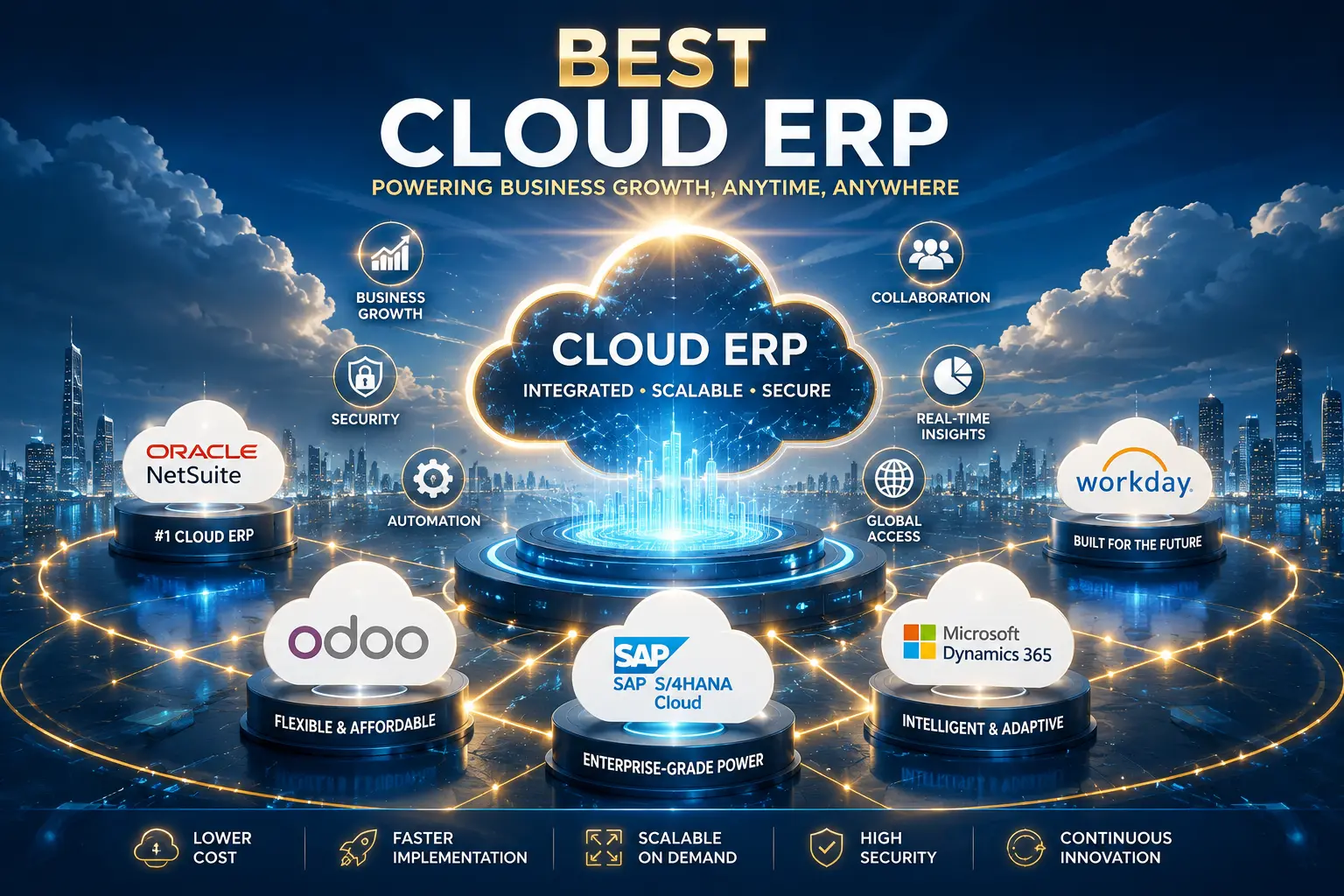

Best Cloud ERP Systems (2026): Top Platforms Compared for Businesses

Best Cloud ERP

Best Cloud ERP Systems

Quick Verdict

If you want flexibility and scalability โ†’ Odoo is the best cloud ERP overall.

If you need a premium enterprise solution โ†’ NetSuite is the top choice.

If you want deep enterprise customization โ†’ SAP S/4HANA Cloud is ideal.

๐Ÿ‘‰ The best cloud ERP depends on your business size, budget, and growth strategy.


Introduction

Cloud ERP systems have become the backbone of modern businesses in 2026. Companies are rapidly moving away from on-premise solutions toward cloud-based platforms that offer scalability, flexibility, and lower infrastructure costs.

Choosing the best cloud ERP system is not just about featuresโ€”itโ€™s about long-term ROI, performance, and adaptability in a competitive market.


Core Differences

Cloud ERP systems differ in architecture, pricing models, and target users.

  • Odoo: Modular cloud ERP with flexible pricing and scalability.
  • NetSuite: Fully integrated cloud ERP for growing and mid-sized businesses.
  • SAP S/4HANA Cloud: Enterprise-grade ERP with advanced capabilities.
  • Microsoft Dynamics 365: Strong integration with Microsoft ecosystem.
  • Oracle Cloud ERP: High-performance cloud ERP for enterprises.

๐Ÿ‘‰ Businesses should focus on scalability, ease of integration, and long-term cost efficiency.


Pricing Comparison (2026)

Cloud ERP pricing varies significantly depending on features and scale.

Odoo Pricing: Free community version with optional paid apps.

NetSuite Pricing: Subscription-based with higher entry cost.

SAP Cloud Pricing: Premium enterprise pricing with complex structure.

Microsoft Dynamics 365 Pricing: Subscription-based with modular pricing.

Oracle Cloud ERP Pricing: Subscription-based with enterprise-level costs.

๐Ÿ’ก ROI Insight: Cloud ERP reduces infrastructure costs and improves efficiency, resulting in faster ROI compared to on-premise systems.

๐Ÿ’ก Hidden Cost Insight: Implementation, customization, and integration costs can significantly increase total investment.


Pros and Cons

Odoo Pros:

  • Highly flexible and customizable
  • Affordable starting cost
  • Large app ecosystem

Odoo Cons:

  • Costs increase with scaling
  • Requires configuration

NetSuite Pros:

  • Fully integrated cloud ERP
  • Strong financial management
  • Scalable for growth

NetSuite Cons:

  • High cost
  • Requires implementation partner

SAP Cloud Pros:

  • Enterprise-grade capabilities
  • Deep customization
  • Strong industry solutions

SAP Cloud Cons:

  • Very expensive
  • Complex implementation

Microsoft Dynamics 365 Pros:

  • Seamless integration with Microsoft tools
  • Flexible pricing model
  • Strong business applications

Microsoft Dynamics 365 Cons:

  • Complex licensing
  • Customization required for advanced use

Oracle Cloud ERP Pros:

  • High performance and scalability
  • Strong analytics capabilities
  • Enterprise-ready

Oracle Cloud ERP Cons:

  • Premium pricing
  • Requires expert implementation

Comparison Table

ERP Pricing Ease of Use Scalability Best For
Odoo Low โ†’ Medium High High SMBs & startups
NetSuite High High Very High Growing businesses
SAP Cloud Very High Moderate Very High Enterprises
Dynamics 365 Medium โ†’ High High High Microsoft users
Oracle Cloud ERP High Moderate Very High Large enterprises

Use Cases

  • Startups: Odoo for flexibility and low cost.
  • Growing companies: NetSuite or Dynamics 365.
  • Large enterprises: SAP Cloud or Oracle ERP.

Real-World Example

A startup may choose Odoo to build operations with minimal cost and scale gradually.

A mid-sized company may adopt NetSuite to unify operations and improve efficiency.

A global enterprise may implement SAP Cloud to manage complex workflows and compliance.

๐Ÿ‘‰ Insight: The best cloud ERP evolves with your business growth.


Scalability & Performance

Cloud ERP systems are designed for scalability and performance.

  • Odoo: Scales through modular apps.
  • NetSuite: Scales through unified cloud architecture.
  • SAP Cloud: Handles large enterprise workloads.
  • Dynamics 365: Scales with Microsoft ecosystem.
  • Oracle Cloud ERP: Optimized for high-performance operations.

๐Ÿ‘‰ Choosing a scalable ERP prevents costly migrations in the future.


Hidden Costs You Should Know

Cloud ERP systems come with hidden costs that businesses often overlook.

  • Implementation and onboarding
  • Customization and integration
  • Training and support

๐Ÿ‘‰ These costs directly impact total cost of ownership (TCO).


Future Trends in Cloud ERP

Cloud ERP is evolving rapidly in 2026.

  • AI-powered automation
  • Real-time analytics
  • Subscription-based pricing dominance

๐Ÿ‘‰ Businesses adopting modern cloud ERP gain a competitive advantage.


Which Should You Choose?

  • Choose Odoo if: you want flexibility and affordability.
  • Choose NetSuite if: you need a complete cloud ERP.
  • Choose SAP Cloud if: you need enterprise-level power.
  • Choose Dynamics 365 if: you rely on Microsoft tools.
  • Choose Oracle ERP if: you need high-performance enterprise systems.

๐Ÿ‘‰ ERP selection is a strategic decision that impacts long-term growth.

Frequently Asked Questions (FAQ)

1. Why should my enterprise choose a cloud-based ERP over an on-premise solution in 2026? Cloud ERP solutions provide superior scalability, lower total cost of ownership (TCO) by eliminating complex hardware maintenance, and seamless access to AI-driven predictive insights. For modern enterprises, cloud-native platforms are essential for maintaining agility in a competitive global market.

2. Which ERP system is best for a high-growth company scaling internationally? There is no “one-size-fits-all” solution, but leading platforms like SAP S/4HANA, Odoo Enterprise, and Oracle NetSuite are top contenders for global scaling. When choosing, prioritize systems that offer multi-entity support, robust regulatory compliance, and native interoperability with your existing tech stack.

3. How does PT Dominasi Serp Indonesia assess the ROI of an ERP implementation? We evaluate ROI by auditing your digital infrastructure to identify operational bottlenecks and hidden costs. Our assessment focuses on how well an ERP improves workflow automation, inventory synchronization, and data accuracyโ€”all of which are critical for maximizing your long-term business performance.

4. Is it necessary to integrate my ERP with other business tools like CRM or e-commerce platforms? Yes, integration is critical. For instance, linking your ERP with platforms like Shopify allows for real-time inventory synchronization and automated order fulfillment. A seamless digital foundation ensures your infrastructure supports high-volume transactions without sacrificing data integrity.

5. How do I start a migration roadmap to a modern ERP system? A successful migration requires a robust technical strategy that prioritizes data integrity and performance. We recommend starting with a detailed architecture audit to mitigate risks, followed by a phased transition to ensure sub-second performance and minimized operational downtime during the shift from legacy systems.


Final Recommendation

In 2026, Odoo remains the best cloud ERP for most businesses due to its flexibility and cost efficiency, while NetSuite and SAP Cloud dominate in enterprise environments.


Conclusion

The best cloud ERP system depends on your business size, budget, and growth strategy. Choosing the right platform ensures long-term efficiency and scalability.

Avoiding ERP Implementation Failure: A Strategic Guide for Business Owners

ERP Implementation Failure –ย  For the modern enterprise, an Enterprise Resource Planning (ERP) system is not merely a software suite; it is the digital scaffolding upon which the entire organization rests. Yet, the road to digital transformation is littered with the wreckage of failed implementations. Industry data suggests that nearly 50% of ERP projects fail the first time around, often resulting in costs that exceed budgets by three or four times. For a CEO or business owner, an ERP failure is more than a technical glitchโ€”it is a strategic crisis that can paralyze operations and erode shareholder value.

The transition to systems like SAP, Odoo, or Microsoft Dynamics requires more than financial capital; it demands a fundamental shift in leadership philosophy. To ensure your investment yields a high ROI and strengthens your competitive moat, you must navigate the implementation with a consultantโ€™s precision and a visionaryโ€™s foresight.

ADVERTISEMENT / SPONSORED SOLUTION

Reliable resources for your business growth

ADVERTISEMENT / SPONSORED SOLUTION

Reliable resources for your business growth

The Root Causes of Executive-Level Failure

Most ERP projects do not fail because the software is “broken.” They fail because of a disconnect between the boardroomโ€™s expectations and the reality of organizational change.

  • Lack of Strategic Alignment: When an ERP is treated as an “IT project” rather than a “business transformation,” it is doomed. If the software does not directly serve your 5-year growth plan, it is a liability.

  • Poor Data Hygiene: Migrating “dirty” data into a new, sophisticated system is like putting low-grade fuel into a Ferrari. The result is an expensive machine that underperforms.

  • Underestimating Change Management: The greatest resistance to a new ERP isn’t the code; itโ€™s the culture. Without a clear strategy to bring your human capital along for the ride, user adoption will plummet.

The Strategic Framework for Success

To safeguard your organization, leadership must adopt a three-pillar approach: Preparation, Governance, and Optimization.

1. Define Your ‘North Star’ Metrics Before signing a contract with a vendor, define what success looks like in terms of ROI. Are you looking to reduce DSO (Days Sales Outstanding)? Do you need to consolidate multi-company financial reporting in real-time? By identifying these Key Performance Indicators (KPIs) early, you ensure the implementation partner focuses on business outcomes rather than just “going live.”

2. The Power of the Internal ‘Dream Team’ A successful implementation requires your best people, not just your available people. You need a dedicated task force led by a high-ranking executive who has the authority to make cross-departmental decisions. This team bridges the gap between the technical implementers and the strategic vision of the C-suite.

3. Phased Implementation vs. ‘Big Bang’ For large-scale enterprises, the “Big Bang” approachโ€”flipping the switch for all modules at onceโ€”is high-risk. A phased rollout allows for iterative learning, minimizes operational disruption, and provides “quick wins” that build organizational confidence.

Navigating the Mid-Project Slump

Every major implementation hits a “valley of despair” where costs rise and productivity temporarily dips. This is where leadership is tested. A strategic CEO uses this time to reinforce the vision, ensuring that the organization does not revert to manual workarounds. Transparency in communication during this phase is vital to maintaining the trust of stakeholders and high-net-worth investors.

Post-Implementation: The Optimization Phase

“Live” is not the finish line; it is the starting block. The true value of an ERP is realized in the months following implementation through continuous optimization. Leveraging the data insights provided by the system allows the C-suite to move from reactive management to predictive strategy. Whether itโ€™s optimizing supply chains through AI integration or personalizing customer journeys via CRM data, the ERP is the engine for this evolution.

Conclusion

By understanding common causes of ERP Implementation Failure, companies can take proactive measures to safeguard their investment.

Avoiding ERP failure requires a shift in perspective: see it not as a cost center, but as a strategic asset. By prioritizing data integrity, cultural alignment, and clear business objectives, owners can transform their operations into a lean, scalable, and data-driven powerhouse. In the era of hyper-competition, the question is not whether you can afford a top-tier ERP, but whether you can afford to fail at implementing one.

Top Rated Odoo vs SAP Analysis

Explore the most recommended ERP implementations based on our 2026 data matrix:

Need custom ERP consulting? Contact our experts.