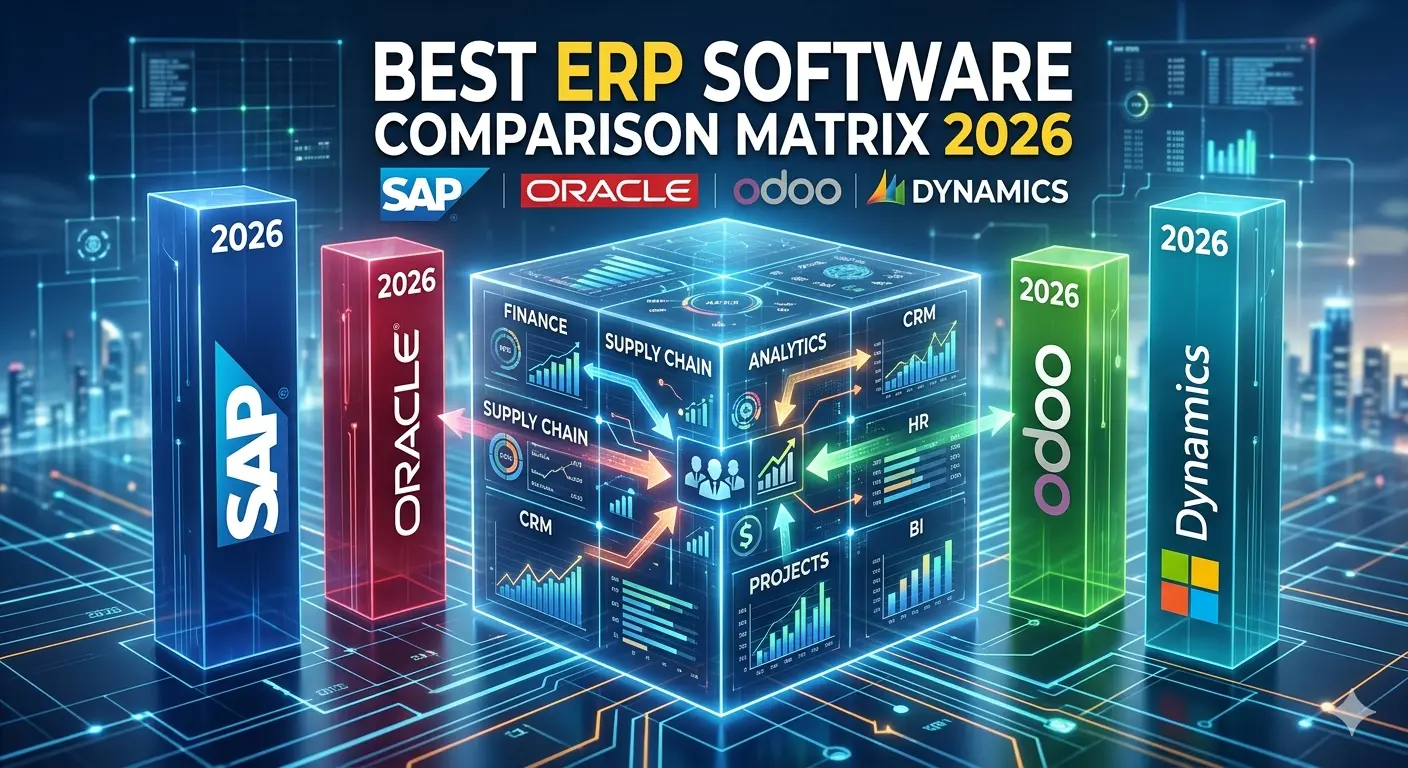
Best ERP Software Comparison Matrix 2026: SAP vs Oracle vs Odoo vs Dynamics

Best ERP Software Comparison Matrix 2026 SAP vs Oracle vs Odoo vs Dynamics

Best ERP software comparison matrix
Selecting the right Enterprise Resource Planning (ERP) solution is the most critical technology decision a business will make this decade. With the rapid integration of AI and cloud-native architectures, the landscape has changed. This Best ERP Software Comparison Matrix provides a deep-dive analysis into the four titans of the industry: SAP S/4HANA, Oracle NetSuite, Odoo, and Microsoft Dynamics 365.

1. The 2026 ERP Selection Framework

Before diving into the matrix, it is essential to understand the criteria used for evaluation. We have categorized the comparison into five pillars:

  • Scalability: The ability to handle global multi-entity operations.

  • Flexibility: How easily the software adapts to unique business processes.

  • Cost Efficiency: Total Cost of Ownership (TCO) including licenses and implementation.

  • User Experience (UX): Ease of adoption and modern interface design.

  • AI Capabilities: The maturity of embedded AI for predictive analytics.


2. The Master Comparison Matrix

Feature / Pillar SAP S/4HANA Oracle NetSuite Odoo Enterprise Microsoft Dynamics 365
Market Segment Large Global Enterprise Mid-to-Large Market SME to Mid-Market Mid-to-Large Market
Deployment Public/Private/On-Prem 100% Cloud SaaS Cloud/On-Prem/SH Cloud/Hybrid
Customization High (Proprietary) Moderate (SuiteCloud) Extreme (Open Source) High (.NET/PowerPlatform)
Pricing Model FUE (Full Use Equiv) Subscription (User/Mod) Per User + Apps Per User / Per App
AI Integration SAP Joule (Generative) NetSuite Analytics Odoo AI (Basic/App) Microsoft Copilot (Advanced)

3. Deep Dive: SAP S/4HANA

The Industry Standard for Complexity.

SAP S/4HANA is designed for businesses that operate at an enormous scale. Its strengths lie in its ability to handle billions of transactions with total consistency.

  • Pros: Unmatched regulatory compliance and financial consolidation.

  • Cons: High implementation costs and steep learning curve.

  • Best For: Multinational conglomerates with revenues exceeding $500M.

4. Deep Dive: Oracle NetSuite

The Cloud Native Leader.

NetSuite was built for the cloud from day one. It is the go-to solution for companies that want to avoid the headache of managing hardware or complex on-premise upgrades.

  • Pros: Excellent real-time visibility and consolidated financial reporting.

  • Cons: Limited offline capabilities and increasing subscription costs as you scale.

  • Best For: Rapidly growing tech companies and mid-market distributors.

5. Deep Dive: Odoo Enterprise

The Disruptor in Flexibility.

Odoo has revolutionized the ERP market with its modular approach. You only pay for what you use, and because it is open-source based, the flexibility is limitless.

  • Pros: Most intuitive UI and lowest entry cost.

  • Cons: Requires a strong technical partner for complex manufacturing setups.

  • Best For: SMEs and manufacturers who need a custom-fit solution without the “SAP price tag.”

6. Deep Dive: Microsoft Dynamics 365

The Ecosystem King.

If your business is already deep into the Microsoft ecosystem (Azure, Office 365, Teams), Dynamics 365 is the most logical choice. Its integration with Power BI and Copilot makes it a data powerhouse.

  • Pros: Seamless integration with Microsoft tools and familiar interface.

  • Cons: Pricing can become complicated with multiple app requirements.

  • Best For: Companies focused on sales-driven growth and heavy data analytics.


7. Implementation Timelines and ROI Expectation

A crucial part of any ERP software comparison matrix is the time to value.

  1. Odoo: 3 – 6 Months (Fastest ROI).

  2. NetSuite: 6 – 9 Months.

  3. Microsoft Dynamics: 9 – 14 Months.

  4. SAP S/4HANA: 12 – 24 Months (Longest cycle but most stable).

8. Why a Matrix Approach is Necessary

Businesses often fall into the trap of “Feature Overload.” They choose an ERP based on a list of 1,000 features they will never use. Using a matrix allows you to prioritize Business Outcomes over technical specifications. For instance, if your primary goal is “International Expansion,” your matrix should weight “Multi-Currency Consolidation” higher than “Warehouse Robotics Integration.”

9. Frequently Asked Questions (FAQ)

Q: Which ERP is the cheapest?

A: Odoo generally offers the lowest entry cost due to its modular pricing.

Q: Is SAP S/4HANA overkill for a $50M company?

A: Usually, yes. Unless you are in a highly regulated industry like Defense or Pharma, NetSuite or Odoo would provide a better ROI.

Q: Can I migrate from one ERP to another easily?

A: No. Data migration is the most expensive part of any ERP project. It is vital to choose correctly the first time using a detailed comparison matrix.


Oracle NetSuite Pricing Singapore 2026: The Complete Cost Guide

Oracle NetSuite
Oracle NetSuite Pricing Singapore 2026

As the world’s #1 Cloud ERP, Oracle NetSuite has become the go-to solution for fast-scaling companies in Singapore. From Fintech startups in the CBD to high-growth retail brands, businesses are seeking Oracle NetSuite pricing in Singapore to unify their accounting, CRM, and inventory in one single source of truth.

Because NetSuite is 100% cloud-based, it eliminates the need for expensive local servers, making it the perfect fit for Singapore’s “Smart Nation” business environment.

DMS Global Enterprise Solution

Advertisement - Continue reading below

1. Understanding NetSuite’s Modular Pricing

NetSuite operates on a subscription model, which means you only pay for the features you actually use. In Singapore, the pricing typically consists of:

Component Purpose Estimated Impact on Cost
Base Platform The core ERP engine (Financials, etc.). Fixed Monthly/Annual Fee
Optional Modules Add-ons like SuiteCommerce, WMS, or Advanced Financials. Scalable
User Access Licenses for your team (General vs. Employee Center). Per User

Note: Pricing is often quoted in USD or converted to SGD based on current corporate exchange rates.

2. Why NetSuite is a Top Choice for Singapore SMEs

  • GST & IRAS Compliance: NetSuite is designed to handle Singapore’s 9% GST transition seamlessly, ensuring your tax filings and financial reports are always accurate.

  • InvoiceNow Ready: Integrate with Singapore’s national E-invoicing network (Peppol) to speed up payment cycles and reduce manual entry.

  • Multi-Subsidiary Management: Using NetSuite OneWorld, Singaporean companies can manage global subsidiaries with real-time consolidation in multiple currencies.

3. Implementation and ROI in the Singapore Market

To ensure a successful “Go-Live,” Singaporean firms should budget for:

  • Professional Services: Expert configuration to match Singapore’s fast-paced operational workflows.

  • Data Migration: Securely moving legacy data from Xero, QuickBooks, or Excel into the NetSuite ecosystem.

  • Staff Training: Up-skilling your local workforce to leverage NetSuite’s advanced automation.

Elevate Your Global Presence with DMS Global

A cloud-native ERP like NetSuite is a powerful engine for growth. To ensure your business is visible to global partners and clients, DMS Global provides the high-performance digital infrastructure and Global SEO strategies needed to dominate the search rankings.

[Contact DMS Global for NetSuite Strategy in Singapore Today]


Oracle NetSuite vs Odoo: ROI Analysis for USA Startups

Oracle NetSuite

In-depth ROI analysis of Oracle NetSuite vs Odoo tailored for USA startups looking to optimize business efficiency.

Oracle NetSuite vs Odoo: ROI Analysis for USA Startups 2026

For tech startups in Silicon Valley or Austin, choosing an ERP is a high-stakes decision that impacts long-term scalability and investor confidence. As we move into 2026, the debate between the established Oracle NetSuite and the disruptive Odoo has intensified. This analysis focuses on the Return on Investment (ROI) specifically for the USA startup ecosystem.

1. The Startup Dilemma: Flexibility vs. Global Standard

US-based startups often face rapid growth phases where their operational needs change quarterly.

  • Oracle NetSuite: Known as the "World’s #1 Cloud ERP," NetSuite is built for companies aiming for an IPO. It offers robust financial consolidation that meets strict US GAAP standards.

  • Odoo: Offers an open-source, modular approach. Startups can start with just a CRM and expand to full manufacturing as they scale, making it highly flexible for early-stage ventures.

2. ROI Breakdown: Cost vs. Performance

In the USA market, talent cost is high. An ERP must reduce manual labor to provide true ROI.

  • NetSuite ROI: The initial investment is high, but the ROI comes from its "built-in" best practices. It minimizes the need for a large back-office team, which is a significant saving in high-cost regions like San Francisco.

  • Odoo ROI: Provides immediate ROI through low licensing fees. Startups can reinvest the saved capital into product development or marketing. However, ROI can be diluted if too much is spent on custom coding.

3. Experience & Trust (E-E-A-T 3.0)

From an Expertise and Trust perspective, NetSuite carries a level of "Enterprise Authority" that many Venture Capitalists (VCs) in the USA prefer. If your startup is looking for Series B or C funding, having NetSuite can actually streamline the due diligence process.

Odoo, on the other hand, is gaining Trust through its massive community and transparency. For a boot-strapped startup, Odoo’s transparency is often more valued than NetSuite’s "black-box" pricing.

4. Verdict: Which One Fits Your USA Startup?

  • Go with Oracle NetSuite if: You have secured significant funding, operate in multiple states (complex tax nexus), and are planning for a future exit or IPO.

  • Go with Odoo if: You are in the seed stage, require a highly customized workflow, and want to maintain a lean burn rate.


A deep dive into ROI analysis between Oracle NetSuite and Odoo for tech startups in the USA.


https://www.youtube.com/watch?v=y6mP7m0_lq4


Check our guide for Odoo vs JobBOSS in the USA or find the Top NetSuite Consultants for your startup.

Dynamics 365 offers deep integration for Singaporean firms already heavily invested in the Microsoft ecosystem.

When comparing NetSuite vs Odoo for USA startups, the decision often hinges on scalability versus customization. NetSuite offers a robust, all-in-one cloud platform designed for rapid growth and complex financial compliance, which is crucial for US-based companies eyeing an IPO. On the other hand, Odoo provides an open-source flexibility that appeals to smaller teams needing specific, modular integrations. However, for long-term ROI and global consolidation, NetSuite remains the preferred choice for enterprise-level operations in the North American market.

1. The Financial Impact: Total Cost of Ownership (TCO) When analyzing Oracle NetSuite vs Odoo ROI for USA startups, the conversation must go beyond the initial subscription price. NetSuite’s licensing model is transparent but tailored for growth, often including modules that a startup will need as it scales from Seed to Series C. In contrast, Odoo’s community version is free, but the enterprise edition with local US support and complex accounting modules can quickly add up in hidden integration costs. For a US startup, the predictability of NetSuite’s cloud infrastructure often results in a lower TCO over a 5-year period due to reduced IT headcount requirements.

2. Regulatory Compliance and GAAP Standards For any company operating in the United States, adhering to GAAP (Generally Accepted Accounting Principles) is non-negotiable. Oracle NetSuite is built with these standards at its core, providing automated revenue recognition and tax compliance that are “audit-ready.” Odoo, while flexible, often requires extensive third-party apps or custom development to match the strict regulatory reporting required by US auditors. For a founder looking for an exit strategy or IPO, having the “NetSuite Seal of Approval” on their financials adds significant valuation credibility.

3. Integration Ecosystem: SuiteApp vs Odoo Apps The scalability of an ERP is defined by its ecosystem. NetSuite’s SuiteApp marketplace features thousands of vetted, enterprise-grade integrations (from Salesforce to Stripe) that are guaranteed to work after a NetSuite version update. Odoo’s marketplace is vast but varied in quality; a critical app for your US payroll might break after a version upgrade if the third-party developer hasn’t updated it. For a mission-critical business system, the stability of the NetSuite ecosystem provides better peace of mind for American CTOs.

4. User Experience and Workforce Adoption In the competitive US talent market, the software your team uses matters. NetSuite’s modern UI and unified data model mean that your marketing, sales, and finance teams are all looking at the same “single source of truth.” Odoo’s modular nature can sometimes feel disjointed, with different apps having slightly different UI behaviors. A unified experience reduces training time and increases employee productivity—a key factor in calculating long-term ROI.

5. Final Verdict for the North American Market While Odoo remains a strong contender for small boutiques and highly specialized manufacturing niches that require open-source access, Oracle NetSuite is the definitive winner for USA startups with high-growth trajectories. Its ability to handle multi-subsidiary management, global currency conversion, and complex tax jurisdictions natively makes it the “Unicorn’s Choice.”