
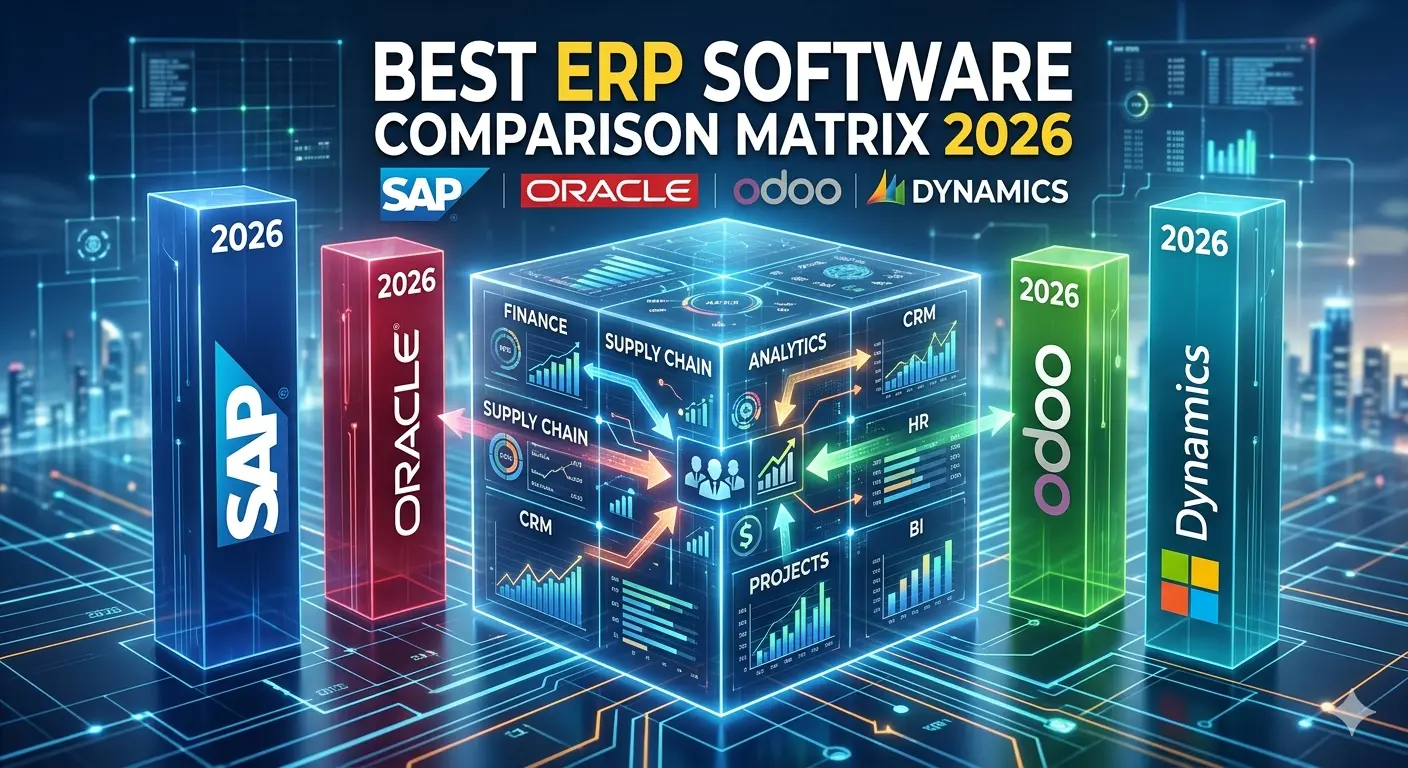
Best ERP software comparison matrix
Selecting the right Enterprise Resource Planning (ERP) solution is the most critical technology decision a business will make this decade. With the rapid integration of AI and cloud-native architectures, the landscape has changed. This Best ERP Software Comparison Matrix provides a deep-dive analysis into the four titans of the industry: SAP S/4HANA, Oracle NetSuite, Odoo, and Microsoft Dynamics 365.
1. The 2026 ERP Selection Framework
Before diving into the matrix, it is essential to understand the criteria used for evaluation. We have categorized the comparison into five pillars:
-
Scalability: The ability to handle global multi-entity operations.
-
Flexibility: How easily the software adapts to unique business processes.
-
Cost Efficiency: Total Cost of Ownership (TCO) including licenses and implementation.
-
User Experience (UX): Ease of adoption and modern interface design.
-
AI Capabilities: The maturity of embedded AI for predictive analytics.
2. The Master Comparison Matrix
| Feature / Pillar | SAP S/4HANA | Oracle NetSuite | Odoo Enterprise | Microsoft Dynamics 365 |
| Market Segment | Large Global Enterprise | Mid-to-Large Market | SME to Mid-Market | Mid-to-Large Market |
| Deployment | Public/Private/On-Prem | 100% Cloud SaaS | Cloud/On-Prem/SH | Cloud/Hybrid |
| Customization | High (Proprietary) | Moderate (SuiteCloud) | Extreme (Open Source) | High (.NET/PowerPlatform) |
| Pricing Model | FUE (Full Use Equiv) | Subscription (User/Mod) | Per User + Apps | Per User / Per App |
| AI Integration | SAP Joule (Generative) | NetSuite Analytics | Odoo AI (Basic/App) | Microsoft Copilot (Advanced) |
3. Deep Dive: SAP S/4HANA
The Industry Standard for Complexity.
SAP S/4HANA is designed for businesses that operate at an enormous scale. Its strengths lie in its ability to handle billions of transactions with total consistency.
-
Pros: Unmatched regulatory compliance and financial consolidation.
-
Cons: High implementation costs and steep learning curve.
-
Best For: Multinational conglomerates with revenues exceeding $500M.
4. Deep Dive: Oracle NetSuite
The Cloud Native Leader.
Executive Deep-Dive
Scaling Beyond Traffic to Revenue
Most enterprises fail because they chase clicks instead of trust. While building your global presence, ensure your EEAT 3.0 signals are synchronized across all regions.
Recommended for you:
→ The Shift from Traffic to Trust: A New KPI for Enterprise SEONetSuite was built for the cloud from day one. It is the go-to solution for companies that want to avoid the headache of managing hardware or complex on-premise upgrades.
-
Pros: Excellent real-time visibility and consolidated financial reporting.
-
Cons: Limited offline capabilities and increasing subscription costs as you scale.
-
Best For: Rapidly growing tech companies and mid-market distributors.
5. Deep Dive: Odoo Enterprise
The Disruptor in Flexibility.
Odoo has revolutionized the ERP market with its modular approach. You only pay for what you use, and because it is open-source based, the flexibility is limitless.
-
Pros: Most intuitive UI and lowest entry cost.
-
Cons: Requires a strong technical partner for complex manufacturing setups.
-
Best For: SMEs and manufacturers who need a custom-fit solution without the “SAP price tag.”
6. Deep Dive: Microsoft Dynamics 365
The Ecosystem King.
If your business is already deep into the Microsoft ecosystem (Azure, Office 365, Teams), Dynamics 365 is the most logical choice. Its integration with Power BI and Copilot makes it a data powerhouse.
-
Pros: Seamless integration with Microsoft tools and familiar interface.
-
Cons: Pricing can become complicated with multiple app requirements.
-
Best For: Companies focused on sales-driven growth and heavy data analytics.
7. Implementation Timelines and ROI Expectation
A crucial part of any ERP software comparison matrix is the time to value.
-
Odoo: 3 – 6 Months (Fastest ROI).
-
NetSuite: 6 – 9 Months.
-
Microsoft Dynamics: 9 – 14 Months.
-
SAP S/4HANA: 12 – 24 Months (Longest cycle but most stable).
8. Why a Matrix Approach is Necessary
Businesses often fall into the trap of “Feature Overload.” They choose an ERP based on a list of 1,000 features they will never use. Using a matrix allows you to prioritize Business Outcomes over technical specifications. For instance, if your primary goal is “International Expansion,” your matrix should weight “Multi-Currency Consolidation” higher than “Warehouse Robotics Integration.”
9. Frequently Asked Questions (FAQ)
Q: Which ERP is the cheapest?
A: Odoo generally offers the lowest entry cost due to its modular pricing.
Q: Is SAP S/4HANA overkill for a $50M company?
A: Usually, yes. Unless you are in a highly regulated industry like Defense or Pharma, NetSuite or Odoo would provide a better ROI.
Q: Can I migrate from one ERP to another easily?
A: No. Data migration is the most expensive part of any ERP project. It is vital to choose correctly the first time using a detailed comparison matrix.
Last Updated on 4 months ago by dudung
Exclusive Early Access: Q1 2026
The Global SEO Blueprint for C-Suite
We are finalizing an exclusive strategic framework for global enterprise scaling. Join the elite waitlist for early-bird pricing.
Secure Your Priority Spot