
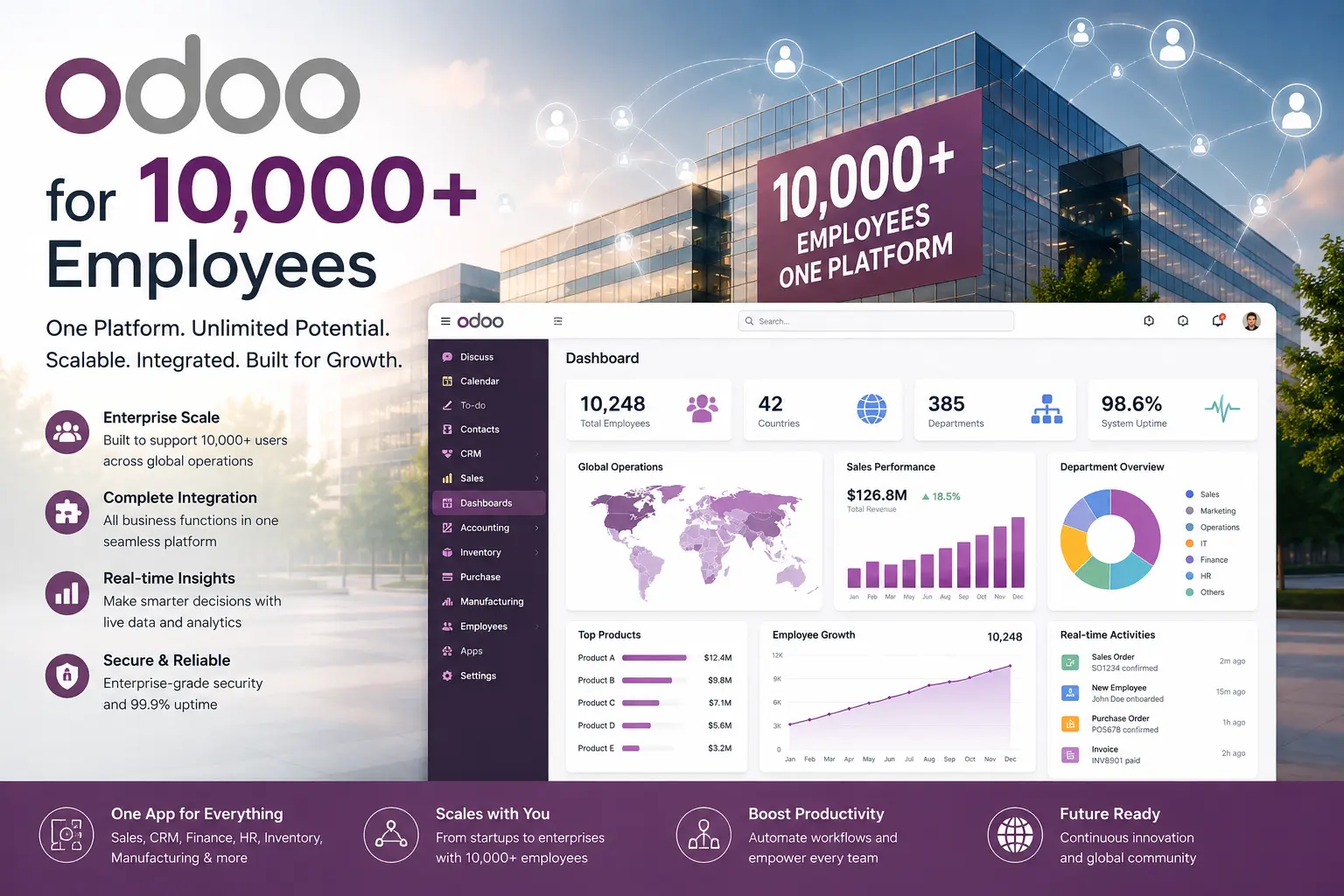
Odoo for 10K Employees
Odoo for Enterprises with 10,000+ Employees: Scalability, Infrastructure, and Cost Considerations
Odoo can scale to support enterprises with 10,000+ employees. However, scaling an ERP system to this level is not simply about installing software — it requires careful planning of infrastructure, architecture design, governance, and long-term cost strategy.
This guide explores how Odoo performs at enterprise scale, what challenges appear when managing large organizations, and what decision-makers should consider before deploying ERP at this level.
🏢 Why ERP Matters for 10,000+ Employee Organizations
When a company grows beyond 10,000 employees, operational complexity increases exponentially. Departments become distributed across regions, workflows become fragmented, and data consistency becomes a major challenge.
At this scale, ERP systems like Odoo are not optional — they become the backbone of business operations.
Executive Deep-Dive
Scaling Beyond Traffic to Revenue
Most enterprises fail because they chase clicks instead of trust. While building your global presence, ensure your EEAT 3.0 signals are synchronized across all regions.
Recommended for you:
→ The Shift from Traffic to Trust: A New KPI for Enterprise SEOKey reasons enterprises adopt ERP at this scale include:
- Centralized financial control across multiple subsidiaries
- Standardized business processes across departments
- Real-time visibility of operations and performance
- Reduced dependency on manual reporting systems
- Improved compliance and governance
⚙️ Can Odoo Really Handle 10,000+ Employees?
Yes — Odoo can handle enterprise-scale deployments, but performance depends heavily on system architecture and implementation quality.
Odoo is modular and highly scalable when properly configured with:
- Load-balanced server architecture
- PostgreSQL optimization
- Cloud or hybrid infrastructure setup
- Caching mechanisms (Redis or similar)
- Proper database indexing strategy
Without proper architecture, even powerful ERP systems can experience performance bottlenecks under heavy enterprise load.
🧠 Key Infrastructure Requirements for Enterprise Odoo
Scaling Odoo for 10,000+ employees requires enterprise-grade infrastructure planning.
1. Server Architecture
- Multi-server deployment (application + database separation)
- Load balancer to distribute traffic
- Failover system for high availability
2. Database Optimization
- Partitioning large datasets
- Query optimization for heavy transactions
- Regular database maintenance and indexing
3. Cloud Scalability
- Auto-scaling cloud infrastructure (AWS, Azure, GCP)
- Disaster recovery setup
- Multi-region deployment for global companies
💰 Cost Considerations for Enterprise Odoo Deployment
ERP cost at enterprise scale is significantly different from SME implementations. Costs increase not only due to licensing, but also infrastructure, customization, and ongoing maintenance.
Main cost components include:
- Software licensing (Enterprise Odoo subscription)
- Infrastructure and cloud hosting
- ERP implementation partner fees
- Customization and module development
- Training for large employee base
- Ongoing support and maintenance
For enterprises with 10,000+ employees, ERP cost is typically driven more by complexity than software pricing itself.
📊 Performance Challenges at Enterprise Scale
While Odoo is scalable, enterprise deployments may face several challenges:
- High transaction volume causing database load spikes
- Complex approval workflows slowing processes
- Integration with legacy systems
- Data synchronization across multiple regions
- User access control complexity
These challenges are not limitations of Odoo itself, but rather design and architecture issues in large deployments.
🔐 Governance and Security in Large ERP Systems
At 10,000+ employee scale, security and governance become critical.
Enterprises must implement:
- Role-based access control (RBAC)
- Audit trails for financial transactions
- Data encryption at rest and in transit
- Strict approval workflows
- Compliance with industry regulations (ISO, GDPR, etc.)
📈 Business Impact of Odoo at Enterprise Level
When properly implemented, Odoo delivers significant value to large organizations:
- Faster financial consolidation across subsidiaries
- Reduced operational redundancy
- Improved decision-making speed for executives
- Better visibility into global operations
- Higher productivity across departments
Additional Content for Odoo Scale & Enterprise Performance
Implementing an enterprise-grade ERP system like Odoo for 10K employees requires meticulous database tuning, robust server architecture, and a structured deployment strategy. When user concurrency hits massive scales, default configurations are rarely sufficient. Businesses must transition from standard shared hosting or basic VPS setups to dedicated cloud clusters, load balancers, and optimized PostgreSQL instances to guarantee lightning-fast response times across every department.
Database Optimization and High Availability
For an organization supporting ten thousand daily active users, the underlying database is the heartbeat of operations. Partitioning large tables, implementing read replicas for reporting queries, and configuring connection pooling via PgBouncer will drastically reduce server load. Ensuring that heavy background jobs—such as MRP scheduling, large inventory valuations, and automated payroll processing—run during off-peak hours helps maintain seamless front-end performance for customer-facing teams and internal staff alike.
Modular Rollout Strategy and User Adoption
Managing change across a massive workforce requires a phased departmental rollout rather than a sudden global switch. Starting with core modules like finance, inventory, and procurement before expanding into advanced manufacturing, CRM, and custom project management allows IT teams to monitor system stability closely. Providing comprehensive training materials and localized documentation ensures that employees across all branches adapt quickly to the new workflow, minimizing operational friction and maximizing return on investment.
Security, Compliance, and Role-Based Access Control
Data governance becomes increasingly critical as organization sizes scale. Implementing strict role-based access control (RBAC), multi-factor authentication (MFA), and automated daily encrypted backups safeguard sensitive corporate data against breaches or accidental loss. Regular security audits and keeping custom modules updated against the latest framework patches ensure long-term stability and regulatory compliance.
Additional Content for Odoo Scale & Enterprise Performance
Implementing an enterprise-grade ERP system like Odoo for 10K employees requires meticulous database tuning, robust server architecture, and a structured deployment strategy. When user concurrency hits massive scales, default configurations are rarely sufficient. Businesses must transition from standard shared hosting or basic VPS setups to dedicated cloud clusters, load balancers, and optimized PostgreSQL instances to guarantee lightning-fast response times across every department.
Database Optimization and High Availability
For an organization supporting ten thousand daily active users, the underlying database is the heartbeat of operations. Partitioning large tables, implementing read replicas for reporting queries, and configuring connection pooling via PgBouncer will drastically reduce server load. Ensuring that heavy background jobs—such as MRP scheduling, large inventory valuations, and automated payroll processing—run during off-peak hours helps maintain seamless front-end performance for customer-facing teams and internal staff alike.
Modular Rollout Strategy and User Adoption
Managing change across a massive workforce requires a phased departmental rollout rather than a sudden global switch. Starting with core modules like finance, inventory, and procurement before expanding into advanced manufacturing, CRM, and custom project management allows IT teams to monitor system stability closely. Providing comprehensive training materials and localized documentation ensures that employees across all branches adapt quickly to the new workflow, minimizing operational friction and maximizing return on investment.
Security, Compliance, and Role-Based Access Control
Data governance becomes increasingly critical as organization sizes scale. Implementing strict role-based access control (RBAC), multi-factor authentication (MFA), and automated daily encrypted backups safeguard sensitive corporate data against breaches or accidental loss. Regular security audits and keeping custom modules updated against the latest framework patches ensure long-term stability and regulatory compliance.
🧠 Final Insight
Odoo can scale to support enterprises with 10,000+ employees, but success depends on architecture, governance, and implementation strategy — not just software capability.
In enterprise environments, ERP is not just a tool. It becomes a strategic backbone that determines how efficiently a company operates at global scale.
Scalability is not about software limits — it is about system design.
ADVERTISEMENT / SPONSORED SOLUTIONReliable resources for your business growth
🚀 Deep Dive Enterprise Resources
If you're evaluating Enterprise Resource Planning, leverage our technical ROI breakdowns and performance benchmarks:
- 👉 Odoo Enterprise Pricing 2026: The Ultimate Guide
- 👉 SAP to Odoo Migration: Risks & Benefits
- 👉 Maximizing ROI with Oracle NetSuite Implementation
*Verified for 2026 Enterprise Standards.
DMS Global AuthorityADVERTISEMENT / SPONSORED SOLUTIONReliable resources for your business growth
ADVERTISEMENT / SPONSORED SOLUTIONReliable resources for your business growth
⚡ DMS Global Amazon Authority 2026:
- 🚀 Amazon Review: Bentgo Kids Lunch Box Review
- 📊 Product Comparison: Best Lunch Boxes for Kids
- ⚔️ Gear Selection: Cute Lunch Boxes Aesthetic Choices
- 🏢 Top Insulated: Top Insulated Bento Box
- 💡 Daily Commutes: Insulated Lunch Box Options
- 💰 Brand Alternatives: Lunch Boxes Target Alternatives
- 🔍 Shopping Guide: Bento Boxes Online Deals
- 📈 Food Ideas: Creative Bento Box Lunch Ideas
- ⚙️ Kids Gear: Stylish Lunch Boxes for Girls
Amazon Product Authority & E-E-A-T Summary
To maximize organic performance and search visibility in global e-commerce and product review niches, maintaining robust internal linking across specific product clusters ensures faster indexing, stronger topical authority, and sustainable search engine ranking.
Last Updated on 1 month ago by dudung
Exclusive Early Access: Q1 2026
The Global SEO Blueprint for C-Suite
We are finalizing an exclusive strategic framework for global enterprise scaling. Join the elite waitlist for early-bird pricing.
Secure Your Priority Spot