Enterprise SEO Toronto: Driving Global Authority from a Local Hub (2026)

Enterprise SEO Toronto

Enterprise SEO Toronto

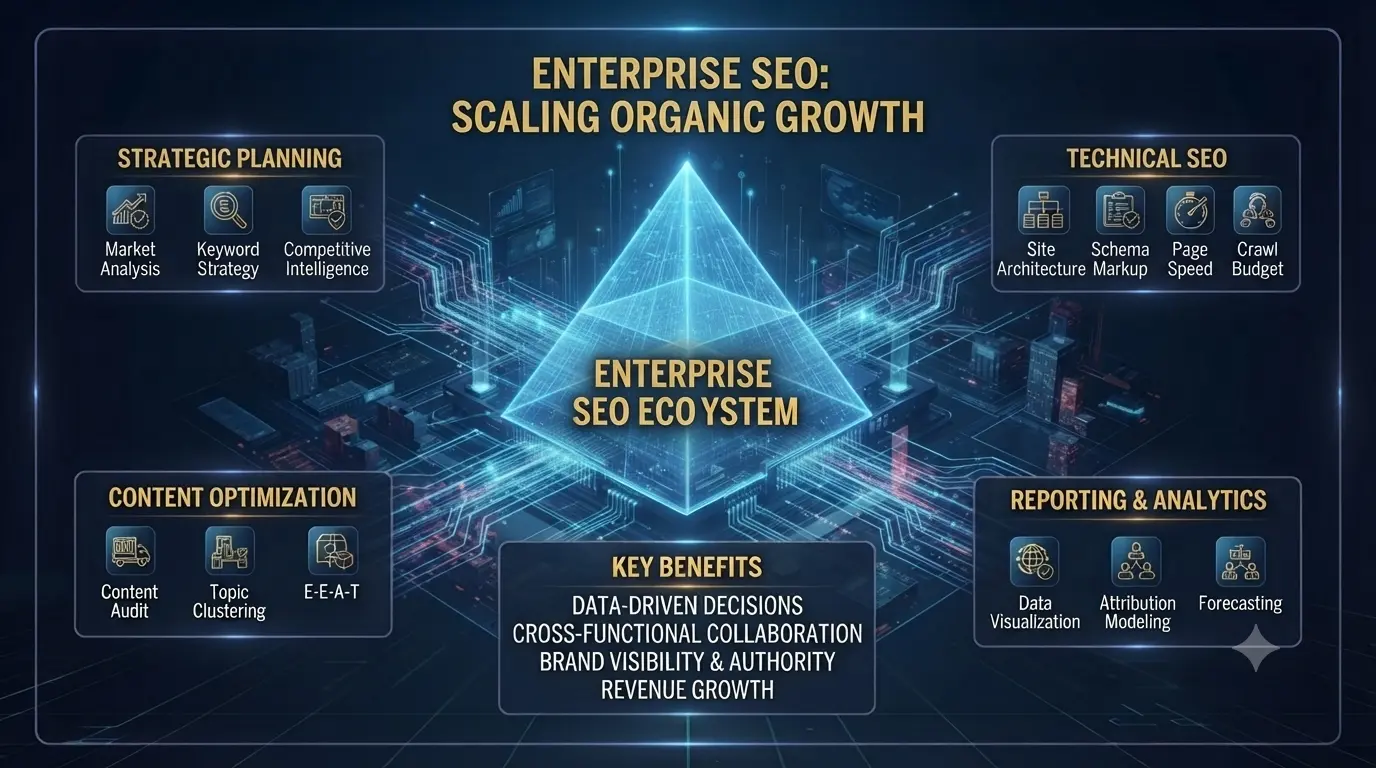
In the hyper-competitive digital landscape of 2026, Enterprise SEO in Toronto has transcended traditional local search optimization. For large-scale organizations, Toronto—a major nexus of North American commerce, finance, and technology—is not merely a geographical base; it is a strategic hub for projecting authority across global markets. Mastering the intricacies of enterprise-level search engine optimization requires moving beyond keyword rankings to focus on massive-scale infrastructure, technical precision, and topical dominance.

1. The Strategic Importance of Enterprise SEO in Toronto

Toronto’s market is characterized by a unique blend of high-tech startups, established financial institutions, and a diverse, multi-cultural consumer base. For enterprises operating here, the challenge is two-fold: maintaining visibility in a saturated domestic market while simultaneously scaling digital assets for international reach.

Enterprise SEO in this context is about infrastructure and scale. While a small business focuses on ranking for a specific term, an enterprise must manage thousands of pages, complex site architectures, and millions of search queries. Success is defined by how well you can consolidate your brand’s digital footprint to satisfy both local Toronto-based intent and broader global search demands.

2. Technical Infrastructure at Scale

The cornerstone of successful Enterprise SEO is a robust, clean technical foundation. In 2026, enterprise sites often face the “spaghetti code” problem—a mix of legacy systems, fragmented databases, and inefficient indexing patterns.

  • Advanced Crawl Budget Management: With thousands of pages, search engine bots can easily get lost. Enterprise SEO in Toronto requires rigorous crawl budget management, ensuring that Google’s crawlers prioritize your high-value transactional pages rather than wasting resources on low-value, duplicate, or outdated assets.

  • Structured Data and Schema: For global enterprises, structured data is not optional. It is the language that allows search engines to understand your content in context. Implementing schema across enterprise-wide entities helps Google identify your brand, your products, and your authority, leading to richer search snippets and higher CTR.

  • The Power of Clean Site Architecture: Whether you are utilizing advanced ERP platforms or complex CMS environments, your architecture must be logical. Abandoning tag-based navigation in favor of a strictly defined category-based hierarchy is essential for passing link equity throughout your site and ensuring that search engines can easily discover your core pillar content.

3. Topical Authority: The New Ranking Currency

Search engines have evolved to prioritize “Topical Authority” over simple backlink volume. For an enterprise in Toronto, this means your content must demonstrate comprehensive expertise in your niche.

  • The Pillar-Cluster Strategy: Instead of targeting keywords in isolation, build comprehensive “hubs” of content. Create authoritative pillar pages (e.g., “Enterprise Software Solutions”) supported by a network of interconnected cluster pages (e.g., “ERP Implementation Costs,” “Multi-Company Setup Guide”). This internal linking structure signals to search engines that your site is the definitive resource on the topic.

  • User-Centric Content: In the “useful” era of SEO, content must solve problems. Your articles should not just target high-volume keywords; they should anticipate the user’s intent and provide solutions that satisfy their needs. Whether a user is looking for software pricing or technical documentation, your site must provide the most accurate, reliable, and actionable information in your industry.

4. Scaling Global SEO from a Toronto Hub

Toronto is a gateway to the world. Enterprises based here often need to serve users across the UK, USA, UAE, and beyond. This introduces the complexity of International SEO.

  • Hreflang Implementation: Properly configuring hreflang tags is critical for enterprises managing multiple regional versions of their site. Without it, you face the risk of cannibalization, where your Toronto site competes with your UK site for the same search queries, ultimately hurting the performance of both.

  • Localizing Global Assets: While your core brand strategy remains consistent, your content must be localized to suit regional nuances. This involves adapting not just language, but also currency, regulatory context, and cultural search behaviors.

  • Consolidation of Assets: Rather than creating hundreds of disconnected regional domains, high-performing enterprises are moving toward consolidated, “global-first” domain architectures. This concentrates your domain authority, making it easier to rank in competitive international markets.

5. Data-Driven Decision Making

The difference between an average SEO project and a high-performing enterprise strategy is the use of data. Enterprise SEO requires a continuous feedback loop.

  • Attribution Modeling: It is essential to track how your organic traffic contributes to actual business outcomes—not just rankings, but leads, sales, and long-term customer lifetime value. Integrating your SEO data with your CRM (like Odoo or Salesforce) allows you to see the “revenue per search term” and prioritize your optimization efforts on keywords that drive actual profit.

  • Continuous Auditing: SEO in 2026 is not a “set it and forget it” task. Large-scale sites are dynamic; they break, they bloat, and they become outdated. Continuous technical auditing—using enterprise-grade tools to monitor for 404s, redirect chains, and performance bottlenecks—is mandatory to protect your investment.

6. The Human Element of Enterprise SEO

Finally, the most overlooked aspect of enterprise SEO is Change Management. Deploying a large-scale SEO strategy requires alignment across departments: IT, Marketing, Sales, and Leadership.

  • Breaking Silos: Often, the biggest hurdle to SEO success is internal friction. Marketing wants the traffic, but IT is concerned with site stability. Successful enterprise SEO in Toronto bridges this gap by demonstrating how SEO is a business-wide asset, not just a marketing function.

  • Continuous Education: As search engine algorithms change, your internal teams must stay informed. Promoting a culture of SEO awareness within your organization ensures that every piece of content created, or every update made to the site, adheres to the established standards of authority and quality.

Conclusion

Enterprise SEO in Toronto is a test of organizational resilience and technical mastery. It is about leveraging the strategic advantages of a global city to build a digital infrastructure that is as robust as it is visible. By focusing on deep technical foundation, demonstrating unmatched topical authority, and managing global complexity with precision, enterprises can turn their digital assets into an unstoppable engine for growth.

As you look toward the challenges of 2030, remember that the goal is not to “hack” the algorithm, but to become an indispensable resource for your target audience. When you combine the power of enterprise-scale data with a commitment to high-utility content, you don’t just compete—you dominate. Toronto is your launchpad; your digital ecosystem is your foundation; and your strategy is your path to sustained global leadership.
Global Programmatic SEO Strategy: Scaling Search Dominance Across Borders

Programmatic SEO

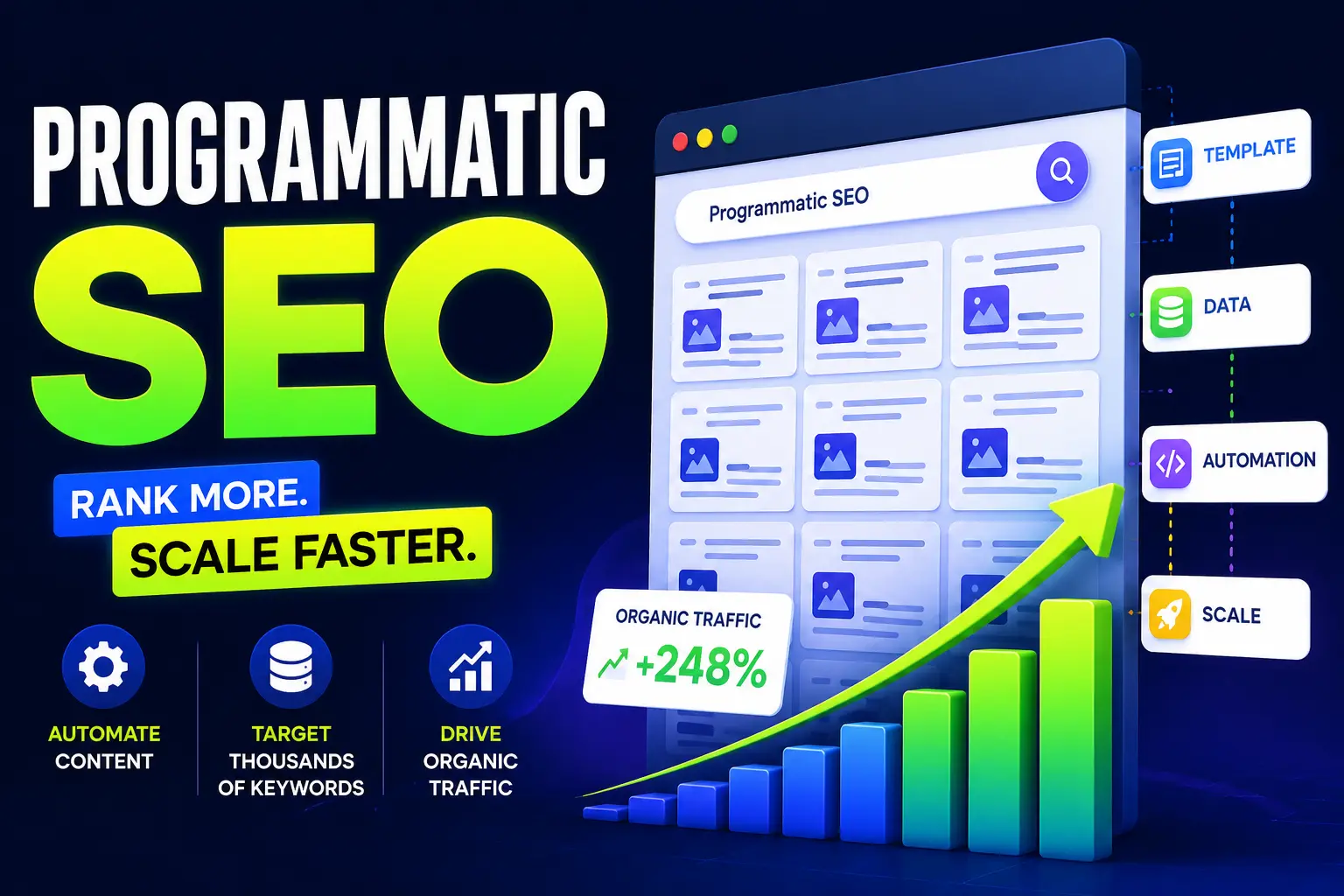
In the hyper-competitive arena of international digital marketing, relying solely on manual, artisanal content creation is a recipe for stagnation. To capture market share across multiple countries and search intents simultaneously, enterprises are turning to a more sophisticated approach: Global Programmatic SEO (PSEO). This strategy leverages automation, large-scale data structures, and AI-driven content generation to build thousands of highly relevant, optimized landing pages at an unprecedented scale. For SEO directors and digital architects, mastering PSEO is the ultimate demonstration of E-E-A-T (Experience, Expertise, Authoritativeness, and Trustworthiness). This guide provides the blueprint for executing a programmatic strategy that commands global search authority.

Top Rated Odoo vs SAP Analysis

Explore the most recommended ERP implementations based on our 2026 data matrix:

Need custom ERP consulting? Contact our experts.

The Strategic Anatomy of Programmatic SEO

Programmatic SEO is not about spinning low-quality content or spamming search engines. It is about identifying predictable search patterns (e.g., “Best [Software] for [Industry] in [City]”) and building a scalable infrastructure to answer those queries programmatically, using structured data as the foundation.

Why PSEO is a Global Imperative

  • Exponential Scale: While a human team might produce 20 articles a month, a well-architected PSEO system can generate and publish 2,000 highly targeted pages in the same timeframe.

  • Long-Tail Capture: Global PSEO allows you to capture hyper-specific, low-competition, high-intent search queries that would be too expensive to target manually.

  • Cost Efficiency: Once the programmatic infrastructure is built, the marginal cost of creating an additional page is near zero, resulting in massive ROI over time.

DMS Global Enterprise Solution

Advertisement - Continue reading below

Building E-E-A-T into Programmatic Architecture

Google’s E-E-A-T guidelines are often seen as the enemy of automation, but a properly designed PSEO strategy actually enhances E-E-A-T by providing consistent, data-backed value.

  • Experience: Designing a global PSEO campaign requires deep “Experience” in data architecture, technical SEO, and international market research.

  • Expertise: Utilizing complex data structures (like customized CSVs or APIs) to generate dynamic, factually accurate content demonstrates technical “Expertise” that search engines reward.

  • Authoritativeness: When your site comprehensively covers every possible variation of a search query within your niche, you become the undisputed “Authoritative” hub for that topic.

  • Trustworthiness: Trust in PSEO comes from data integrity. If your programmatic pages provide accurate, helpful data (e.g., accurate pricing, correct local regulations), you build trustworthiness with the user and the algorithm.

Executive Deep-Dive

Scaling Beyond Traffic to Revenue

Most enterprises fail because they chase clicks instead of trust. While building your global presence, ensure your EEAT 3.0 signals are synchronized across all regions.

Executing the Global PSEO Blueprint

To build a programmatic strategy that survives Google’s core updates and dominates international SERPs, follow these foundational steps:

  1. The Data Foundation (The CSV Strategy): The core of PSEO is your database. You must build structured datasets that contain unique, valuable variables (e.g., local market insights, specific feature comparisons, localized pricing). This data is the “fuel” for your content engine.

  2. Template Architecture: Design dynamic page templates that are fast, technically sound, and user-friendly. The template must seamlessly integrate the variables from your database, ensuring that every generated page reads naturally and provides immediate value.

  3. Strict Language Governance: For a global strategy, language control is paramount. As per strict project standards (the P0 rule), all AI-generated content targeting global markets must be maintained in professional English to ensure uniformity and broad accessibility.

  4. Intelligent Internal Linking: A massive influx of pages requires a flawless internal linking structure. Use automated “cluster-boosting” or inlink systems to ensure link equity flows efficiently from your high-authority hub pages down to your programmatic long-tail pages.

Maximizing Strategic ROI and Indexing

The biggest challenge in PSEO is not creation; it is indexing. A thousand pages are useless if Google refuses to crawl them.

  • Avoid “Thin Content”: Ensure your database provides enough unique variables so that your generated pages are not viewed as doorway pages or thin content.

  • Monitor the Crawl Budget: Submit highly organized XML sitemaps and monitor Google Search Console religiously for “Crawled – currently not indexed” errors.

  • Iterative Refinement: Use your AdSense and traffic data to refine your database. If a specific programmatic cluster is underperforming, update the data variables and regenerate the content to improve relevancy.

The AdSense Advantage: High-Volume Global Traffic

Content covering a Global Programmatic SEO Strategy attracts a premium audience: SEO agency owners, enterprise marketers, and high-level digital strategists. These are professionals actively looking to invest in scalable infrastructure. By providing expert, authoritative content on this complex topic, you position your site as a thought leader in advanced digital architecture. This high-level “Topical Authority” is a magnet for premium B2B advertisers (like SaaS providers, enterprise hosting companies, and SEO tool developers), making it an ideal environment for generating high-RPM AdSense revenue.

Conclusion

Global Programmatic SEO is the engine of modern digital dominance. By architecting an infrastructure built on clean data, intelligent templates, and automated linking, you decouple your search growth from human limitations. As you continue to build out your domain, mastering these programmatic strategies will solidify your platform as an essential destination for executive decision-makers. You are not just building a blog; you are creating a self-sustaining, high-authority digital asset that thrives on providing the expert clarity that modern leaders demand.

Exclusive Early Access: Q1 2026

The Global SEO Blueprint for C-Suite

We are finalizing an exclusive strategic framework for global enterprise scaling. Join the elite waitlist for early-bird pricing.

Secure Your Priority Spot

⚡ DMS Global Amazon Authority 2026:

Amazon Product Authority & E-E-A-T Summary

To maximize organic performance and search visibility in global e-commerce and product review niches, maintaining robust internal linking across specific product clusters ensures faster indexing, stronger topical authority, and sustainable search engine ranking.

Stop Wasting Time: The Only 10 AI Tools You Need to Scale Your Digital Assets in 2026

best ai seo tools

By: Dudung Arief Rahmanto (Senior SEO Specialist)

In 2026, the question is no longer “which AI tool should I use?” but “which system actually scales my revenue?”. After managing thousands of ERP-related articles and programmatic SEO projects, I’ve learned one hard truth: most AI tools are just noise.

If you are still manually researching keywords or writing content from scratch, you are effectively paying a “laziness tax” to your competitors. This guide isn’t just a list—it’s the exact workflow I use at DMS Global to automate content production and maintain topical authority without burning out.

The 2026 “Co-Creation” Model: How We Work

True E-E-A-T isn’t just about what you write; it’s about the perspective you bring. AI handles the framework and data processing, but you are the conductor.

My workflow follows a three-step cycle: Monitor, Audit, Create. We use AI to detect volatility, audit content gaps in real-time, and deploy content that answers user intent better than any static page.

The 10 Essential Tools for Your 2026 Stack

I have filtered these based on three criteria: efficiency, integration capability, and ROI.

Tool  Recommended Tool Why It’s a Must-Have
Search Intelligence Perplexity AI Best for real-time data and finding verifiable sources for citations.
SEO Workflow Surfer SEO The gold standard for monitoring AI visibility and optimizing content structure.
Content Creation Claude 3.5/4 Unmatched nuance and “human-like” tone compared to standard models.
Competitor Audit SE Ranking Predictive keyword suggestions and automated traffic forecasting.
Automation Make.com Connects your SEO data to your content pipelines without manual input.
Visuals Ideogram 3.0 Professional, brand-aligned imagery that AI systems recognize easily.
Technical SEO Cursor AI-driven coding to fix schema and site architecture in minutes.
Brand Presence Profound Measures “Share of Voice” across AI search and conversational snippets.
Knowledge Mgmt Notion AI Centralizes your strategy, prompts, and content schedules.
Data Analytics Semrush AI Essential for competitor benchmarking and keyword clustering.

Building Your “Defensible” Authority

Why does this stack work for DMS Global? Because it integrates AI agents into the strategy.

The Hidden Costs of Not Using AI in 2026

Many SEOs are still hesitant to adopt a full AI stack, fearing it will “devalue” their work. However, in 2026, the cost of manual labor is a competitive disadvantage. Consider these three areas where you are losing money:

  • Research Latency: Manual keyword research takes hours. AI tools can crawl SERPs and analyze intent in seconds.
  • Content Stagnation: Search engines now prioritize “freshness.” AI helps you update and refresh your content clusters daily, not monthly.
  • Technical Debt: Fixing site architecture issues used to require a developer. With AI-assisted coding tools, you can resolve technical SEO errors in minutes.

My Proven AI Workflow: From Zero to Authority

People often ask me how I manage to produce high-quality ERP comparisons while maintaining an SEO blog. The secret is the “DMS Global Workflow”:

  1. Data Extraction: Use Perplexity to gather raw data on competitors.
  2. Contextual Writing: Feed that data into Claude 3.5. Tell it: “Write like an expert who has 10 years of experience in ERP implementation.”
  3. Quality Assurance: Manually inject your own “lived experience.” Add specific anecdotes from your projects in Jakarta or global implementations. This is what Google’s E-E-A-T loves.
  4. Distribution: Use AI to repurpose the article into LinkedIn updates, newsletter snippets, and short-form video scripts.

The Future: AI Agents and Beyond (2027-2030)

Looking ahead, we are moving from “tools” to “autonomous agents.” Imagine an agent that proactively detects your site’s traffic drop, analyzes the SERP, drafts a fix, and requests re-indexing while you sleep. This isn’t science fiction; it is the trajectory of the AI tools we are using today. By mastering these 10 tools now, you are future-proofing your career.

Final Thought: You are the Pilot

AI is not here to replace you; it is here to replace the “manual you.” By adopting these tools, you are buying back your time. Invest that time into high-level strategy, client relations, and building your brand. That is how you dominate the search landscape in 2026 and beyond.

  1. Optimize for Micro-Interfaces: Google’s Search Generative Experience (SGE) now pulls content into summary boxes. By using hierarchical headings and concise, data-backed summaries, we make it easy for AI to cite our work as the definitive source.

  2. Multimodal Optimization: We don’t just write text. We label images with contextual alt-text and provide chaptered transcripts for video content.

  3. The “Human Injector”: Every piece of content is reviewed for “lived experience.” If a tool suggests a fact, I cross-reference it with my own project data (e.g., our ERP comparison matrix) to ensure accuracy.

The Bottom Line: SEO as a System

Stop treating SEO as a series of manual tasks. Treat it as a scalable machine. The brands winning in 2026 are not the ones with the largest budgets, but the ones with the smartest systems.

By automating the “boring stuff” (keyword research, technical audits, reporting) with the tools above, you free yourself to do what AI cannot: build real relationships and provide unique, expert-led value.

Are you ready to automate your authority? Share your thoughts on our latest ERP comparison matrix below!

Odoo for 10,000 Employees: Scalability & Enterprise Guide

Odoo for 10,000 Employees

Odoo for 10K Employees

Odoo for Enterprises with 10,000+ Employees: Scalability, Infrastructure, and Cost Considerations

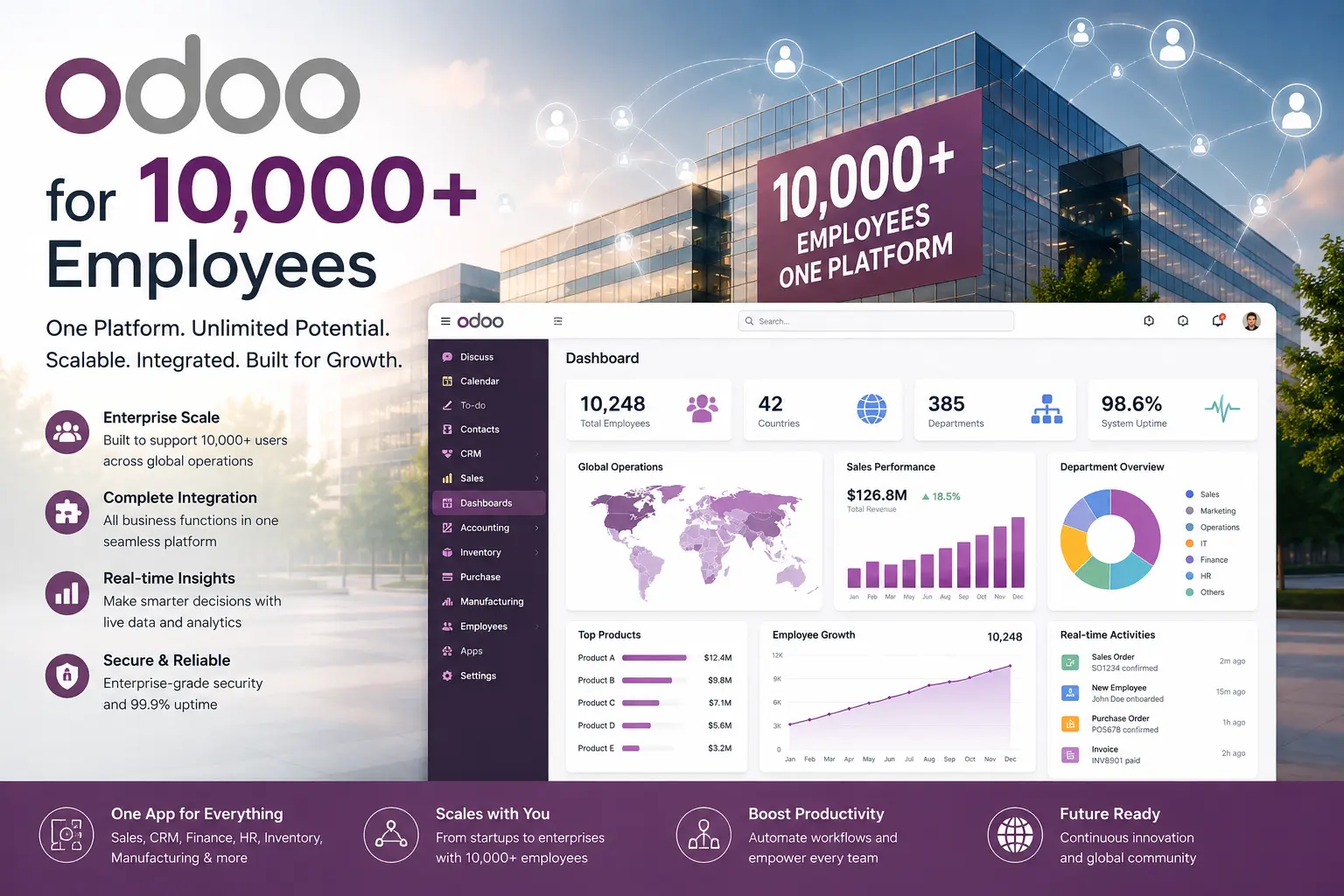
Odoo can scale to support enterprises with 10,000+ employees. However, scaling an ERP system to this level is not simply about installing software — it requires careful planning of infrastructure, architecture design, governance, and long-term cost strategy.

This guide explores how Odoo performs at enterprise scale, what challenges appear when managing large organizations, and what decision-makers should consider before deploying ERP at this level.


🏢 Why ERP Matters for 10,000+ Employee Organizations

When a company grows beyond 10,000 employees, operational complexity increases exponentially. Departments become distributed across regions, workflows become fragmented, and data consistency becomes a major challenge.

At this scale, ERP systems like Odoo are not optional — they become the backbone of business operations.

Key reasons enterprises adopt ERP at this scale include:

  • Centralized financial control across multiple subsidiaries
  • Standardized business processes across departments
  • Real-time visibility of operations and performance
  • Reduced dependency on manual reporting systems
  • Improved compliance and governance

⚙️ Can Odoo Really Handle 10,000+ Employees?

Yes — Odoo can handle enterprise-scale deployments, but performance depends heavily on system architecture and implementation quality.

Odoo is modular and highly scalable when properly configured with:

  • Load-balanced server architecture
  • PostgreSQL optimization
  • Cloud or hybrid infrastructure setup
  • Caching mechanisms (Redis or similar)
  • Proper database indexing strategy

Without proper architecture, even powerful ERP systems can experience performance bottlenecks under heavy enterprise load.


🧠 Key Infrastructure Requirements for Enterprise Odoo

Scaling Odoo for 10,000+ employees requires enterprise-grade infrastructure planning.

1. Server Architecture

  • Multi-server deployment (application + database separation)
  • Load balancer to distribute traffic
  • Failover system for high availability

2. Database Optimization

  • Partitioning large datasets
  • Query optimization for heavy transactions
  • Regular database maintenance and indexing

3. Cloud Scalability

  • Auto-scaling cloud infrastructure (AWS, Azure, GCP)
  • Disaster recovery setup
  • Multi-region deployment for global companies

💰 Cost Considerations for Enterprise Odoo Deployment

ERP cost at enterprise scale is significantly different from SME implementations. Costs increase not only due to licensing, but also infrastructure, customization, and ongoing maintenance.

Main cost components include:

  • Software licensing (Enterprise Odoo subscription)
  • Infrastructure and cloud hosting
  • ERP implementation partner fees
  • Customization and module development
  • Training for large employee base
  • Ongoing support and maintenance

For enterprises with 10,000+ employees, ERP cost is typically driven more by complexity than software pricing itself.


📊 Performance Challenges at Enterprise Scale

While Odoo is scalable, enterprise deployments may face several challenges:

  • High transaction volume causing database load spikes
  • Complex approval workflows slowing processes
  • Integration with legacy systems
  • Data synchronization across multiple regions
  • User access control complexity

These challenges are not limitations of Odoo itself, but rather design and architecture issues in large deployments.


🔐 Governance and Security in Large ERP Systems

At 10,000+ employee scale, security and governance become critical.

Enterprises must implement:

  • Role-based access control (RBAC)
  • Audit trails for financial transactions
  • Data encryption at rest and in transit
  • Strict approval workflows
  • Compliance with industry regulations (ISO, GDPR, etc.)

📈 Business Impact of Odoo at Enterprise Level

When properly implemented, Odoo delivers significant value to large organizations:

  • Faster financial consolidation across subsidiaries
  • Reduced operational redundancy
  • Improved decision-making speed for executives
  • Better visibility into global operations
  • Higher productivity across departments

Additional Content for Odoo Scale & Enterprise Performance

Implementing an enterprise-grade ERP system like Odoo for 10K employees requires meticulous database tuning, robust server architecture, and a structured deployment strategy. When user concurrency hits massive scales, default configurations are rarely sufficient. Businesses must transition from standard shared hosting or basic VPS setups to dedicated cloud clusters, load balancers, and optimized PostgreSQL instances to guarantee lightning-fast response times across every department.

Database Optimization and High Availability

For an organization supporting ten thousand daily active users, the underlying database is the heartbeat of operations. Partitioning large tables, implementing read replicas for reporting queries, and configuring connection pooling via PgBouncer will drastically reduce server load. Ensuring that heavy background jobs—such as MRP scheduling, large inventory valuations, and automated payroll processing—run during off-peak hours helps maintain seamless front-end performance for customer-facing teams and internal staff alike.

Modular Rollout Strategy and User Adoption

Managing change across a massive workforce requires a phased departmental rollout rather than a sudden global switch. Starting with core modules like finance, inventory, and procurement before expanding into advanced manufacturing, CRM, and custom project management allows IT teams to monitor system stability closely. Providing comprehensive training materials and localized documentation ensures that employees across all branches adapt quickly to the new workflow, minimizing operational friction and maximizing return on investment.

Security, Compliance, and Role-Based Access Control

Data governance becomes increasingly critical as organization sizes scale. Implementing strict role-based access control (RBAC), multi-factor authentication (MFA), and automated daily encrypted backups safeguard sensitive corporate data against breaches or accidental loss. Regular security audits and keeping custom modules updated against the latest framework patches ensure long-term stability and regulatory compliance.

Additional Content for Odoo Scale & Enterprise Performance

Implementing an enterprise-grade ERP system like Odoo for 10K employees requires meticulous database tuning, robust server architecture, and a structured deployment strategy. When user concurrency hits massive scales, default configurations are rarely sufficient. Businesses must transition from standard shared hosting or basic VPS setups to dedicated cloud clusters, load balancers, and optimized PostgreSQL instances to guarantee lightning-fast response times across every department.

Database Optimization and High Availability

For an organization supporting ten thousand daily active users, the underlying database is the heartbeat of operations. Partitioning large tables, implementing read replicas for reporting queries, and configuring connection pooling via PgBouncer will drastically reduce server load. Ensuring that heavy background jobs—such as MRP scheduling, large inventory valuations, and automated payroll processing—run during off-peak hours helps maintain seamless front-end performance for customer-facing teams and internal staff alike.

Modular Rollout Strategy and User Adoption

Managing change across a massive workforce requires a phased departmental rollout rather than a sudden global switch. Starting with core modules like finance, inventory, and procurement before expanding into advanced manufacturing, CRM, and custom project management allows IT teams to monitor system stability closely. Providing comprehensive training materials and localized documentation ensures that employees across all branches adapt quickly to the new workflow, minimizing operational friction and maximizing return on investment.

Security, Compliance, and Role-Based Access Control

Data governance becomes increasingly critical as organization sizes scale. Implementing strict role-based access control (RBAC), multi-factor authentication (MFA), and automated daily encrypted backups safeguard sensitive corporate data against breaches or accidental loss. Regular security audits and keeping custom modules updated against the latest framework patches ensure long-term stability and regulatory compliance.


🧠 Final Insight

Odoo can scale to support enterprises with 10,000+ employees, but success depends on architecture, governance, and implementation strategy — not just software capability.

In enterprise environments, ERP is not just a tool. It becomes a strategic backbone that determines how efficiently a company operates at global scale.

Scalability is not about software limits — it is about system design.

ADVERTISEMENT / SPONSORED SOLUTION

Reliable resources for your business growth

ADVERTISEMENT / SPONSORED SOLUTION

Reliable resources for your business growth

ADVERTISEMENT / SPONSORED SOLUTION

Reliable resources for your business growth

⚡ DMS Global Amazon Authority 2026:

Amazon Product Authority & E-E-A-T Summary

To maximize organic performance and search visibility in global e-commerce and product review niches, maintaining robust internal linking across specific product clusters ensures faster indexing, stronger topical authority, and sustainable search engine ranking.