Enterprise SEO Toronto
In the hyper-competitive digital landscape of 2026, Enterprise SEO in Toronto has transcended traditional local search optimization. For large-scale organizations, Toronto—a major nexus of North American commerce, finance, and technology—is not merely a geographical base; it is a strategic hub for projecting authority across global markets. Mastering the intricacies of enterprise-level search engine optimization requires moving beyond keyword rankings to focus on massive-scale infrastructure, technical precision, and topical dominance.
1. The Strategic Importance of Enterprise SEO in Toronto
Toronto’s market is characterized by a unique blend of high-tech startups, established financial institutions, and a diverse, multi-cultural consumer base. For enterprises operating here, the challenge is two-fold: maintaining visibility in a saturated domestic market while simultaneously scaling digital assets for international reach.
Enterprise SEO in this context is about infrastructure and scale. While a small business focuses on ranking for a specific term, an enterprise must manage thousands of pages, complex site architectures, and millions of search queries. Success is defined by how well you can consolidate your brand’s digital footprint to satisfy both local Toronto-based intent and broader global search demands.
2. Technical Infrastructure at Scale
The cornerstone of successful Enterprise SEO is a robust, clean technical foundation. In 2026, enterprise sites often face the “spaghetti code” problem—a mix of legacy systems, fragmented databases, and inefficient indexing patterns.
-
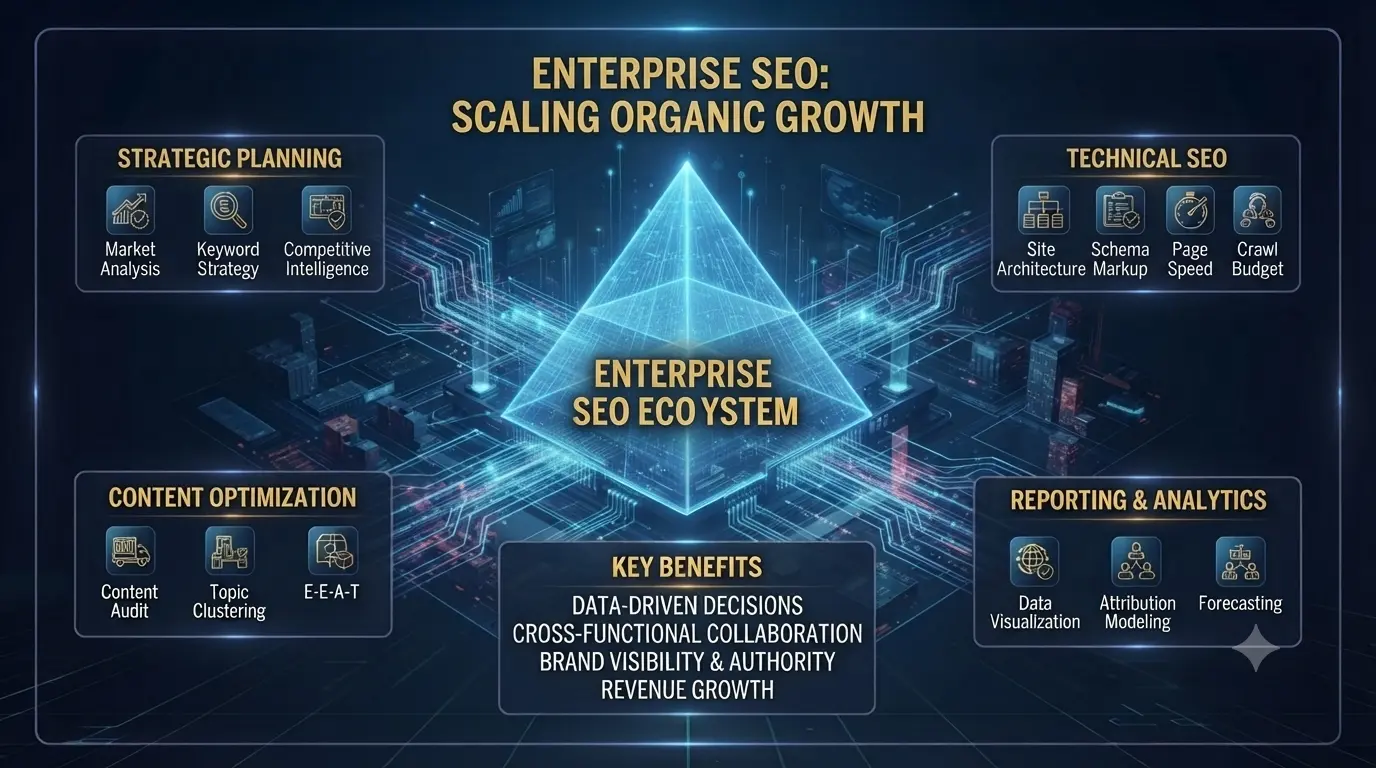
Advanced Crawl Budget Management: With thousands of pages, search engine bots can easily get lost. Enterprise SEO in Toronto requires rigorous crawl budget management, ensuring that Google’s crawlers prioritize your high-value transactional pages rather than wasting resources on low-value, duplicate, or outdated assets.
-
Structured Data and Schema: For global enterprises, structured data is not optional. It is the language that allows search engines to understand your content in context. Implementing schema across enterprise-wide entities helps Google identify your brand, your products, and your authority, leading to richer search snippets and higher CTR.
-
The Power of Clean Site Architecture: Whether you are utilizing advanced ERP platforms or complex CMS environments, your architecture must be logical. Abandoning tag-based navigation in favor of a strictly defined category-based hierarchy is essential for passing link equity throughout your site and ensuring that search engines can easily discover your core pillar content.
3. Topical Authority: The New Ranking Currency
Search engines have evolved to prioritize “Topical Authority” over simple backlink volume. For an enterprise in Toronto, this means your content must demonstrate comprehensive expertise in your niche.
-
The Pillar-Cluster Strategy: Instead of targeting keywords in isolation, build comprehensive “hubs” of content. Create authoritative pillar pages (e.g., “Enterprise Software Solutions”) supported by a network of interconnected cluster pages (e.g., “ERP Implementation Costs,” “Multi-Company Setup Guide”). This internal linking structure signals to search engines that your site is the definitive resource on the topic.
-
User-Centric Content: In the “useful” era of SEO, content must solve problems. Your articles should not just target high-volume keywords; they should anticipate the user’s intent and provide solutions that satisfy their needs. Whether a user is looking for software pricing or technical documentation, your site must provide the most accurate, reliable, and actionable information in your industry.
4. Scaling Global SEO from a Toronto Hub
Toronto is a gateway to the world. Enterprises based here often need to serve users across the UK, USA, UAE, and beyond. This introduces the complexity of International SEO.
-
Hreflang Implementation: Properly configuring
hreflangtags is critical for enterprises managing multiple regional versions of their site. Without it, you face the risk of cannibalization, where your Toronto site competes with your UK site for the same search queries, ultimately hurting the performance of both. -
Localizing Global Assets: While your core brand strategy remains consistent, your content must be localized to suit regional nuances. This involves adapting not just language, but also currency, regulatory context, and cultural search behaviors.
-
Consolidation of Assets: Rather than creating hundreds of disconnected regional domains, high-performing enterprises are moving toward consolidated, “global-first” domain architectures. This concentrates your domain authority, making it easier to rank in competitive international markets.
5. Data-Driven Decision Making
The difference between an average SEO project and a high-performing enterprise strategy is the use of data. Enterprise SEO requires a continuous feedback loop.
-
Attribution Modeling: It is essential to track how your organic traffic contributes to actual business outcomes—not just rankings, but leads, sales, and long-term customer lifetime value. Integrating your SEO data with your CRM (like Odoo or Salesforce) allows you to see the “revenue per search term” and prioritize your optimization efforts on keywords that drive actual profit.
-
Continuous Auditing: SEO in 2026 is not a “set it and forget it” task. Large-scale sites are dynamic; they break, they bloat, and they become outdated. Continuous technical auditing—using enterprise-grade tools to monitor for 404s, redirect chains, and performance bottlenecks—is mandatory to protect your investment.
6. The Human Element of Enterprise SEO
Finally, the most overlooked aspect of enterprise SEO is Change Management. Deploying a large-scale SEO strategy requires alignment across departments: IT, Marketing, Sales, and Leadership.
-
Breaking Silos: Often, the biggest hurdle to SEO success is internal friction. Marketing wants the traffic, but IT is concerned with site stability. Successful enterprise SEO in Toronto bridges this gap by demonstrating how SEO is a business-wide asset, not just a marketing function.
-
Continuous Education: As search engine algorithms change, your internal teams must stay informed. Promoting a culture of SEO awareness within your organization ensures that every piece of content created, or every update made to the site, adheres to the established standards of authority and quality.
Conclusion
Enterprise SEO in Toronto is a test of organizational resilience and technical mastery. It is about leveraging the strategic advantages of a global city to build a digital infrastructure that is as robust as it is visible. By focusing on deep technical foundation, demonstrating unmatched topical authority, and managing global complexity with precision, enterprises can turn their digital assets into an unstoppable engine for growth.
As you look toward the challenges of 2030, remember that the goal is not to “hack” the algorithm, but to become an indispensable resource for your target audience. When you combine the power of enterprise-scale data with a commitment to high-utility content, you don’t just compete—you dominate. Toronto is your launchpad; your digital ecosystem is your foundation; and your strategy is your path to sustained global leadership.
