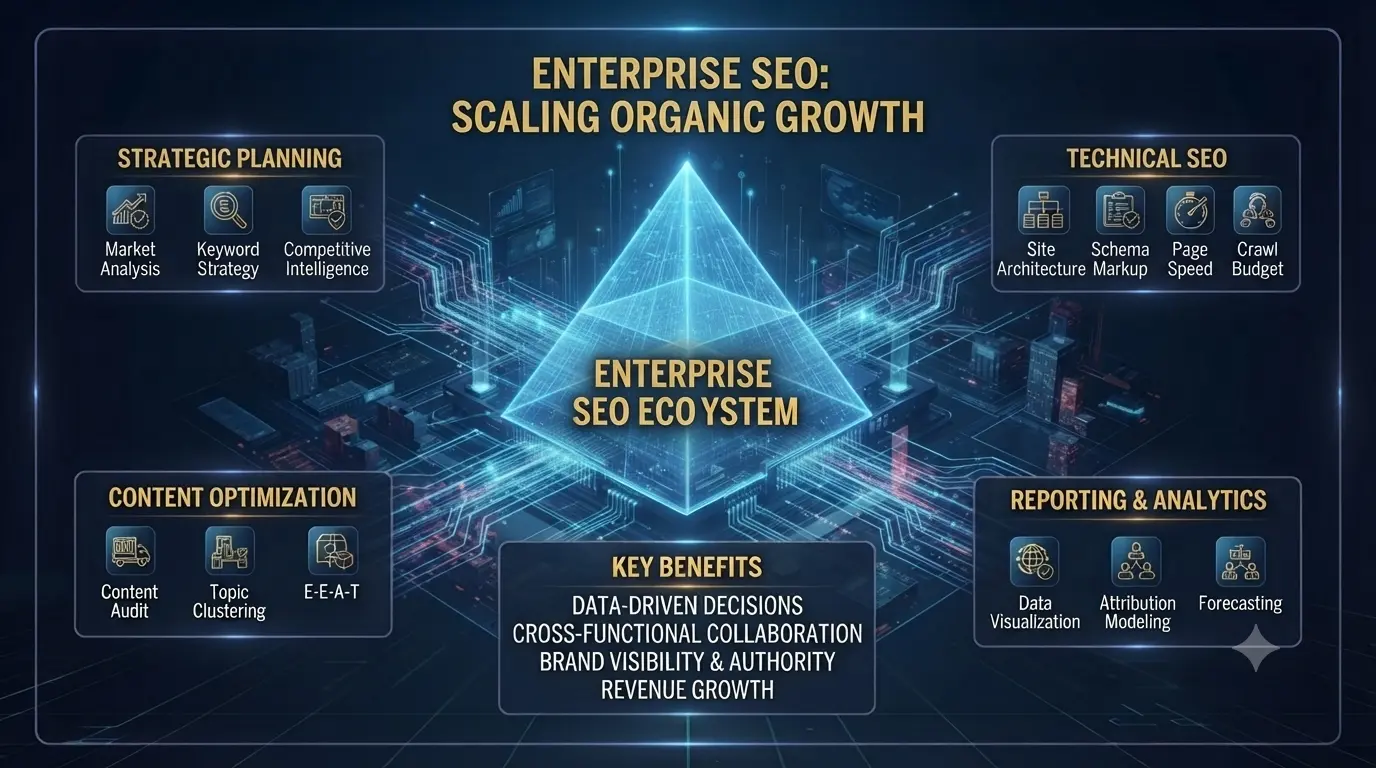
Introduction: The Complexity of Global Scale
In 2026, SEO for a single-country startup is a different beast compared to International Enterprise SEO. When you are managing tens of thousands of pages across multiple languages, regions, and legal jurisdictions, a simple keyword strategy is no longer enough.
For global enterprises, SEO is not just about rankings—it’s about data synchronization, infrastructure stability, and brand consistency. This guide explores the sophisticated frameworks required to dominate global search results in 2026.
1. Global Site Architecture: Subfolders, Subdomains, or ccTLDs?
One of the most debated topics in international SEO is the domain structure.
-
ccTLDs (e.g., .de, .fr, .id): Best for local signals but expensive and difficult to maintain at an enterprise scale.
-
Subfolders (e.g., domain.com/en/): The gold standard for Enterprise SEO in 2026. It consolidates all “Domain Authority” into one root, making it easier to rank new regional pages.
-
Subdomains (e.g., us.domain.com): Useful for separating distinct business units or tech stacks, but can dilute link equity.
2. Hreflang Mastery at Scale
Hreflang is the “Achilles’ heel” of international SEO. For an enterprise with 50 countries, the mapping becomes a nightmare.
-
The XML Sitemap Approach: In 2026, we recommend handling hreflang via XML sitemaps rather than on-page tags to reduce page bloat and improve load speeds.
-
Dynamic Mapping: Utilizing automation to ensure that when a page is updated in the UK, its US and Australian counterparts are correctly cross-referenced instantly.
3. Centralized vs. Decentralized Content Strategy
How do you maintain a “Global Voice” while staying “Locally Relevant”?
-
The Hybrid Model: Create core “Global Assets” at the headquarters level, but allow regional teams to localize (not just translate) the content to fit cultural nuances and local search intent.
-
AI-Assisted Localization: In 2026, enterprises are using advanced LLMs to adapt content for local dialects while maintaining strict brand guidelines (E-E-A-T).
4. Technical Infrastructure for Global Speed
-
Edge SEO & CDNs: For international enterprises, serving a site from a single server is a recipe for high bounce rates. Utilizing Edge Computing (like Cloudflare Workers) to inject SEO metadata based on the user’s location is a 2026 requirement.
-
Core Web Vitals Across Borders: Ensuring that your site passes the “LCP” and “INP” benchmarks in regions with slower internet infrastructure (like parts of SE Asia or Africa) is crucial for global rankings.
5. International Keyword Research: Beyond Translation
Translating keywords is the biggest mistake in Enterprise SEO.
-
Example: A “cell phone” in the US is a “mobile” in the UK and a “handphone” in Indonesia.
-
The Strategy: Conduct native-language keyword research in every target market to capture local search volume that automated tools often miss.
6. Enterprise SEO Reporting for Stakeholders
At the enterprise level, you aren’t just reporting to SEOs; you are reporting to the C-Suite.
-
Share of Voice (SoV): Measuring how much of the “Search Real Estate” your brand owns compared to global competitors.
-
Revenue Attribution: Connecting organic global traffic directly to lead generation and sales via CRM integrations (like Odoo or NetSuite).
7. Comparison: International SEO Challenges
Conclusion: The Future of Global Search
International Enterprise SEO in 2026 is an ongoing battle of technical precision and cultural adaptation. By focusing on a solid architectural foundation and localized content excellence, your brand can become a global authority that Google trusts implicitly.