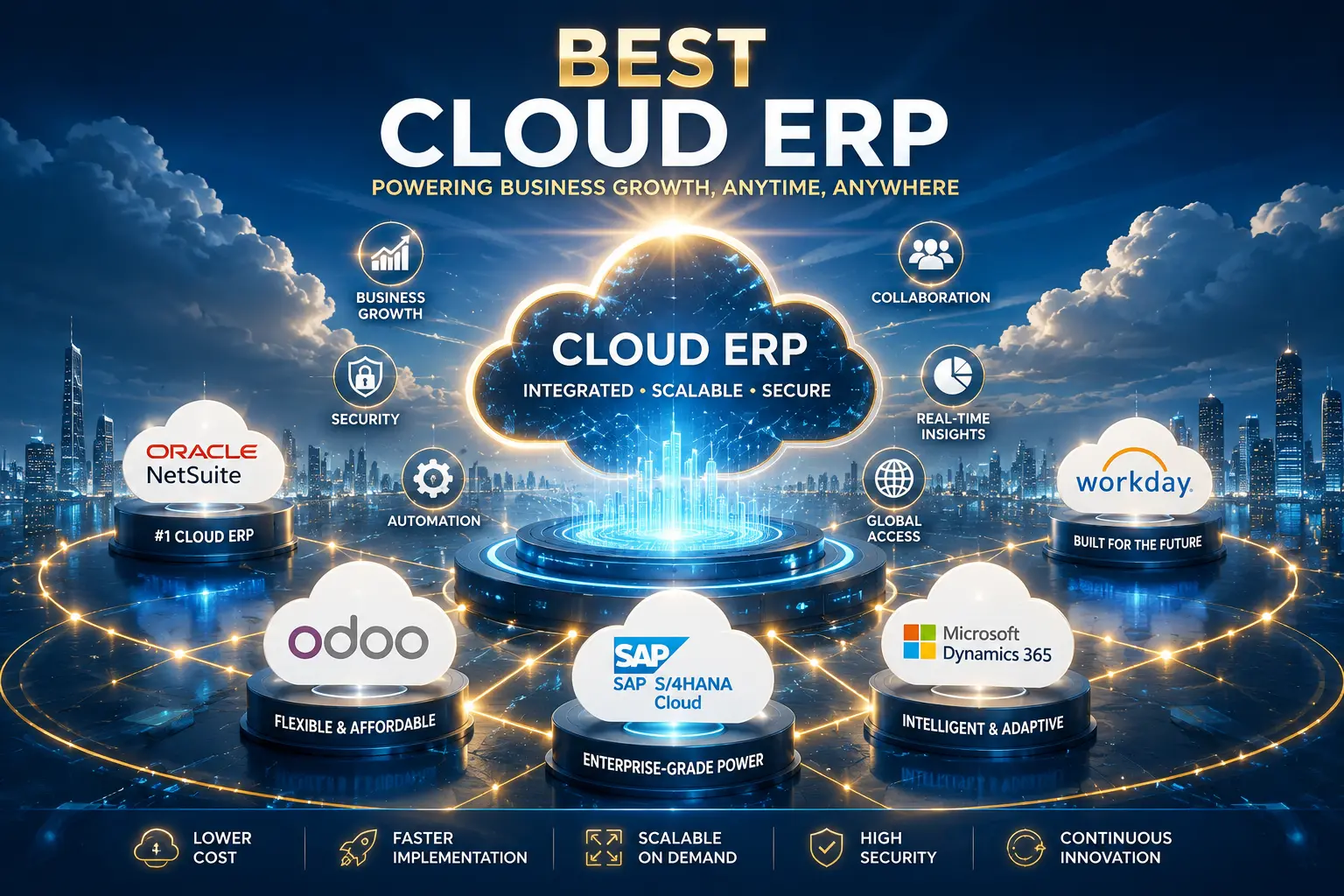
Best Cloud ERP Systems
Quick Verdict
If you want flexibility and scalability → Odoo is the best cloud ERP overall.
If you need a premium enterprise solution → NetSuite is the top choice.
If you want deep enterprise customization → SAP S/4HANA Cloud is ideal.
👉 The best cloud ERP depends on your business size, budget, and growth strategy.
Introduction
Cloud ERP systems have become the backbone of modern businesses in 2026. Companies are rapidly moving away from on-premise solutions toward cloud-based platforms that offer scalability, flexibility, and lower infrastructure costs.
Choosing the best cloud ERP system is not just about features—it’s about long-term ROI, performance, and adaptability in a competitive market.
Core Differences
Cloud ERP systems differ in architecture, pricing models, and target users.
- Odoo: Modular cloud ERP with flexible pricing and scalability.
- NetSuite: Fully integrated cloud ERP for growing and mid-sized businesses.
- SAP S/4HANA Cloud: Enterprise-grade ERP with advanced capabilities.
- Microsoft Dynamics 365: Strong integration with Microsoft ecosystem.
- Oracle Cloud ERP: High-performance cloud ERP for enterprises.
👉 Businesses should focus on scalability, ease of integration, and long-term cost efficiency.
Pricing Comparison (2026)
Cloud ERP pricing varies significantly depending on features and scale.
Odoo Pricing: Free community version with optional paid apps.
NetSuite Pricing: Subscription-based with higher entry cost.
SAP Cloud Pricing: Premium enterprise pricing with complex structure.
Microsoft Dynamics 365 Pricing: Subscription-based with modular pricing.
Oracle Cloud ERP Pricing: Subscription-based with enterprise-level costs.
💡 ROI Insight: Cloud ERP reduces infrastructure costs and improves efficiency, resulting in faster ROI compared to on-premise systems.
💡 Hidden Cost Insight: Implementation, customization, and integration costs can significantly increase total investment.
Pros and Cons
Odoo Pros:
- Highly flexible and customizable
- Affordable starting cost
- Large app ecosystem
Odoo Cons:
- Costs increase with scaling
- Requires configuration
NetSuite Pros:
- Fully integrated cloud ERP
- Strong financial management
- Scalable for growth
NetSuite Cons:
- High cost
- Requires implementation partner
SAP Cloud Pros:
- Enterprise-grade capabilities
- Deep customization
- Strong industry solutions
SAP Cloud Cons:
- Very expensive
- Complex implementation
Microsoft Dynamics 365 Pros:
- Seamless integration with Microsoft tools
- Flexible pricing model
- Strong business applications
Microsoft Dynamics 365 Cons:
- Complex licensing
- Customization required for advanced use
Oracle Cloud ERP Pros:
- High performance and scalability
- Strong analytics capabilities
- Enterprise-ready
Oracle Cloud ERP Cons:
- Premium pricing
- Requires expert implementation
Comparison Table
| ERP | Pricing | Ease of Use | Scalability | Best For |
|---|---|---|---|---|
| Odoo | Low → Medium | High | High | SMBs & startups |
| NetSuite | High | High | Very High | Growing businesses |
| SAP Cloud | Very High | Moderate | Very High | Enterprises |
| Dynamics 365 | Medium → High | High | High | Microsoft users |
| Oracle Cloud ERP | High | Moderate | Very High | Large enterprises |
Use Cases
- Startups: Odoo for flexibility and low cost.
- Growing companies: NetSuite or Dynamics 365.
- Large enterprises: SAP Cloud or Oracle ERP.
Real-World Example
A startup may choose Odoo to build operations with minimal cost and scale gradually.
A mid-sized company may adopt NetSuite to unify operations and improve efficiency.
A global enterprise may implement SAP Cloud to manage complex workflows and compliance.
👉 Insight: The best cloud ERP evolves with your business growth.
Scalability & Performance
Cloud ERP systems are designed for scalability and performance.
- Odoo: Scales through modular apps.
- NetSuite: Scales through unified cloud architecture.
- SAP Cloud: Handles large enterprise workloads.
- Dynamics 365: Scales with Microsoft ecosystem.
- Oracle Cloud ERP: Optimized for high-performance operations.
👉 Choosing a scalable ERP prevents costly migrations in the future.
Hidden Costs You Should Know
Cloud ERP systems come with hidden costs that businesses often overlook.
- Implementation and onboarding
- Customization and integration
- Training and support
👉 These costs directly impact total cost of ownership (TCO).
Future Trends in Cloud ERP
Cloud ERP is evolving rapidly in 2026.
- AI-powered automation
- Real-time analytics
- Subscription-based pricing dominance
👉 Businesses adopting modern cloud ERP gain a competitive advantage.
Which Should You Choose?
- Choose Odoo if: you want flexibility and affordability.
- Choose NetSuite if: you need a complete cloud ERP.
- Choose SAP Cloud if: you need enterprise-level power.
- Choose Dynamics 365 if: you rely on Microsoft tools.
- Choose Oracle ERP if: you need high-performance enterprise systems.
👉 ERP selection is a strategic decision that impacts long-term growth.
Frequently Asked Questions (FAQ)
1. Why should my enterprise choose a cloud-based ERP over an on-premise solution in 2026? Cloud ERP solutions provide superior scalability, lower total cost of ownership (TCO) by eliminating complex hardware maintenance, and seamless access to AI-driven predictive insights. For modern enterprises, cloud-native platforms are essential for maintaining agility in a competitive global market.
2. Which ERP system is best for a high-growth company scaling internationally? There is no “one-size-fits-all” solution, but leading platforms like SAP S/4HANA, Odoo Enterprise, and Oracle NetSuite are top contenders for global scaling. When choosing, prioritize systems that offer multi-entity support, robust regulatory compliance, and native interoperability with your existing tech stack.
3. How does PT Dominasi Serp Indonesia assess the ROI of an ERP implementation? We evaluate ROI by auditing your digital infrastructure to identify operational bottlenecks and hidden costs. Our assessment focuses on how well an ERP improves workflow automation, inventory synchronization, and data accuracy—all of which are critical for maximizing your long-term business performance.
4. Is it necessary to integrate my ERP with other business tools like CRM or e-commerce platforms? Yes, integration is critical. For instance, linking your ERP with platforms like Shopify allows for real-time inventory synchronization and automated order fulfillment. A seamless digital foundation ensures your infrastructure supports high-volume transactions without sacrificing data integrity.
5. How do I start a migration roadmap to a modern ERP system? A successful migration requires a robust technical strategy that prioritizes data integrity and performance. We recommend starting with a detailed architecture audit to mitigate risks, followed by a phased transition to ensure sub-second performance and minimized operational downtime during the shift from legacy systems.
Final Recommendation
In 2026, Odoo remains the best cloud ERP for most businesses due to its flexibility and cost efficiency, while NetSuite and SAP Cloud dominate in enterprise environments.
Conclusion
The best cloud ERP system depends on your business size, budget, and growth strategy. Choosing the right platform ensures long-term efficiency and scalability.