Cloud ERP for Startups and Scaleups: Accelerating Growth with Scalable Architecture

In the high-speed environment of 2026, startups and scaleups face a unique paradox: they must operate with the agility of a small team while managing the complexity of a rapidly expanding enterprise. As your venture transitions from initial product-market fit to rapid scaling, the manual spreadsheets and disconnected tools that served you in the early days become dangerous liabilities. Implementing a Cloud ERP for Startups and Scaleups is the definitive move to replace operational chaos with a unified, automated digital framework that scales at the speed of your business.

Why Cloud ERP is the Engine of Modern Scaling

Startups do not have the luxury of time or the budget for massive, on-premise hardware installations. They need solutions that are cloud-native, modular, and instantly deployable. A Cloud ERP acts as the “operating system” for your growth. By integrating core functions—finance, customer relationship management (CRM), inventory, and human resources—into a single cloud environment, you create a source of truth that allows your founders and leadership team to make data-driven decisions in real-time.

For scaleups, the primary challenge is preventing operational bottlenecks as you double or triple your headcount and revenue. Cloud ERP systems provide the scalability required to support this growth without requiring an overhaul of your technical architecture every six months.

ADVERTISEMENT / SPONSORED SOLUTION

Reliable resources for your business growth

Strategic Pillars of ERP Success for High-Growth Ventures

When evaluating Cloud ERP solutions for your scaleup, you must prioritize flexibility and integration capability. Here are the pillars that determine whether your system will support your growth or hinder it:

1. Modular Architecture (Pay-as-you-Scale)

Unlike legacy systems that force you to buy everything upfront, modern Cloud ERPs allow you to start with core modules—like finance and billing—and add advanced functionalities like supply chain or automated procurement only when you reach the necessary complexity. This protects your cash flow and ensures you are not overspending on features you don’t yet need.

2. Seamless Third-Party Integrations (API-First)

Startups rely on a stack of best-in-breed tools—SaaS platforms for marketing, developer tools, and niche operational software. Your ERP must have a robust, open API architecture that connects effortlessly with your existing stack. If your ERP sits in a silo, it is failing you. It must talk to your payment gateways, project management tools, and communication channels.

3. Automated Financial Reporting and Compliance

As you prepare for new funding rounds or M&A activities, your financial records must be audit-ready. Cloud ERPs automate the consolidation of financial data, making it easy to generate investor-grade reports, track cash burn, and maintain compliance across different tax jurisdictions.

4. Real-time Visibility for Founders

When you are scaling, you need to know your Unit Economics—Customer Acquisition Cost (CAC), Lifetime Value (LTV), and Gross Margin—at any given moment. A Cloud ERP surfaces this data automatically, giving leadership the visibility to pivot strategies or double down on successful markets without waiting for end-of-month manual reports.

Building Digital Authority and Capturing High-Value Traffic

The startup and scaleup technology niche is an exceptionally high-authority space. It attracts founders, CTOs, CFOs, and VPs of Operations who are actively researching how to build efficient, scalable organizations. These individuals are not just looking for tools; they are looking for expert perspectives on how to avoid the pitfalls of scaling too quickly without the right infrastructure.

By providing deep-dive insights into how Cloud ERP implementation solves specific scaling bottlenecks, you position your platform as an indispensable industry resource. This high-intent traffic is exceptionally valuable. When you consistently provide technical value that solves real-world pain points, you cultivate a premium digital environment. Because your content is tailored to business-critical scaling decisions, your site becomes high-value real estate for premium advertisers, setting the stage for consistent, high-paying AdSense revenue.

ADVERTISEMENT / SPONSORED SOLUTION

Reliable resources for your business growth

ADVERTISEMENT / SPONSORED SOLUTION

Reliable resources for your business growth

Driving Consistent Financial Results Through Authority

Achieving monthly AdSense payouts is the direct result of building a helpful, authoritative ecosystem that founders and growth managers rely on. The E-E-A-T (Experience, Expertise, Authoritativeness, and Trustworthiness) standards are paramount here. By focusing on the specific hurdles of scaling—such as how to transition from QuickBooks to a full ERP without breaking your workflows, or how to automate HR for a remote, global workforce—you build a loyal, recurring readership.

As your site becomes the “go-to” guide for scaleup digital transformation, decision-makers will visit more frequently, read your articles in depth, and interact with the professional advertisements strategically placed throughout your content. This level of engagement is the primary engine of your monthly AdSense income. When your content helps a startup leader solve a complex operational bottleneck, they engage with your platform, and the quality of that engagement directly reflects in your AdSense performance.

ADVERTISEMENT / SPONSORED SOLUTION

Reliable resources for your business growth

Strategic Roadmap for 2026 and Beyond

The startup landscape is becoming increasingly efficient and data-driven. Scaleups that adopt comprehensive, cloud-native ERP solutions today will be the ones that achieve unicorn status tomorrow.

If you are beginning your digital transformation, start by auditing your most significant operational “pain points.” Are you drowning in manual expense reports? Is your inventory data misaligned with your sales platform? Choose a modular approach—implement the core ERP functions that address your immediate risks, then scale the platform as your revenue grows.

By blending the precision of an enterprise-grade ERP with a data-driven content strategy, you turn your digital presence into a powerful, revenue-generating asset. Stay analytical, maintain absolute data integrity in your articles, and continue building your platform with the same professional rigor you apply to your own startup growth. Your path to operational excellence and sustainable financial growth starts right here. By establishing yourself as the voice of authority in startup tech, you are building a digital business that works as efficiently as the scaleups you write about.

Oracle NetSuite Implementation Guide for 2026

Oracle NetSuite OneWorld

Navigating the complex Oracle NetSuite landscape in 2026 requires more than just installation—it demands strategic alignment.
Many firms experience stalled deployments due to poor data migration and misaligned configurations.

Feature NetSuite Traditional ERP
Deployment Cloud-Native On-Premise
Maintenance Low (SaaS) High (Manual)
Scalability High Limited

NetSuite leverages a unified multi-subsidiary management core that simplifies global financial reporting significantly compared to fragmented legacy systems. In 2026, the competitive advantage lies in real-time data visibility; NetSuite allows decision-makers to move from reactive reporting to predictive analytics without the need for complex manual reconciliation.
Focus on iterative module deployment, starting with financial core before expanding to CRM and inventory management. 1) Modular Phase-in, 2) Data Mapping, 3) Process Automation, 4) Real-time Dashboard Setup, 5) User Adoption Training
Secure your cloud future with NetSuite. Contact our expert team for a bespoke implementation audit today.”

FAQ
Q: Is NetSuite suitable for SMEs? A: While high-cost, it offers unparalleled scalability for high-growth SMEs aiming to build an enterprise-level data core.

Best Cloud ERP Systems (2026): Top Platforms Compared for Businesses

Best Cloud ERP

Best Cloud ERP Systems

Quick Verdict

If you want flexibility and scalability → Odoo is the best cloud ERP overall.

If you need a premium enterprise solution → NetSuite is the top choice.

If you want deep enterprise customization → SAP S/4HANA Cloud is ideal.

👉 The best cloud ERP depends on your business size, budget, and growth strategy.


Introduction

Cloud ERP systems have become the backbone of modern businesses in 2026. Companies are rapidly moving away from on-premise solutions toward cloud-based platforms that offer scalability, flexibility, and lower infrastructure costs.

Choosing the best cloud ERP system is not just about features—it’s about long-term ROI, performance, and adaptability in a competitive market.


Core Differences

Cloud ERP systems differ in architecture, pricing models, and target users.

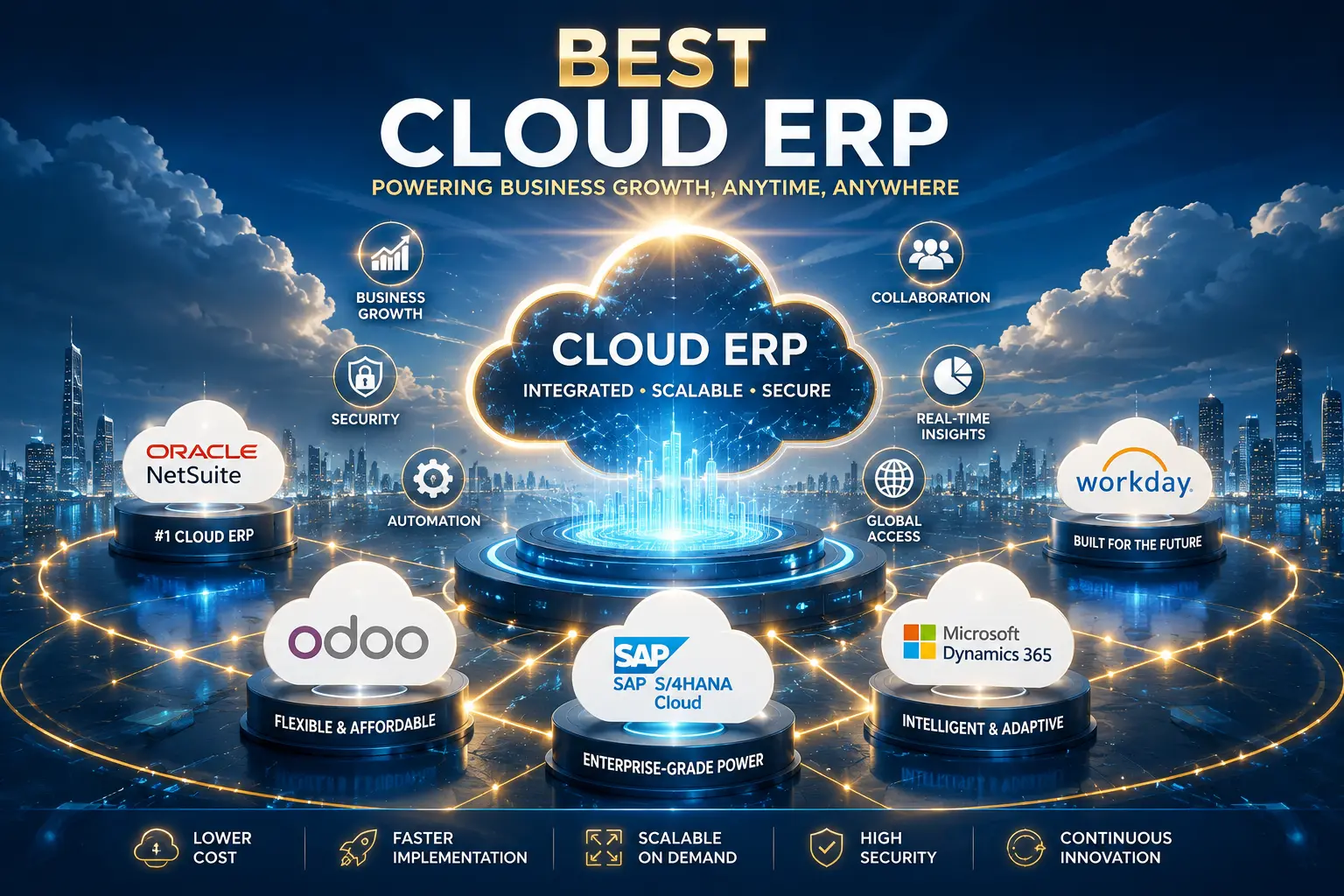
  • Odoo: Modular cloud ERP with flexible pricing and scalability.
  • NetSuite: Fully integrated cloud ERP for growing and mid-sized businesses.
  • SAP S/4HANA Cloud: Enterprise-grade ERP with advanced capabilities.
  • Microsoft Dynamics 365: Strong integration with Microsoft ecosystem.
  • Oracle Cloud ERP: High-performance cloud ERP for enterprises.

👉 Businesses should focus on scalability, ease of integration, and long-term cost efficiency.


Pricing Comparison (2026)

Cloud ERP pricing varies significantly depending on features and scale.

Odoo Pricing: Free community version with optional paid apps.

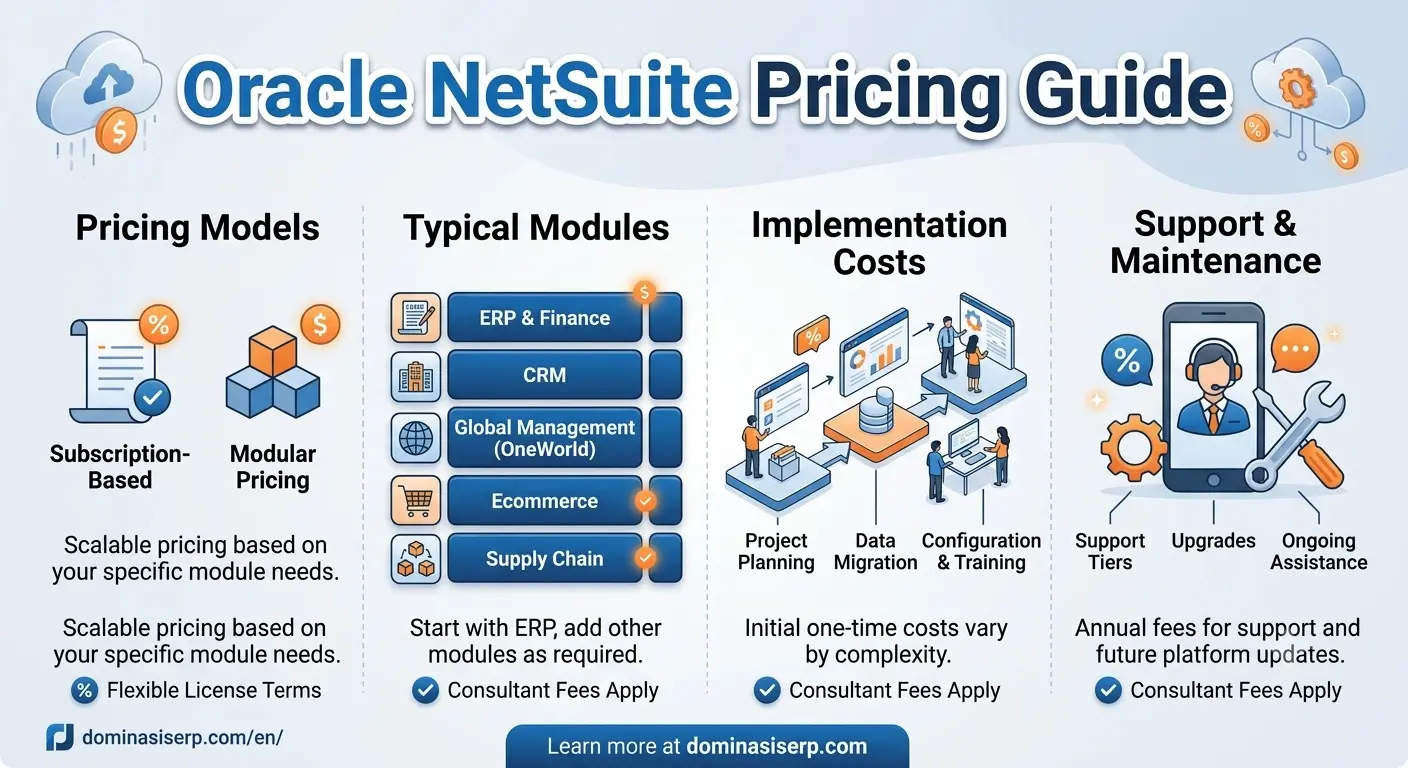
NetSuite Pricing: Subscription-based with higher entry cost.

SAP Cloud Pricing: Premium enterprise pricing with complex structure.

Microsoft Dynamics 365 Pricing: Subscription-based with modular pricing.

Oracle Cloud ERP Pricing: Subscription-based with enterprise-level costs.

💡 ROI Insight: Cloud ERP reduces infrastructure costs and improves efficiency, resulting in faster ROI compared to on-premise systems.

💡 Hidden Cost Insight: Implementation, customization, and integration costs can significantly increase total investment.


Pros and Cons

Odoo Pros:

  • Highly flexible and customizable
  • Affordable starting cost
  • Large app ecosystem

Odoo Cons:

  • Costs increase with scaling
  • Requires configuration

NetSuite Pros:

  • Fully integrated cloud ERP
  • Strong financial management
  • Scalable for growth

NetSuite Cons:

  • High cost
  • Requires implementation partner

SAP Cloud Pros:

  • Enterprise-grade capabilities
  • Deep customization
  • Strong industry solutions

SAP Cloud Cons:

  • Very expensive
  • Complex implementation

Microsoft Dynamics 365 Pros:

  • Seamless integration with Microsoft tools
  • Flexible pricing model
  • Strong business applications

Microsoft Dynamics 365 Cons:

  • Complex licensing
  • Customization required for advanced use

Oracle Cloud ERP Pros:

  • High performance and scalability
  • Strong analytics capabilities
  • Enterprise-ready

Oracle Cloud ERP Cons:

  • Premium pricing
  • Requires expert implementation

Comparison Table

ERP Pricing Ease of Use Scalability Best For
Odoo Low → Medium High High SMBs & startups
NetSuite High High Very High Growing businesses
SAP Cloud Very High Moderate Very High Enterprises
Dynamics 365 Medium → High High High Microsoft users
Oracle Cloud ERP High Moderate Very High Large enterprises

Use Cases

  • Startups: Odoo for flexibility and low cost.
  • Growing companies: NetSuite or Dynamics 365.
  • Large enterprises: SAP Cloud or Oracle ERP.

Real-World Example

A startup may choose Odoo to build operations with minimal cost and scale gradually.

A mid-sized company may adopt NetSuite to unify operations and improve efficiency.

A global enterprise may implement SAP Cloud to manage complex workflows and compliance.

👉 Insight: The best cloud ERP evolves with your business growth.


Scalability & Performance

Cloud ERP systems are designed for scalability and performance.

  • Odoo: Scales through modular apps.
  • NetSuite: Scales through unified cloud architecture.
  • SAP Cloud: Handles large enterprise workloads.
  • Dynamics 365: Scales with Microsoft ecosystem.
  • Oracle Cloud ERP: Optimized for high-performance operations.

👉 Choosing a scalable ERP prevents costly migrations in the future.


Hidden Costs You Should Know

Cloud ERP systems come with hidden costs that businesses often overlook.

  • Implementation and onboarding
  • Customization and integration
  • Training and support

👉 These costs directly impact total cost of ownership (TCO).


Future Trends in Cloud ERP

Cloud ERP is evolving rapidly in 2026.

  • AI-powered automation
  • Real-time analytics
  • Subscription-based pricing dominance

👉 Businesses adopting modern cloud ERP gain a competitive advantage.


Which Should You Choose?

  • Choose Odoo if: you want flexibility and affordability.
  • Choose NetSuite if: you need a complete cloud ERP.
  • Choose SAP Cloud if: you need enterprise-level power.
  • Choose Dynamics 365 if: you rely on Microsoft tools.
  • Choose Oracle ERP if: you need high-performance enterprise systems.

👉 ERP selection is a strategic decision that impacts long-term growth.

Frequently Asked Questions (FAQ)

1. Why should my enterprise choose a cloud-based ERP over an on-premise solution in 2026? Cloud ERP solutions provide superior scalability, lower total cost of ownership (TCO) by eliminating complex hardware maintenance, and seamless access to AI-driven predictive insights. For modern enterprises, cloud-native platforms are essential for maintaining agility in a competitive global market.

2. Which ERP system is best for a high-growth company scaling internationally? There is no “one-size-fits-all” solution, but leading platforms like SAP S/4HANA, Odoo Enterprise, and Oracle NetSuite are top contenders for global scaling. When choosing, prioritize systems that offer multi-entity support, robust regulatory compliance, and native interoperability with your existing tech stack.

3. How does PT Dominasi Serp Indonesia assess the ROI of an ERP implementation? We evaluate ROI by auditing your digital infrastructure to identify operational bottlenecks and hidden costs. Our assessment focuses on how well an ERP improves workflow automation, inventory synchronization, and data accuracy—all of which are critical for maximizing your long-term business performance.

4. Is it necessary to integrate my ERP with other business tools like CRM or e-commerce platforms? Yes, integration is critical. For instance, linking your ERP with platforms like Shopify allows for real-time inventory synchronization and automated order fulfillment. A seamless digital foundation ensures your infrastructure supports high-volume transactions without sacrificing data integrity.

5. How do I start a migration roadmap to a modern ERP system? A successful migration requires a robust technical strategy that prioritizes data integrity and performance. We recommend starting with a detailed architecture audit to mitigate risks, followed by a phased transition to ensure sub-second performance and minimized operational downtime during the shift from legacy systems.


Final Recommendation

In 2026, Odoo remains the best cloud ERP for most businesses due to its flexibility and cost efficiency, while NetSuite and SAP Cloud dominate in enterprise environments.


Conclusion

The best cloud ERP system depends on your business size, budget, and growth strategy. Choosing the right platform ensures long-term efficiency and scalability.