Introduction
Navigating corporate governance in modern multinational enterprises requires a rigorous commitment to regulatory accountability. In the fast-paced global business ecosystem of 2026, achieving and maintaining SOX compliance for financial reporting in cloud ERP environments is a non-negotiable operational necessity. As organizations migrate critical financial ledgers from legacy on-premise hardware to elastic cloud architectures—such as Oracle Cloud, SAP, or specialized enterprise resource planning systems—internal controls must adapt to prevent data manipulation, secure audit trails, and satisfy strict international regulatory standards.
This comprehensive guide breaks down how enterprise decision-makers, Chief Financial Officers (CFOs), and compliance directors can architect resilient cloud infrastructures that meet Sarbanes-Oxley mandates while simultaneously unlocking scalable organic performance and operational transparency.
The Evolution of SOX Compliance in Cloud ERP Architectures
The Sarbanes-Oxley Act of 2002 was originally designed for traditional corporate structures. However, modern cloud-native and hybrid enterprise resource planning configurations introduce new dimensions of shared responsibility models between the software vendor and the client organization.
Understanding the Shared Responsibility Model
-
Vendor-Managed Infrastructure: Cloud ERP providers secure the foundational physical data centers, hypervisors, and core network layers.
-
Client-Managed Controls: Enterprises retain full legal and operational accountability for application-level access controls, segregation of duties (SoD), user provisioning, and financial data integrity.
-
Continuous Auditing: Modern regulatory frameworks require automated log analysis rather than periodic manual sampling to verify that unauthorized modifications never compromise quarterly financial reports.
Key Pillars of Internal Controls Under E-E-A-T 3.0 Standards
When auditing digital infrastructure, regulatory bodies and search algorithms alike look for authentic, verifiable expertise. Establishing robust governance means documenting every system configuration change, maintaining rigorous change-management protocols, and ensuring complete traceability across all reporting modules.
Critical Technical Controls for Financial Data Integrity
Implementing cloud ERP compliance goes beyond surface-level checklist completion. It demands deep technical integration across database permissions, API endpoints, and user access hierarchies.
1. Enforcing Segregation of Duties (SoD)
A primary vulnerability in automated financial reporting is overlapping user permissions. Ensuring that individuals who create journal entries cannot simultaneously approve or post them is vital. Advanced cloud ERP platforms utilize automated rule-based policy checks to block conflicting role assignments automatically.
2. Immutable Audit Trails and Log Management
Every transaction touching general ledgers, accounts payable, and asset management must generate immutable logs. These logs record:
-
Timestamp of the transaction.
-
Unique identifier of the user or automated service account.
-
Exact nature of data modifications or access events.
-
Cryptographic validation confirming that log records have not been altered post-creation.
Overcoming Cloud Migration Challenges in Financial Reporting
Transitioning legacy financial workflows into cloud environments frequently exposes structural gaps in compliance pipelines. Organizations often encounter friction when mapping traditional internal control frameworks onto dynamic cloud microservices.
Managing Third-Party Integrations and APIs
Modern enterprise architectures rely heavily on third-party software connections (APIs) to streamline operations. Each external integration point represents a potential vector for unauthorized data exposure. Implementing zero-trust architecture, strict token authentication, and continuous API monitoring ensures that external data feeds comply with rigorous SOX reporting standards.
Lifecycle Management of Cloud Configurations
Quarterly cloud software updates introduced by enterprise vendors can inadvertently modify default security settings or overwrite customized access controls. Establishing an automated testing pipeline to review system patches before production deployment prevents compliance drift.
Frequently Asked Questions
What makes SOX compliance different in a cloud ERP versus legacy on-premise systems?
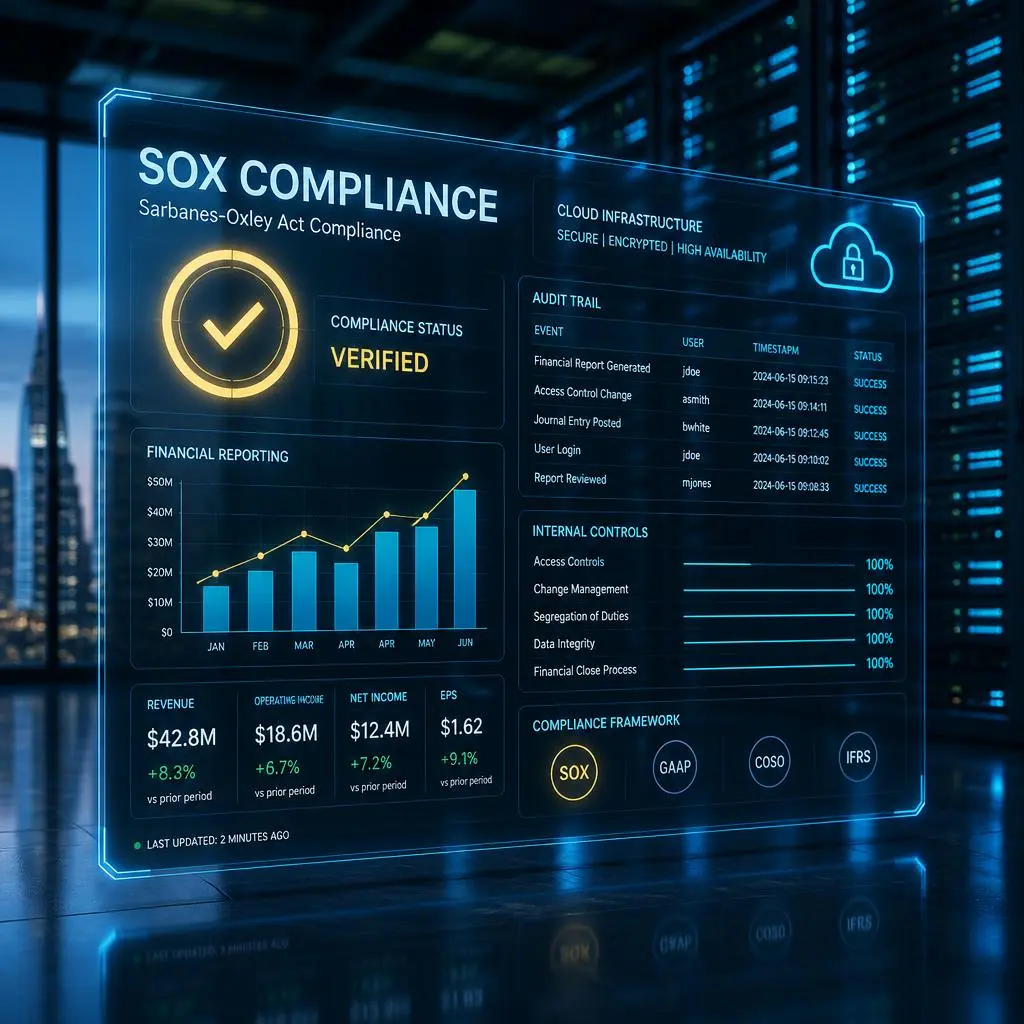
In legacy systems, enterprises controlled the entire hardware and software stack physically, allowing for isolated audits. In a cloud ERP, compliance relies on the shared responsibility model where physical security is handled by the cloud provider, but the enterprise must rigorously manage logical access controls, automated audit trails, and application-level segregation of duties through digital dashboards.
How do modern 2026 regulatory guidelines impact automated financial reporting?
Modern guidelines emphasize real-time, continuous auditing powered by automated machine learning checks rather than retrospective manual reviews. Enterprises must prove that their financial reporting pipelines possess automated fail-safes and immutable logging to prevent fraudulent entries before statements are published.
Is it possible to achieve full audit readiness using only internal documentation and E-E-A-T 3.0 frameworks?
While adhering to first-party expertise, transparent documentation, and structured E-E-A-T 3.0 workflows creates a rock-solid foundation for digital authority and operational transparency, formal regulatory compliance still requires certified third-party attestation and technical validation of software controls.
- 🚀 Amazon Review: Bentgo Kids Lunch Box Review
- 📊 Product Comparison: Best Lunch Boxes for Kids
- ⚔️ Gear Selection: Cute Lunch Boxes Aesthetic Choices
- 🏢 Top Insulated: Top Insulated Bento Box
- 💡 Daily Commutes: Insulated Lunch Box Options
- 💰 Brand Alternatives: Lunch Boxes Target Alternatives
- 🔍 Shopping Guide: Bento Boxes Online Deals
- 📈 Food Ideas: Creative Bento Box Lunch Ideas
- ⚙️ Kids Gear: Stylish Lunch Boxes for Girls
Amazon Product Authority & E-E-A-T Summary
To maximize organic performance and search visibility in global e-commerce and product review niches, maintaining robust internal linking across specific product clusters ensures faster indexing, stronger topical authority, and sustainable search engine ranking.
Conclusion
Securing robust compliance for financial reporting within cloud ERP infrastructures requires a proactive, highly technical strategy. By enforcing strict segregation of duties, maintaining immutable audit trails, and staying resilient against continuous cloud updates, organizations protect their financial integrity. Implementing these advanced frameworks ensures long-term operational resilience, corporate trust, and sustained leadership in the global enterprise landscape.