The Hidden Costs of Cloud Infrastructure: How to Avoid Budget Overruns

CLOUD COST OPTIMIZATION ENGINE

The Hidden Costs of Cloud Infrastructure have become a primary threat to IT budgets in 2026.

In the race for digital transformation, many mid-size and large enterprises have aggressively migrated their operations to the cloud. While the benefits of scalability and accessibility are clear, the financial reality often tells a different story. In 2026, “cloud sprawl” and uncontrolled infrastructure spending have become the primary threats to IT budgets. Understanding and mitigating these hidden costs is no longer just a financial task—it is a strategic necessity for sustainable enterprise growth.

The Cloud Cost Paradox

The allure of the cloud is simplicity: pay-as-you-go. However, without strict governance, this flexibility often leads to “bill shock.” Enterprises frequently find that their monthly cloud spend far exceeds their initial projections, largely due to architectural inefficiencies, lack of visibility, and underutilized resources.

Common Sources of Budget Overruns

1. Data Egress and Transfer Fees

One of the most frequently overlooked costs is data egress—the fee charged for moving data out of the cloud provider’s network. For enterprises with high data-transfer requirements, these costs can accumulate rapidly, creating an unpredictable variable in your monthly operational expenditure.

2. Over-Provisioning and Idle Resources

It is common for teams to over-provision virtual machines (VMs) and storage “just in case” of traffic spikes. In reality, these resources often sit idle. Paying for capacity that you aren’t using is the fastest way to bleed your infrastructure budget.

3. Complexity in Licensing

Cloud environments often involve intricate licensing models. If not managed centrally, you may end up paying for redundant licenses across different departments or failing to utilize volume-based discounts provided by your vendor.

Strategies for Cost Optimization (FinOps)

To maintain an optimized cloud budget, enterprises must adopt a FinOps (Financial Operations) mindset, which brings financial accountability to the variable spend model of the cloud.

  • Implement Tagging Policies: Every resource should be tagged by department, project, or environment. This visibility allows you to hold specific teams accountable for their infrastructure consumption.

  • Automated Scaling: Use cloud-native tools to automate the scaling of resources. Ensure that instances are automatically spun down during off-peak hours to prevent unnecessary costs.

  • Right-Sizing Initiatives: Conduct quarterly audits to analyze the performance of your cloud assets. If an instance is consistently running at 10% CPU utilization, it is time to downsize.

The Role of Architecture in Cost Control

Your cloud architecture dictates your cost structure. Transitioning from monolithic applications to containerized, microservices-based architectures allows for more granular resource management. By using Kubernetes or similar orchestrators, you can ensure that you are only utilizing the specific compute power required for each individual service.

FAQs: Managing Cloud Infrastructure Costs

1. What is the most effective way to detect hidden cloud costs? The most effective way is to use cloud-native cost monitoring tools (such as AWS Cost Explorer or Azure Cost Management) coupled with a dedicated FinOps dashboard that provides real-time visibility into spending trends.

2. Should we opt for Reserved Instances or On-Demand? For predictable, long-term workloads, Reserved Instances or Savings Plans offer significant discounts. On-Demand instances should be reserved strictly for unpredictable or short-term bursts in demand.

3. Does moving to a multi-cloud strategy help reduce costs? Multi-cloud can prevent vendor lock-in and allow you to leverage the best pricing from different providers, but it adds significant operational complexity. Only consider this if your team has the expertise to manage disparate environments effectively.

Conclusion

Hidden costs in cloud infrastructure are not inevitable. By shifting from a reactive approach to a proactive FinOps strategy, enterprises can regain control of their IT spend. In 2026, the competitive advantage belongs to those who can innovate rapidly while maintaining a lean, optimized, and transparent cloud infrastructure.

AWS vs Azure vs Google Cloud: Comprehensive Cost Analysis for Mid-Size Enterprises

CLOUD COST OPTIMIZATION ENGINE
Cloud Infrastructure

Overview: Selecting the Right Cloud Provider

For mid-size enterprises, choosing between AWS, Azure, and Google Cloud is no longer just about technical features—it is about Total Cost of Ownership (TCO) and operational efficiency.

1. AWS: The Industry Standard

AWS offers the most extensive service catalog. For enterprises requiring mature tools, AWS provides unmatched stability, though costs can scale quickly if not monitored.

2. Azure: The Microsoft Ecosystem Advantage

If your organization relies heavily on Microsoft 365 or Windows Server, Azure offers seamless integration and often significant cost savings through existing enterprise agreements.

3. Google Cloud (GCP): Performance and Data Analytics

GCP stands out for its superior data analytics, machine learning capabilities, and flexible pricing models, making it a favorite for data-heavy projects.

Comparative Analysis Matrix

Provider Best For Pricing Model
AWS Global Scalability Pay-as-you-go
Azure Microsoft Integration Enterprise Agreements
GCP Data/ML Projects Sustained Use Discounts

Why Cloud Infrastructure Matters for Scalability Choosing the right Cloud Infrastructure is not just about the monthly bill; it is about long-term business agility. For mid-size enterprises, the infrastructure serves as the backbone of every digital operation. A robust cloud setup ensures that as your user base grows, your applications can scale seamlessly without manual intervention. By leveraging the right provider, businesses can deploy resources globally in minutes, ensuring high availability and disaster recovery, which are essential for maintaining professional authority and uptime.

Key Factors When Comparing Cloud Infrastructure Providers When evaluating Cloud Infrastructure services, stakeholders must look beyond the sticker price. Several technical parameters directly influence your total cost of ownership (TCO):

  • Compute Instance Types: Different workloads require different CPU and RAM configurations. Misalignment here is the number one cause of cloud waste.

  • Data Transfer Costs: Egress fees can balloon quickly. Understanding how data flows within your architecture is key to keeping costs predictable.

  • Storage Tiers: Utilizing cold storage for non-critical historical data can significantly lower your monthly infrastructure expenditure compared to keeping everything on high-performance drives.

  • Managed Services: Sometimes paying a premium for managed databases or Kubernetes clusters actually saves money by reducing the engineering hours required to maintain the system.

Optimizing for ROI in 2026 To stay competitive in 2026, the Cloud Infrastructure strategy must shift from a “set it and forget it” mentality to an active optimization cycle. Enterprises that regularly audit their resource utilization, implement automated scaling policies, and leverage spot instances for non-critical workloads will always outperform those that don’t. DMS Global focuses on these nuances, ensuring that your enterprise cloud environment remains an asset rather than a liability.

Additional Technical Deep Dive: Enterprise Cloud Considerations

Compliance and Security Protocols When selecting a Cloud Infrastructure provider, compliance is non-negotiable for mid-size enterprises. Whether you operate in finance, healthcare, or retail, you must ensure that your cloud partner adheres to global standards like ISO 27001, SOC 2, and GDPR. A well-architected Cloud Infrastructure allows for granular control over data residency, ensuring that your sensitive information remains within legally required boundaries while still being accessible to your global workforce.

The Role of Automation in Modern Infrastructure Manual management of servers is a relic of the past. To truly benefit from your Cloud Infrastructure investment, you must embrace Infrastructure as Code (IaC) tools like Terraform or CloudFormation. Automation not only reduces the risk of human error—which is the most common cause of security breaches—but also allows your development team to replicate production environments in minutes. This agility is what sets industry leaders apart from the competition.

Future-Proofing Your Business As we look beyond 2026, the integration of Artificial Intelligence and edge computing will redefine how we perceive Cloud Infrastructure. By staying platform-agnostic or using multi-cloud strategies, your enterprise gains the flexibility to switch providers if one offers a better solution for a specific AI-driven task. Remember, the goal of your infrastructure is to support your business vision, not to trap you into a single ecosystem that limits your ability to innovate.

The Financial Impact of Infrastructure Misconfiguration Many enterprises underestimate the long-term financial burden of poorly architected Cloud Infrastructure. It is not just about the monthly subscription fees; it is about the “hidden” operational costs. When your Cloud Infrastructure is not optimized for your specific workload, you end up paying for idle CPU cycles and wasted storage. Implementing a FinOps culture is essential in 2026. By tracking resource usage and aligning it with actual business demand, companies can reduce their monthly cloud spend by up to 30% without sacrificing performance.

Scaling Strategies for Global Enterprise When your operations span multiple regions, the complexity of your Cloud Infrastructure increases exponentially. You need to consider data sovereignty laws, latency issues, and the cost of inter-region data transfer. Choosing a provider that offers a robust global backbone is crucial. Whether you are using AWS, Azure, or Google Cloud, your infrastructure must be designed for elasticity. This means using auto-scaling groups and load balancers to ensure that your application remains responsive whether you have 10 users or 10,000.

Monitoring and Maintenance A “set-and-forget” approach to Cloud Infrastructure is a recipe for disaster. Constant monitoring is required to detect performance bottlenecks before they affect your end-users. Tools like CloudWatch, Azure Monitor, and Google Cloud Operations Suite provide deep visibility into your system health. By setting up automated alerts, your engineering team can proactively address issues, maintaining the high availability that is expected of a professional enterprise service. Furthermore, regularly patching and updating your containerized environments ensures that your security posture remains solid against emerging threats.

Conclusion

Selecting the right provider depends on your current infrastructure and long-term growth strategy. Always consider your egress costs and support requirements before migrating.

🚀 Master Global SEO & ERP

Ready to scale your enterprise? Get exclusive insights used by unicorn founders.

Get it on Lemon Squeezy

ADVERTISEMENT / SPONSORED SOLUTION

Reliable resources for your business growth


💡 Strategic ERP Insights for Executives

Beyond understanding TCO, choosing the right platform is critical for long-term ROI. Explore our high-stakes comparisons:

*Optimized for high-ticket decision making and ROI analysis.

Read also: Linode vs AWS for more insights on linode

Odoo Enterprise vs. Community Pricing: A Comprehensive 2026 Guide for Informed Decision-Making

Odoo Enterprise vs. Community Pricing

Odoo Enterprise vs Community Pricing

For businesses evaluating Enterprise Resource Planning (ERP) solutions in 2026, the choice between Odoo Community and Odoo Enterprise is often the most critical juncture in their digital transformation journey. As a Senior SEO Specialist and Digital Marketing Strategist at PT Dominasi Serp Indonesia, I have observed countless enterprises struggle with this decision. It is rarely just about the immediate license cost; it is about the total cost of ownership (TCO), scalability, and the long-term strategic value to your business.

Understanding the Core Distinction

At its simplest level, Odoo Community is the open-source version, providing the foundational modules for core business processes without license fees. In contrast, Odoo Enterprise is a proprietary, subscription-based model that offers a significantly broader range of features, advanced mobile support, and comprehensive professional services.

When we analyze these options through the lens of E-E-A-T (Experience, Expertise, Authoritativeness, and Trustworthiness), the “best” choice is not a universal truth. It is entirely dependent on your business’s technical maturity and operational requirements. Relying on deep-rooted experience in ERP implementations, we recognize that Enterprise often provides the necessary “Expertise” (E) baked into the software, while Community requires a higher degree of internal expertise to maintain and customize.

Analyzing the Pricing Models

1. Odoo Community: The Open-Source Foundation

Odoo Community is free to download and install. However, the “free” aspect is a common trap for the unwary.

  • Cost Drivers: While you bypass subscription fees, you assume full responsibility for hosting, security, backups, and maintenance.

  • Hidden Expenses: The cost of hiring specialized developers to bridge the feature gap between Community and Enterprise often exceeds the price of an Enterprise subscription.

  • Strategic Suitability: This version is best suited for tech-savvy organizations with a dedicated IT department capable of managing the infrastructure, security patches, and potential performance bottlenecks.

2. Odoo Enterprise: The Scalable Business Engine

Odoo Enterprise operates on a per-user subscription model. While this creates a predictable monthly or annual recurring cost, it unlocks the full potential of the platform.

  • Feature Parity: Enterprise provides access to essential modules—such as Accounting, advanced Studio customization, and full mobile application support—that are either limited or non-existent in the Community version.

  • The Value of Support: When you pay for the Enterprise license, you are essentially paying for “Trustworthiness” (T). You get access to official Odoo support, upgrades, and a stable, vendor-backed ecosystem that reduces operational risk for your company.

  • Long-Term ROI: Our analysis of ERP implementation costs consistently shows that for mid-to-large enterprises, the reduction in maintenance effort and the increase in productivity afforded by Enterprise features result in a superior Return on Investment (ROI) over a three-to-five-year period.

Strategic Considerations: Experience and Growth

When DMS Global evaluates ERP options for our internal infrastructure or for our partners, we apply a specific methodology. We do not just look at the upfront price tag; we map the software’s capabilities against our growth projections.

  • Customization vs. Configuration: Odoo Enterprise allows for rapid configuration via Odoo Studio, a drag-and-drop tool that empowers non-technical users to modify workflows. Community requires manual coding for similar changes, which significantly slows down operational agility.

  • Accountability: As a company owner, I understand the need for reliable financial tracking. Enterprise Accounting is arguably the most significant differentiator. It is designed to meet complex compliance standards—like the UAE VAT compliance or other global regulations—which are standard features in the Enterprise suite but must be built from scratch in the Community version.

Making the Decision: A Framework for Success

To determine which path is right for your organization in 2026, consider these four criteria:

  1. Complexity of Requirements: If your business requires advanced financial reporting, automated invoicing, and complex supply chain management, the Enterprise version is nearly mandatory. Attempting to force the Community version to meet these standards often leads to “technical debt.”

  2. In-house Technical Capability: Does your company have the human resources to manage servers, perform database migrations, and handle security updates? If the answer is no, the Community version will likely become a liability.

  3. Scalability Needs: Enterprise is built to handle rapid scaling. As you expand into new global markets or add thousands of users, the performance optimizations and official upgrades provided by Odoo Enterprise ensure your systems remain resilient.

  4. TCO Analysis: Perform a realistic audit of your potential internal labor costs versus the cost of an Enterprise subscription. In our experience, many organizations find that the subscription cost is highly competitive when compared to the overhead of managing a custom-coded Community environment.

Final Thoughts: Beyond the Price Tag

In the realm of enterprise software, the cheapest option is rarely the most cost-effective. Odoo Enterprise offers a stable, vendor-supported environment that allows your team to focus on business growth rather than infrastructure maintenance. While the Community version serves a vital role for developers and smaller, technically-gifted teams, the maturity of the Enterprise version aligns better with the requirements of growing, global-focused enterprises like DMS Global.

Ultimately, your choice should reflect your organization’s commitment to efficiency and reliability. Whether you choose the path of open-source freedom or the path of vendor-supported scalability, ensure that your decision is backed by a rigorous analysis of your long-term business goals, not just the monthly billing statement.

Author: Dudung Arief Rahmanto Senior SEO Specialist & Digital Marketing Strategist Founder, PT Dominasi Serp Indonesia

ServerMania Review: Enterprise-Grade Infrastructure with a $100 Credit Bonus

servermania

ServerMania Review

In the rapidly evolving digital landscape of 2026, the foundation of your online business is more critical than ever. As the founder of DominasiSERP, I have navigated through countless hosting providers, seeking that elusive balance between raw power, stability, and scalability. Today, I am diving deep into ServerMania, a provider that has been increasingly making waves for its enterprise-grade infrastructure. Whether you are a co-founder, a tech manager, or an agency owner, this review will help you decide if it is time to make the switch.

What is ServerMania?

ServerMania is not your typical shared hosting provider. They specialize in high-performance infrastructure—offering robust dedicated servers, cloud solutions, and colocation services. Engineered for performance and long-term scalability, ServerMania is built for businesses that cannot afford to be offline. Their reputation centers on providing private, custom environments backed by 24/7 expert support, making them a serious contender for any high-traffic digital project.

Why Choose ServerMania? The Competitive Edge

In my years of SEO practice, I have learned that your server is the invisible engine of your E-E-A-T (Experience, Expertise, Authoritativeness, and Trustworthiness) strategy. Here is why ServerMania stands out:

  • Unparalleled Uptime: When your business depends on accessibility, ServerMania’s focus on stability is a major asset. Minimal downtime means better user experiences and, crucially, better signals for search engine crawlers.

  • Enterprise-Grade Hardware: They offer powerful AMD Dedicated Servers that are designed to handle heavy workloads, making them ideal for programmatic SEO, large-scale content management, and data-intensive applications.

  • Global Reach: With data centers strategically located, they ensure that your content is served with minimal latency to your target audience, regardless of where they are in the world.

  • 24/7 Expert Support: In the enterprise world, waiting for a ticket response can cost thousands. ServerMania’s support team is built to handle complex technical queries instantly.

The Connection Between Server Performance and SEO

Many SEO practitioners focus heavily on content, but your infrastructure is the backbone of your rankings. Google’s Core Web Vitals heavily prioritize site speed and stability. A slow-loading site, often caused by inferior hosting, will lead to higher bounce rates and lower search engine visibility. By migrating to a premium, dedicated environment with ServerMania, you are not just getting hosting; you are investing in a ranking factor that can give you a significant competitive advantage in 2026.

Who is ServerMania For?

ServerMania is purpose-built for:

User Type Primary Benefit
SEO Agencies Manage multiple high-traffic client sites on dedicated resources.
Enterprise Managers Reliable uptime and custom environment control for mission-critical applications.
Digital Entrepreneurs Infrastructure that scales seamlessly as your business grows.

Exclusive Offer: Claim Your $100 Credit

Performance upgrades are always better with a financial incentive. ServerMania is currently offering an excellent opportunity for new customers: get $100 off your first month on AMD Dedicated Servers. This is a perfect way to test the enterprise-grade performance of their hardware without a full upfront commitment. You can claim this offer and start your migration journey here: https://idev.servermania.com/idevaffiliate.php?id=10581.

servermania
servermania

Expert Tips for Migrating to ServerMania

Migrating your infrastructure is a significant step, but ServerMania makes the process seamless with their dedicated support team. Before you initiate the transfer, perform a full backup of your existing databases and media files. We recommend scheduling your migration during off-peak hours to ensure zero disruption for your active users. Once you have transferred your data, take full advantage of their custom environment settings to optimize your site’s loading speed based on your specific traffic patterns. Finally, always reach out to their 24/7 technical team if you encounter any compatibility issues with your current plugins or CMS configurations; they are highly skilled at ensuring a smooth transition to their high-performance dedicated environment. By following these steps, you minimize downtime and quickly begin leveraging the full power of enterprise-grade hosting to boost your digital presence and overall business performance in 2026.

Final Verdict

If you are serious about the long-term success of your digital presence, shifting from shared or low-tier hosting to a dedicated, enterprise-grade environment is a mandatory step. This ServerMania Review provides the stability, speed, and scalability required to compete in a crowded market. My advice? Don’t wait for a server crash to realize your hosting isn’t up to the task. Leverage the $100 credit to test their dedicated servers today and see how superior infrastructure transforms your business efficiency.

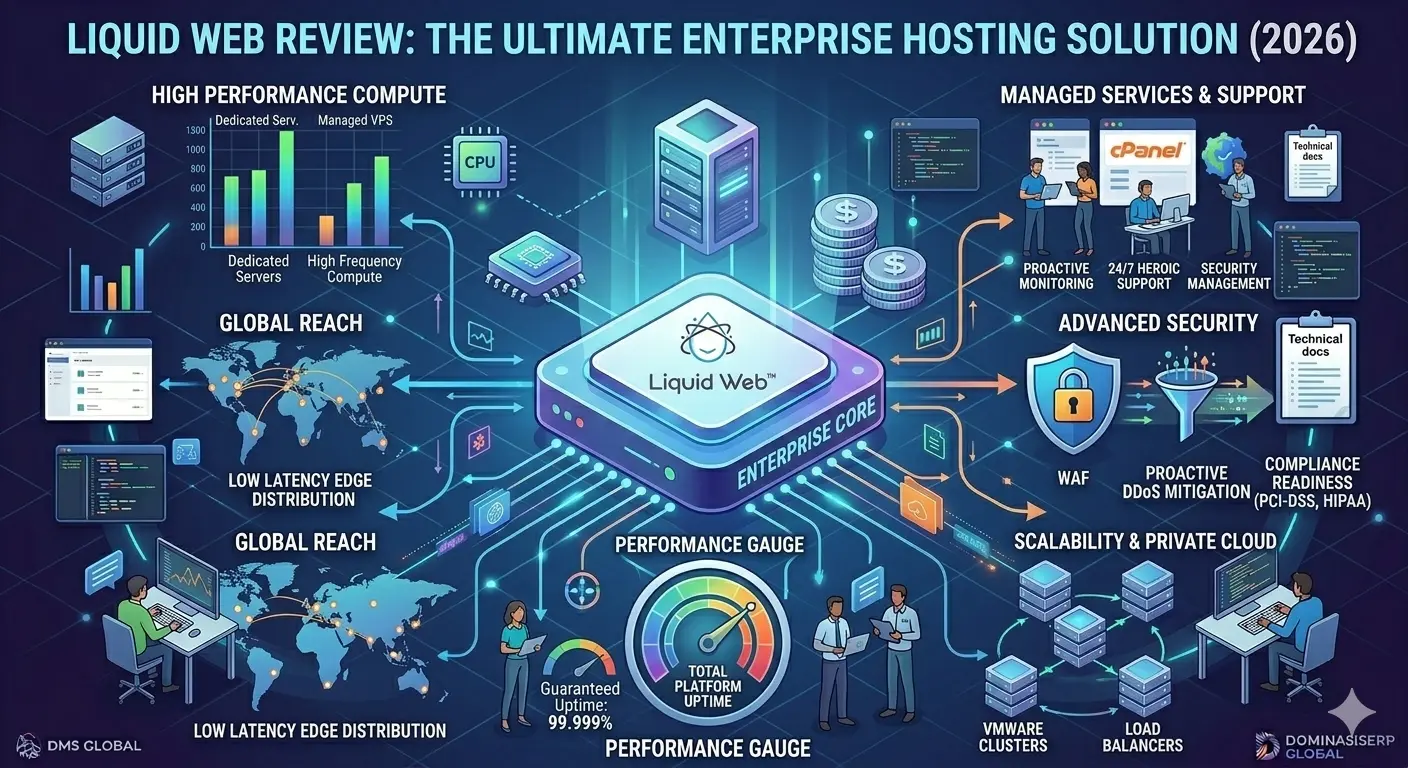
Liquid Web Review: The Ultimate Solution for Enterprise Hosting

Liquid Web

In the high-stakes world of enterprise-level digital operations, the infrastructure supporting your application is not just a cost center—it is a foundational pillar of your business performance. While shared and entry-level cloud hosting are suitable for startups, mature businesses, eCommerce powerhouses, and high-traffic platforms eventually face a critical juncture: they need more than just space; they need reliability, security, and an infrastructure partner that acts as an extension of their own IT team. This is where Liquid Web has carved out its reputation as the ultimate solution for enterprise hosting.

Why Enterprise Hosting Requires a Different Standard

Enterprise hosting is defined by three non-negotiable requirements: uptime, security, and scalability. When your platform handles thousands of concurrent users, a single hour of downtime can equate to significant financial loss and brand erosion. Unlike mass-market hosting providers that focus on volume, Liquid Web specializes in high-performance environments tailored for mission-critical applications.

Whether you are managing a massive WooCommerce store, a complex SaaS platform, or a private cloud environment, Liquid Web provides the specialized hardware and managed services that ensure your operations remain fluid and secure under any load.

The Liquid Web Advantage: Managed Performance

The true differentiator for Liquid Web is its “managed” philosophy. For enterprises, managing raw infrastructure—patching kernels, handling firewall rules, and optimizing database configurations—is a distraction from product innovation.

1. High-Performance Infrastructure

Liquid Web offers a diverse portfolio of infrastructure, including:

  • Dedicated Servers: For businesses that require absolute isolation and raw power without sharing hardware resources.

  • Managed VPS: Providing the flexibility of virtualization with the performance of enterprise-grade hardware.

  • Private Cloud & VMware: Tailored solutions that allow enterprises to build scalable, hybrid cloud environments with the control of an on-premise data center.

2. Managed Services as a Core Offering

When you host with Liquid Web, you are not just getting a server; you are getting a team of systems administrators. This includes proactive monitoring, 24/7/365 support, and, in many cases, security management. For enterprise IT leads, this means your internal team can focus on software deployment and user experience, while Liquid Web handles the “heavy lifting” of the underlying hardware and network layers.

Security at the Enterprise Level

For enterprise-level businesses, security is a constant battle. Liquid Web integrates multiple layers of protection directly into its hosting packages, reducing the need for expensive third-party tools.

  • Advanced Firewall Configurations: Tailored to block malicious traffic before it reaches your application.

  • Proactive DDoS Protection: With enterprise-grade hardware, Liquid Web mitigates volumetric attacks, ensuring your site stays online even during malicious activity.

  • Compliance Readiness: Liquid Web provides infrastructure that is built with compliance in mind, supporting businesses that need to adhere to strict regulatory standards like PCI-DSS and HIPAA.

Scalability Without Complexity

Scalability is often where enterprise projects falter. Scaling a server setup manually is fraught with risk. Liquid Web addresses this by offering load balancing, autoscaling (in specific cloud environments), and easy migration paths. As your business grows, moving from a single dedicated server to a load-balanced cluster is a streamlined, supported process rather than a complex engineering headache.

The “Heroic” Support Philosophy

Perhaps the most talked-about aspect of Liquid Web is its support team. In the enterprise sector, standard ticketing systems are often insufficient. Liquid Web’s “Heroic Support” model guarantees access to real engineers who understand the architecture of your specific environment. This reduction in “time-to-resolution” is vital for enterprises where every minute of downtime impacts the bottom line.

Conclusion: When to Choose Liquid Web

Liquid Web is not for the hobbyist or the beginner; it is a premium investment for businesses that have moved beyond the “growth” phase and into the “scaling” phase. If your business depends on its online presence to generate revenue, if you handle sensitive customer data that requires top-tier security, and if you have outgrown the limitations of standard shared or basic cloud environments, Liquid Web provides the stability you need.

By combining enterprise-grade hardware, proactive management, and a support team that functions as an extension of your company, Liquid Web allows you to offload the burden of infrastructure, enabling your organization to focus on what it does best: driving value for your customers.

related tags: Liquid Web, enterprise hosting, dedicated servers, managed hosting, cloud infrastructure

Linode vs AWS: Why Startups Prefer Linode for Simplicity

linode vs aws

For startups navigating the competitive digital landscape of 2026, the choice of cloud infrastructure is a critical decision that influences everything from operational efficiency to long-term profitability. While Amazon Web Services (AWS) is undeniably the largest player in the hyperscale market, an increasing number of startups are gravitating toward Linode (now part of Akamai Cloud Computing) for its clarity, predictability, and developer-centric philosophy.

The Complexity of Hyperscale vs. The Power of Simplicity

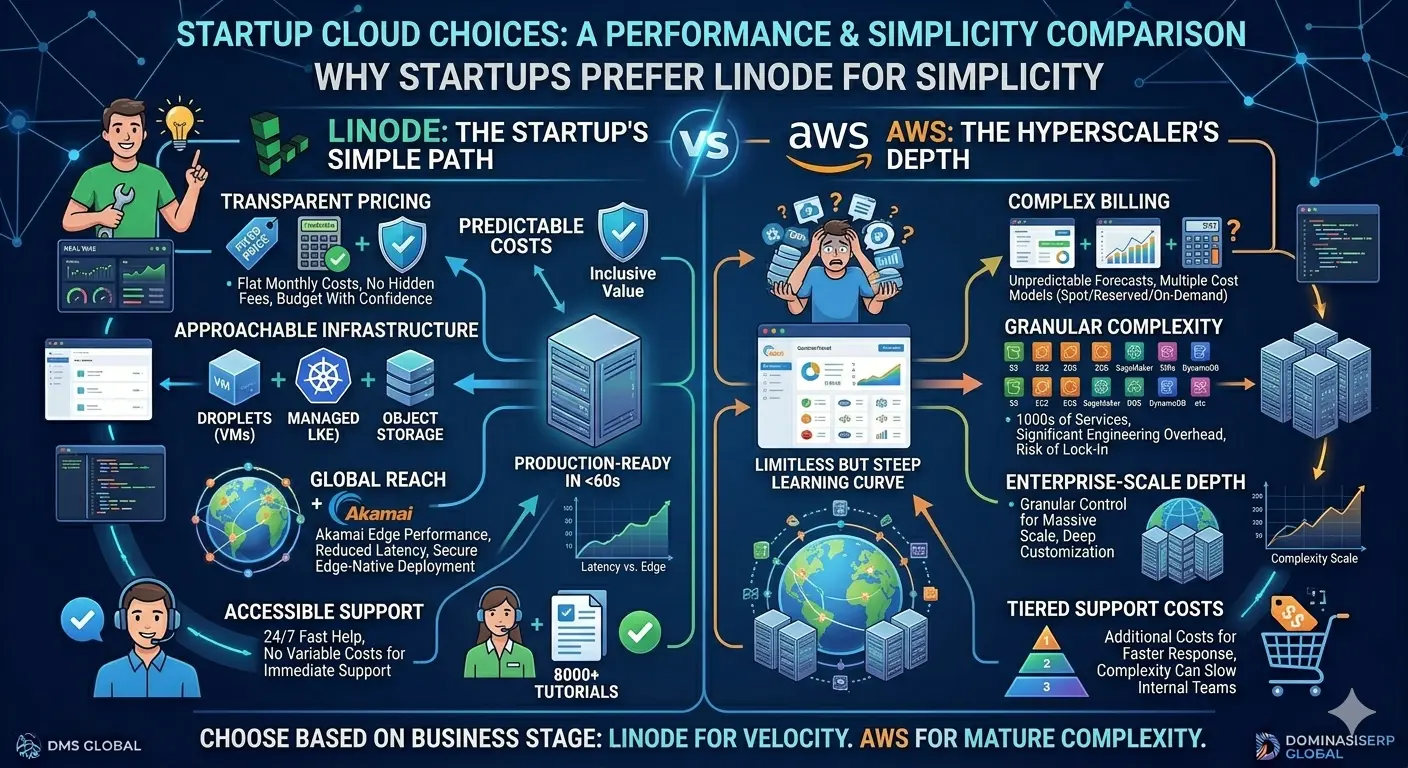
AWS provides an exhaustive catalog of thousands of specialized services, offering virtually limitless scalability and granular control. However, this depth often creates a steep learning curve and operational overhead that can distract early-stage teams from their core product development.

In contrast, Linode differentiates itself by focusing on a “developer-first” experience. It provides a suite of essential cloud products—such as compute, block storage, and managed Kubernetes (LKE)—that are designed to be intuitive and easy to manage without requiring a dedicated cloud engineering team. For startups, this means spending less time configuring complex interfaces and more time building.

Transparent Pricing: A Startup’s Best Friend

One of the most significant pain points for startups on AWS is the unpredictable nature of billing. AWS’s pricing models, involving reserved instances, spot instances, and complex data transfer fees, can make it notoriously difficult to forecast expenses accurately.

Linode offers a refreshing alternative with a transparent, flat-rate, and predictable monthly pricing model.

  • No Hidden Costs: Startup founders can budget with confidence knowing exactly what their monthly infrastructure bill will be.

  • Inclusive Value: Linode plans often bundle generous amounts of storage and outbound transfer, which are frequently charged as separate, variable costs on AWS.

  • Cost Efficiency: By avoiding the “hyperscaler tax” of complex networking and storage add-ons, startups can maintain a leaner operational budget.

Developer-Centric Experience and Support

Startups prioritize speed and agility. Linode’s dashboard is widely regarded for its clarity, allowing developers to provision instances in under 60 seconds. The platform’s documentation is another cornerstone of its success, with over 8,000 community-driven tutorials and guides that assist teams in troubleshooting and optimizing their deployments.

Moreover, while AWS support is often tiered and can be expensive for immediate technical assistance, Linode is recognized for providing accessible support, which is invaluable for lean teams that do not have 24/7 dedicated DevOps engineers.

Global Reach Meets Edge Performance

With its integration into the Akamai ecosystem, Linode has expanded its reach significantly, combining its traditional VPS simplicity with Akamai’s global edge network. This allows startups to benefit from:

  • Reduced Latency: Deploying applications closer to users through Akamai’s extensive network of edge PoPs.

  • Enterprise-Grade Security: Default DDoS protection and security layers that would often require complex configuration on other platforms.

  • Scalable AI Inference: Through the Akamai Inference Cloud, startups can now tap into powerful GPU resources for AI-driven applications, maintaining simplicity even as they scale into advanced workloads.

Conclusion

For the majority of startups, AWS represents a “future-proof” destination that may be overkill in the early stages, whereas Linode represents a “production-ready” starting point that accelerates time-to-market. By choosing a platform that champions transparent pricing, approachable infrastructure, and a clear developer experience, startups can focus their limited resources on innovation rather than infrastructure management.