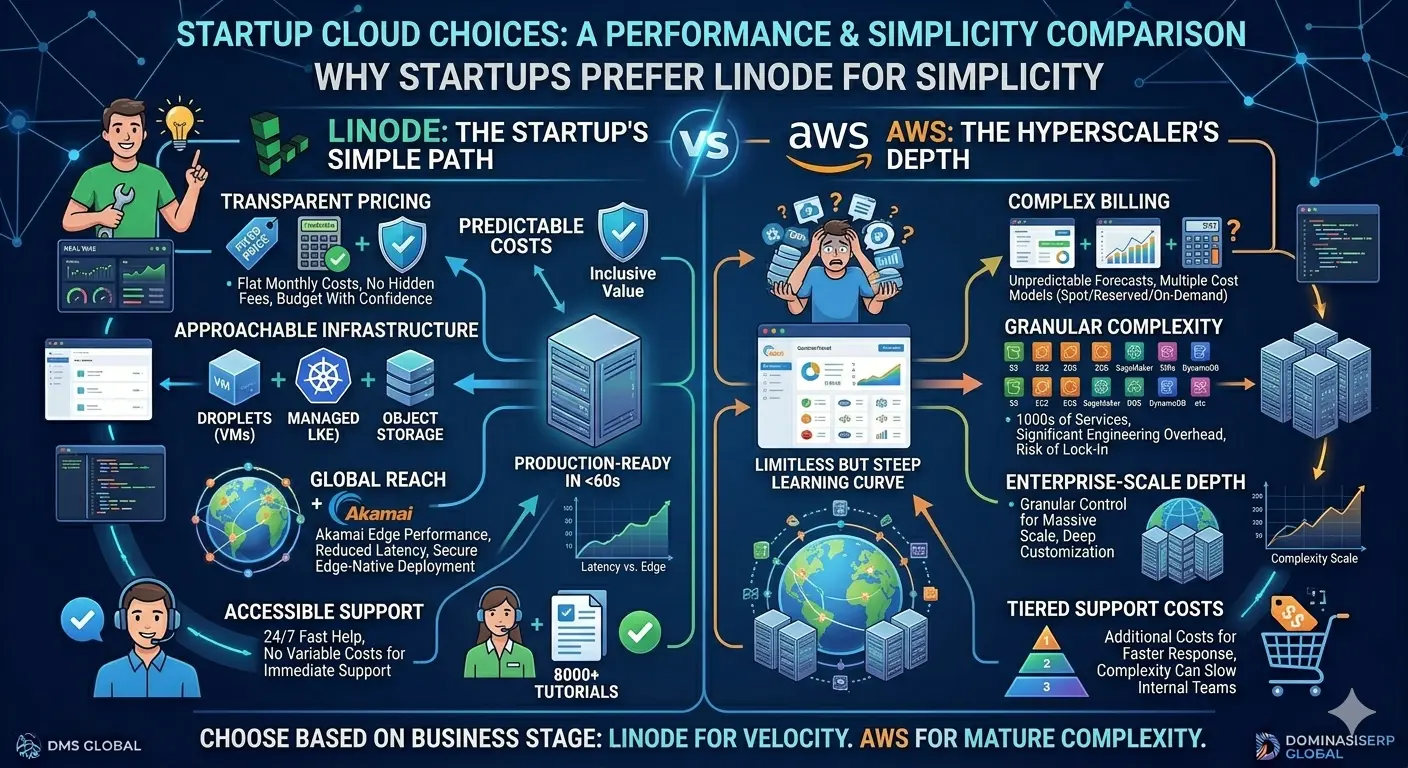
For startups navigating the competitive digital landscape of 2026, the choice of cloud infrastructure is a critical decision that influences everything from operational efficiency to long-term profitability. While Amazon Web Services (AWS) is undeniably the largest player in the hyperscale market, an increasing number of startups are gravitating toward Linode (now part of Akamai Cloud Computing) for its clarity, predictability, and developer-centric philosophy.
The Complexity of Hyperscale vs. The Power of Simplicity
AWS provides an exhaustive catalog of thousands of specialized services, offering virtually limitless scalability and granular control. However, this depth often creates a steep learning curve and operational overhead that can distract early-stage teams from their core product development.
In contrast, Linode differentiates itself by focusing on a “developer-first” experience. It provides a suite of essential cloud products—such as compute, block storage, and managed Kubernetes (LKE)—that are designed to be intuitive and easy to manage without requiring a dedicated cloud engineering team. For startups, this means spending less time configuring complex interfaces and more time building.
Transparent Pricing: A Startup’s Best Friend
One of the most significant pain points for startups on AWS is the unpredictable nature of billing. AWS’s pricing models, involving reserved instances, spot instances, and complex data transfer fees, can make it notoriously difficult to forecast expenses accurately.
Linode offers a refreshing alternative with a transparent, flat-rate, and predictable monthly pricing model.
-
No Hidden Costs: Startup founders can budget with confidence knowing exactly what their monthly infrastructure bill will be.
-
Inclusive Value: Linode plans often bundle generous amounts of storage and outbound transfer, which are frequently charged as separate, variable costs on AWS.
-
Cost Efficiency: By avoiding the “hyperscaler tax” of complex networking and storage add-ons, startups can maintain a leaner operational budget.
Developer-Centric Experience and Support
Startups prioritize speed and agility. Linode’s dashboard is widely regarded for its clarity, allowing developers to provision instances in under 60 seconds. The platform’s documentation is another cornerstone of its success, with over 8,000 community-driven tutorials and guides that assist teams in troubleshooting and optimizing their deployments.
Moreover, while AWS support is often tiered and can be expensive for immediate technical assistance, Linode is recognized for providing accessible support, which is invaluable for lean teams that do not have 24/7 dedicated DevOps engineers.
Global Reach Meets Edge Performance
With its integration into the Akamai ecosystem, Linode has expanded its reach significantly, combining its traditional VPS simplicity with Akamai’s global edge network. This allows startups to benefit from:
-
Reduced Latency: Deploying applications closer to users through Akamai’s extensive network of edge PoPs.
-
Enterprise-Grade Security: Default DDoS protection and security layers that would often require complex configuration on other platforms.
-
Scalable AI Inference: Through the Akamai Inference Cloud, startups can now tap into powerful GPU resources for AI-driven applications, maintaining simplicity even as they scale into advanced workloads.
Conclusion
For the majority of startups, AWS represents a “future-proof” destination that may be overkill in the early stages, whereas Linode represents a “production-ready” starting point that accelerates time-to-market. By choosing a platform that champions transparent pricing, approachable infrastructure, and a clear developer experience, startups can focus their limited resources on innovation rather than infrastructure management.