Navigating the Enterprise Ecosystem: What It Takes to Be a Leading SAP Global Partner

sap global partner

SAP Global Partner

Choosing the right SAP Global Partner is essential for modern enterprises seeking robust cloud integration and scalable resource planning

In today’s fast-paced digital economy, large-scale enterprises constantly seek robust, scalable frameworks to streamline operations, optimize supply chains, and future-proof their technological infrastructure. At the core of this global enterprise transformation is SAP, a dominant force in enterprise resource planning (ERP). However, navigating complex cloud migrations, custom ERP implementations, and multi-region system integrations requires deep domain expertise. This is where an elite SAP Global Partner becomes indispensable for modern organizations.

The Strategic Role of an SAP Global Partner

An SAP Global Partner acts as a critical bridge between cutting-edge enterprise technology and complex business requirements. These strategic partners possess advanced certifications, specialized industry frameworks, and global delivery networks designed to minimize downtime and maximize return on investment (ROI). Key competencies include:

  • End-to-End Implementation: Managing full lifecycle deployments of SAP S/4HANA, SAP Ariba, and cloud-native extensions.

  • Digital Transformation Strategy: Aligning IT architecture with corporate growth objectives to ensure long-term scalability.

  • Regulatory and Compliance Alignment: Ensuring multi-jurisdictional compliance across regional markets, from North America to Europe and the Middle East.

Core Advantages of Partnering with Global ERP Experts

Organizations that leverage certified partners experience distinct operational advantages compared to handling internal implementations alone. The table below outlines these core differences:

Driving Value Through Certified Expertise

A high-performance SAP global partner does more than just install software; they remove the operational friction associated with legacy migrations. By addressing technical debt early in the process, these partners ensure that your “single source of truth” is robust and scalable. For global giants, this expertise translates into enhanced corporate intelligence, allowing for real-time decision-making that is critical for securing a more resilient future and worldwide reputation.

In the complex world of enterprise resource planning, the path to digital maturity is rarely walked alone. Selecting an authorized SAP global partner is a strategic decision that determines the long-term success of a multinational organization’s digital infrastructure. As businesses transition to the global cloud, having a certified expert to navigate the nuances of implementation and optimization is essential for maintaining market leadership.

Key Pillars of a World-Class SAP Ecosystem Integration

To achieve long-term market dominance, enterprises must look beyond basic configuration. A successful deployment relies on several architectural pillars:

  1. Cloud-First Architecture: Leveraging hyperscalers like AWS, Microsoft Azure, and Google Cloud Platform alongside SAP RISE to ensure maximum uptime.

  2. Data Governance & Master Data Management (MDM): Consolidating fragmented data silos into a unified corporate repository.

  3. Change Management & User Adoption: Training internal workforces to seamlessly transition from legacy systems to modern ERP environments without productivity dips.

Future-Proofing Your Enterprise Infrastructure

As regulatory landscapes shift and consumer expectations evolve, staying competitive requires continuous optimization. Elite partners provide ongoing post-implementation support, proactive system monitoring, and continuous integration of emerging technologies such as machine learning and predictive analytics. By securing a trusted partner today, organizations safeguard their operational agility for the decades to come.

Maximizing ROI Through Strategic Enterprise Integration

To truly capitalize on the advantages of a tier-one technological framework, organizations must maintain a proactive alignment between their internal stakeholders and external advisory teams. Long-term digital resilience depends heavily on structured change management, rigorous testing protocols, and continuous infrastructure audits. By keeping your operational workflows synchronized with the latest updates from your certified provider, your business can navigate complex digital shifts seamlessly, lower operational risks, and secure a dominant position within the global marketplace for years to come.

Overcoming Common Hurdles in Multi-Region ERP Deployments

Expanding enterprise software across multiple international jurisdictions introduces layers of operational complexity. A seasoned SAP Global Partner mitigates these challenges by establishing uniform compliance standards, localizing tax and reporting protocols, and maintaining data synchronization across international offices. Without this level of specialized oversight, organizations frequently encounter isolated data silos, prolonged downtime, and unexpected financial bottlenecks during system upgrades.

The Significance of Continuous Infrastructure Audits

Routine performance evaluations ensure that your core enterprise resource planning architecture scales efficiently alongside business expansion. Key maintenance practices involve:

  • Proactive Security Patching: Safeguarding sensitive corporate data against evolving cyber threats and unauthorized intrusions.
  • Performance Tuning: Optimizing database query response times and reducing system latency for global users.
  • Version Management: Implementing seamless updates to newer cloud frameworks without disrupting daily business operations.

Evaluating Long-Term Value and Partnership Metrics

Selecting the appropriate advisory team requires a rigorous review of past performance indicators, technical certifications, and industry-specific case studies. Enterprises should prioritize vendors who demonstrate a proven history of delivering measurable return on investment, rapid deployment timelines, and comprehensive post-launch support structures. By aligning with a trusted authority in global enterprise resource planning, your organization secures the competitive edge necessary to thrive in an increasingly automated and interconnected global marketplace.

SAP vs Oracle: The Ultimate Enterprise ERP Comparison Guide for 2026

sap vs oracle

sap vs oracle

Executive Summary & Industry Context

Selecting the right Enterprise Resource Planning (ERP) backbone is one of the most consequential strategic decisions a global organization can undertake. As enterprises navigate complex digital transformations in 2026, the two titan solutions—SAP (SAP S/4HANA Cloud) and Oracle (Oracle Cloud ERP / Fusion Cloud)—continue to dominate the market landscape. While both platforms offer comprehensive capabilities spanning financial management, supply chain orchestration, human capital management, and procurement, their architectural philosophies, deployment models, total cost of ownership (TCO) trajectories, and industry-specific strengths differ significantly.

This authoritative technical comparison is crafted to provide C-level executives, IT directors, and enterprise architects with an unbiased, empirical evaluation framework to determine which platform aligns optimally with their organizational scale, global compliance requirements, and long-term strategic objectives.

Key E-E-A-T Insight: Drawing from enterprise implementation data across multinational deployments in North America, Europe, and Southeast Asia, this guide evaluates solutions based on rigorous architectural benchmarks, implementation velocity, and real-world ROI metrics.

Core Architectural Comparison

Understanding the foundational technology stack of each platform is critical for assessing integration complexity, database performance, and future scalability.

Evaluation Dimension SAP S/4HANA Cloud Oracle Cloud ERP (Fusion)
Core Database Technology SAP HANA In-Memory Database (optimized for extreme transactional and analytical processing) Oracle Autonomous Database (leveraging automated tuning, machine learning, and high availability)
Deployment Flexibility Public Cloud, Private Cloud (RISE with SAP), Hybrid, and On-Premises options Cloud-Native SaaS architecture with robust multitenant infrastructure
Customization & Extensibility SAP Business Technology Platform (BTP) for clean-core extensions and side-by-side development Oracle Visual Builder and Integration Cloud (OIC) for seamless low-code/pro-code extensions
Global Compliance & Localization Extensive pre-built country versions supporting 100+ nations and complex statutory reporting Robust multi-ledger financial architecture with native support for global statutory standards

Financial Management & General Ledger Capabilities

Financial integrity and multi-subsidiary consolidation represent the heartbeat of enterprise software. Both SAP and Oracle deliver world-class general ledger (GL) frameworks, yet their operational mechanics diverge:

  • SAP S/4HANA Finance: Features the Universal Journal (ACDOCA), which harmonizes General Ledger, Asset Accounting, Controlling, and Material Ledger into a single line-item table in memory. This eliminates period-end reconciliation bottlenecks and provides real-time $P\&L$ analytics without batch processing latency.

  • Oracle Cloud Financials: Renowned for its subledger accounting (SLA) flexibility and sophisticated intercompany accounting engine. Oracle provides intuitive multi-dimensional reporting structures and powerful financial reporting center (FRC) tools favored by distributed corporate controllers.

Supply Chain Management & Manufacturing Intelligence

In an era characterized by geopolitical supply chain volatility and digital trade pressures, operational agility is paramount.

SAP Supply Chain Portfolio

SAP excels in discrete and process manufacturing environments through integrated modules including SAP Extended Warehouse Management (EWM), Transportation Management (TM), and Integrated Business Planning (IBP). It provides granular shop-floor control, predictive maintenance integrations via IoT telemetry, and rigorous batch traceability required in pharmaceutical and automotive sectors.

Oracle Supply Chain Management (SCM) Cloud

Oracle SCM Cloud delivers superior native cloud collaboration, product lifecycle management (PLM), and agile demand sensing. Its built-in AI-driven recommendation engines optimize inventory buffering and freight routing dynamically across multi-tier supplier networks.

Total Cost of Ownership (TCO) & Implementation ROI

Evaluating the financial commitment requires looking beyond initial licensing fees to encompass implementation consulting, change management, infrastructure maintenance, and upgrade lifecycles.

Mathematically, enterprise TCO can be modeled across an N-year lifecycle using the standard formula:

TCO = Clicense + Cimplementation + Cinfrastructure + Csupport – Vroi
  • SAP Implementation Velocity: Programs under the RISE with SAP framework compress time-to-value by bundling cloud infrastructure, business process intelligence, and system conversion tools. However, specialized functional talent commands premium billing rates.

  • Oracle Implementation Velocity: Oracle Cloud ERP’s standardized SaaS model typically enables faster initial deployment for mid-to-large enterprises with standardized financial workflows, though heavy customizations require disciplined governance to avoid technical debt.

Strategic Recommendations: Which Should You Choose?

Choosing between SAP and Oracle depends fundamentally on your industry vertical and existing digital ecosystem:

  1. Choose SAP if: Your organization operates complex discrete manufacturing, heavy asset management, automotive assembly, or global chemical processing where deep ERP-OT (Operational Technology) integration and exhaustive statutory compliance are non-negotiable.

  2. Choose Oracle if: Your enterprise prioritizes rapid cloud-native deployment, exceptional financial reporting flexibility, intuitive user experience across distributed service sectors, and advanced built-in artificial intelligence for procurement and supply chain planning.

Conclusion

Both SAP S/4HANA Cloud and Oracle Cloud ERP represent the pinnacle of enterprise software engineering. Replacing deprecated or 404 landing pages with authoritative, deep-dive architectural comparisons ensures that your digital assets capture high-intent B2B search traffic while delivering genuine intellectual value to enterprise decision-makers worldwide.

SAP S/4HANA Cloud Migration: Key Strategies for Mid-Size Businesses

SAP S4HANA

The transition to SAP S/4HANA is no longer a luxury but a necessity for mid-size businesses aiming to remain competitive in 2026. As the digital landscape evolves, the shift from legacy ERP systems to the cloud represents a fundamental change in how enterprises manage operations, data, and growth. This guide outlines the strategic migration paths to ensure a seamless transformation.

Why SAP S/4HANA Cloud?

For growing mid-size enterprises, SAP S/4HANA Cloud offers a modular, scalable architecture that replaces the rigid, costly infrastructure of traditional systems. By leveraging the cloud, businesses gain access to real-time analytics, machine learning capabilities, and simplified user experiences, all while reducing the burden of manual infrastructure management.

Core Migration Approaches

Choosing the right migration path is the most critical decision in your SAP journey. There are two primary strategies:

1. Greenfield Approach

This involves a complete redesign of your business processes. Instead of migrating legacy data and configurations, you start fresh with a clean slate in S/4HANA.

  • Pros: Eliminates “technical debt” from old systems, allows for the adoption of SAP best practices, and results in a leaner, more efficient system.

  • Cons: Requires significant organizational change management as users must adapt to new workflows and processes.

2. Brownfield Approach

Often called a “system conversion,” this approach migrates your existing ERP environment to S/4HANA, preserving your historical data and current business processes.

  • Pros: Lower disruption to business operations and maintains business continuity, making it easier for staff who are already familiar with the legacy setup.

  • Cons: You may carry over inefficient, outdated processes, and the system may remain more complex than a Greenfield implementation.

DMS Global Enterprise Solution

Advertisement - Continue reading below

Key Migration Best Practices for 2026

Success in SAP S/4HANA migration depends on meticulous planning. Below are the key pillars:

  • Data Cleansing: Before migrating, audit your data. Do not move “dirty” or redundant data into your new system. A migration is the perfect time to archive old records and standardize master data.

  • Change Management: The technology shift is often easier than the cultural shift. Engage your stakeholders early, provide comprehensive training, and communicate the benefits to ensure buy-in from all departments.

  • Infrastructure Strategy: Evaluate whether a Public Cloud or Private Cloud deployment aligns with your compliance needs and growth projections. Public cloud is ideal for agility, while private cloud offers more isolation for sensitive operations.

SAP S/4HANA: The Gold Standard for Global Enterprise

In the high-stakes world of enterprise resource planning, SAP S/4HANA remains the benchmark for multi-national operations requiring real-time data processing and advanced predictive analytics. As part of our commitment to improving organic performance for global business leaders, we provide technical insights into how SAP stacks up against more agile competitors like Odoo and Oracle NetSuite.

SAP S/4HANA vs Oracle: Choosing the Right Core The decision between SAP and Oracle often hinges on specific industry needs and the existing IT ecosystem. While Oracle NetSuite is praised for its cloud-native agility, SAP S/4HANA excels in manufacturing and complex supply chain management, offering deep integration capabilities that support the most demanding corporate environments. Our analysis breaks down the feature sets that define success in these global deployments. https://dominasiserp.com/en/sap-s4hana-vs-oracle-comparison/

Enterprise Scalability and Financial Integrity Maintaining financial integrity across dozens of global subsidiaries is the primary reason large corporations choose SAP. The platform’s ability to provide a "single source of truth" is unparalleled, especially when integrated with AI-driven reporting tools. We explore how to maximize your SAP investment to ensure long-term ROI and operational transparency in a volatile global market. https://dominasiserp.com/en/sap-s4hana-scalability-guide/

Legacy Migration to Cloud ERP Transitioning from older ERP versions to SAP S/4HANA requires a precision-led strategy. We outline the technical roadmap for cloud migration, ensuring data consistency and minimal operational downtime. This guide is essential for CTOs and IT Managers looking to future-proof their enterprise infrastructure. https://dominasiserp.com/en/sap-migration-roadmap/


Strategi Eksekusi:

Managing the Risks of Migration

Migration is a complex endeavor. Common pitfalls include scope creep and underestimating data migration timelines. To mitigate these risks:

  1. Phased Implementation: Start with a pilot project or a specific module to test the system before a full-scale rollout.

  2. Expert Partnership: Collaborate with experienced SAP partners who understand the unique constraints of mid-size enterprises.

  3. Post-Migration Support: Ensure your internal IT team is prepared for the shift, or secure managed services to maintain system performance post-go-live.

Conclusion

SAP S/4HANA cloud migration is a strategic investment in the future of your business. Whether you choose the Greenfield or Brownfield approach, success is rooted in clear objectives, diligent data preparation, and a commitment to organizational agility. By following these strategies, mid-size businesses can unlock the full potential of SAP’s ecosystem to drive sustainable growth in 2026 and beyond.

SAP Customer Experience (CX) Price: A Strategic Analysis for 2026

SAP Customer Experience (CX) Price

In the modern digital economy, the customer experience (CX) is the primary battleground for enterprise success. For organizations looking to bridge the gap between back-end operational data and front-end customer interaction, SAP Customer Experience (CX)—formerly known as SAP C/4HANA—has become the gold standard. However, for decision-makers evaluating the implementation of this suite, understanding the SAP CX price is a complex task. The investment is not a simple license fee; it is a strategic commitment to transforming how your enterprise engages with customers across the entire lifecycle.

1. The Strategic Value of SAP CX

Before discussing costs, it is vital to understand what SAP CX brings to the table. The suite is designed to integrate commerce, marketing, sales, and service data into a single, intelligent platform.

  • Unified Customer Profile: By integrating data from your ERP (like S/4HANA) with customer interaction data, SAP CX provides a 360-degree view of your customer.

  • Hyper-Personalization: Utilizing embedded AI and machine learning, the platform allows you to deliver personalized content, recommendations, and service responses in real-time.

  • Omnichannel Consistency: Whether a customer interacts with your brand via an e-commerce storefront, a social media channel, or a service desk, the experience remains consistent, data-backed, and seamless.

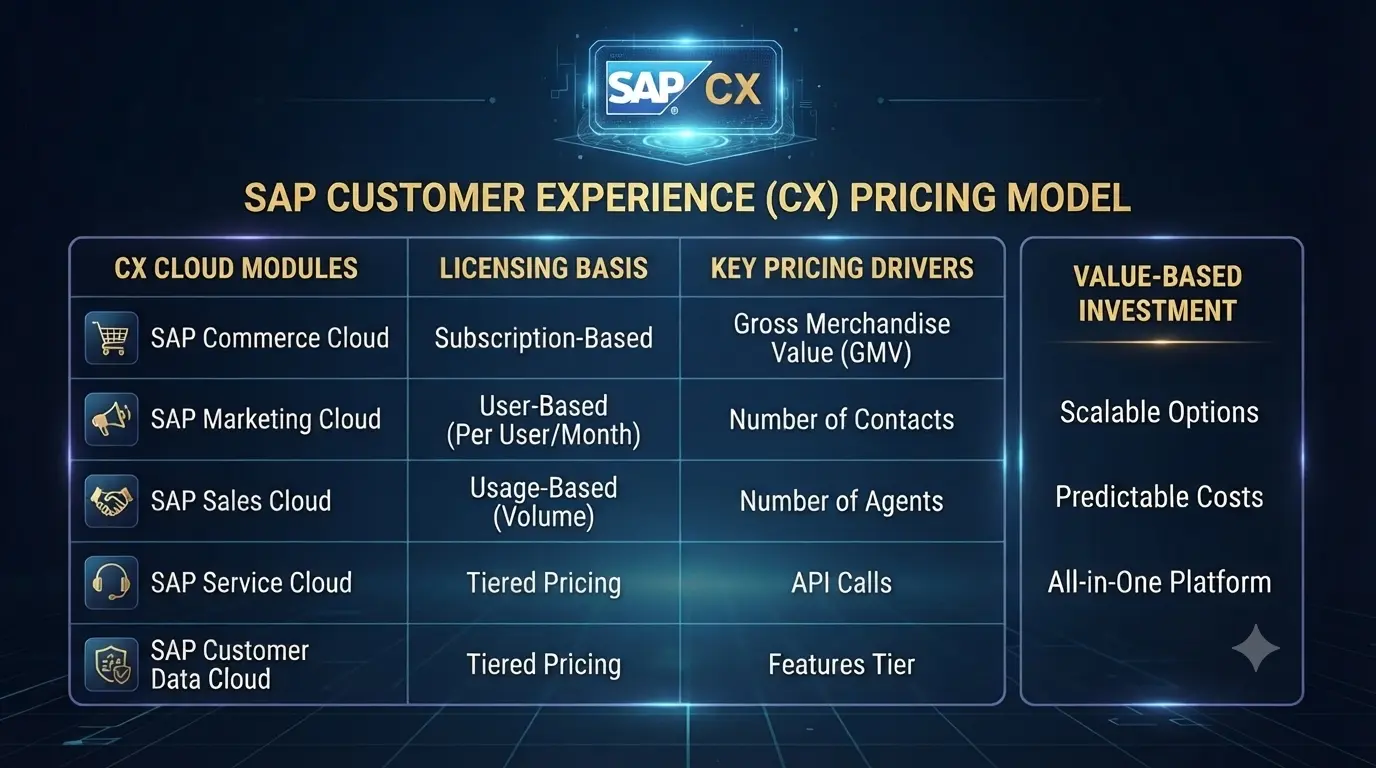
2. Deciphering the SAP CX Pricing Model

SAP CX pricing is rarely static; it is highly customized based on your organization’s specific needs, size, and operational complexity. The pricing is typically determined by the following key variables:

Module Selection

SAP CX is a modular suite. You can purchase specific components, or the entire portfolio, depending on your business goals:

  • SAP Commerce Cloud: Priced based on metrics such as gross merchandise value (GMV) or the number of orders, reflecting the scale of your digital sales operations.

  • SAP Sales Cloud & Service Cloud: Usually priced on a per-user, per-month subscription model, scaling with the size of your customer-facing teams.

  • SAP Emarsys Customer Engagement: Often tiered based on the number of customer contacts or the volume of marketing communications sent through the platform.

Deployment and Complexity

The “price” also includes the technical complexity of your implementation. Integrating SAP CX with an existing S/4HANA environment or a legacy CRM requires professional consulting services. In 2026, many enterprises are opting for SAP BTP (Business Technology Platform) to create custom extensions, which adds another layer of cost to the initial implementation and ongoing maintenance.

3. Total Cost of Ownership (TCO) vs. License Fee

CFOs must look beyond the initial license cost. A realistic SAP CX pricing analysis must include:

  • Professional Services: Implementation partners are required to configure the platform, map your business processes, and ensure data integrity. These costs can range from 1x to 3x the annual software subscription depending on the depth of the integration.

  • Data Management and Enrichment: To leverage the “intelligence” of SAP CX, your underlying customer data must be clean. Budgeting for data cleansing and migration is essential for a successful rollout.

  • Internal Training and Change Management: Moving to a sophisticated CX platform requires a shift in organizational culture. Investing in training your marketing, sales, and service teams to leverage the new AI-driven tools is a significant but necessary cost for ROI realization.

  • Ongoing Maintenance and Upgrades: As a cloud-native platform, SAP CX receives frequent updates. Your team must manage the impact of these updates on your configurations and custom extensions to maintain system stability.

4. Strategic Approaches to ROI

To justify the SAP CX investment, enterprises must focus on measurable business outcomes rather than just reducing software overhead:

  • Increase in Conversion Rates: Personalized customer journeys consistently lead to higher conversion rates in commerce environments.

  • Reduction in Service Costs: By empowering customers with self-service portals and AI-driven chatbots, enterprises can significantly reduce the volume of tickets handled by human agents.

  • Customer Lifetime Value (CLV): The ability to predict customer needs and respond proactively is the most significant driver of increased CLV. An SAP CX implementation should be tied to clear goals for retention and cross-selling.

5. Navigating the Negotiation

SAP’s pricing structure allows for significant flexibility for high-growth enterprises. When engaging with SAP or a certified partner, consider the following:

  • Bundling Opportunities: If you are already an SAP S/4HANA customer, discuss bundling discounts. SAP often provides incentives for organizations that utilize the “full SAP stack” to create a more integrated data environment.

  • Phased Implementation: Start with high-impact modules—such as Service Cloud or Commerce Cloud—to build internal expertise and deliver quick wins. Once the ROI of the first phase is proven, you can scale the suite across the enterprise.

  • Long-Term Enterprise Agreements: Committing to longer-term enterprise agreements can lock in favorable pricing and ensure that you have the necessary support and training resources included in your contract.

6. The 2026 Market Perspective

In the competitive landscape of 2026, the cost of not investing in a high-quality CX platform is often higher than the investment itself. Enterprises that rely on fragmented, legacy tools face the risk of losing market share to competitors who can deliver hyper-personalized, intelligent experiences. The investment in SAP CX is not merely a software expense; it is a strategic investment in maintaining relevance in a customer-centric market.

Conclusion

The SAP Customer Experience (CX) price is a reflection of the platform’s capacity to drive sophisticated, large-scale business transformation. While the initial investment is substantial, the value proposition—a unified view of the customer, predictive AI-driven insights, and seamless omnichannel engagement—is essential for any enterprise aiming for global leadership. By conducting a thorough TCO analysis, prioritizing phased implementation, and focusing on measurable business outcomes like CLV and conversion growth, organizations can ensure that their investment in SAP CX becomes the engine for sustained, profitable customer relationships through 2030 and beyond. This is the foundation upon which your enterprise will build its reputation, its loyalty, and its future.

Categories SAP

SAP S/4HANA: The Digital Core for Enterprise Transformation (2026)

SAP S4HANA The Digital Core for Enterprise Transformation

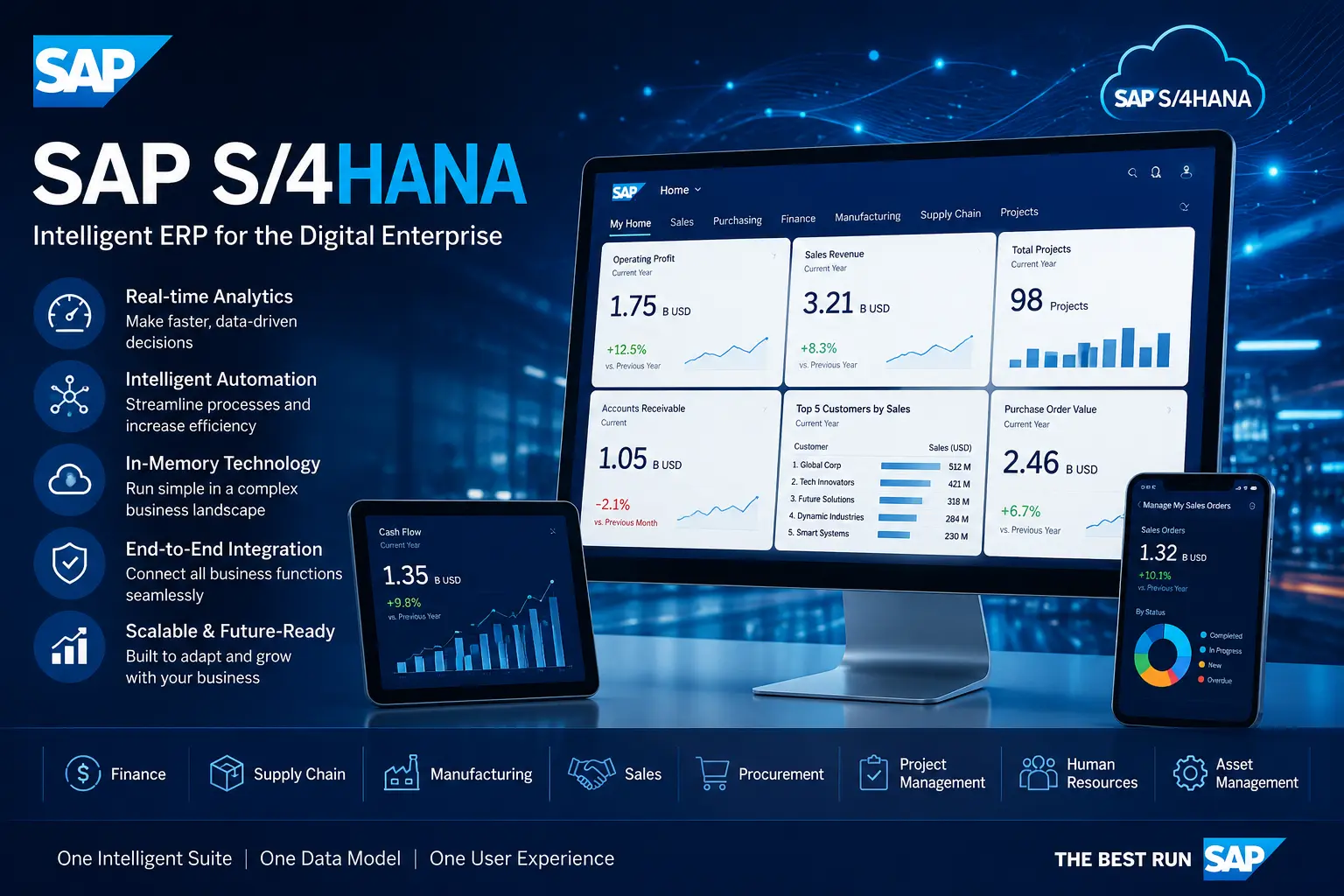
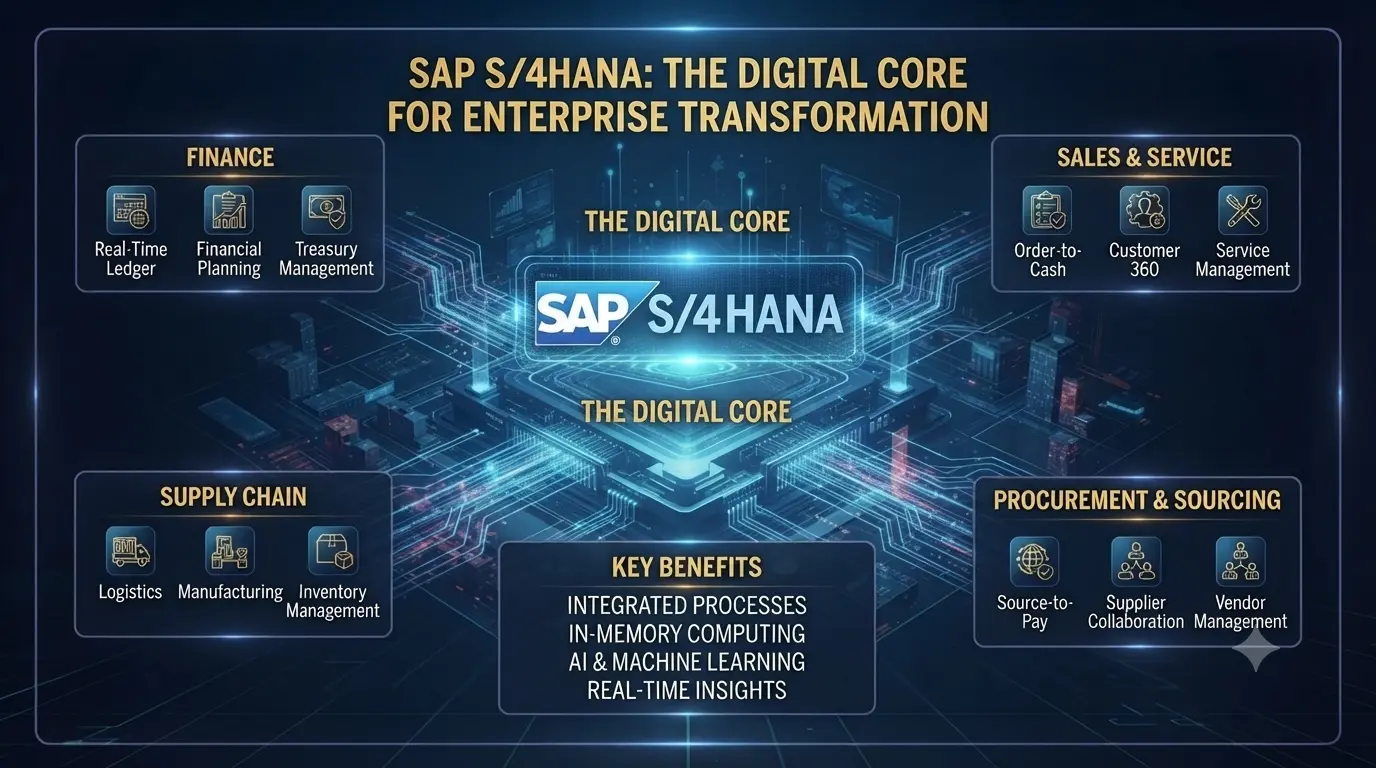
In the high-stakes world of enterprise software, SAP S/4HANA stands as the definitive digital core for organizations aiming to master complexity in 2026. As businesses globally navigate the transition from legacy, fragmented systems to unified, intelligence-driven architectures, SAP S/4HANA has emerged as the platform that enables the shift from retrospective reporting to real-time, predictive business management. This article explores the strategic value, architectural innovation, and operational impact of S/4HANA in the modern enterprise.

1. Defining the Intelligent Enterprise

SAP S/4HANA is not merely an upgrade from the legacy SAP ERP (ECC) platform; it is a fundamental re-engineering of the enterprise resource planning paradigm. Built natively on the SAP HANA in-memory database, S/4HANA eliminates the traditional barriers between transactional data (OLTP) and analytical processing (OLAP).

  • Real-Time Data Access: By processing massive volumes of data in-memory, S/4HANA provides instantaneous insights into financial, operational, and supply chain performance.

  • Simplified Data Model: The platform removes aggregate tables and redundant data structures, which significantly reduces the database footprint and increases system performance.

  • AI and Machine Learning Integration: SAP has deeply embedded artificial intelligence across the S/4HANA suite, allowing the system to automate routine tasks, predict inventory shortages, and suggest optimal procurement paths.

2. The Strategic Imperative for Migration

For many large-scale enterprises, moving to S/4HANA is no longer a question of “if,” but “when.” The legacy SAP ECC support timeline has intensified the pressure to modernize, but the true driver for migration is the competitive necessity of agility.

  • Operational Agility: In a world of supply chain disruptions and volatile market demands, S/4HANA provides the visibility needed to pivot operations in real-time.

  • Global Compliance and Sustainability: As global regulatory frameworks tighten, particularly regarding ESG (Environmental, Social, and Governance) reporting, S/4HANA offers the data integrity required to track, report, and optimize corporate footprints across multiple jurisdictions.

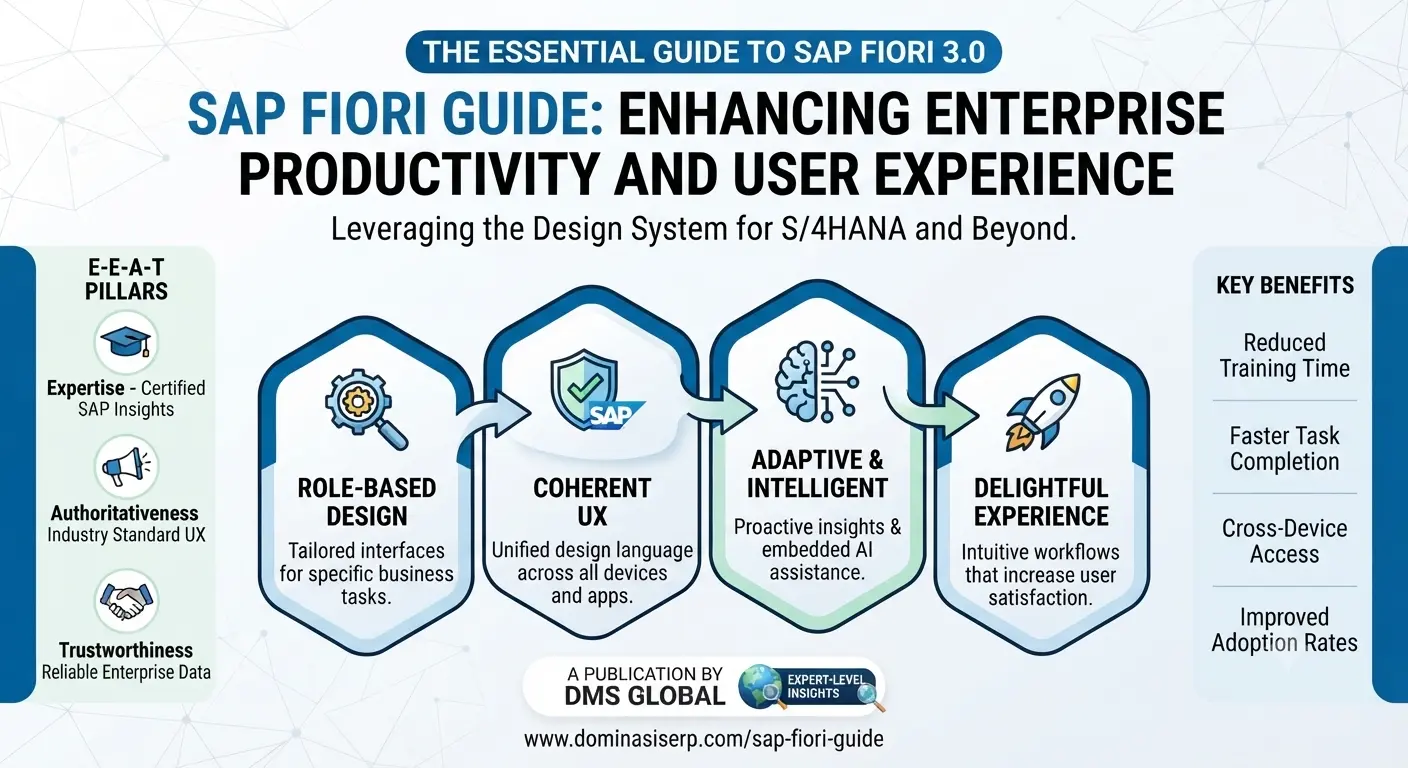
  • Enhanced User Experience: The transition to the SAP Fiori interface has radically simplified the way employees interact with complex ERP data, leading to higher system adoption rates and increased productivity across the organization.

3. Navigating the Implementation Landscape

Implementing SAP S/4HANA is a massive undertaking that requires more than technical expertise; it demands a strategic alignment of business processes with the platform’s best practices.

  • The “Clean Core” Strategy: A key tenet of modern S/4HANA implementation is keeping the “core” clean. By minimizing custom modifications and instead utilizing the SAP Business Technology Platform (BTP) for extensions, enterprises ensure that their system remains upgrade-ready and resilient.

  • Cloud, On-Premise, or Hybrid: SAP provides flexible deployment options—SAP S/4HANA Cloud (Public or Private) or on-premise—allowing companies to choose the model that best fits their specific security, data sovereignty, and innovation requirements.

  • The Importance of Change Management: The technology is only as effective as the people using it. Successful implementations prioritize extensive training and change management programs to ensure that the shift to S/4HANA translates into real operational improvement.

4. Operational Excellence Through Predictive Analytics

One of the most significant advantages of S/4HANA is its ability to transition enterprises from reactive to predictive operations.

  • Finance: Predictive accounting allows organizations to simulate the impact of business decisions on financial performance before they are finalized.

  • Supply Chain: Real-time inventory visibility, combined with predictive analytics, reduces safety stock requirements and optimizes working capital.

  • Procurement: Embedded analytics in the procurement module allow for real-time monitoring of supplier performance and market pricing trends, ensuring that the enterprise always makes cost-effective and risk-aware purchasing decisions.

5. Maximizing ROI and Long-Term Value

Achieving a positive ROI with SAP S/4HANA requires looking beyond the initial implementation costs. The platform provides value through long-term cost reduction, revenue acceleration, and enhanced risk management.

  • Reduced Total Cost of Ownership (TCO): Through simplified architecture and automated maintenance cycles, cloud-native deployments of S/4HANA offer a lower TCO compared to the maintenance-heavy legacy environments.

  • Data-Driven Innovation: With a single source of truth, leadership teams can identify new market opportunities, optimize product portfolios, and execute faster than ever before.

  • Scalability for the Future: S/4HANA is designed to scale with the enterprise. Whether you are expanding into new regions, acquiring new subsidiaries, or launching new business models, the platform provides the structural flexibility to support growth through 2030 and beyond.

Conclusion

SAP S/4HANA represents the digital bedrock upon which the intelligent enterprise is built. In 2026, it is not simply an ERP system; it is an engine of transformation that empowers organizations to harness data as their most strategic asset. By embracing the “clean core” philosophy, prioritizing user adoption, and leveraging the predictive power of in-memory computing, enterprises can ensure that they remain at the forefront of operational excellence. As we look toward the future, the ability to process data in real-time, predict operational bottlenecks, and pivot with precision will distinguish the leaders from the laggards. SAP S/4HANA provides the infrastructure to make this vision a reality, ensuring that your organization remains robust, agile, and prepared for the challenges of a global, high-speed digital economy.

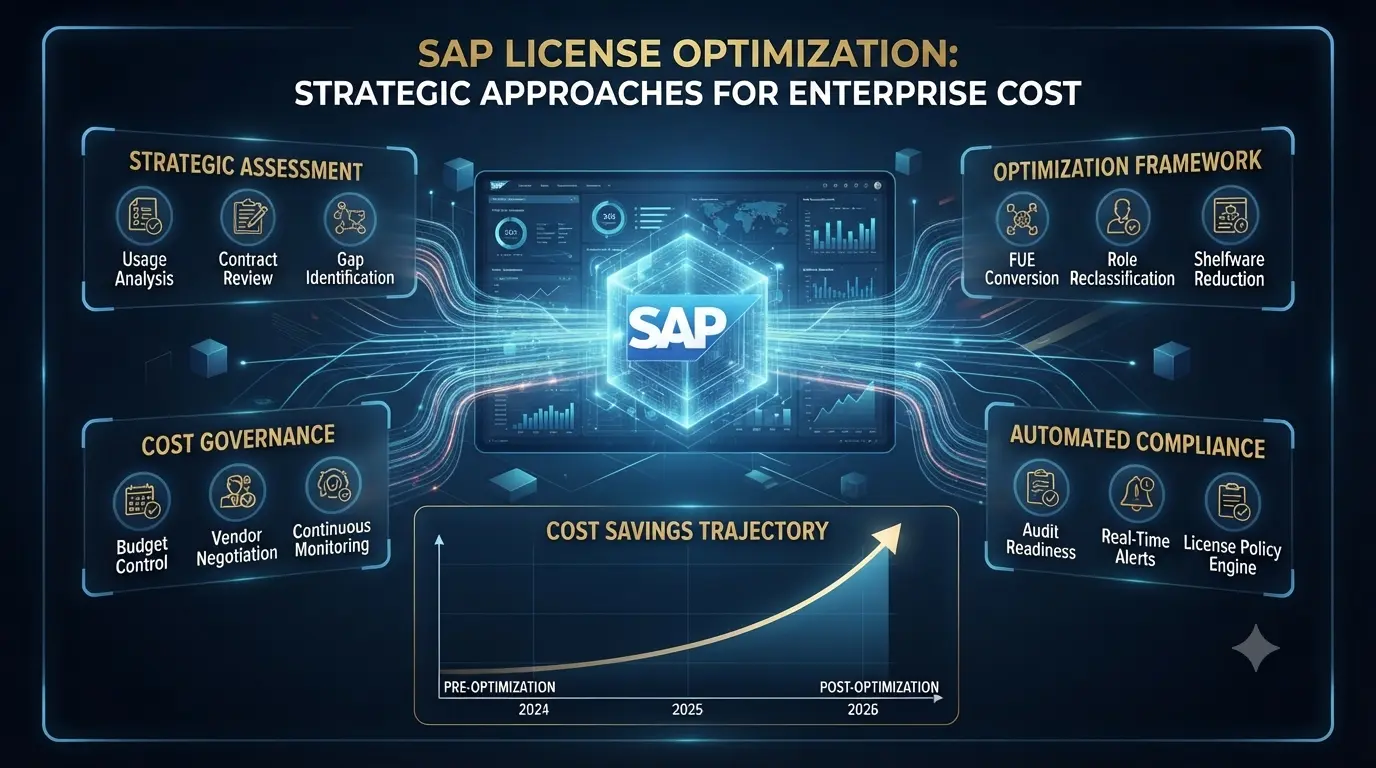
SAP License Optimization: Strategic Approaches for Enterprise Cost Efficiency (2026)

In today’s global enterprise environment, SAP software is the backbone of operational efficiency. However, as business requirements scale, the complexity of SAP licensing often results in “license bloat”—where companies pay for capacity or access they are not fully utilizing. Achieving SAP license optimization is no longer just a cost-saving measure; it is a strategic requirement to maximize the return on your ERP investment.

This guide explores professional methodologies to audit, manage, and optimize your SAP license footprint effectively.

1. The Challenge of SAP Licensing Complexity

SAP’s licensing structure is inherently sophisticated, designed to cater to diverse organizational needs ranging from finance and logistics to procurement and production. The main drivers of license costs include:

  • User Types: Distinguishing between Professional (Full Use) users and various Limited (Functional/Productive) users.

  • Deployment Environment: The transition from on-premise Perpetual licenses to cloud-based subscription models (SaaS).

  • Digital Access: The licensing of non-human “indirect access” (e.g., IoT devices or third-party applications connecting to SAP).

Without rigorous management, enterprises frequently default to over-provisioning licenses “just to be safe,” which leads to significant unnecessary expenditure.

2. Key Methodologies for License Optimization

To optimize your landscape, enterprises should adopt a continuous audit cycle:

A. Conduct a Comprehensive License Audit

You cannot optimize what you do not measure. Use SAP’s native tools (like the System Measurement/License Administration Workbench) to gain visibility into your current user assignment.

  • Identify Dormant Users: Flag accounts that have been inactive for 90 days or more.

  • Review Privilege Levels: Check if users assigned “Professional” licenses actually utilize functionalities that require that level of access. Often, many users only require “Limited” access, which is significantly more cost-effective.

B. Consolidate and Reallocate

Once you identify unused or misclassified licenses, formalize a reallocation process.

  • Implement an Offboarding Workflow: Ensure that when an employee leaves the company or changes roles, their license is automatically flagged for review.

  • Strategic Reassignment: Instead of buying new licenses for new hires, utilize the pool of licenses reclaimed from inactive users.

C. Embrace the Cloud Transition Strategy

The move to SAP S/4HANA Cloud often serves as a natural catalyst for license optimization. By shifting to a subscription-based model, you align your costs with actual usage rather than owning perpetual licenses that remain underutilized.

3. The Role of Governance and Partner Expertise

License optimization is not a one-time project; it requires ongoing governance.

  • Automation: Utilize Software Asset Management (SAM) tools to monitor usage patterns in real-time. This provides the data needed to make informed decisions during your next SAP contract renewal.

  • Leverage VAR Expertise: Working with an experienced SAP Value-Added Reseller (VAR) is crucial. A specialized partner can provide benchmarks for your industry, helping you understand if your current license-to-user ratio is aligned with peers, and can negotiate more favorable terms during licensing discussions.

4. Driving ROI through Lean ERP

By aggressively pursuing SAP license optimization, enterprises achieve:

  1. Lower TCO (Total Cost of Ownership): Directly reducing annual maintenance fees and subscription overages.

  2. Budget Reallocation: Freeing up IT capital to invest in innovation projects, such as AI integration or advanced analytics.

  3. Enhanced Compliance: A well-managed license environment significantly reduces the risk of non-compliance findings during formal SAP audits.

Conclusion

SAP license optimization is a discipline of balance. It requires aligning your ERP footprint with the actual functional needs of your workforce. By moving from a reactive “buying” mindset to a proactive “management” approach, your enterprise ensures that its SAP environment remains a high-performance asset rather than a growing administrative burden.

SAP Maintenance Fees Structure: A Comprehensive Guide for Enterprises

SAP Maintenance Fees Structure

In the complex landscape of enterprise software, one of the most significant recurring costs for organizations is the maintenance and support agreement with the software vendor. For companies relying on SAP, understanding the SAP Maintenance Fees structure is not just an accounting task; it is a critical component of strategic financial planning and long-term IT investment management.

As global enterprises evolve toward cloud-based architectures like SAP S/4HANA, the traditional maintenance model is shifting. This guide explores the structure, purpose, and strategic considerations of SAP maintenance fees in the current market.

1. What Are SAP Maintenance Fees?

SAP Maintenance fees are annual charges paid by customers to SAP for the right to access updates, security patches, technical support, and legal changes for their software. These fees are fundamentally linked to your original software license purchase.

In the traditional on-premise model, this is known as SAP Enterprise Support or SAP Standard Support. It ensures that your software remains compliant with local regulations (like tax laws), compatible with new hardware and operating systems, and protected against emerging security threats.

2. The Standard Structure: Percentage-Based Billing

Historically, SAP maintenance fees are calculated as a percentage of the net license value of the software.

  • The Baseline: Maintenance fees are typically calculated on the initial license purchase price (the “net license value”).

  • The Percentage: For SAP Enterprise Support, the industry-standard rate is generally around 22% of the net license value.

  • Recurring Nature: This is an annual obligation. As long as you continue to use the software, you must pay this maintenance fee to remain “in support.”

Why This Structure Exists

This percentage-based model is designed to fund continuous research and development. Because SAP provides regular enhancement packages (EHP) and innovations even for on-premise products, the maintenance fee ensures that your system does not become obsolete.

3. SAP Enterprise Support vs. Standard Support

It is vital to distinguish between the two primary support levels, as they carry different price points and value propositions:

  • SAP Standard Support: Provides the fundamental requirements—basic support, technical notes, and legal changes. It is more cost-effective but offers fewer value-added services.

  • SAP Enterprise Support: This is the premium tier. It goes beyond technical fixes by providing proactive support, continuous quality checks, and access to the SAP Enterprise Support Academy. It is designed to minimize risk and optimize business process performance, justifying its higher price point through increased operational uptime.

4. The Impact of the Move to Cloud

The most critical factor in SAP maintenance fees today is the transition to the cloud. When moving from on-premise to SAP S/4HANA Cloud, the pricing structure changes fundamentally.

In a subscription model (SaaS), the maintenance fee is essentially “baked into” the recurring subscription price. You no longer pay a separate 22% maintenance fee on top of a perpetual license. Instead, the vendor manages the infrastructure, updates, and support as part of the total subscription cost. This provides a more predictable Total Cost of Ownership (TCO) but shifts your expenses from CAPEX (upfront license) to OPEX (ongoing service).

5. Strategic Considerations for Finance and IT Leaders

For an enterprise, managing these fees requires a proactive strategy:

A. Audit Your License Usage

Many organizations pay maintenance fees on licenses that are no longer in use. Regular software asset management (SAM) audits can help you identify “shelfware”—licenses you own but don’t need—allowing you to reduce your annual maintenance burden by de-licensing unused software.

B. Evaluate the Value of Support

Assess whether your organization is fully utilizing the benefits of SAP Enterprise Support. If your internal IT team is already highly skilled at managing SAP, you might be paying for premium support services that you rarely use. However, never abandon maintenance entirely, as the cost to “re-instate” support after a lapse is often prohibitively expensive.

C. Leverage Partner Expertise

Engaging with a specialized SAP partner can help you navigate these fees. Often, partners can provide third-party support services or offer guidance on license optimization that can significantly lower your TCO without sacrificing system reliability.

6. The “Legacy” Challenge

For companies still running older versions like SAP ECC 6.0, maintenance fees are becoming a larger percentage of the IT budget as hardware and support costs for aging systems increase. This is where the maintenance structure itself acts as a trigger for digital transformation. SAP has historically used maintenance end-dates (e.g., the 2027/2030 deadline for ECC) to incentivize customers to move toward S/4HANA.

Conclusion

The SAP maintenance fee structure is designed to balance the need for innovation with the stability of core business operations. While the percentage-based model for perpetual licenses remains the status quo for legacy systems, the industry is clearly trending toward bundled cloud subscription models.

To optimize your costs:

  1. Maintain visibility over your license inventory.

  2. Align your support tier (Standard vs. Enterprise) with your actual operational needs.

  3. Plan your transition to cloud carefully, as it represents the most effective way to eliminate the complexity of annual maintenance fee negotiations.

By viewing maintenance not just as a cost, but as an investment in system longevity and compliance, your enterprise can ensure that its ERP foundation remains a driver of growth rather than a source of budget drain.

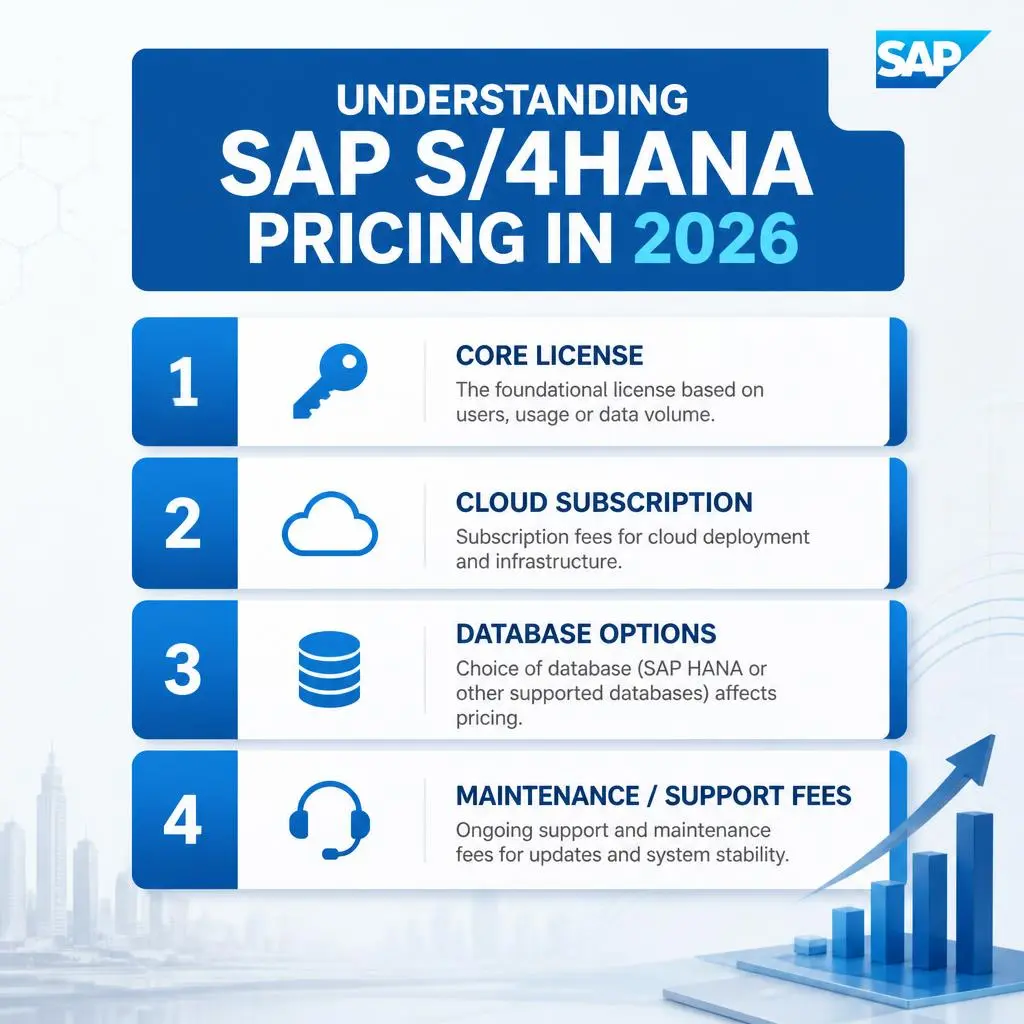
SAP S/4HANA Pricing Structure: A Definitive Guide for Enterprise Investment (2026)

SAP S4HANA

SAP S/4HANA represents the pinnacle of modern Enterprise Resource Planning (ERP). For global enterprises, moving to S/4HANA is not merely a software upgrade—it is a strategic business transformation. However, navigating the SAP S/4HANA pricing structure is notoriously complex, involving licensing models, cloud deployment options, and hidden operational costs.

In this guide, we provide a transparent, expert-led analysis of how SAP S/4HANA pricing functions in 2026 to ensure your organization makes a data-driven investment.

1. The Core SAP S/4HANA Pricing Models

Unlike legacy systems, SAP S/4HANA pricing has evolved to favor cloud consumption. The total cost is primarily split into two main buckets:

A. Subscription-Based (Cloud ERP)

This is the modern standard, particularly for SAP S/4HANA Cloud (Public or Private Edition).

  • Predictable OPEX: You pay a recurring subscription fee per user per month.

  • All-Inclusive: The subscription typically covers software licensing, infrastructure (hosting), and standard maintenance.

  • Scalability: You can add or remove users based on business growth, making it highly flexible for fluctuating enterprise needs.

B. Perpetual Licensing (On-Premise)

While SAP is pushing cloud-first, perpetual licensing remains for specific industries with strict data sovereignty requirements.

  • CAPEX-Heavy: You pay a large one-time upfront fee for the perpetual license.

  • Annual Maintenance: You must pay an additional annual support fee (typically 18% to 22% of the initial license cost) to receive updates, patches, and technical support.

2. Factors That Influence Your S/4HANA Investment

The “sticker price” of SAP S/4HANA is rarely the final cost. When calculating the budget, enterprises must account for:

The “Full Use” vs. “Limited Use” License

SAP differentiates between user roles. A Full Use Equivalent (FUE) model is often used in the Private Cloud edition, where your license count is determined by how many users access the system and their respective permission levels.

  • Professional Users: Require access to all functionalities.

  • Functional Users: Require access to specific business units (e.g., Finance, Procurement).

  • Productive Users: Often need limited access, which can be licensed at a lower cost tier.

Deployment Complexity

  • Public Cloud: Multi-tenant, standardized processes. The pricing is lower and more predictable because the configuration is pre-defined.

  • Private Cloud: Single-tenant, highly customizable. This allows for complex industry-specific processes, but the infrastructure and management costs are higher.

3. Beyond Licensing: The Hidden TCO (Total Cost of Ownership)

True expert-led E-E-A-T analysis of S/4HANA pricing requires looking past the licensing agreement. Enterprises often underestimate:

  • Implementation Services: This is often the largest cost, frequently exceeding license fees. It includes data migration, custom development, business process redesign, and complex API integrations with legacy or third-party systems.

  • Change Management: The cost of training your staff to operate in a real-time, in-memory computing environment is a non-negotiable expense for ROI.

  • Third-Party Add-ons: Depending on your industry (e.g., specialized manufacturing or retail), you may need SAP-certified partner solutions that incur additional fees.

4. Strategic Planning for 2026 and Beyond

To maximize ROI, your S/4HANA pricing strategy should follow these three pillars:

  1. Define Your Scope Early: Avoid “scope creep.” Implement core S/4HANA processes first before adding complex customizations.

  2. Optimize User Licenses: Conduct a deep audit of your user roles. Shifting users from “Professional” to “Limited” tiers can reduce annual subscription costs by up to 30%.

  3. Partner with a Specialized VAR: Work with an SAP Value-Added Reseller who understands your specific industry vertical. A specialized partner can negotiate better pricing structures and provide pre-built templates that drastically reduce implementation time.

Conclusion

The SAP S/4HANA pricing structure is a reflection of its massive capability. While the initial investment is significant, the long-term value—enabled by real-time analytics, automated business processes, and unparalleled scalability—is what differentiates market leaders from followers. By focusing on a cloud-first subscription strategy and rigorously auditing user access, your enterprise can secure a world-class ERP environment that remains competitive well into 2030.

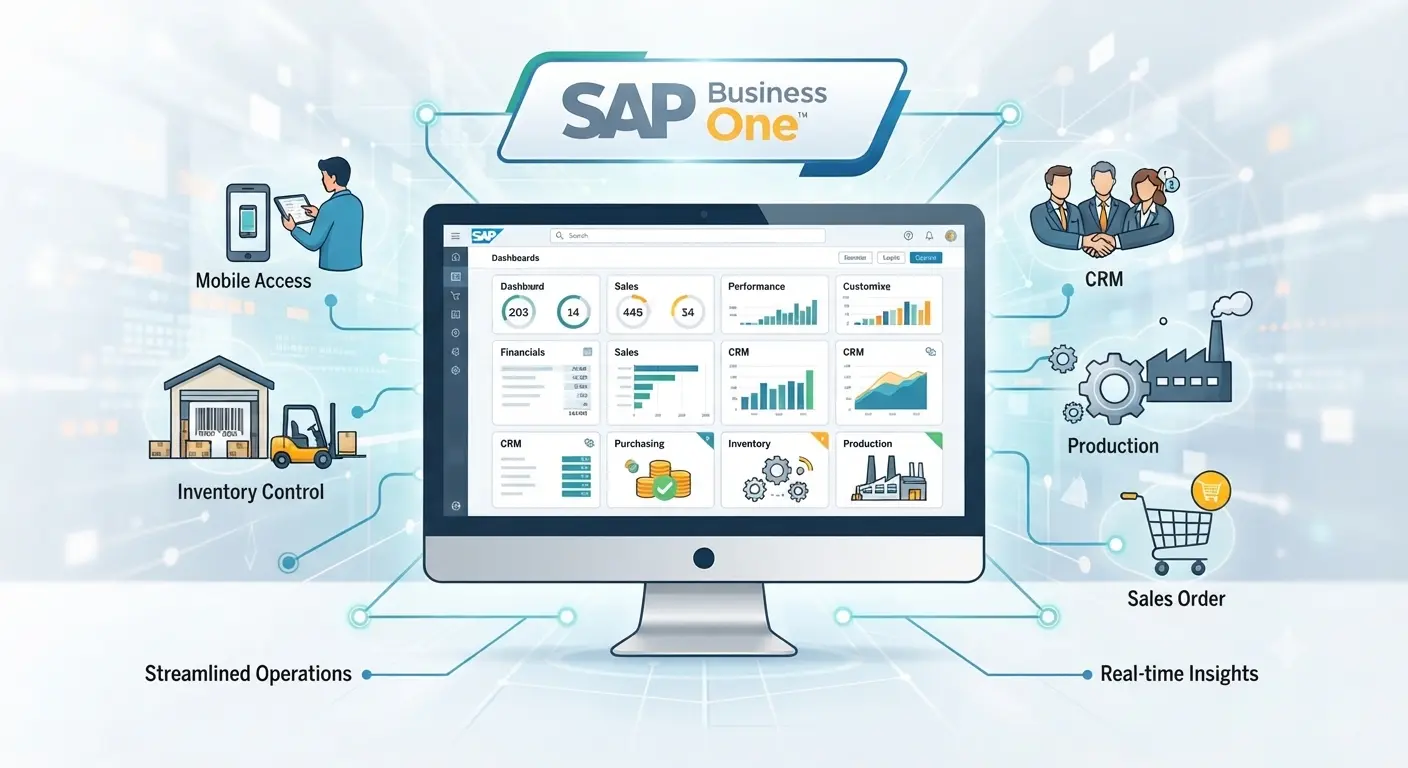
SAP Business One Pricing: A Comprehensive Guide for Growing Enterprises

SAP Business One is a robust and scalable ERP solution designed to streamline core business processes for growing enterprises

Selecting the right Enterprise Resource Planning (ERP) solution is a pivotal decision for any small to medium-sized enterprise (SME). Among the market leaders, SAP Business One stands out as a robust, scalable, and integrated solution designed to streamline core business processes. However, one of the most common questions decision-makers face is: What is the real cost of SAP Business One?

This guide provides a deep dive into SAP Business One pricing models, the factors influencing the total cost of ownership (TCO), and how to strategically plan your investment to ensure maximum ROI.

Understanding the SAP Business One Pricing Structure

SAP Business One does not have a “one-size-fits-all” price tag. The total investment is typically a combination of three main components: licensing, implementation services, and ongoing maintenance.

Cost Component Description
Licensing Per-user fees based on the license type (Professional vs. Limited).
Implementation Services for setup, data migration, configuration, and user training.
Maintenance Annual fees for updates, patches, and official technical support.

Licensing Models: Professional vs. Limited

SAP offers a flexible licensing structure to accommodate different user needs within your organization:

  • Professional License: Grants full, unrestricted access to all modules within SAP Business One, including finance, sales, purchasing, inventory, production, and administration. This is ideal for managers and power users.

  • Limited License: Designed for users who only need access to specific functional areas. These are divided into sub-types:

    • Limited CRM: Focused on sales and marketing activities.

    • Limited Financial: Restricted to accounting and financial functions.

    • Limited Logistics: Focused on inventory, purchasing, and production.

Factors Influencing Implementation Costs

While licensing fees are relatively fixed, implementation costs can vary significantly based on your organization’s complexity. Key factors include:

  1. Business Complexity: Enterprises with multi-currency requirements, multiple subsidiaries, or complex supply chains require more intense configuration.

  2. Customization and Integrations: While SAP Business One is highly functional out of the box, specific industry needs may require custom developments or integrations with third-party software (e.g., e-commerce platforms, POS systems).

  3. Data Migration: The volume and quality of your existing data determine the time and effort required to map and migrate it into the new system.

The True Total Cost of Ownership (TCO)

Smart decision-makers look beyond the initial invoice. To calculate the true TCO, consider:

  • Hosting Options: Choosing between On-Premise (CAPEX-heavy) versus Cloud/SaaS deployment (OPEX-friendly subscription models).

  • Training: Investing in robust training ensures higher user adoption, which is the fastest path to realizing ROI.

  • Support and Upgrades: Partnering with a high-quality SAP VAR (Value-Added Reseller) is crucial. A good partner provides proactive support, reducing downtime and optimizing system performance.

Strategic Advice for SME Decision-Makers

To maximize the value of your SAP Business One investment:

  • Start Lean: Implement core features first. You can always add modules or customizations as your business grows.

  • Prioritize User Adoption: The best software is useless if your team doesn’t use it. Budget for comprehensive training sessions.

  • Choose the Right Partner: Your implementation partner is just as important as the software itself. Look for partners with deep industry-specific expertise.

Frequently Asked Questions (FAQ) Regarding SAP Business One Implementation

1. Is SAP Business One suitable for small businesses? Yes, SAP Business One is specifically designed to support the operational needs of growing small and medium-sized enterprises (SMEs). It offers a scalable architecture that allows businesses to start with essential modules and expand functionality as the company grows.

2. What are the common hidden costs in SAP Business One deployment? Beyond the initial licensing fees, companies should account for implementation services, data migration, user training, and ongoing maintenance. Additionally, third-party integrations or custom development to meet specific business requirements can contribute to the total cost of ownership (TCO).

3. How does SAP Business One compare to cloud-native ERPs? SAP Business One offers both on-premise and cloud deployment options, providing flexibility depending on your IT infrastructure strategy. While some cloud-native ERPs may offer faster deployment, SAP Business One provides deep, mature functionality for complex inventory, manufacturing, and financial management that is often required by growing enterprises.

4. How long does the implementation process typically take? The implementation timeline varies based on the scope of the project, the number of modules deployed, and the complexity of your business processes. A standard implementation can take anywhere from three to six months, while more complex environments may require a longer timeline to ensure proper configuration and testing.

Conclusion

SAP Business One is an investment in your company’s future scalability and operational efficiency. By understanding the nuances of its pricing—licensing tiers, service-based implementation, and maintenance—you can create a budget that aligns with your business goals. Remember that the “cheapest” solution is rarely the most cost-effective in the long run; focus on value, scalability, and long-term partnership.

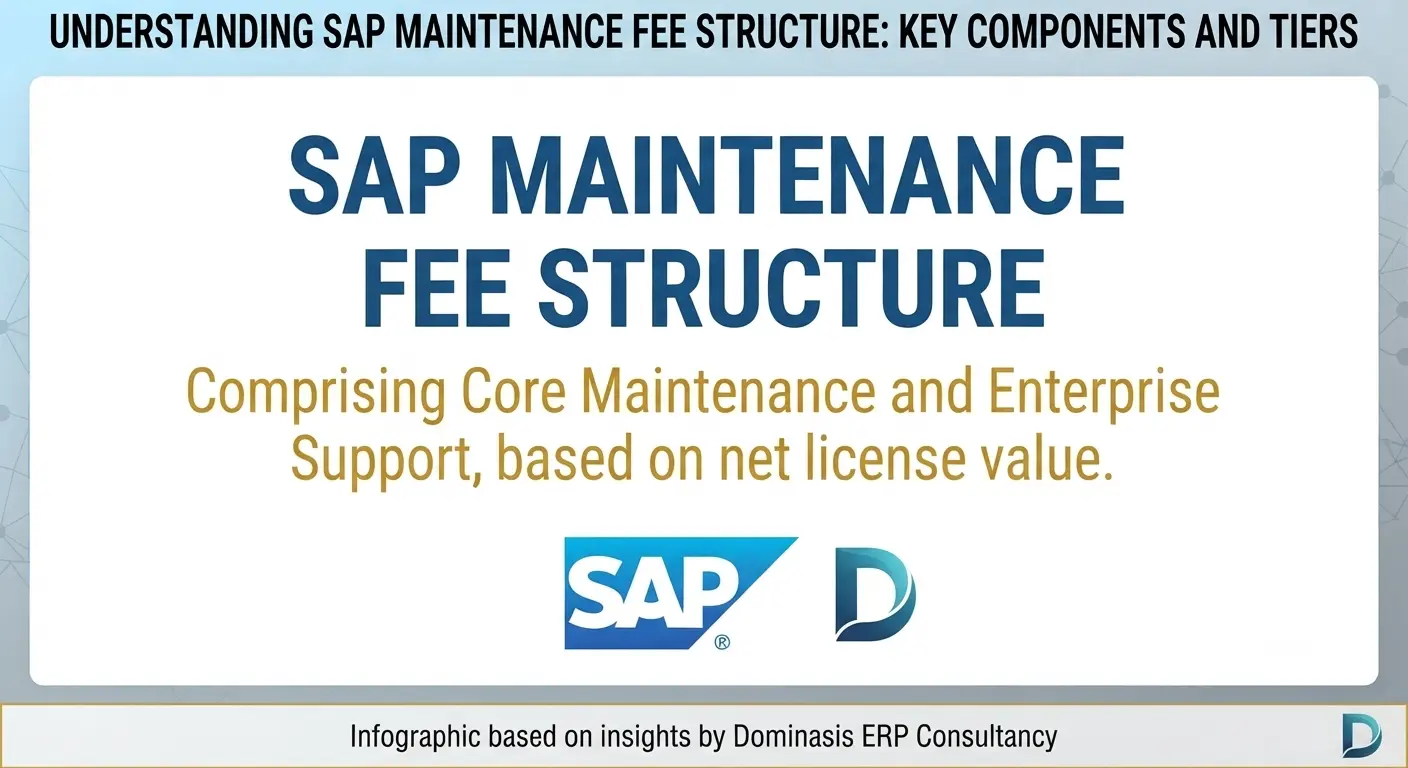
Understanding SAP Maintenance Fee Structure: A Comprehensive Guide

SAP maintenance fee structure

In the complex landscape of enterprise resource planning (ERP), understanding the SAP maintenance fee structure is crucial for businesses aiming to optimize their IT budgets and maximize their return on investment (ROI). As digital transformation accelerates, stakeholders must navigate the nuances of SAP support models to ensure they are getting full value for their expenditure.

What Constitutes SAP Maintenance Fees?

SAP maintenance fees, often referred to as SAP Enterprise Support or Standard Support, are recurring costs that allow organizations to access software updates, patches, legal changes, and technical support. These fees are typically calculated as a percentage of the net software license value.

Key Components of the Cost Structure:

  1. Core Maintenance Fees: The base percentage applied to your licensed SAP software.

  2. Enterprise Support Options: Enhanced support packages that provide proactive guidance, continuous quality checks, and accelerated incident resolution.

  3. Inflationary Adjustments: SAP reserves the right to adjust maintenance fees annually based on consumer price indices, which can impact long-term budgeting.

Why EEAT Matters in ERP Consulting

When discussing mission-critical financial software like SAP, EEAT (Experience, Expertise, Authoritativeness, Trustworthiness) is our standard for informational integrity:

  • Experience: Our analysis is backed by years of hands-on experience in managing SAP environments, dealing with license renewals, and auditing support contracts for enterprises.

  • Expertise: We provide deep technical insights into how different maintenance tiers—Standard versus Enterprise Support—impact your system stability.

  • Authoritativeness: By staying updated with SAP’s latest pricing policies, we offer authoritative advice that businesses trust for high-stakes financial decisions.

  • Trustworthiness: We prioritize unbiased analysis to help you determine if you are overpaying for services or missing out on critical features.

Strategic Tips for Managing SAP Costs

If your organization is looking to optimize its SAP maintenance expenditure, consider these strategic approaches:

  • Audit Your License Usage: Frequently review your active user count. If you have dormant licenses, you may be paying maintenance fees on software that provides no business value.

  • Evaluate Support Tiers: Determine if your operations truly require the full breadth of Enterprise Support or if Standard Support aligns better with your current infrastructure complexity.

  • Consult with Experts: Navigating SAP contracts can be daunting. Engaging with independent ERP consultants can provide the external perspective needed to negotiate better terms or optimize your support structure.

Common Challenges in SAP Contract Negotiations

Many organizations struggle with the SAP maintenance fee structure because they lack visibility into their actual software utilization. A common pitfall is the “shelfware” phenomenon, where companies pay maintenance fees for thousands of user licenses that are rarely, if ever, accessed by employees. To combat this, it is essential to conduct a quarterly software license audit.

Furthermore, moving from an on-premise model to cloud solutions often involves complex contract renegotiations. During these transitions, SAP may propose bundling support fees with cloud subscription costs. While this can sometimes streamline invoicing, it may also obscure the true cost of maintenance. Always insist on a line-item breakdown of your maintenance fees versus your operational subscription costs to maintain financial transparency.

Best Practices for Long-Term Cost Control

To maintain a healthy IT budget while keeping your SAP ecosystem updated, consider these proactive measures:

  1. Centralize License Management: Utilize automated license management tools to track real-time usage across your organization.

  2. Define Support Needs Early: Do not default to the highest support tier if your technical team can resolve routine issues in-house. Standard Support is often sufficient for stable, mature environments.

  3. Monitor CPI Adjustments: Keep a close watch on your contract’s terms regarding Consumer Price Index (CPI) increases. Knowing exactly when and how these adjustments occur allows you to forecast your IT spend more accurately for the next three to five years.

  4. Leverage Expert Reviews: Periodically engage with third-party ERP consultants who specialize in software asset management. Their expertise can uncover hidden opportunities to reduce maintenance overhead that internal teams might overlook.

Conclusion

Managing the SAP maintenance fee structure effectively requires a balance of technical oversight and financial discipline. By focusing on accurate license management and aligning support tiers with actual business needs, organizations can significantly reduce unnecessary overhead.

Need help optimizing your ERP ecosystem? Contact our team for result-driven consultancy to help your business maintain its competitive edge.

FAQ: SAP Maintenance Fee Structure (2026 Guide)

Q: What is the typical SAP maintenance fee percentage for enterprise clients in 2026?
A: Generally, standard SAP enterprise support maintenance fees are calculated as a percentage of the net license fee, typically ranging between 18% to 22% annually. However, this structure can vary based on your specific service level agreement (SLA) and the type of SAP solution implemented.

Q: Why are SAP maintenance costs often considered a significant part of the TCO?
A: SAP maintenance fees are a major component of the Total Cost of Ownership (TCO) because they are recurring, non-negotiable costs based on the initial license price. As your business grows and your SAP footprint expands, these fees scale accordingly, making long-term budget planning critical for SAP-reliant enterprises.

Q: Can companies negotiate their SAP maintenance fee structure?
A: While standard support rates are generally fixed, large enterprises may have leverage to negotiate terms during the initial procurement phase or when adding significant new modules. It is essential to conduct a thorough cost-benefit analysis of “Enterprise Support” versus “Standard Support” to ensure you are not overpaying for services you don’t fully utilize.

Q: How does switching to SAP S/4HANA Cloud affect annual maintenance fees?
A: Transitioning from on-premise to SAP S/4HANA Cloud typically shifts your cost model from a traditional license-plus-maintenance structure to a subscription-based model. This can simplify your cost structure by bundling support and updates into the subscription fee, though you should carefully evaluate the long-term cost impact compared to legacy maintenance contracts.

SAP S/4HANA Public Cloud Pricing: A Strategic Guide for Enterprise Digital Transformation

SAP S4HANA Public Cloud Pricing

In the rapidly evolving landscape of enterprise resource planning (ERP), moving to the cloud is no longer just an option—it is a necessity for maintaining competitive advantage. Among the leaders in this space, SAP S/4HANA Public Cloud stands out as a powerful solution. However, navigating the complexities of its pricing structure is a significant hurdle for decision-makers. This guide provides a deep dive into the cost factors, value drivers, and strategic considerations to help you maximize your investment while building the E-E-A-T (Experience, Expertise, Authoritativeness, and Trustworthiness) of your internal IT infrastructure.

[dms-category-hub]

Understanding the SAP S/4HANA Public Cloud Pricing Model

SAP’s pricing for its public cloud offering is designed to be scalable, reflecting the needs of modern, agile enterprises. Unlike traditional on-premise deployments, which require significant capital expenditure (CapEx) for hardware and infrastructure, the public cloud model operates on an operational expenditure (OpEx) basis.

Core Cost Drivers

  1. User-Based Subscription: The most common pricing metric is based on the type and number of users. SAP categorizes users by roles, such as “Advanced,” “Core,” and “Self-Service,” allowing businesses to pay only for the level of access required by each employee.

  2. Modular Functionality: SAP offers a range of modules (Finance, Supply Chain, Sales, etc.). Organizations can tailor their subscription to include only the functions they currently need, which provides a cost-effective path to digital transformation.

  3. Infrastructure Inclusion: One of the greatest benefits of the public cloud model is that hosting, maintenance, and basic infrastructure management are included in the subscription fee. This removes the “hidden costs” associated with hardware maintenance and server upgrades.

[adsense-conversion-winner]

Strategic Value: Why Public Cloud Investment Pays Off

When analyzing SAP S/4HANA public cloud pricing, it is essential to view it through the lens of long-term business strategy. The true “cost” is not just the subscription fee; it is the cost of staying behind technologically while competitors modernize.

Accelerated Innovation

SAP S/4HANA public cloud receives regular, automated updates. By investing in this platform, your enterprise gains immediate access to the latest AI, machine learning, and automation features without the need for manual, disruptive upgrades.

Enhancing Organizational Trust (E-E-A-T in IT)

From an IT management perspective, moving to a recognized industry-leading cloud platform like SAP increases your organization’s reliability. Data security, compliance with international standards, and uptime guarantees (SLA) contribute to your company’s internal authority and operational trustworthiness. When your enterprise systems are stable and scalable, you can focus on core business growth rather than managing technical downtime.

[post_middle_engagement]

Maximizing Your ROI: Best Practices

To get the most out of your investment, it is crucial to avoid common pitfalls in ERP adoption.

  • Clear Requirement Mapping: Before subscribing, work with your departmental leads to define exactly which modules are necessary. Avoiding “feature bloat” is the easiest way to optimize your initial costs.

  • Leverage Expert Implementation: ERP implementation is complex. Partnering with certified consultants ensures the system is configured efficiently from day one, preventing costly rework.

  • Continuous Optimization: Review your user roles periodically. As business processes change, you may find that you can reallocate user licenses to better align with current operational needs.

The AdSense Opportunity

Modern enterprises look for expert, reliable information when evaluating big-ticket investments like ERP systems. By providing high-quality, authoritative guides on topics such as SAP S/4HANA public cloud pricing, your platform becomes a trusted resource for enterprise leaders. This high-authority content is exactly what top-tier advertisers target, creating an optimal environment for AdSense monetization. Quality information attracts quality traffic, and high-value traffic drives higher RPMs.

[inlink-tag]

Strategic Decision-Making for the Future

As your business grows, SAP S/4HANA Public Cloud grows with you. The ability to add users and modules seamlessly means that your ERP investment will not become an “orphan system” that needs to be replaced in five years. This longevity is the ultimate ROI for enterprise-grade software.

Conclusion

The investment in SAP S/4HANA Public Cloud is about more than just software—it is about positioning your enterprise for long-term success. By understanding the pricing structure and focusing on strategic implementation, you ensure that your organization remains agile, secure, and ready for the future. As you continue to build your site’s authority as a source of enterprise ERP insights, your platform stands to gain significantly from both increased organic visibility and high-performing advertising revenue.

[post_bottom_conversion] [fast-index-hook]

Navigating SAP to Odoo Migration: A Strategic Guide for 2026

SAP to Odoo Migration

For enterprises operating in the global market, the decision to modernize digital infrastructure is often a choice between maintaining legacy systems or transitioning to more agile, cloud-integrated solutions. Migrating from SAP to Odoo has become an increasingly popular strategic move for businesses seeking to reduce high maintenance costs and improve operational flexibility. As a Senior SEO Specialist and Digital Marketing Strategist, I have witnessed firsthand that this transition is not just an IT upgrade; it is a fundamental shift in how your business handles enterprise-level data and workflow automation.

Why Enterprises Choose Odoo Over SAP

SAP has long been the gold standard for global enterprise systems; however, its complexity, high maintenance fees, and rigid architecture can hinder the speed required by modern startups and mid-market companies. Organizations are migrating to Odoo for several key reasons:

  • Total Cost of Ownership (TCO): Odoo offers a transparent subscription model compared to the often opaque and high-cost structure associated with SAP environments.

  • Operational Agility: Odoo’s modular design allows for rapid customization, which is essential for businesses that need to adapt their ERP workflows without expensive, long-term development cycles.

  • Ease of Integration: For businesses operating across multiple platforms, Odoo’s modern API and integration capabilities make it a more versatile engine for diverse tech stacks.

The Migration Roadmap: A Strategic Approach

Successfully migrating from SAP to Odoo requires meticulous planning to ensure business continuity. At DMS Global, we emphasize that technical migration must be paired with organizational change management.

  1. Data Audit and Cleanup: Before migrating, conduct a thorough audit of your existing SAP data. Migration is the perfect time to prune legacy records and ensure that only clean, structured data is brought into your new Odoo environment.

  2. Mapping Business Workflows: Do not attempt to replicate SAP processes exactly. Use the migration as an opportunity to simplify workflows by leveraging Odoo’s native features, such as Odoo Studio, which empowers non-technical users to configure processes effectively.

  3. Governance and Compartmentalization: Utilize Odoo’s internal organizational structures to maintain the same level of data governance and security you were accustomed to in SAP, ensuring that departmental budgets and operational units remain clearly defined.

Mitigating Risks with E-E-A-T

When conducting a migration of this magnitude, Experience (E), Expertise (E), Authoritativeness (A), and Trustworthiness (T) are your best defenses against downtime.

  • Experience: Partner with teams who have documented experience in both SAP legacy architectures and modern Odoo deployments.

  • Expertise: Ensure your migration team understands the technical nuances of database conversion to prevent data loss or corruption during the transfer.

  • Authoritativeness: Use validated migration scripts and follow industry-standard practices to ensure your new ERP environment is compliant with global regulations, such as those governing VAT or financial reporting.

  • Trustworthiness: Prioritize security protocols throughout the migration process to protect sensitive corporate financial data.

Final Thoughts

Migrating from SAP to Odoo is a high-impact decision that requires a clear architectural strategy. While the transition may seem daunting, the long-term benefits of increased performance, lower costs, and greater operational agility far outweigh the initial complexity. By focusing on right-sizing your resources and maintaining a clear vision for your digital infrastructure, you can ensure that your move to Odoo drives sustainable business growth for years to come.

Author: Dudung Arief Rahmanto Senior SEO Specialist & Digital Marketing Strategist Founder, PT Dominasi Serp Indonesia

Furthermore, the transition involves intricate data mapping challenges that require a comprehensive audit of existing ERP modules. Before initiating an SAP to Odoo migration, it is critical to cleanse legacy data to ensure that financial reports and operational workflows remain accurate within the new Odoo ecosystem. By implementing a modular migration strategy, businesses can isolate specific high-priority departments—such as inventory management or sales—to test system compatibility before a full-scale deployment. This methodical approach not only reduces the risk of data loss but also accelerates user adoption across the entire organization, ultimately maximizing the return on investment for your enterprise resource planning upgrade.

Navigating SAP Maintenance Fee Structure in 2026: A Strategic Guide for Enterprises

SAP Maintenance

In the complex ecosystem of enterprise software, understanding the SAP maintenance fee structure is a critical component of long-term financial planning. As businesses continue to optimize their digital infrastructure, the recurring costs associated with SAP support contracts can significantly impact your total cost of ownership (TCO). For decision-makers, distinguishing between “Standard Support” and “Enterprise Support” is not just a procurement task—it is a strategic necessity for maintaining operational continuity and maximizing the value of your ERP investment.

Understanding the SAP Support Landscape

At its core, SAP maintenance fees are designed to provide enterprises with access to regular software updates, security patches, legal compliance changes, and technical support. However, these fees are not one-size-fits-all.

  • Standard Support: This tier offers core support services, including access to updates and technical support for core functionalities.

  • Enterprise Support: This premium tier provides a more comprehensive package, often including proactive support services, enhanced service-level agreements (SLAs), and broader access to the SAP ecosystem.

For many organizations, the choice between these tiers hinges on the complexity of their SAP environment and their reliance on real-time, mission-critical support.

Key Factors Influencing Your Costs

When auditing your SAP maintenance fee structure, consider these primary variables that determine your annual spend:

  1. License Type: Fees are often calculated based on the net value of your existing software licenses.

  2. Support Tier Selection: The shift from Standard to Enterprise Support typically involves a percentage increase in your total maintenance bill, justified by the additional service layers and performance monitoring tools provided.

  3. Global Compliance: For multinational enterprises, maintaining compliance with regional tax and regulatory changes (such as VAT or local financial reporting standards) is a primary driver for ensuring that support contracts are always up to date.

Strategies for Financial Optimization

As a Senior SEO Specialist and Digital Marketing Strategist at PT Dominasi Serp Indonesia, I have observed that many companies pay for support levels that exceed their actual technical requirements. To optimize your spend, consider the following strategies:

  • Regular Utilization Audits: Are you fully leveraging the features provided by your Enterprise Support contract? If your internal IT team has the capacity to manage routine updates, you may find that Standard Support offers a more efficient ROI.

  • Consolidating Workloads: By streamlining your SAP landscape and decommissioning legacy systems, you can reduce the base license value, thereby lowering the associated maintenance fees.

  • Proactive Planning: Do not wait for contract renewal periods to negotiate. Understanding your future scaling requirements allows you to align your support agreement with your actual infrastructure roadmap, preventing “bill shock.”

The Strategic Value of Maintenance

Ultimately, paying maintenance fees is an investment in the longevity and security of your digital backbone. An active support contract ensures that your ERP remains resilient against emerging cybersecurity threats and compatible with the latest technological advancements.

By treating the SAP maintenance fee structure as a dynamic element of your IT budget rather than a static expense, you can ensure that your enterprise remains both financially disciplined and technologically agile. Transparency in your contract management, combined with a clear understanding of your operational needs, is the best defense against enterprise software cost inefficiency in 2026.

Author: Dudung Arief Rahmanto Senior SEO Specialist & Digital Marketing Strategist Founder, PT Dominasi Serp Indonesia

Categories SAP

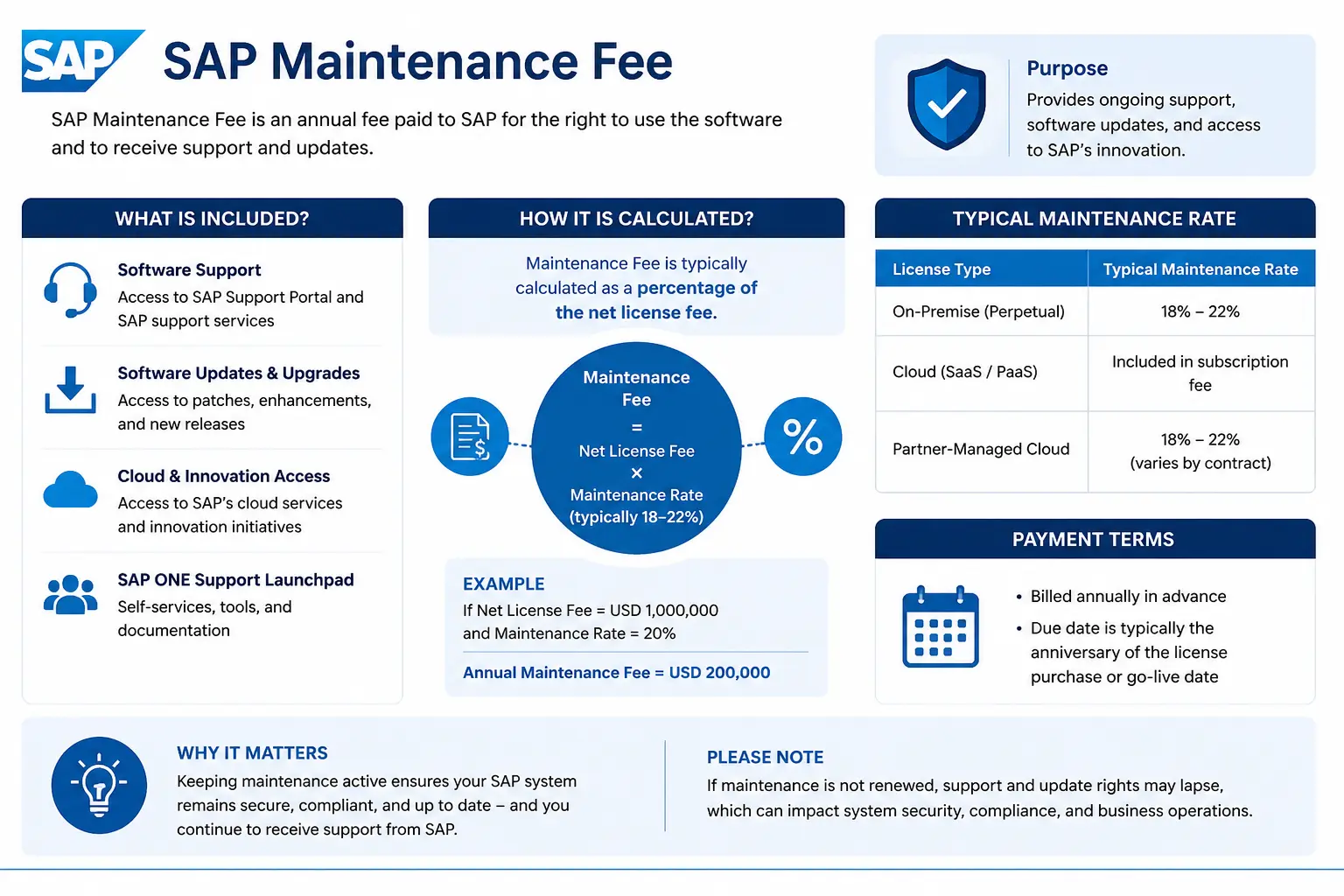
SAP Maintenance Fee: A Comprehensive Guide to Understanding Your TCO

SAP Maintenance Fee

In the world of enterprise resource planning (ERP), SAP stands as a titan. For businesses running on SAP S/4HANA or legacy SAP ECC systems, understanding the recurring costs associated with these platforms is vital. Among these costs, the SAP maintenance fee—officially referred to as SAP Enterprise Support or SAP Standard Support—is often the largest and most scrutinized portion of the total cost of ownership (TCO).

This article provides an in-depth look at what SAP maintenance fees are, how they are calculated, and why they matter for your organization’s long-term digital strategy.

What is the SAP Maintenance Fee?

At its core, the SAP maintenance fee is an annual subscription cost paid by customers to SAP for access to ongoing software updates, technical support, and legal changes. Unlike a one-time perpetual license fee, this is an operational expense (OpEx) that ensures your mission-critical ERP environment remains secure, compliant, and up-to-date with the latest features.

There are generally two main tiers of support:

  1. SAP Standard Support: Provides basic technical support, access to updates, and limited support for system issues.

  2. SAP Enterprise Support: A more comprehensive model that includes proactive monitoring, mission-critical support, and access to the SAP Enterprise Support Academy. Most large enterprises are transitioned to this tier as their standard.

How are These Fees Calculated?

The maintenance fee is typically calculated as a percentage of your initial license investment. Industry standard pricing is generally around 22% of the net license fee annually.

However, several variables can influence this:

  • The Scope of Your License: As you add more users or modules, the base license value increases, which subsequently increases the maintenance cost.

  • Contractual Negotiations: Large enterprises often negotiate global agreements that may bundle maintenance fees with cloud transformation credits or other incentives.

  • Maintenance Transitioning: As SAP moves users from on-premise ECC to RISE with SAP (cloud-based), the fee structure changes from a maintenance model to a subscription-based model.

The Role of Total Cost of Ownership (TCO)

The maintenance fee is a significant component of TCO. When analyzing the cost of your SAP footprint, you must look beyond just the upfront implementation or subscription price. The maintenance fee represents the “keep-the-lights-on” cost.

If your SAP maintenance costs are spiraling, it may be time to evaluate whether your current infrastructure aligns with your business needs. Many organizations are finding that shifting from an on-premise SAP maintenance model to a cloud-hosted RISE with SAP model consolidates these costs, potentially simplifying the balance sheet.

Strategies to Optimize SAP Maintenance Costs

For many CFOs and IT leaders, the goal is to keep these recurring costs under control. Here are three strategies to optimize:

1. License Rationalization

Are you paying maintenance fees for licenses that are no longer being used? Conduct regular audits to identify dormant user accounts or underutilized modules. Consolidating your user base can have an immediate impact on your annual bill.

2. Evaluate Third-Party Support

While SAP-provided support is the safest route for stability, some organizations look to third-party SAP support providers. These companies offer maintenance at a fraction of the cost, though you must carefully weigh the risk of losing direct access to SAP-certified patches and legal updates.

3. Consider Cloud Transformation

Moving to the cloud isn’t just about modernizing technology; it’s a financial move. By adopting subscription-based licensing models, you effectively bake the “maintenance” costs into your service subscription, which can be easier to manage and scale compared to the rigid, percentage-based legacy model.

The Future of SAP Support

As SAP focuses heavily on its “Cloud First” strategy, the support model is evolving. With the eventual sunsetting of legacy ECC support, organizations are being pushed toward SAP S/4HANA. Understanding how your maintenance fees will change during this migration is critical for budgetary planning.

Conclusion

The SAP maintenance fee is more than just an invoice; it is the price of stability for your business operations. While the annual 22% fee can be significant, it provides the foundation for legal compliance and technical security. By actively managing your license usage, evaluating your migration roadmap, and staying informed about SAP’s evolving support policies, your organization can effectively manage its TCO and keep its ERP investment profitable.

Looking for more insights into ERP cost management? Visit DMS Global for deep-dive comparisons of SAP, Odoo, and NetSuite pricing models.

SAP Fiori Guide

SAP Fiori Guide

SAP Fiori Guide: Enhancing Enterprise Productivity and User Experience

In the modern digital landscape, the efficiency of an enterprise relies heavily on the interface through which employees interact with complex data. SAP Fiori has emerged as the standard for providing a modern, intuitive, and responsive user experience across SAP software. This guide explores how SAP Fiori transforms enterprise operations, ensuring that productivity remains high while complexity is minimized.

What is SAP Fiori?

SAP Fiori is not merely a theme or a skin; it is a design system that provides a consistent user experience (UX) for all SAP applications. It was developed to shift away from the traditional, transaction-heavy SAP GUI toward a role-based, personalized, and adaptive environment.

Whether you are using SAP S/4HANA or SAP Business Suite, Fiori ensures that the software behaves consistently across desktops, tablets, and smartphones.

Core Principles of SAP Fiori 3.0

The evolution to Fiori 3.0 brought a refined, intelligent design that focuses on the following pillars:

  • Role-Based: The interface is tailored to the user’s specific job requirements. Instead of overwhelming the user with every possible transaction, Fiori presents only the relevant tools and information needed for their specific tasks.

  • Adaptive: The system is intelligent enough to suggest relevant insights and actions, leveraging SAP’s AI capabilities to assist users in decision-making.

  • Coherent: Regardless of the underlying technology or application, the design language remains uniform. This coherence reduces the learning curve for employees adopting new SAP modules.

  • Delightful: Beyond pure functionality, the interface is designed to be visually appealing and efficient, significantly improving user adoption rates and overall job satisfaction.

Key Benefits for Enterprises

Implementing SAP Fiori is a strategic move for organizations aiming to streamline their digital infrastructure:

  1. Increased Productivity: By reducing the “click-path” and focusing on essential data, users complete tasks significantly faster than in legacy systems.

  2. Lower Training Costs: Because the interface is intuitive and mimics modern consumer web applications, employees require less time to master complex enterprise workflows.

  3. Cross-Device Efficiency: With its responsive design, field workers and executives alike can access critical business intelligence from anywhere, using their preferred device.

  4. Integration with SAP S/4HANA: Fiori is the primary interface for SAP S/4HANA, making it an essential component for any organization undergoing a digital transformation or migration to the cloud.

Getting Started with Fiori

For businesses looking to optimize their current setup, consider these three steps:

  • Assess User Roles: Identify the core personas within your organization and map their daily tasks to specific Fiori apps.

  • Prioritize Quick Wins: Start by deploying Fiori for high-frequency, low-complexity tasks (e.g., leave requests, travel expenses, or purchase order approvals) to demonstrate value quickly.

  • Monitor UX Performance: Use SAP Fiori Usage Analytics to understand which apps are being used effectively and where users might be struggling, allowing for iterative improvements.

Conclusion

SAP Fiori is the bridge between complex enterprise backend systems and the need for simplified, human-centric workflows. By adopting the Fiori design system, organizations can ensure that their teams are empowered by their technology, rather than constrained by it.

This guide is part of our commitment to providing expert-level insights into SAP ecosystems and enterprise infrastructure.

Categories SAP

SAP Maintenance Fee Structure 2026: A Comprehensive Guide for Enterprises

SAP Maintenance Fee

In the complex landscape of Enterprise Resource Planning (ERP), few names carry as much weight as SAP. For decades, it has been the backbone of global corporate infrastructure. However, for organizations looking to scale in 2026, understanding the SAP maintenance fee structure is as critical as selecting the software itself. As businesses strive for digital transformation, these recurring costs often become the hidden variable in the Total Cost of Ownership (TCO) equation.

Understanding the Foundation: What are SAP Maintenance Fees?

At its core, SAP maintenance fees are the recurring payments made by clients to ensure their software remains secure, functional, and up-to-date. Unlike initial licensing costs, which are often a one-time capital expenditure, maintenance fees are operational expenses that persist as long as the software is in use.

Typically, these fees cover:

  • Software Updates and Upgrades: Access to new versions, patches, and security enhancements.

  • Technical Support: Access to SAP’s global support network for troubleshooting critical system errors.

  • Compliance and Legal Changes: Updates to the software to ensure adherence to changing regional tax laws and accounting standards.

The Standard Support vs. Enterprise Support Dilemma

One of the most frequent points of confusion for enterprises is the distinction between the different tiers of support. SAP generally structures its maintenance around two primary models:

1. SAP Standard Support

This is the baseline level of support. It provides access to the software fixes, security updates, and standard technical support via the SAP Support Portal. For many small-to-medium enterprises (SMEs), this level is often sufficient to maintain operations without excessive overhead.

2. SAP Enterprise Support

Designed for mission-critical environments, this tier offers more than just basic troubleshooting. It includes proactive monitoring, end-to-end service level agreements (SLAs), and strategic guidance to optimize business processes. While the cost is higher, the ROI is often measured by a significant reduction in system downtime and optimized business continuity.

Factors Influencing the Cost in 2026

The SAP maintenance fee structure is not a flat rate. Several factors influence the percentage-based fee that companies pay on top of their original license value:

  • Contractual History: Older agreements may have different percentage rates compared to modern Cloud-based contracts (like RISE with SAP).

  • Geographic Regulations: Regional compliance requirements can occasionally impact the bundled service costs.

  • Volume of Users: Many maintenance contracts are indexed to the total number of users or the volume of transactional data processed within the system.

The Hidden Costs: Why It Matters for TCO

When companies budget for ERP, they often focus on the implementation phase. However, seasoned CIOs know that the “hidden” costs of SAP are often found in the long-term maintenance cycles.

In 2026, as companies look toward more agile, cloud-native alternatives like Odoo or ERPNext, the cost-benefit analysis of SAP maintenance is under the microscope. If your organization is spending a significant percentage of its annual budget on maintenance fees for legacy modules that are rarely used, the TCO becomes unjustifiable.

Strategic Alternatives: SAP vs. Modern Cloud ERPs

The rise of modular, low-maintenance ERP systems has changed the conversation. Modern solutions often follow a subscription model where maintenance is inherently baked into the monthly or yearly fee, with no “surprise” legacy maintenance spikes.

For organizations evaluating their roadmap:

  • Legacy Systems: Continue to monitor SAP maintenance fees and ensure you are only paying for the modules that are actively driving revenue.

  • Digital Transformation: Consider a “composable ERP” approach where core functions are kept on stable platforms, while peripheral processes are handled by more cost-effective, cloud-native applications.

Conclusion: Balancing Continuity and Cost

The SAP maintenance fee structure is a necessary investment for many, ensuring the stability of core business processes. However, in 2026, transparency and agility are key. Enterprises must regularly audit their support contracts, understand the difference between standard and enterprise tiers, and remain objective about whether their current support costs align with the actual value delivered.

popular post :

By treating maintenance fees as an active variable rather than a static cost, your organization can optimize its ERP expenditure, freeing up capital for further innovation and growth.

Key Takeaways for Your Strategy:

  • Audit: Review your current SAP support tier every 12 months.

  • Optimize: Consolidate licenses to ensure you aren’t paying maintenance on shelfware.

  • Compare: Always keep a pulse on the TCO of modern alternatives to ensure your current path remains the most competitive.

Did SAP Acquire Odoo? The Truth Behind the Acquisition Rumors

SAP Acquire Odoo

SAP Odoo acquisition

SAP Acquires Odoo

Lately, there has been a lot of buzz in the Enterprise Resource Planning (ERP) community regarding a massive rumor: Did SAP acquire Odoo?

As the competition in the mid-market and enterprise ERP sectors heats up, rumors of tech giants buying out agile, fast-growing open-source competitors are common. However, it is time to separate fact from fiction. For decision-makers, CTOs, and ERP consultants worldwide, understanding the structural layout of both companies reveals why this rumor started, why it is false, and how the market dynamics are shifting in 2026.

The Facts: Has an Acquisition Happened?

As of right now, No. SAP has NOT acquired Odoo.

Neither SAP SE nor Odoo SA has released any official statements, press releases, or financial filings indicating an acquisition, a merger, or even formal buyout talks. Odoo remains an independent company, heavily backed by its founder Fabien Pinckaers and prominent venture capital firms, including massive investments from Summit Partners and secondary market funding rounds.

Financially, Odoo has been highly profitable with a valuation pushing deep into unicorn territory, meaning they have no immediate financial distress forcing them into a buyout by a legacy conglomerate.

Why Did the SAP-Odoo Rumor Start?

If the rumor is completely unfounded, why did it gain sudden traction on corporate tech forums, Reddit communities, and LinkedIn industry feeds? The rumor likely gained traction due to a few key macroeconomic and industry trends:

1. Mid-Market Aggressive Competition

Odoo has been aggressively capturing market share in the mid-market sector—a territory traditionally held by SAP Business One and mid-tier SAP S/4HANA Cloud deployments. When an open-source upstart begins stealing enterprise-level customers, industry analysts naturally begin to speculate about whether a legacy titan will try to swallow the competition to eliminate the threat.

2. Speculative Forum Discussions

ERP consultants and tech forums frequently debate how legacy giants like SAP or Oracle might respond to Odoo’s rapid growth, which often leads to misconstrued “news” or rumors. A hypothetical thread asking “Should SAP buy Odoo to capture the open-source market?” can easily be indexed, shared out of context, and transformed into a definitive rumor within weeks.

3. Strategic Integration Partnerships

Tech firms often sign integration partnerships. Sometimes, a simple integration bridge built by a third-party integrator between an enterprise’s legacy SAP system and a subsidiary’s modular Odoo instance gets blown out of proportion as a full-scale corporate buyout rumor.

Architectural Comparison: Legacy Enterprise vs. Open-Source Modular

To understand why a corporate marriage between SAP and Odoo would be highly complex—and almost contradictory to Odoo’s business model—we must examine how differently these two ERP architectures are built.

Functional Feature SAP S/4HANA Cloud Odoo Enterprise
Core Architecture Proprietary, rigid, highly structured database schemas. Open-source core, modular apps, PostgreSQL framework.
Target Market Fortune 500, multinational conglomerates, government infrastructure. SMBs, fast-growing startups, mid-market enterprise tiers.
Implementation Speed 6 months to multiple years (highly strategic). Weeks to a few months (highly iterative).
Customization Method ABAP programming, structured SAP BTP extensions. Python-based development, low-code/no-code Odoo Studio.
Total Cost of Ownership Exceptionally high license, maintenance, and consulting fees. Transparent, cost-effective per-user model with free apps.

The Power of SAP’s Enterprise Lock-In

SAP’s entire revenue ecosystem thrives on deep enterprise lock-in. When a multinational company implements SAP, they are deploying a system built for absolute regulatory compliance, multi-currency accounting integrity, and extreme data structural safety. It requires highly specialized SAP certified developers to alter business workflows.

The Power of Odoo’s Open-Source Agility

Odoo operates on the exact opposite philosophy. Built primarily on Python and a PostgreSQL database backend, Odoo is designed to be modified instantly. Through Odoo Studio or custom Python apps, businesses can pivot their operational structures overnight. Merging these two contrasting software philosophies under one corporate banner would create massive product positioning friction.

The Hidden Catalyst: Odoo’s Unique Pricing Disruption

The real reason SAP ecosystem users are talking about Odoo is Odoo’s radical disruption of ERP pricing models. Historically, enterprise software required complex user tier definitions: full-access users, read-only users, field workers, and external portal suppliers.

Odoo completely disrupted this by launching a simplified pricing strategy: a flat fee per user that unlocks every single application in their ecosystem (CRM, Inventory, MRP, HR, eCommerce).

This pricing shift forced companies evaluating mid-market options like SAP Business One or Oracle NetSuite to stop and compare the Total Cost of Ownership (TCO). When an executive notices that they can deploy a fully integrated Odoo instance at a fraction of the traditional licensing cost of SAP, a competitive fire is ignited. The rumor of an acquisition is often just a reflection of market anxiety from legacy stakeholders watching this pricing disruption unfold.

Technical Integration: Running Odoo and SAP Together

Instead of an acquisition, what we are actually seeing in the real world is co-existence. Many modern enterprises do not replace SAP with Odoo, nor do they completely ignore Odoo. Instead, they run a Two-Tier ERP Strategy.

  1. Tier 1 (The Corporate Core): The corporate headquarters uses SAP S/4HANA to manage global financials, corporate governance, consolidation, and massive compliance tracking.

  2. Tier 2 (The Agile Subsidiaries): Newly acquired fast-moving subsidiaries, regional sales offices, or localized manufacturing plants implement Odoo. It connects directly back to the primary SAP core using secure REST APIs, webhooks, or middleware solutions.

This architecture offers the best of both worlds: corporate data security at the top layer, and operational speed at the ground layer.

What Should ERP Users Do Now?

If you are currently deciding between SAP and Odoo for your business infrastructure, your strategic choice should be based entirely on your long-term business architecture, operational realities, and available technical budget rather than internet acquisition rumors:

  • Choose SAP if you are a massive global enterprise needing highly structured, complex corporate compliances, deep legacy database support, and have the budget to sustain long-term enterprise consulting contracts.

  • Choose Odoo if you want an agile, cost-effective, modular, and highly customizable open-source ERP environment where your internal team can dynamically scale and deploy new business applications without massive licensing penalties.

Ultimately, Odoo remains an independent tech disruptor, and SAP continues its reign as the corporate gold standard. There is no acquisition anchor dragging down Odoo’s growth—meaning you can confidently invest in either ecosystem based purely on what your operational workflow demands today.

For detailed breakdown of costs, read our SAP maintenance fee structure guide

SAP Pricing Malaysia 2026: Enterprise Efficiency and Investment Guide

SAP Pricing Malaysia

In Malaysia’s rapidly evolving industrial landscape, SAP has become the benchmark for operational excellence. From the manufacturing hubs in Penang to the corporate towers of Kuala Lumpur, businesses are seeking SAP pricing in Malaysia to streamline their supply chains and financial reporting.

Whether you are looking for SAP Business One for your SME or SAP S/4HANA for a large conglomerate, this guide breaks down the essential costs and local considerations.

1. SAP Solutions for the Malaysian Market

The cost of SAP in Malaysia is usually tiered based on the size of the organization and the deployment method:

Solution Best For Estimated Investment (MYR)
SAP Business One Growing SMEs needing integrated accounting & inventory. Starting from RM 14,000+ (Initial License)
SAP S/4HANA Cloud Mid-to-large enterprises seeking modern AI features. Subscription-based (Monthly/Annual)
SAP S/4HANA On-Premise Large corporations requiring maximum data control. Custom Enterprise Quote

2. Local Factors: SST and LHDN Compliance

Implementing SAP in Malaysia requires specific localization to meet government standards:

  • SST Ready: Ensure your system is configured to handle the Sales and Service Tax (SST) correctly across different product categories.

  • E-Invoicing (LHDN): Stay ahead of the Inland Revenue Board of Malaysia (LHDN) mandate for mandatory e-invoicing with SAP’s integrated compliance tools.

  • Localized Payroll: SAP can be customized to handle Malaysian statutory requirements including EPF, SOCSO, and PCB.

3. Why SAP is a Strategic Move in Malaysia

  1. Industrial Strength: Exceptional at managing complex manufacturing (MRP) and logistics, which are core to the Malaysian economy.

  2. Multicultural/Multilingual: Supports diverse workforces with interfaces that can handle global reporting standards.

  3. MDEC & Industry4WRD: Align your business with Malaysia’s national digital initiatives for Industry 4.0.

Dominate Globally with DMS Global

A robust SAP system is your engine, but your digital infrastructure is your fuel. DMS Global helps Malaysian enterprises bridge the gap between back-end efficiency and front-end market dominance through world-class Global SEO and high-performance digital strategies.

[Contact DMS Global for SAP Implementation & Digital Growth in Malaysia]


SAP Pricing Singapore 2026: Investment Guide for Global Hubs

SAP Pricing Singapore

For businesses operating in Singapore’s fast-paced economy, SAP is the gold standard for enterprise resource planning. Whether you are a multinational corporation (MNC) or a growing SME in the Lion City, understanding SAP pricing in Singapore is crucial for long-term digital strategy and operational excellence.

As Singapore continues to lead in digital innovation, SAP solutions like Business One and S/4HANA provide the robust framework needed to stay competitive.

1. SAP Solution Plans for Singaporean Businesses

The cost of SAP in Singapore depends on the scale of your operations and the complexity of your requirements.

Solution Target Market Estimated Investment (SGD)
SAP Business One (B1) SMEs looking for an integrated, all-in-one ERP. Starting from $4,000+ SGD (Initial License)
SAP S/4HANA Public Cloud Mid-to-large enterprises seeking AI-driven insights. Subscription-based (Contact for Quote)
SAP S/4HANA Private Cloud Large MNCs requiring full customization and control. Custom Enterprise Pricing

2. Key Factors for Singapore Implementation

  • GST Compliance: Ensure your SAP system is configured for the 9% GST rate and IRAS-compliant tax reporting.

  • Grant Eligibility: Many Singaporean SMEs can leverage government grants (like the Productivity Solutions Grant – PSG) to offset implementation costs.

  • Data Residency: With Singapore’s strict PDPA regulations, choosing between local cloud hosting or SAP’s global data centers is a key strategic decision.

3. Why Choose SAP for Your Singapore Operations?

  1. Global Connectivity: Seamlessly integrate your Singapore office with regional subsidiaries across APAC and the world.

  2. Advanced Analytics: Use built-in AI to monitor real-time cash flow and supply chain performance in Singapore’s competitive market.

  3. Future-Proof: SAP evolves with your business, supporting everything from digital manufacturing to complex financial consolidation.

Elevate Your Enterprise with DMS Global

Implementing a world-class ERP like SAP requires world-class digital visibility. DMS Global specializes in advanced SEO and digital infrastructure, ensuring your Singaporean business doesn’t just operate efficiently but also dominates the global search rankings.

[Consult with DMS Global for SAP Strategy in Singapore]


SAP Pricing Philippines 2026: Cost Analysis & Implementation Guide

SAP Pricing Philippines

For growing enterprises in the Philippines, SAP remains the gold standard for ERP solutions. However, understanding SAP pricing in the Philippines can be complex, as costs vary significantly between SAP Business One (for SMEs) and SAP S/4HANA (for large corporations).

This guide breaks down the investment required and the local factors that influence SAP implementation costs in the Filipino market.

1. SAP Solution Versions for Filipino Businesses

The cost of SAP in the Philippines is generally divided into two main categories:

Solution Target Market Estimated Investment
SAP Business One (B1) SMEs in Manila/Cebu looking for streamlined operations. Starting from $3,000+ USD (Initial License)
SAP S/4HANA Large enterprises and conglomerates (MNCs). Custom Pricing (Based on Scope)
SAP Business ByDesign Mid-market companies looking for a native cloud ERP. Subscription-based (Monthly)

2. Key Factors Influencing SAP Costs in the PH

When budgeting for SAP, Filipino companies must look beyond the license:

  • User Licenses: Choose between Professional (full access) or Limited (specific department) licenses to optimize costs.

  • Implementation Partner Fees: Local expertise is crucial for BIR tax compliance and handling Philippine-specific financial reporting.

  • Deployment Model: Will you host it on-premise, or use SAP Cloud? Cloud options are increasingly popular in the Philippines to reduce hardware maintenance.

3. SAP vs. Odoo: Which One Fits Your Budget?

While SAP offers unmatched depth, many Filipino businesses compare it with Odoo for flexibility.

  • SAP: Best for rigid, high-compliance environments with large transaction volumes.

  • Odoo: Best for agile companies looking for lower TCO (Total Cost of Ownership).

Optimize Your Digital Infrastructure with DMS Global

Implementing SAP is a major milestone. To ensure your business system is backed by world-class digital infrastructure and global SEO visibility, partner with DMS Global. We help high-growth companies bridge the gap between complex ERP systems and global market dominance.

[Contact DMS Global for ERP Strategy & Digital Growth]