
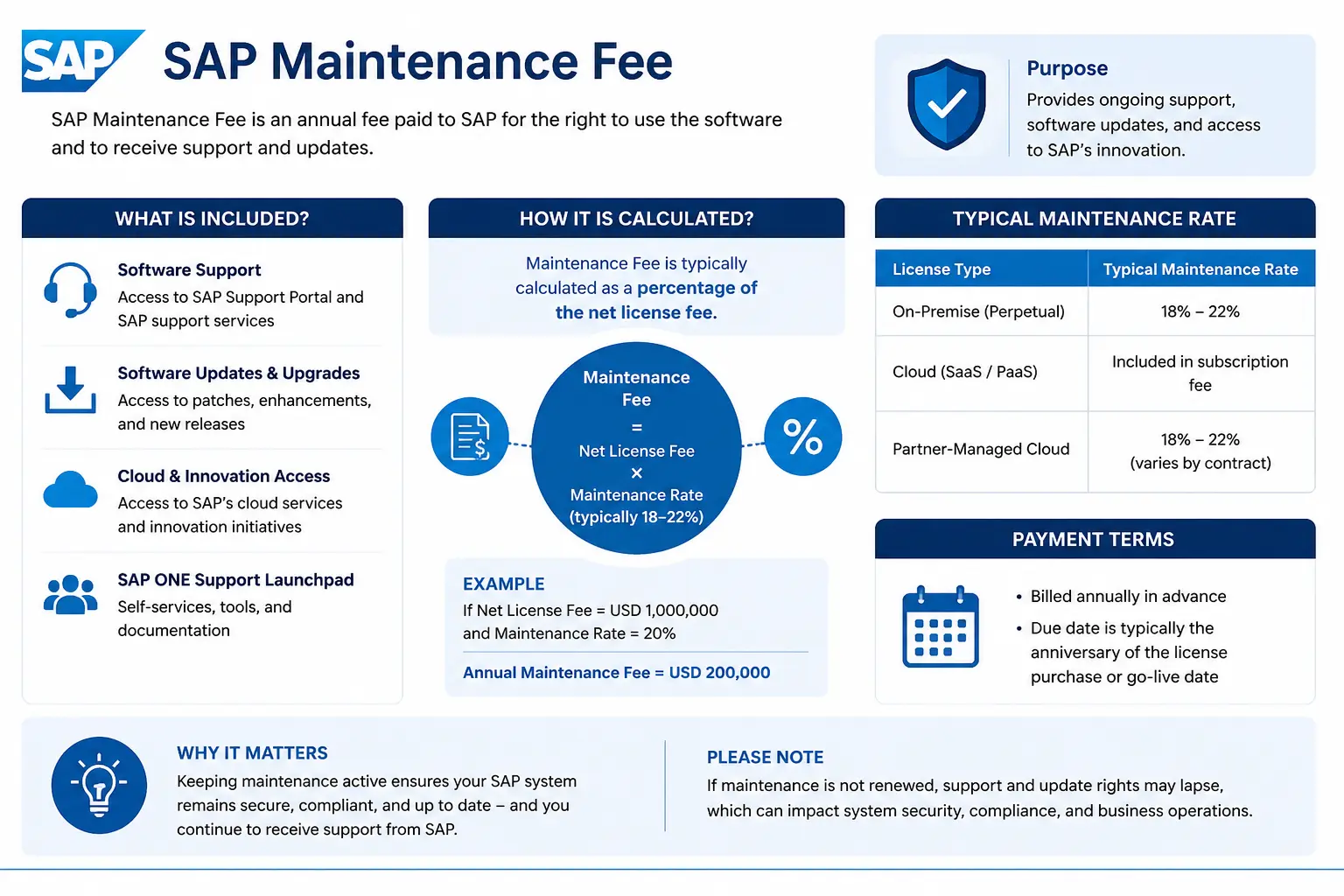
In the complex landscape of Enterprise Resource Planning (ERP), few names carry as much weight as SAP. For decades, it has been the backbone of global corporate infrastructure. However, for organizations looking to scale in 2026, understanding the SAP maintenance fee structure is as critical as selecting the software itself. As businesses strive for digital transformation, these recurring costs often become the hidden variable in the Total Cost of Ownership (TCO) equation.
Understanding the Foundation: What are SAP Maintenance Fees?
At its core, SAP maintenance fees are the recurring payments made by clients to ensure their software remains secure, functional, and up-to-date. Unlike initial licensing costs, which are often a one-time capital expenditure, maintenance fees are operational expenses that persist as long as the software is in use.
Typically, these fees cover:
-
Software Updates and Upgrades: Access to new versions, patches, and security enhancements.
-
Technical Support: Access to SAP’s global support network for troubleshooting critical system errors.
-
Compliance and Legal Changes: Updates to the software to ensure adherence to changing regional tax laws and accounting standards.
The Standard Support vs. Enterprise Support Dilemma
One of the most frequent points of confusion for enterprises is the distinction between the different tiers of support. SAP generally structures its maintenance around two primary models:
1. SAP Standard Support
This is the baseline level of support. It provides access to the software fixes, security updates, and standard technical support via the SAP Support Portal. For many small-to-medium enterprises (SMEs), this level is often sufficient to maintain operations without excessive overhead.
Executive Deep-Dive
Scaling Beyond Traffic to Revenue
Most enterprises fail because they chase clicks instead of trust. While building your global presence, ensure your EEAT 3.0 signals are synchronized across all regions.
Recommended for you:
→ The Shift from Traffic to Trust: A New KPI for Enterprise SEO2. SAP Enterprise Support
Designed for mission-critical environments, this tier offers more than just basic troubleshooting. It includes proactive monitoring, end-to-end service level agreements (SLAs), and strategic guidance to optimize business processes. While the cost is higher, the ROI is often measured by a significant reduction in system downtime and optimized business continuity.
Factors Influencing the Cost in 2026
The SAP maintenance fee structure is not a flat rate. Several factors influence the percentage-based fee that companies pay on top of their original license value:
-
Contractual History: Older agreements may have different percentage rates compared to modern Cloud-based contracts (like RISE with SAP).
-
Geographic Regulations: Regional compliance requirements can occasionally impact the bundled service costs.
-
Volume of Users: Many maintenance contracts are indexed to the total number of users or the volume of transactional data processed within the system.
The Hidden Costs: Why It Matters for TCO
When companies budget for ERP, they often focus on the implementation phase. However, seasoned CIOs know that the “hidden” costs of SAP are often found in the long-term maintenance cycles.
In 2026, as companies look toward more agile, cloud-native alternatives like Odoo or ERPNext, the cost-benefit analysis of SAP maintenance is under the microscope. If your organization is spending a significant percentage of its annual budget on maintenance fees for legacy modules that are rarely used, the TCO becomes unjustifiable.
Strategic Alternatives: SAP vs. Modern Cloud ERPs
The rise of modular, low-maintenance ERP systems has changed the conversation. Modern solutions often follow a subscription model where maintenance is inherently baked into the monthly or yearly fee, with no “surprise” legacy maintenance spikes.
For organizations evaluating their roadmap:
-
Legacy Systems: Continue to monitor SAP maintenance fees and ensure you are only paying for the modules that are actively driving revenue.
-
Digital Transformation: Consider a “composable ERP” approach where core functions are kept on stable platforms, while peripheral processes are handled by more cost-effective, cloud-native applications.
Conclusion: Balancing Continuity and Cost
The SAP maintenance fee structure is a necessary investment for many, ensuring the stability of core business processes. However, in 2026, transparency and agility are key. Enterprises must regularly audit their support contracts, understand the difference between standard and enterprise tiers, and remain objective about whether their current support costs align with the actual value delivered.
popular post :
- majestic seo alternatives
- majestic vs ahrefs
- oracle netsuite cost
- odoo pricing guide
- Semrush Free Trial Without a Credit Card
- oracle netsuite pricing
By treating maintenance fees as an active variable rather than a static cost, your organization can optimize its ERP expenditure, freeing up capital for further innovation and growth.
Key Takeaways for Your Strategy:
-
Audit: Review your current SAP support tier every 12 months.
-
Optimize: Consolidate licenses to ensure you aren’t paying maintenance on shelfware.
-
Compare: Always keep a pulse on the TCO of modern alternatives to ensure your current path remains the most competitive.
Exclusive Early Access: Q1 2026
The Global SEO Blueprint for C-Suite
We are finalizing an exclusive strategic framework for global enterprise scaling. Join the elite waitlist for early-bird pricing.
Secure Your Priority Spot