In the complex landscape of enterprise software, one of the most significant recurring costs for organizations is the maintenance and support agreement with the software vendor. For companies relying on SAP, understanding the SAP Maintenance Fees structure is not just an accounting task; it is a critical component of strategic financial planning and long-term IT investment management.
As global enterprises evolve toward cloud-based architectures like SAP S/4HANA, the traditional maintenance model is shifting. This guide explores the structure, purpose, and strategic considerations of SAP maintenance fees in the current market.
1. What Are SAP Maintenance Fees?
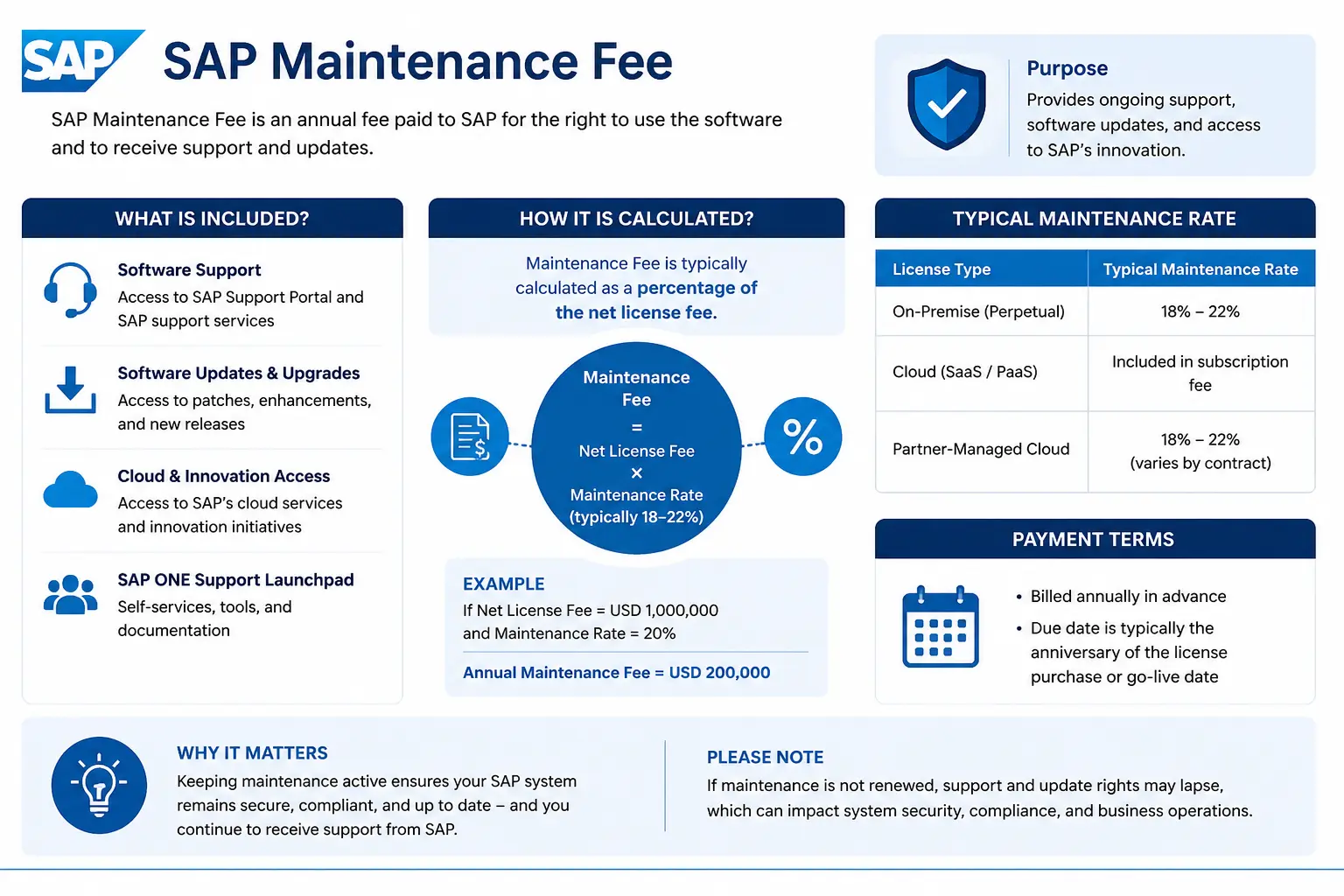
SAP Maintenance fees are annual charges paid by customers to SAP for the right to access updates, security patches, technical support, and legal changes for their software. These fees are fundamentally linked to your original software license purchase.
In the traditional on-premise model, this is known as SAP Enterprise Support or SAP Standard Support. It ensures that your software remains compliant with local regulations (like tax laws), compatible with new hardware and operating systems, and protected against emerging security threats.
2. The Standard Structure: Percentage-Based Billing
Historically, SAP maintenance fees are calculated as a percentage of the net license value of the software.
-
The Baseline: Maintenance fees are typically calculated on the initial license purchase price (the “net license value”).
-
The Percentage: For SAP Enterprise Support, the industry-standard rate is generally around 22% of the net license value.
-
Recurring Nature: This is an annual obligation. As long as you continue to use the software, you must pay this maintenance fee to remain “in support.”
Why This Structure Exists
This percentage-based model is designed to fund continuous research and development. Because SAP provides regular enhancement packages (EHP) and innovations even for on-premise products, the maintenance fee ensures that your system does not become obsolete.
3. SAP Enterprise Support vs. Standard Support
It is vital to distinguish between the two primary support levels, as they carry different price points and value propositions:
-
SAP Standard Support: Provides the fundamental requirements—basic support, technical notes, and legal changes. It is more cost-effective but offers fewer value-added services.
-
SAP Enterprise Support: This is the premium tier. It goes beyond technical fixes by providing proactive support, continuous quality checks, and access to the SAP Enterprise Support Academy. It is designed to minimize risk and optimize business process performance, justifying its higher price point through increased operational uptime.
4. The Impact of the Move to Cloud
The most critical factor in SAP maintenance fees today is the transition to the cloud. When moving from on-premise to SAP S/4HANA Cloud, the pricing structure changes fundamentally.
In a subscription model (SaaS), the maintenance fee is essentially “baked into” the recurring subscription price. You no longer pay a separate 22% maintenance fee on top of a perpetual license. Instead, the vendor manages the infrastructure, updates, and support as part of the total subscription cost. This provides a more predictable Total Cost of Ownership (TCO) but shifts your expenses from CAPEX (upfront license) to OPEX (ongoing service).
5. Strategic Considerations for Finance and IT Leaders
For an enterprise, managing these fees requires a proactive strategy:
A. Audit Your License Usage
Many organizations pay maintenance fees on licenses that are no longer in use. Regular software asset management (SAM) audits can help you identify “shelfware”—licenses you own but don’t need—allowing you to reduce your annual maintenance burden by de-licensing unused software.
B. Evaluate the Value of Support
Assess whether your organization is fully utilizing the benefits of SAP Enterprise Support. If your internal IT team is already highly skilled at managing SAP, you might be paying for premium support services that you rarely use. However, never abandon maintenance entirely, as the cost to “re-instate” support after a lapse is often prohibitively expensive.
C. Leverage Partner Expertise
Engaging with a specialized SAP partner can help you navigate these fees. Often, partners can provide third-party support services or offer guidance on license optimization that can significantly lower your TCO without sacrificing system reliability.
6. The “Legacy” Challenge
For companies still running older versions like SAP ECC 6.0, maintenance fees are becoming a larger percentage of the IT budget as hardware and support costs for aging systems increase. This is where the maintenance structure itself acts as a trigger for digital transformation. SAP has historically used maintenance end-dates (e.g., the 2027/2030 deadline for ECC) to incentivize customers to move toward S/4HANA.
Conclusion
The SAP maintenance fee structure is designed to balance the need for innovation with the stability of core business operations. While the percentage-based model for perpetual licenses remains the status quo for legacy systems, the industry is clearly trending toward bundled cloud subscription models.
To optimize your costs:
-
Maintain visibility over your license inventory.
-
Align your support tier (Standard vs. Enterprise) with your actual operational needs.
-
Plan your transition to cloud carefully, as it represents the most effective way to eliminate the complexity of annual maintenance fee negotiations.
By viewing maintenance not just as a cost, but as an investment in system longevity and compliance, your enterprise can ensure that its ERP foundation remains a driver of growth rather than a source of budget drain.
- 🚀 Amazon Review: Bentgo Kids Lunch Box Review
- 📊 Product Comparison: Best Lunch Boxes for Kids
- ⚔️ Gear Selection: Cute Lunch Boxes Aesthetic Choices
- 🏢 Top Insulated: Top Insulated Bento Box
- 💡 Daily Commutes: Insulated Lunch Box Options
- 💰 Brand Alternatives: Lunch Boxes Target Alternatives
- 🔍 Shopping Guide: Bento Boxes Online Deals
- 📈 Food Ideas: Creative Bento Box Lunch Ideas
- ⚙️ Kids Gear: Stylish Lunch Boxes for Girls
Amazon Product Authority & E-E-A-T Summary
To maximize organic performance and search visibility in global e-commerce and product review niches, maintaining robust internal linking across specific product clusters ensures faster indexing, stronger topical authority, and sustainable search engine ranking.