
In the modern digital economy, the customer experience (CX) is the primary battleground for enterprise success. For organizations looking to bridge the gap between back-end operational data and front-end customer interaction, SAP Customer Experience (CX)—formerly known as SAP C/4HANA—has become the gold standard. However, for decision-makers evaluating the implementation of this suite, understanding the SAP CX price is a complex task. The investment is not a simple license fee; it is a strategic commitment to transforming how your enterprise engages with customers across the entire lifecycle.
1. The Strategic Value of SAP CX
Before discussing costs, it is vital to understand what SAP CX brings to the table. The suite is designed to integrate commerce, marketing, sales, and service data into a single, intelligent platform.
-
Unified Customer Profile: By integrating data from your ERP (like S/4HANA) with customer interaction data, SAP CX provides a 360-degree view of your customer.
-
Hyper-Personalization: Utilizing embedded AI and machine learning, the platform allows you to deliver personalized content, recommendations, and service responses in real-time.
-
Omnichannel Consistency: Whether a customer interacts with your brand via an e-commerce storefront, a social media channel, or a service desk, the experience remains consistent, data-backed, and seamless.
2. Deciphering the SAP CX Pricing Model
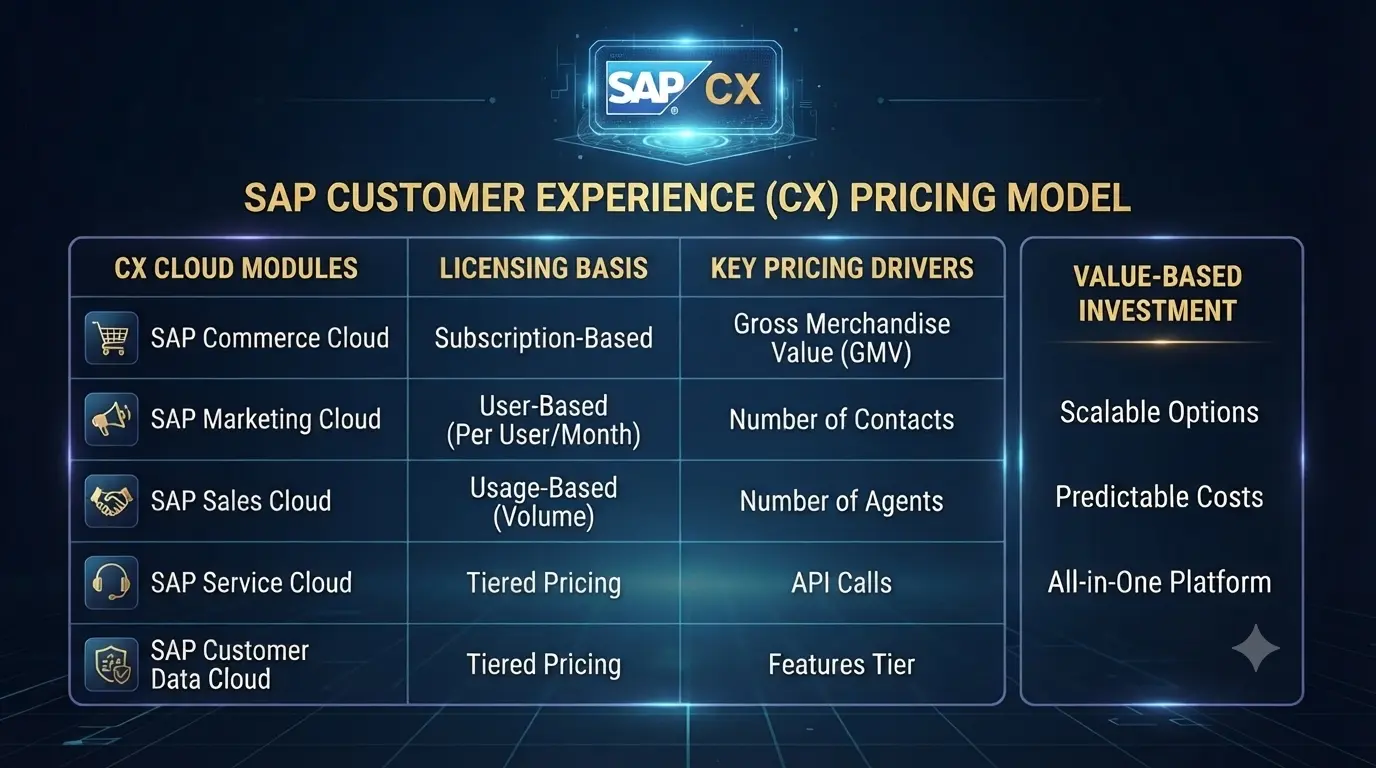
SAP CX pricing is rarely static; it is highly customized based on your organization’s specific needs, size, and operational complexity. The pricing is typically determined by the following key variables:
Module Selection
SAP CX is a modular suite. You can purchase specific components, or the entire portfolio, depending on your business goals:
-
SAP Commerce Cloud: Priced based on metrics such as gross merchandise value (GMV) or the number of orders, reflecting the scale of your digital sales operations.
-
SAP Sales Cloud & Service Cloud: Usually priced on a per-user, per-month subscription model, scaling with the size of your customer-facing teams.
-
SAP Emarsys Customer Engagement: Often tiered based on the number of customer contacts or the volume of marketing communications sent through the platform.
Deployment and Complexity
The “price” also includes the technical complexity of your implementation. Integrating SAP CX with an existing S/4HANA environment or a legacy CRM requires professional consulting services. In 2026, many enterprises are opting for SAP BTP (Business Technology Platform) to create custom extensions, which adds another layer of cost to the initial implementation and ongoing maintenance.
Executive Deep-Dive
Scaling Beyond Traffic to Revenue
Most enterprises fail because they chase clicks instead of trust. While building your global presence, ensure your EEAT 3.0 signals are synchronized across all regions.
Recommended for you:
→ The Shift from Traffic to Trust: A New KPI for Enterprise SEO3. Total Cost of Ownership (TCO) vs. License Fee
CFOs must look beyond the initial license cost. A realistic SAP CX pricing analysis must include:
-
Professional Services: Implementation partners are required to configure the platform, map your business processes, and ensure data integrity. These costs can range from 1x to 3x the annual software subscription depending on the depth of the integration.
-
Data Management and Enrichment: To leverage the “intelligence” of SAP CX, your underlying customer data must be clean. Budgeting for data cleansing and migration is essential for a successful rollout.
-
Internal Training and Change Management: Moving to a sophisticated CX platform requires a shift in organizational culture. Investing in training your marketing, sales, and service teams to leverage the new AI-driven tools is a significant but necessary cost for ROI realization.
-
Ongoing Maintenance and Upgrades: As a cloud-native platform, SAP CX receives frequent updates. Your team must manage the impact of these updates on your configurations and custom extensions to maintain system stability.
4. Strategic Approaches to ROI
To justify the SAP CX investment, enterprises must focus on measurable business outcomes rather than just reducing software overhead:
-
Increase in Conversion Rates: Personalized customer journeys consistently lead to higher conversion rates in commerce environments.
-
Reduction in Service Costs: By empowering customers with self-service portals and AI-driven chatbots, enterprises can significantly reduce the volume of tickets handled by human agents.
-
Customer Lifetime Value (CLV): The ability to predict customer needs and respond proactively is the most significant driver of increased CLV. An SAP CX implementation should be tied to clear goals for retention and cross-selling.
5. Navigating the Negotiation
SAP’s pricing structure allows for significant flexibility for high-growth enterprises. When engaging with SAP or a certified partner, consider the following:
-
Bundling Opportunities: If you are already an SAP S/4HANA customer, discuss bundling discounts. SAP often provides incentives for organizations that utilize the “full SAP stack” to create a more integrated data environment.
-
Phased Implementation: Start with high-impact modules—such as Service Cloud or Commerce Cloud—to build internal expertise and deliver quick wins. Once the ROI of the first phase is proven, you can scale the suite across the enterprise.
-
Long-Term Enterprise Agreements: Committing to longer-term enterprise agreements can lock in favorable pricing and ensure that you have the necessary support and training resources included in your contract.
6. The 2026 Market Perspective
In the competitive landscape of 2026, the cost of not investing in a high-quality CX platform is often higher than the investment itself. Enterprises that rely on fragmented, legacy tools face the risk of losing market share to competitors who can deliver hyper-personalized, intelligent experiences. The investment in SAP CX is not merely a software expense; it is a strategic investment in maintaining relevance in a customer-centric market.
Conclusion
The SAP Customer Experience (CX) price is a reflection of the platform’s capacity to drive sophisticated, large-scale business transformation. While the initial investment is substantial, the value proposition—a unified view of the customer, predictive AI-driven insights, and seamless omnichannel engagement—is essential for any enterprise aiming for global leadership. By conducting a thorough TCO analysis, prioritizing phased implementation, and focusing on measurable business outcomes like CLV and conversion growth, organizations can ensure that their investment in SAP CX becomes the engine for sustained, profitable customer relationships through 2030 and beyond. This is the foundation upon which your enterprise will build its reputation, its loyalty, and its future.