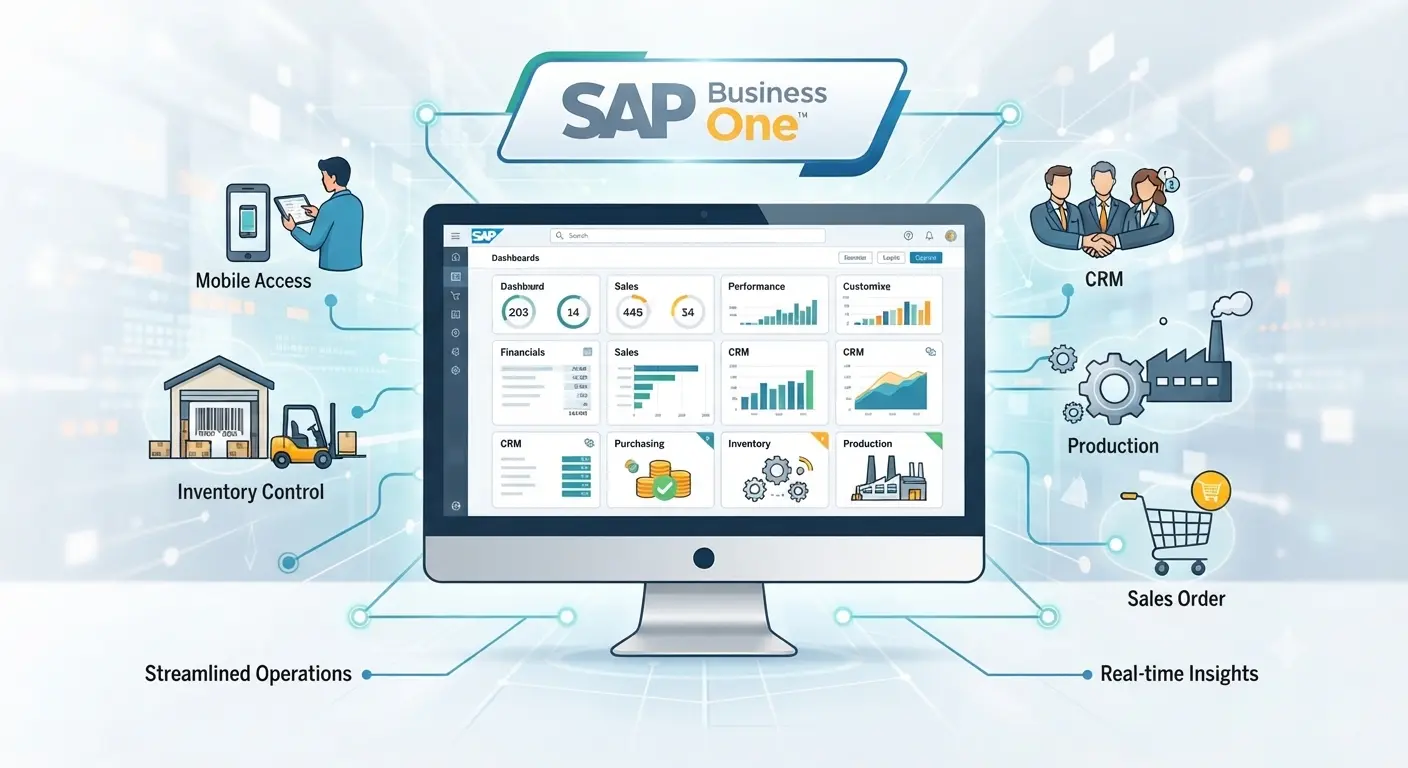
SAP Business One is a robust and scalable ERP solution designed to streamline core business processes for growing enterprises
Selecting the right Enterprise Resource Planning (ERP) solution is a pivotal decision for any small to medium-sized enterprise (SME). Among the market leaders, SAP Business One stands out as a robust, scalable, and integrated solution designed to streamline core business processes. However, one of the most common questions decision-makers face is: What is the real cost of SAP Business One?
This guide provides a deep dive into SAP Business One pricing models, the factors influencing the total cost of ownership (TCO), and how to strategically plan your investment to ensure maximum ROI.
Understanding the SAP Business One Pricing Structure
SAP Business One does not have a “one-size-fits-all” price tag. The total investment is typically a combination of three main components: licensing, implementation services, and ongoing maintenance.
Licensing Models: Professional vs. Limited
SAP offers a flexible licensing structure to accommodate different user needs within your organization:
-
Professional License: Grants full, unrestricted access to all modules within SAP Business One, including finance, sales, purchasing, inventory, production, and administration. This is ideal for managers and power users.
-
Limited License: Designed for users who only need access to specific functional areas. These are divided into sub-types:
-
Limited CRM: Focused on sales and marketing activities.
-
Limited Financial: Restricted to accounting and financial functions.
-
Limited Logistics: Focused on inventory, purchasing, and production.
-
Factors Influencing Implementation Costs
While licensing fees are relatively fixed, implementation costs can vary significantly based on your organization’s complexity. Key factors include:
-
Business Complexity: Enterprises with multi-currency requirements, multiple subsidiaries, or complex supply chains require more intense configuration.
-
Customization and Integrations: While SAP Business One is highly functional out of the box, specific industry needs may require custom developments or integrations with third-party software (e.g., e-commerce platforms, POS systems).
-
Data Migration: The volume and quality of your existing data determine the time and effort required to map and migrate it into the new system.
The True Total Cost of Ownership (TCO)
Smart decision-makers look beyond the initial invoice. To calculate the true TCO, consider:
-
Hosting Options: Choosing between On-Premise (CAPEX-heavy) versus Cloud/SaaS deployment (OPEX-friendly subscription models).
-
Training: Investing in robust training ensures higher user adoption, which is the fastest path to realizing ROI.
-
Support and Upgrades: Partnering with a high-quality SAP VAR (Value-Added Reseller) is crucial. A good partner provides proactive support, reducing downtime and optimizing system performance.
Strategic Advice for SME Decision-Makers
To maximize the value of your SAP Business One investment:
-
Start Lean: Implement core features first. You can always add modules or customizations as your business grows.
-
Prioritize User Adoption: The best software is useless if your team doesn’t use it. Budget for comprehensive training sessions.
-
Choose the Right Partner: Your implementation partner is just as important as the software itself. Look for partners with deep industry-specific expertise.
Frequently Asked Questions (FAQ) Regarding SAP Business One Implementation
1. Is SAP Business One suitable for small businesses? Yes, SAP Business One is specifically designed to support the operational needs of growing small and medium-sized enterprises (SMEs). It offers a scalable architecture that allows businesses to start with essential modules and expand functionality as the company grows.
2. What are the common hidden costs in SAP Business One deployment? Beyond the initial licensing fees, companies should account for implementation services, data migration, user training, and ongoing maintenance. Additionally, third-party integrations or custom development to meet specific business requirements can contribute to the total cost of ownership (TCO).
3. How does SAP Business One compare to cloud-native ERPs? SAP Business One offers both on-premise and cloud deployment options, providing flexibility depending on your IT infrastructure strategy. While some cloud-native ERPs may offer faster deployment, SAP Business One provides deep, mature functionality for complex inventory, manufacturing, and financial management that is often required by growing enterprises.
4. How long does the implementation process typically take? The implementation timeline varies based on the scope of the project, the number of modules deployed, and the complexity of your business processes. A standard implementation can take anywhere from three to six months, while more complex environments may require a longer timeline to ensure proper configuration and testing.
Conclusion
SAP Business One is an investment in your company’s future scalability and operational efficiency. By understanding the nuances of its pricing—licensing tiers, service-based implementation, and maintenance—you can create a budget that aligns with your business goals. Remember that the “cheapest” solution is rarely the most cost-effective in the long run; focus on value, scalability, and long-term partnership.