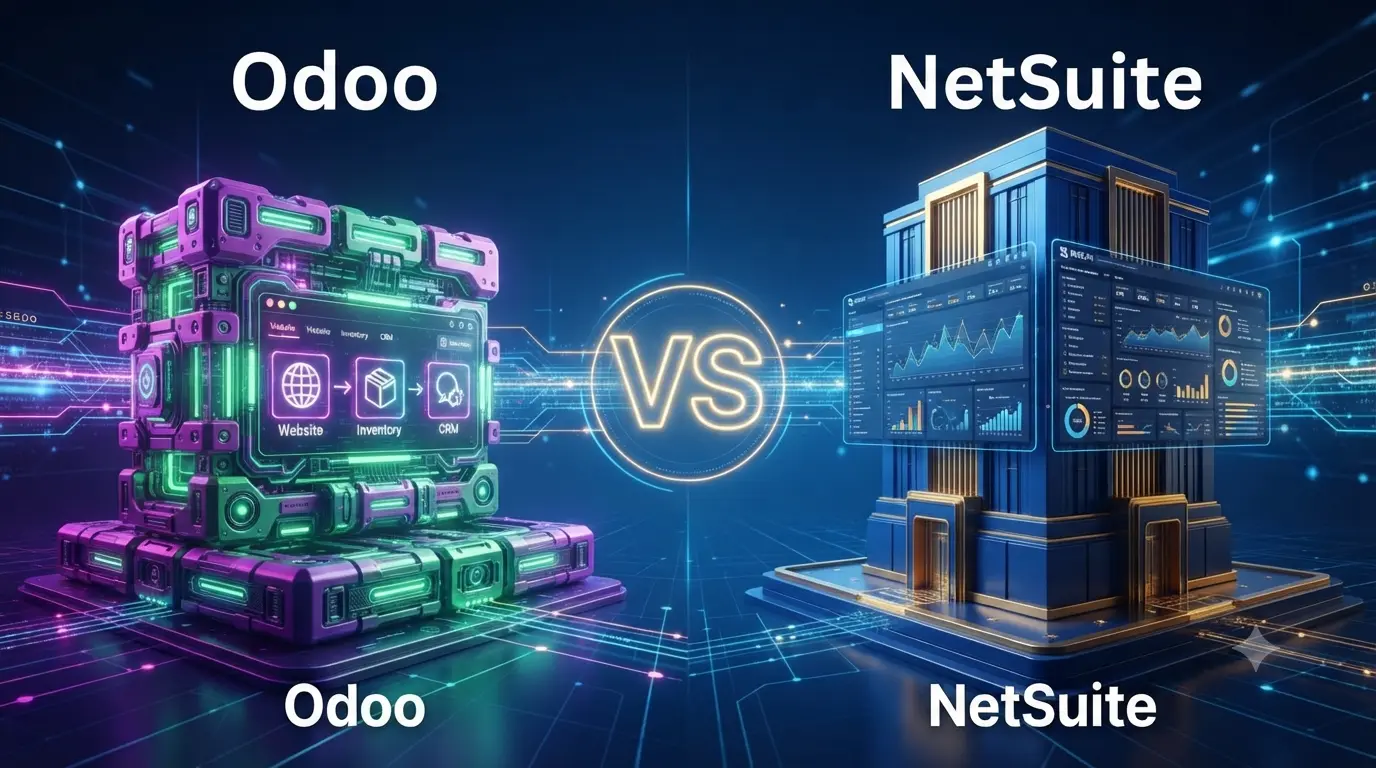
Odoo vs NetSuite: Choosing the Right ERP Platform for Your Business Needs

odoo vs netsuite

Selecting the right Enterprise Resource Planning (ERP) platform is a defining moment for any growing business. In 2026, the marketplace is dominated by two powerful, yet distinct, contenders: Odoo and Oracle NetSuite. While both promise increased efficiency and streamlined operations, their underlying architectures, pricing models, and target demographics differ significantly. This comprehensive comparison will guide you through the critical factors to consider when choosing the platform that best aligns with your long-term business goals.

Understanding the Philosophies

Before diving into technical specifications, it is vital to understand the design philosophies behind these two giants.

Odoo was built on the premise of modular flexibility. It is an open-source framework that allows businesses to start small and add applications—such as CRM, Inventory, or Accounting—as they grow. Its architecture is highly adaptable, making it a favorite for businesses that want a tailor-made solution without the heavy constraints of a monolithic system.

Oracle NetSuite, on the other hand, is the pioneer of cloud-based ERP. It offers a comprehensive, integrated suite designed to handle everything from financial management to global e-commerce from the ground up. NetSuite is built for stability and standardized processes, providing a “single source of truth” that is robust and highly scalable for larger enterprises with complex global operations.

Key Comparison Factors

1. Cost of Ownership (TCO)

  • Odoo: Generally offers a lower entry point. Its modular pricing allows you to pay only for the applications you use. However, as you scale and add complex customizations, the need for specialized development can increase long-term maintenance costs.

  • NetSuite: Operates on a subscription model that is typically higher upfront. The value proposition lies in its “all-in-one” nature, which reduces the need for third-party integrations and provides enterprise-grade support included in the licensing cost.

2. Customization and Flexibility

  • Odoo: Offers unparalleled flexibility. Since it is open-source, developers can modify the core code to fit virtually any business process. This is ideal for companies with unique workflows.

  • NetSuite: While it allows for customization through SuiteScript, it is more “opinionated” than Odoo. NetSuite enforces best practices that are designed to streamline operations, which can be a significant advantage for businesses looking to standardize their processes rather than reinvent them.

3. Implementation and Ease of Use

  • Odoo: Known for its modern, user-friendly interface that feels intuitive to most staff members. Implementation can be incremental, which reduces the “big bang” impact on employees.

  • NetSuite: Due to its depth and comprehensive features, NetSuite typically requires a longer, more structured implementation phase. Once set up, it provides deep reporting and analytics that are unmatched in the industry.

Choosing the Right Fit for 2026

To determine which platform is right for your business, consider your growth trajectory:

  • Choose Odoo if: You are a mid-market enterprise that values flexibility, needs a system that can evolve with your specific business model, and prefers an open-source ecosystem to avoid vendor lock-in.

  • Choose NetSuite if: You are scaling rapidly, require sophisticated financial reporting, manage multiple international subsidiaries, and prioritize a standardized, highly secure, and well-supported environment that comes with Oracle’s enterprise reputation.

Frequently Asked Questions (FAQs)

1. Is Odoo less secure than NetSuite? Not necessarily. While Odoo is open-source, its security depends on your hosting and configuration. NetSuite, being a managed cloud solution, provides enterprise-grade, out-of-the-box security protocols that are handled entirely by Oracle.

2. Which platform is better for global operations? NetSuite is widely considered the leader for global, multi-currency, and multi-subsidiary operations. Its ability to consolidate financial data across different regions is a core strength.

3. Can I switch from Odoo to NetSuite later? Yes, but like any ERP migration, it is a significant project. It is always more cost-effective to choose the right platform from the beginning based on your 5-year growth plan.

Conclusion

The choice between Odoo and NetSuite is not about which software is “better,” but which is the better fit for your organizational architecture. By assessing your technical resources, budget, and need for standardization, you can select the ERP foundation that will support your enterprise’s growth throughout 2026 and beyond.

Odoo vs NetSuite Pricing (2026): Cost Comparison & ROI Breakdown

Odoo vs NetSuite Pricing

Quick Verdict

If you want a low-cost, flexible ERP → Odoo is the better choice.

If you need a premium, all-in-one cloud ERP → NetSuite is the winner.

👉 The best option depends on your budget, scalability goals, and business complexity.


Introduction

In 2026, ERP pricing is one of the most critical factors for businesses choosing a system. Odoo and NetSuite represent two very different pricing philosophies—one flexible and modular, the other premium and fully integrated.

Understanding their true cost requires more than comparing subscription fees. Businesses must consider implementation, customization, and long-term ROI.


Core Differences

  • Odoo: Modular ERP with free community version and paid enterprise apps.
  • NetSuite: Fully integrated cloud ERP with subscription-based pricing.

👉 Odoo offers flexibility and lower entry cost, while NetSuite provides a complete enterprise solution.


Pricing Comparison (2026)

Odoo Pricing: Offers a free community version. Paid plans depend on the number of apps and users. Businesses can start small and scale gradually.

NetSuite Pricing: Requires a base license plus per-user fees and optional modules. Costs can be significantly higher than Odoo.

💡 ROI Insight: Odoo delivers strong ROI for small to mid-sized businesses due to its low entry cost, while NetSuite provides higher ROI for companies needing a fully integrated system.

💡 Hidden Cost Insight: ERP implementation costs often exceed software costs by 2–5x.

Detailed Pricing Breakdown

ERP pricing includes multiple layers beyond subscriptions.

Odoo: Costs include hosting, premium apps, customization, and developer support if needed.

NetSuite: Includes licensing, implementation, integration, and ongoing support.

👉 Key Insight: Odoo is cost-efficient for startups, while NetSuite requires a larger investment but reduces system fragmentation.

⚡ DMS Global Amazon Authority 2026:

Amazon Product Authority & E-E-A-T Summary

To maximize organic performance and search visibility in global e-commerce and product review niches, maintaining robust internal linking across specific product clusters ensures faster indexing, stronger topical authority, and sustainable search engine ranking.


Pros and Cons

Odoo Pros:

  • Low starting cost
  • Highly flexible and customizable
  • Large app ecosystem

Odoo Cons:

  • Costs increase as apps are added
  • Requires technical setup for customization

NetSuite Pros:

  • Fully integrated ERP system
  • Strong financial management tools
  • Scalable for enterprise growth

NetSuite Cons:

  • High cost
  • Requires implementation partners
  • Less flexible pricing

Comparison Table

Feature Odoo NetSuite
Pricing Model Free + Paid Apps Subscription
Entry Cost Low High
Scalability High Very High
Customization High Moderate

Use Cases

  • Odoo: Ideal for startups and growing businesses with limited budgets.
  • NetSuite: Best for mid-to-large enterprises requiring a unified ERP system.

Real-World Example

A startup with limited capital may choose Odoo to minimize costs while building a scalable system.

A mid-sized enterprise may choose NetSuite to unify operations and reduce reliance on multiple tools.

👉 Insight: Odoo is budget-friendly, while NetSuite is efficiency-focused.


Scalability & Performance

Both ERP systems scale effectively but in different ways.

  • Odoo: Scales through additional apps and customization.
  • NetSuite: Scales through its unified cloud architecture.

👉 NetSuite is better for enterprise-scale operations, while Odoo excels in flexibility.


Hidden Costs You Should Know

ERP pricing often includes hidden costs that businesses overlook:

  • Implementation and onboarding
  • Customization and development
  • Maintenance and upgrades

👉 These costs can significantly impact long-term ROI.


Future Trends in ERP Pricing

ERP pricing models are evolving rapidly.

  • Subscription-based pricing dominance
  • AI-driven automation reducing operational costs
  • Cloud-first ERP adoption

👉 Odoo is becoming more enterprise-focused, while NetSuite continues to dominate premium cloud ERP.


Which Should You Choose?

  • Choose Odoo if: you want affordability and flexibility.
  • Choose NetSuite if: you need a fully integrated enterprise ERP.

👉 This is a long-term financial decision that affects your entire business infrastructure.


Final Recommendation

In 2026, Odoo is the best choice for cost-conscious businesses, while NetSuite is ideal for companies seeking a premium, all-in-one ERP solution.


Conclusion

Odoo and NetSuite represent two different approaches to ERP pricing. The right choice depends on your budget, business needs, and long-term strategy.