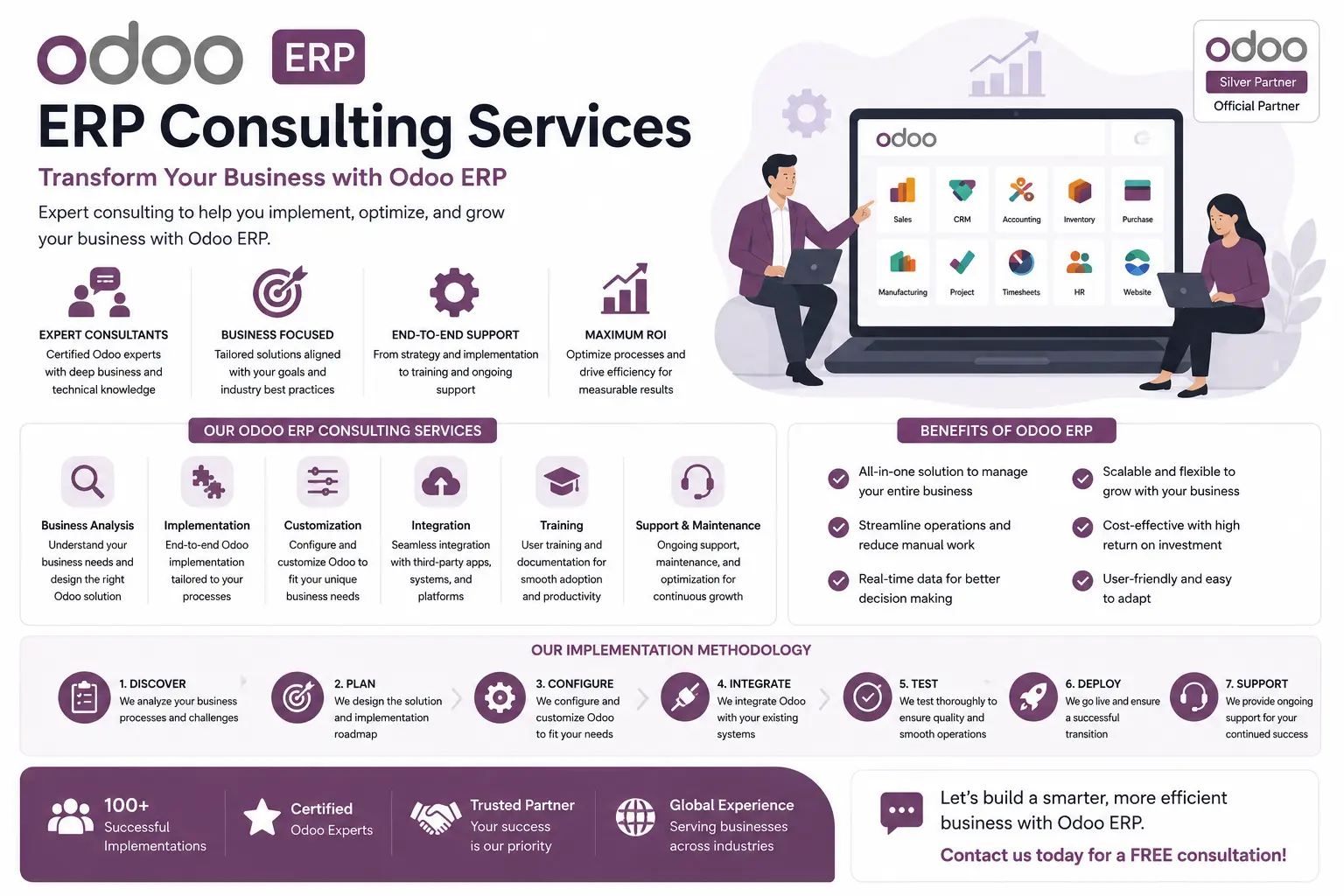
Odoo ERP Consulting Services: Driving Enterprise Excellence in 2026

Odoo ERP Consulting Services

In the complex digital economy of 2026, implementing an Enterprise Resource Planning (ERP) system is no longer just about software installation; it is about architectural business transformation. Organizations worldwide are turning to Odoo to unify their departments—from CRM and inventory to accounting and human resources—into a single, high-performance ecosystem. However, the complexity of these integrations necessitates specialized expertise. This is where professional Odoo ERP consulting services become the most critical investment for enterprises aiming for sustainable growth and operational efficiency.

Defining the Value of Expert Odoo Consulting

Professional consulting is the bridge between out-of-the-box software and a tailored business engine. Expert consultants bring a depth of experience that prevents the common pitfalls of DIY implementation, such as process inefficiencies, data fragmentation, and sub-optimal system architecture. By engaging with consultants who possess deep domain knowledge, enterprises ensure their Odoo environment is built for scale, security, and long-term performance.

Core Pillars of High-Impact Odoo Consulting

When an organization seeks consulting services, the focus should be on partners who deliver more than just configuration. Effective consulting is built on several key pillars:

1. Strategic Business Analysis

Before a single module is activated, top-tier consultants conduct a rigorous audit of your existing business processes. They identify bottlenecks, redundant workflows, and opportunities for automation. This strategic mapping ensures that Odoo is configured to accelerate your business, not just record its data.

2. Tailored System Architecture

One of Odoo’s greatest strengths is its modularity. Consultants translate your operational needs into a lean, efficient architecture. They advise on which modules to prioritize, how to structure your multi-company hierarchy, and where custom development is truly necessary versus where Odoo standard features can be optimized.

3. Data Integrity and Seamless Migration

Data is the lifeblood of an enterprise. A professional consultant manages the complex transition from legacy systems, ensuring that historical data is cleaned, mapped, and migrated without compromising accuracy. This minimizes downtime and guarantees that your new ERP environment starts with reliable, actionable insights.

4. Continuous Operational Optimization

The consulting engagement should not terminate at the ‘go-live’ date. As your business evolves and market conditions shift, your Odoo system must evolve with you. Consultants provide post-implementation audits, training for new staff, and ongoing strategic advice to ensure you are always leveraging the latest Odoo features, such as advanced AI-driven analytics or new workflow automation tools.

The E-E-A-T Difference in ERP Implementation

In 2026, Google’s emphasis on Experience, Expertise, Authoritativeness, and Trustworthiness (E-E-A-T) extends to how business-to-business (B2B) services are presented online. An ERP partner must demonstrate:

  • Experience: A proven history of managing complex, enterprise-level implementations across various industries.

  • Expertise: A deep understanding of Odoo’s technical core, database management, and industry-specific workflows.

  • Authoritativeness: Establishing a voice of leadership through documented success stories, technical guides, and clear methodology.

  • Trustworthiness: Providing transparent communication, clear project roadmaps, and a demonstrated commitment to client success and security.

Navigating the 2026 ERP Landscape

Today’s ERP market demands integration with AI, real-time analytics, and seamless cross-border supply chain capabilities. Enterprises that struggle to integrate these technologies face stagnation. Expert Odoo consultants are essential in navigating this landscape, acting as technical architects who ensure your ERP foundation is robust enough to handle the innovations of today while remaining flexible for the challenges of tomorrow.

Choosing the Right Partner for Your Enterprise

Selecting the right consulting partner requires careful due diligence. Look beyond the cost of the project and focus on the potential for long-term ROI. A partner who understands your long-term goals is far more valuable than one who only offers the lowest upfront price. When evaluating potential partners, ask about their specific experience in your sector, their project management methodology, and their approach to supporting you after the system is deployed.

Conclusion

Odoo ERP consulting services are the catalyst for operational excellence. By moving beyond simple support and treating your consultants as strategic partners, you transform your Odoo system from a basic data repository into a core competitive advantage. For enterprises looking to lead their industry, investing in expert consulting is not merely a service expense—it is a foundational investment in your company’s future growth, stability, and digital authority.
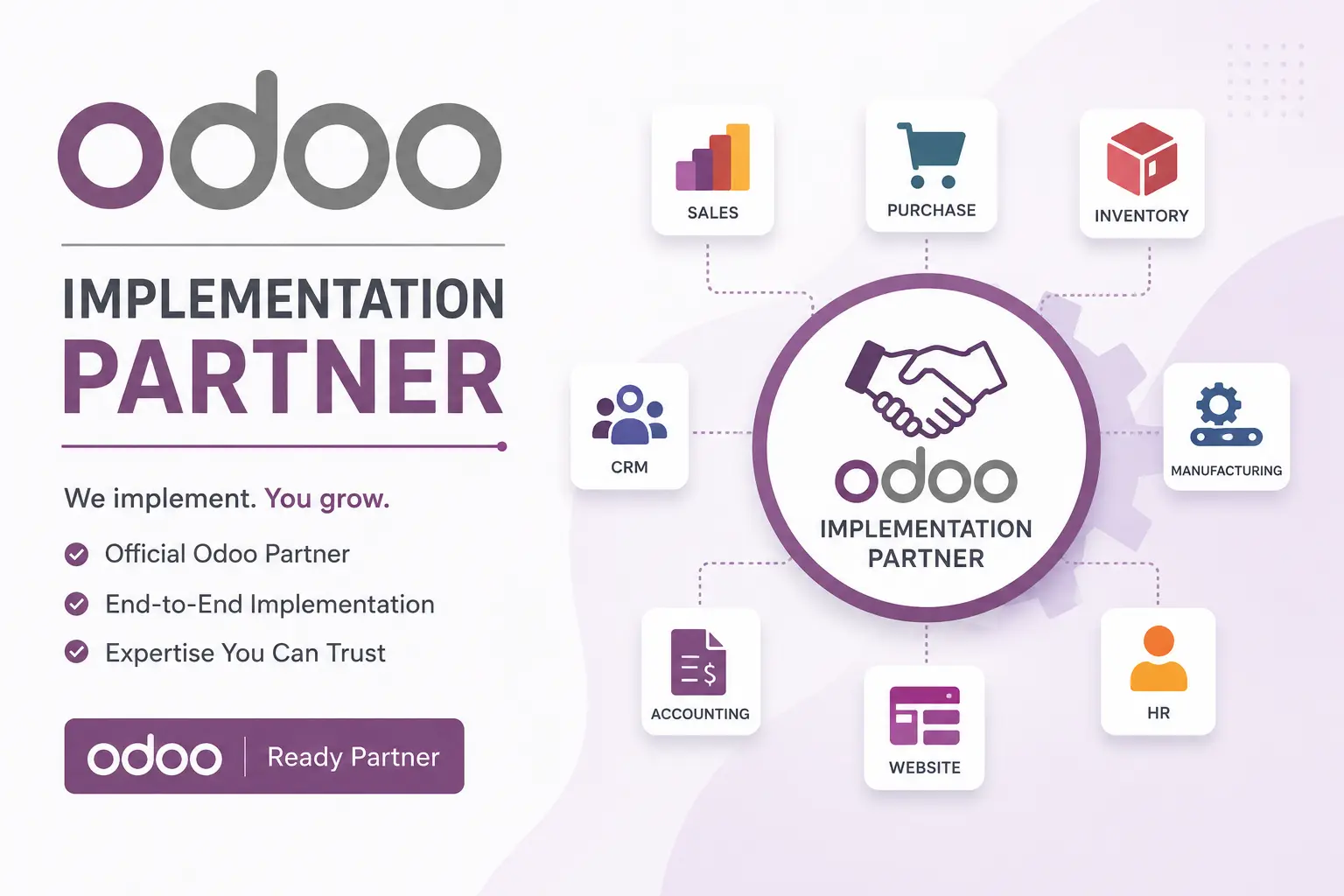
How to Choose the Right Odoo Implementation Partner: A Strategic Guide for Businesses

Odoo Implementation Partner

Choosing an Odoo implementation partner is arguably the most critical decision in your digital transformation journey. Odoo is a powerful, flexible ERP, but its true potential is unlocked only when it is correctly aligned with your specific business processes. An expert partner acts as a bridge between your business goals and the technical configuration of the software, turning a complex ERP project into a streamlined competitive advantage.

ADVERTISEMENT / SPONSORED SOLUTION

Reliable resources for your business growth

Why In-House Implementation Often Fails

Many businesses attempt to implement Odoo in-house, assuming that the software’s user-friendly interface will be enough to get the job done. However, ERP projects are complex, multi-dimensional tasks. Our experience with various enterprise clients shows that common pitfalls include misconfigured workflows, improper data migration, and a lack of understanding of Odoo’s architectural best practices. Without a partner who understands the intricacies of the Odoo framework, businesses often find themselves facing costly system failures, data silos, and operational bottlenecks that appear only after the system goes live. Furthermore, internal teams often lack the experience to foresee how a configuration in one module might impact data integrity in another, leading to long-term structural issues that are difficult and expensive to reverse once data volume grows.

5 Essential Criteria for Selecting an Odoo Partner

  1. Technical Certification and Odoo Status: Always verify the partner’s official status. A Gold or Silver partner demonstrates deep integration with Odoo’s ecosystem, a proven track record of successful projects, and guaranteed access to the latest technical updates and support resources from Odoo itself. They have direct channels to Odoo support, which is critical during high-stakes deployments.

  2. Industry-Specific Expertise: Does your business operate in manufacturing, retail, or professional services? Choose a partner that understands the specific regulatory and operational nuances of your industry. A partner with experience in manufacturing will have a completely different approach to supply chain management—focusing on MRP and shop floor control—compared to one specialized in retail POS systems where the focus is on high-velocity transactions and inventory turnover.

  3. Proven Implementation Methodology: Look for partners who follow a structured approach, such as the Odoo Sure methodology. This ensures that every phase—from requirement analysis to deployment—is documented, milestones are met, and expectations are managed transparently throughout the project lifecycle. A structured methodology acts as a roadmap, preventing “scope creep” and ensuring that all stakeholders remain aligned.

  4. Post-Implementation Support and SLAs: Implementation is not the end of the journey; it is the beginning of the operational phase. Evaluate their long-term commitment, response times, and the clarity of service level agreements (SLAs). You need a partner who treats you as a long-term business ally, not just a one-time project. Technology evolves, and so will your business; having a partner who provides ongoing optimization is crucial for maintaining a competitive edge.

  5. Cultural Fit and Communication Transparency: You will be working closely with this team during the stress of project deployment. Ensure they share your business values and maintain open lines of communication. A good partner should be willing to challenge your assumptions if they believe a different configuration will serve your business better in the long run. Transparency in communication—especially when technical hurdles arise—is a hallmark of a mature partner.

The Role of Technical Architecture and Customization Strategy

ADVERTISEMENT / SPONSORED SOLUTION

Reliable resources for your business growth

A common mistake is selecting a partner based solely on cost. Cheap implementation often leads to “spaghetti code”—excessive custom coding that solves a short-term problem but creates long-term technical debt. A top-tier partner will prioritize configuration over customization, adhering to Odoo best practices to ensure that your system remains upgradeable. If your partner insists on modifying core Odoo modules immediately, consider it a warning sign. True expertise lies in using Odoo’s modular capabilities to their fullest extent before resorting to bespoke development. This ensures that when a new Odoo version is released, your system can be upgraded without breaking your custom workflows.

Navigating the Complexity of Change Management

Choosing the right partner is also about how they handle the human side of ERP. An expert partner understands that technical excellence must be paired with effective change management. They should provide structured user training, documentation, and a clear adoption strategy. They need to help your staff move from their old, familiar processes to the new Odoo-driven environment, ensuring that the team is not just compliant, but enthusiastic about the new capabilities. Without this focus, even the best-engineered system will fail to provide ROI because the team will revert to manual, offline workarounds.

Red Flags to Watch Out For

Be wary of partners who promise immediate results without conducting a thorough business analysis. An implementation partner should spend significant time understanding your “as-is” processes before suggesting any “to-be” configuration. Avoid those who push for excessive custom coding early on, as this increases technical debt and makes future system upgrades significantly more difficult and expensive to manage. Additionally, if a partner cannot provide references or case studies similar to your business scale, proceed with extreme caution. Ask to speak directly with their previous clients to understand their experience during the implementation phase.

The Impact of Localization Experience

Localization is frequently overlooked, yet it is vital for international operations. A partner with proven experience in your specific region understands the local accounting standards, tax regulations, and operational requirements that off-the-shelf software might not support natively. Without correct localization, you risk severe compliance issues, inaccurate financial reporting, and significant manual workload for your accounting team. Ensure your partner has a documented history of navigating the specific legal and fiscal requirements of the jurisdictions where you operate, as this can save you hundreds of hours in audit-related troubleshooting later.

Conclusion: Aligning Your Goals for Growth

Your choice of an Odoo implementation partner defines your project’s ROI. By prioritizing deep technical expertise, a structured methodology, and cultural alignment, you ensure that your investment in Odoo translates into a scalable, efficient engine for your business growth. Choosing the right partner is an investment in your company’s future agility. Do not rush this decision; take the time to evaluate their capabilities, ask the tough questions, and ensure their strategy aligns with your long-term business vision. When you find that synergy, Odoo becomes more than just a software platform—it becomes the backbone of your organization, enabling you to focus on what you do best: growing your business.