
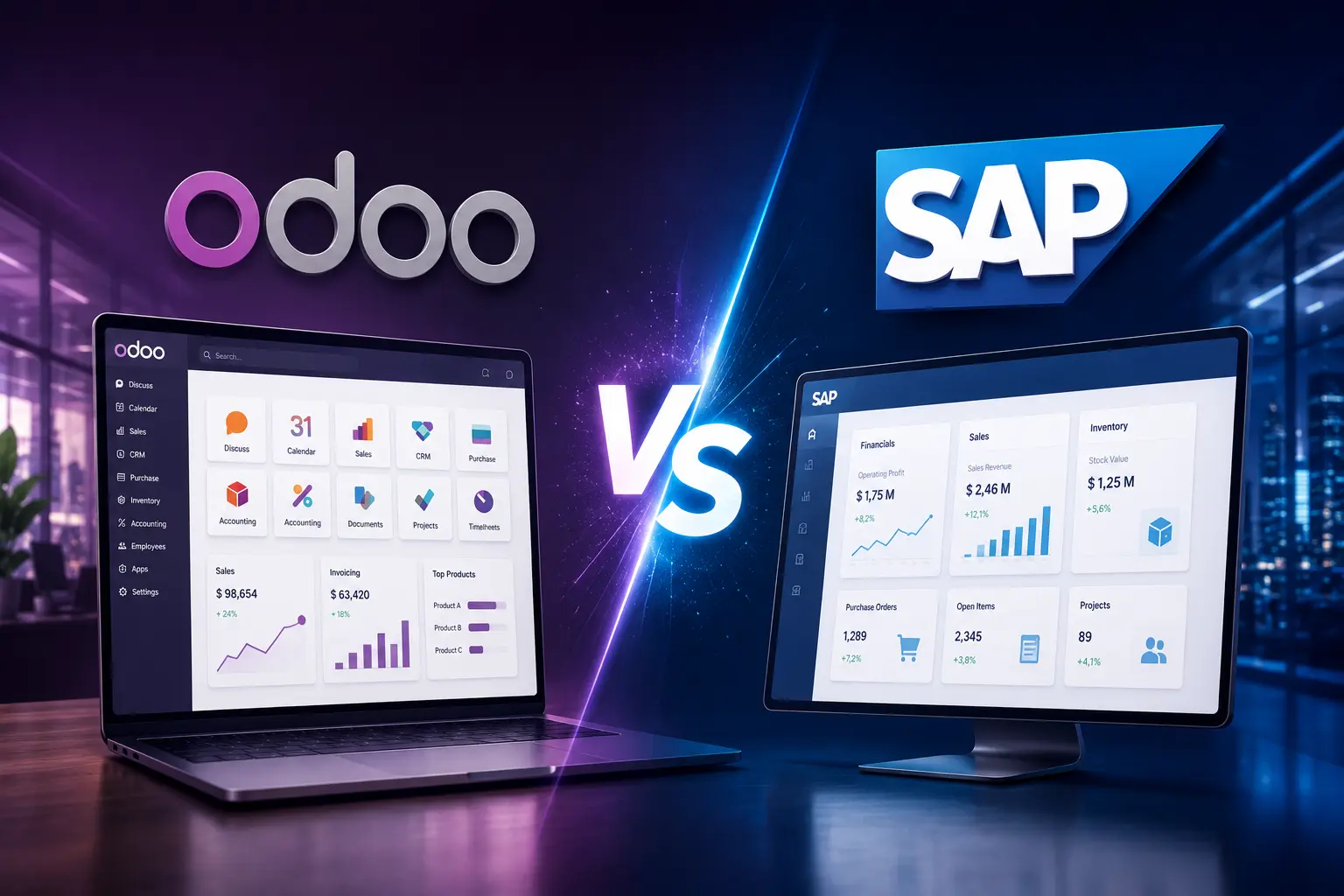
odoo vs SAP
When evaluating Odoo vs SAP, business leaders are often faced with a choice between agility and rigidity
Selecting the right Enterprise Resource Planning (ERP) system is one of the most consequential decisions a business leader can make. It is the digital backbone of your organization, dictating how you manage inventory, finance, sales, and human resources. In the current enterprise landscape, the debate between Odoo vs SAP often takes center stage. Both platforms offer robust features, but they cater to fundamentally different operational philosophies. Understanding these differences is essential to ensuring your choice aligns with your scalability goals, technical expertise, and long-term budget.
The Philosophy of Modern ERP Systems
Historically, SAP has been the gold standard for massive, multinational corporations. Its architecture is built for complexity, designed to handle thousands of users across disparate global branches with rigid, highly standardized processes. Conversely, Odoo represents the new wave of modular, agile ERP solutions. Odoo is designed with a “less is more” approach, allowing businesses to start with a few core modules and scale their infrastructure exactly as their requirements grow. This distinction is vital: are you looking for a system that mandates you adapt your business to its processes, or are you looking for a system that adapts to your unique workflows?
Executive Deep-Dive
Scaling Beyond Traffic to Revenue
Most enterprises fail because they chase clicks instead of trust. While building your global presence, ensure your EEAT 3.0 signals are synchronized across all regions.
Recommended for you:
→ The Shift from Traffic to Trust: A New KPI for Enterprise SEODeep Dive into SAP: The Enterprise Giant
SAP is renowned for its sheer power and integration depth. For global enterprises, the benefit of SAP lies in its ability to enforce strict consistency across every department. When you deploy SAP, you are implementing a globally recognized framework that minimizes variation. However, this power comes at a cost. The implementation time for SAP is notoriously long, often spanning months or even years. Furthermore, the reliance on specialized consultants for every configuration update creates a high cost of ownership that can be prohibitive for SMEs. If your organization is a publicly traded conglomerate requiring extreme auditability and multi-currency complexity across 50 countries, SAP’s rigid framework is a feature, not a bug.
The Agility of Odoo: Flexibility at Scale
In the Odoo vs SAP comparison, Odoo wins on user-centric design and speed. Because Odoo is modular, your team can begin with CRM and Sales, then layer in Inventory and Accounting as you scale. This phased implementation reduces organizational shock and keeps your project costs manageable. Unlike SAP, which requires massive upfront investment, Odoo’s subscription-based model and open-source nature provide a level of transparency and affordability that is unmatched. For SMEs and mid-sized enterprises looking to modernize without losing their competitive edge, Odoo offers the perfect balance of robust functionality and operational flexibility.
Total Cost of Ownership (TCO)
When calculating the TCO, you must look beyond license fees. SAP requires significant investment in hardware, internal infrastructure, and an army of certified consultants for ongoing maintenance. The cumulative cost of these resources often pushes the real budget of an SAP deployment to millions of dollars. Odoo, by contrast, operates on a much lower cost profile. Whether you opt for the cloud-hosted version or manage your own instance on the community edition, the development and maintenance costs are significantly more predictable. This allows business owners to reallocate their capital toward growth initiatives rather than IT maintenance.
User Experience and Adoption Rates
A system is only as good as its adoption rate. SAP’s interface, while powerful, has a steep learning curve that often necessitates intensive classroom training. Employees often find the system cumbersome, leading to “shadow IT” where teams resort to using Excel spreadsheets to bypass the ERP’s complexity. Odoo features a sleek, intuitive interface that looks and feels like modern web applications. Because it is easy to navigate, employee training is accelerated, and adoption rates are substantially higher. When your team actually enjoys using their tools, they input data more accurately and engage more effectively with the system, leading to better operational intelligence.
Integration and Open Ecosystem
Both platforms offer deep integration, but Odoo’s open-source nature provides a strategic advantage for firms that require custom connectivity. Odoo has an extensive marketplace of third-party apps that allow you to connect with almost any modern platform—be it e-commerce, payment gateways, or specialized logistics software. While SAP offers robust APIs, the process of integrating third-party software is often expensive and requires complex development cycles. Odoo’s flexibility ensures that your ERP remains the central hub of your digital ecosystem, effortlessly evolving as your technology stack changes.
Strategic Conclusion: Making the Final Choice
The decision in the Odoo vs SAP dilemma comes down to your business trajectory. SAP is built for stabilization in massive organizations, while Odoo is built for growth and agility in dynamic ones. If you are an SME founder or a leader in a mid-market company looking to professionalize operations, reduce software complexity, and increase your speed-to-market, Odoo is the clear choice. It provides the enterprise-grade functionality you need today, with the modular flexibility to support your business as it grows into the leader of tomorrow.
Related Keywords: Odoo vs SAP, best ERP for SMEs, ERP implementation comparison, Odoo scalability, choosing the right ERP software.
Exclusive Early Access: Q1 2026
The Global SEO Blueprint for C-Suite
We are finalizing an exclusive strategic framework for global enterprise scaling. Join the elite waitlist for early-bird pricing.
Secure Your Priority Spot