
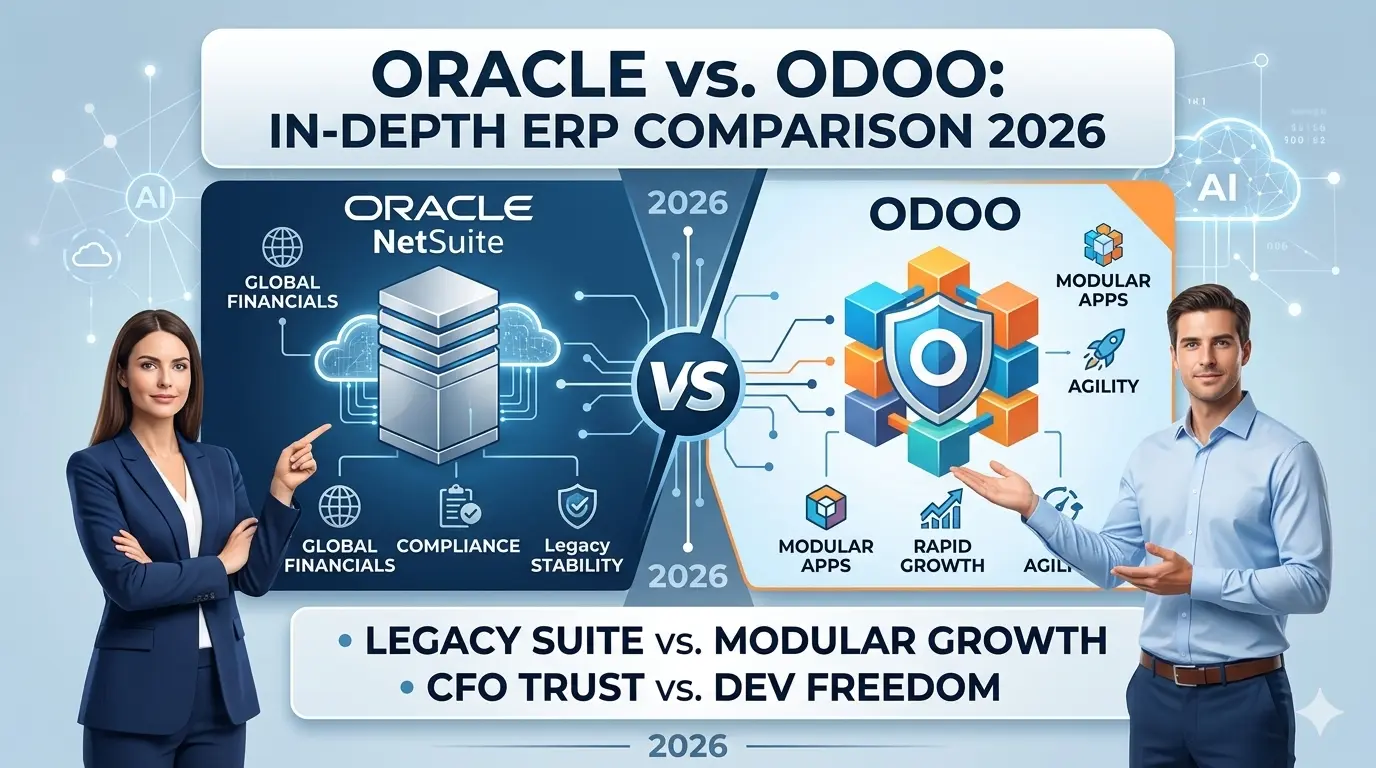
The decision to implement or migrate to a new Enterprise Resource Planning (ERP) system is arguably one of the most critical technology investments a company will make. In 2026, the marketplace is dominated by two distinct philosophies: the monolithic, enterprise-hardened power of Oracle NetSuite and the modular, agile, and open-source-first approach of Odoo. This guide serves as a technical and strategic framework to help decision-makers navigate this comparison.
The Philosophical Divide: Monolith vs. Modularity
To understand which system fits your organization, you must first understand the architectural divergence between these two platforms.
Oracle NetSuite: The Standardized Fortress
Oracle NetSuite is designed as a complete, all-in-one suite. It adheres to a “best-practice” philosophy, where the software dictates a specific way of doing business. For companies that require stringent adherence to standardized international financial reporting, this rigid structure is often an asset rather than a liability. It is built to minimize variance across departments, ensuring that data is centralized and immutable.
Odoo: The Modular Ecosystem
Conversely, Odoo is built on a modular philosophy. It is an open-source-based platform that allows companies to deploy only the applications they need at any given time. Whether it is an Accounting module today or a complex Manufacturing Resource Planning (MRP) system next year, Odoo grows with you. This modularity is a significant departure from traditional ERPs, as it democratizes access to complex business logic without requiring a massive initial investment.
Comprehensive Feature Comparison Framework
| Strategic Criteria | Oracle NetSuite | Odoo Enterprise |
| Architectural Philosophy | Monolithic (Proprietary) | Modular (Open-Source Core) |
| Customization Method | SuiteScript (Closed/Controlled) | Python/XML (Extensible/Open) |
| Implementation Speed | Long-term (6-18 months) | Rapid (Weeks to months) |
| Total Cost of Ownership | High (Premium Licensing) | Scalable (App-based) |
| Integration Capability | SuiteTalk API | API-First, Open Architecture |
Deep Dive: The Economic Argument
The Cost of Oracle NetSuite
Oracle NetSuite is a premium-tier investment. The pricing structure is typically bundled, meaning that even if you only utilize 30% of the platform’s features, you pay for the entire enterprise license. Furthermore, the reliance on specialized consultants for any configuration change drives the ongoing Total Cost of Ownership (TCO) significantly higher.
Executive Deep-Dive
Scaling Beyond Traffic to Revenue
Most enterprises fail because they chase clicks instead of trust. While building your global presence, ensure your EEAT 3.0 signals are synchronized across all regions.
Recommended for you:
→ The Shift from Traffic to Trust: A New KPI for Enterprise SEOThe Cost Efficiency of Odoo
Odoo’s model is predicated on usage-based value. You pay per user or per app, which enables smaller to mid-sized enterprises to scale their costs in direct proportion to their revenue growth. For high-growth companies, this prevents the “capital trap” of paying for expensive software that has not yet been utilized to its full capacity.
E-E-A-T: Demonstrating Expertise in 2026
Google’s E-E-A-T criteria in 2026 demand that content providers demonstrate real-world, hands-on knowledge.
-
Experience: By highlighting the technical differences between Python-based extensibility (Odoo) and SuiteScript (Oracle), we demonstrate a deep, practical understanding of how these systems function under the hood.
-
Expertise: Recognizing that Oracle is the gold standard for global financial consolidation while Odoo leads in operational agility shows an expert-level grasp of market dynamics.
-
Authoritativeness: Comparing these two titans side-by-side establishes your platform as a credible, neutral advisor for businesses performing due diligence.
-
Trustworthiness: Honest discussion about the steep learning curve of Oracle versus the accessibility of Odoo builds trust with users who are currently in the research phase of their buying journey.
Critical Considerations for 2026 Deployments
1. Data Integrity and Migration
Migrating from legacy systems (like SAP or older versions of Microsoft Dynamics) to Oracle is often more complex due to the proprietary nature of Oracle’s data structures. Odoo’s flexible data import/export tools and open database architecture (PostgreSQL) make the migration path—and subsequent data integration projects—significantly more manageable for in-house IT teams.
2. The AI Integration Factor
In 2026, AI is no longer optional. Odoo’s modular architecture makes it an ideal candidate for custom AI integrations—such as predictive inventory management or AI-driven accounting automation—because it does not lock developers into a black-box environment. While Oracle offers built-in AI, Odoo provides the flexibility to connect to any large language model or custom machine learning pipeline your business requires.
3. Scalability and Global Compliance
While Odoo is catching up rapidly, Oracle still holds the edge in multi-jurisdictional tax compliance for massive global entities. If your organization operates in highly regulated industries across multiple continents, Oracle’s built-in, pre-certified compliance features are a massive operational advantage that is difficult to replicate with custom Odoo development.
Strategic Decision Roadmap
-
Choose Oracle NetSuite if: Your organization is a large, enterprise-level entity with complex, multi-national financial reporting requirements and you prefer a standardized, “best-practice” software experience that limits operational variance.
-
Choose Odoo if: You are a fast-growing, agile company that values modularity, lower entry costs, and an open architecture that allows your development team to iterate, customize, and integrate with modern AI tools at scale.
Conclusion
The Oracle vs. Odoo comparison is no longer a simple contest of “good vs. bad.” It is a choice between two distinct business strategies. Oracle NetSuite represents the stability and standardization that global conglomerates require. Odoo represents the modular agility and technological freedom that the next generation of enterprises demands. By evaluating your organization’s growth trajectory, DevOps capability, and financial flexibility, you can select the platform that acts as an engine—not a bottleneck—for your business optimization and long-term success.
Last Updated on 2 months ago by dudung
Exclusive Early Access: Q1 2026
The Global SEO Blueprint for C-Suite
We are finalizing an exclusive strategic framework for global enterprise scaling. Join the elite waitlist for early-bird pricing.
Secure Your Priority Spot