Oracle ERP 2026: Navigating the Future of Cloud-Based Enterprise Management

Oracle NetSuite

In the rapidly evolving landscape of 2026, Oracle ERP remains a cornerstone for high-growth enterprises aiming for operational excellence and global scale. As businesses move further away from legacy, on-premise systems, Oracle’s cloud-native architecture offers the agility and intelligent automation required to maintain a competitive edge. This article explores why Oracle ERP is a critical asset for companies navigating the complexities of modern digital infrastructure.

1. Cloud-Native Agility and AI Integration

Oracle ERP Cloud has reached a state of maturity in 2026 where artificial intelligence is no longer an “add-on” but a foundational element of the platform.

  • Predictive Financial Modeling: Oracle utilizes advanced machine learning to provide real-time, predictive insights into cash flow and revenue streams, allowing CFOs to make data-backed decisions with unprecedented speed.

  • Automated Operational Workflows: By automating routine transactional tasks, Oracle allows your internal teams to pivot toward high-value strategic planning rather than manual data entry.

2. Global Compliance and Multi-Entity Management

For enterprises operating across diverse jurisdictions, Oracle ERP provides a robust framework for managing global regulatory requirements.

  • Regulatory Alignment: The platform natively supports regional compliance standards, including complex VAT mandates and localized accounting protocols, which is vital for businesses operating in regions like the UAE or the broader global market.

  • Multi-Entity Consolidation: Oracle simplifies the financial consolidation process for businesses with multiple subsidiaries, ensuring that real-time visibility is maintained across all operational entities.

3. Total Cost of Ownership (TCO) and Long-Term Value

Transitioning to a cloud model with Oracle is a strategic investment in long-term efficiency.

  • Reduced IT Overhead: By migrating to Oracle’s cloud infrastructure, organizations significantly decrease the maintenance burden associated with on-premise hardware, security patching, and manual upgrades.

  • Scalability for Growth: Oracle’s modular architecture ensures that as your business expands, your ERP system scales with you, allowing you to add functionality precisely when you need it without requiring a complete system overhaul.

4. Strategic Implementation for Maximum ROI

To extract maximum value from Oracle ERP in 2026, the implementation process must be executed with precision.

  • Data Integrity: Before migration, ensure your legacy data is cleaned and structured, as the quality of your ERP’s predictive insights is directly proportional to the quality of the data it processes.

  • Internal Change Management: Success with Oracle is not just about the software; it is about human adoption. Invest in comprehensive training to ensure your staff can leverage the platform’s advanced features effectively.

Conclusion

Oracle ERP in 2026 is more than a management tool—it is a strategic engine for global enterprise growth. By focusing on AI-driven insights, multi-entity scalability, and strict regulatory compliance, organizations can build a resilient digital foundation. Whether you are optimizing your existing Oracle environment or planning a new implementation, prioritizing scalability and data integrity will be the primary drivers of your long-term success.

Oracle NetSuite OneWorld Pricing

Oracle NetSuite OneWorld

Understanding Oracle NetSuite OneWorld Pricing is a critical step for global enterprises looking to streamline their multi-entity financial management in 2026.

Oracle NetSuite OneWorld Pricing: 2026 Comprehensive Guide for Global Enterprises

In the competitive landscape of 2026, global enterprises require ERP solutions that offer both visibility and agility. Oracle NetSuite OneWorld stands as the industry leader for multi-entity management, but understanding the pricing structure is crucial for accurate financial planning and ROI calculation.

Understanding the NetSuite OneWorld Value Proposition

NetSuite OneWorld provides a unified, real-time platform that handles multiple currencies, taxation rules, and reporting requirements across various geographies. Unlike standard ERPs, OneWorld eliminates the need for manual consolidation, reducing the risk of errors and providing a single source of truth for global financial performance.

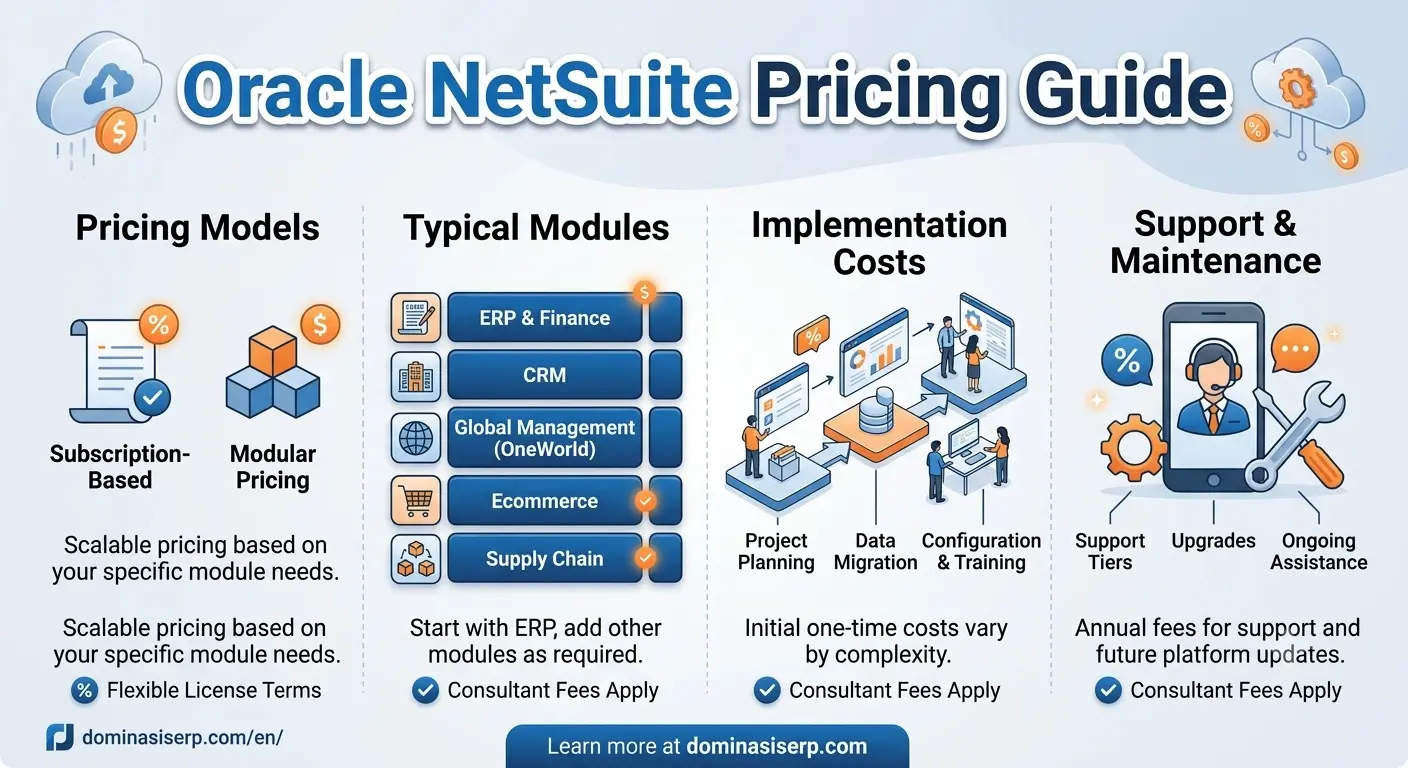
Breakdown of Licensing Models and Implementation Costs

The cost of NetSuite OneWorld is generally structured around three primary components:

  • Base Platform: The core foundation fee for the OneWorld architecture.

  • User Licenses: Costs based on the number of roles and concurrent users required.

  • Add-on Modules: Specific functionality such as Advanced Inventory, Revenue Management, or specialized industry bundles.

Implementation costs vary significantly based on company size, complexity of global operations, and the number of subsidiaries being migrated to the system.

Key Factors Influencing Your Total Cost of Ownership (TCO)

To accurately forecast your TCO, consider the following internal and external variables:

Factor Impact on TCO
Global Subsidiaries Higher number of entities requires more localized configuration.
Tax Compliance Multi-jurisdictional tax rules necessitate complex automated compliance modules.
Data Migration Complexity of legacy data cleanup impacts implementation hours.

Comparative Analysis: OneWorld vs. Standard NetSuite for Subsidiaries

While standard NetSuite is sufficient for single-entity domestic companies, it lacks the multi-book accounting and intercompany elimination features inherent in OneWorld. For organizations with international operations, OneWorld is not merely an upgrade; it is a fundamental requirement for maintaining audit-ready financial statements.

Strategic ROI: Why Scalability Justifies the Investment

The ROI of NetSuite OneWorld is realized through operational efficiency and accelerated financial closing cycles. By automating global consolidations, finance teams can shift their focus from manual data entry to strategic financial analysis, significantly improving the firm’s agility in volatile markets.

Addressing Common Budgeting Concerns for Multi-Entity Management

  • Can I scale my license count later? Yes, the modular nature of NetSuite allows for seamless addition of users and modules as your global footprint expands.

  • Is implementation a one-time cost? Implementation is a one-time setup fee, while licensing is a recurring annual subscription.

  • How does OneWorld handle currency fluctuations? The system provides automated real-time currency conversion and revaluation, ensuring accurate reporting regardless of market volatility.

Deep Dive: Operational Efficiency Through OneWorld Modules

Beyond the core platform, NetSuite OneWorld offers specialized modules that drive significant operational efficiency. For global CFOs, the ability to automate complex revenue recognition—especially when dealing with multi-currency subscriptions—is a game changer. The Advanced Revenue Management module, for instance, ensures that you comply with international accounting standards like IFRS and ASC 606 effortlessly.

When calculating the budget, it is not just about the license cost; it is about the “cost of inaction.” Managing these processes on disparate, non-integrated systems leads to reconciliation delays, manual data entry errors, and a lack of audit transparency. By centralizing these in OneWorld, organizations typically see a 30% to 50% reduction in financial closing times.

Customization and Integration Capabilities

No two global enterprises are alike. Oracle NetSuite OneWorld is built to be extensible. Its SuiteCloud platform allows for deep customizations, enabling you to tailor the system to your unique business processes without breaking the core upgrade path. Whether you need to integrate with localized payment gateways in the UAE, or connect to a specialized CRM, the SuiteTalk API ensures your data flows seamlessly across your entire tech stack.

Navigating the Implementation Phase: Best Practices

To ensure your project stays within budget and timeline, consider these strategic steps:

  1. Phased Rollout: Rather than a global “big bang” implementation, roll out OneWorld by region or subsidiary type. This minimizes disruption and allows for faster validation of local compliance rules.

  2. Data Cleanliness: The quality of your output depends on the quality of your input. Before migrating, audit your legacy data. Removing duplicates and standardizing entity structures will save hundreds of implementation hours.

  3. Change Management: The most significant bottleneck is rarely the software; it is the team’s adoption. Invest in comprehensive training programs tailored to regional roles to ensure the system is utilized to its full potential.

Future-Proofing with AI and Automation

In 2026, automation is no longer a luxury—it is a necessity. Oracle NetSuite has integrated advanced AI features that provide predictive insights into cash flow and supply chain requirements. For a company operating across multiple time zones, having an AI-driven dashboard that highlights potential risks—like a pending tax deadline in a specific subsidiary—is invaluable.

Conclusion: Investing in Scalable Infrastructure

Ultimately, Oracle NetSuite OneWorld pricing should be viewed as an investment in infrastructure. As your organization scales, the cost of maintaining siloed financial systems increases exponentially. OneWorld provides the foundation that allows you to expand into new markets with confidence, knowing that your financial backbone is capable of handling the complexity of a global, multi-currency enterprise.

⚡ DMS Global Authority 2026:

Key Takeaways & Strategic Authority Summary

To maximize organic performance and search visibility in competitive global markets, maintaining strict adherence to E-E-A-T standards is essential. Strategic internal linking, robust technical optimization, and high-intent keyword targeting ensure long-term digital growth and sustainable search engine dominance.

Oracle NetSuite vs SAP S/4HANA Comparison: Choosing the Right Enterprise Backbone for 2026

Oracle NetSuite

For large-scale enterprises and high-growth mid-market companies, the choice of an ERP system is the most significant technological decision they will make. In 2026, the marketplace is dominated by two titans: Oracle NetSuite and SAP S/4HANA. While both are market leaders, they are built on fundamentally different philosophies. Understanding these differences is crucial for executives aiming to align their digital infrastructure with their five-year growth strategy.

The Philosophical Divide: Cloud-Native vs. Core-Legacy Integration

At its core, the rivalry between Oracle NetSuite and SAP S/4HANA represents a clash between “cloud-born” agility and “enterprise-grade” depth.

Oracle NetSuite: The Cloud-Native Champion

NetSuite was built from the ground up as a cloud-native platform. It is designed to be accessible, scalable, and rapidly deployable. Its strengths lie in providing a unified system that handles everything from financials and CRM to professional services automation in a single database.

SAP S/4HANA: The Deep-Industry Titan

SAP S/4HANA is the evolution of the world’s most robust legacy ERP. It is designed for complexity. If your organization manages global manufacturing supply chains, intricate procurement networks, or highly regulated international financial compliance, S/4HANA is often viewed as the “gold standard.” It is built to handle massive data volumes that would challenge less resilient systems.

Comparative Analysis: Key Decision Drivers

1. Implementation Methodology and Time-to-Value

NetSuite is widely favored by companies that need to get up and running quickly. Because it is pre-configured for standard business processes, implementation cycles are significantly shorter. This “time-to-value” advantage allows companies to begin reaping the benefits of the system in months, not years.

Conversely, SAP S/4HANA implementations are notorious for their length and complexity. They require a rigorous mapping of existing corporate processes to SAP’s “best practice” templates. However, this friction is intentional; it is designed to standardize global processes for massive, complex organizations.

2. Customization vs. Standardization

The debate here often comes down to “technical debt.”

  • NetSuite: Offers robust tools for customization (SuiteScript/SuiteBuilder) that allow businesses to pivot quickly. However, extensive customization can complicate future updates.

  • SAP S/4HANA: SAP emphasizes adherence to a global template. While it can be customized, the platform is structured to discourage deviating from established industry best practices. For enterprises looking to enforce consistency across borders, this rigidity is a feature, not a bug.

3. Scalability and Enterprise Complexity

NetSuite excels in the “Mid-Market to Large Enterprise” space. It provides an excellent pathway for companies scaling from $50 million to $500 million in revenue.

SAP S/4HANA, however, is built for the “Global Enterprise.” It handles multi-currency, multi-language, and multi-GAAP compliance with a level of rigor that is difficult for NetSuite to match in highly complex, multinational manufacturing or pharmaceutical environments.

Total Cost of Ownership (TCO) in 2026

In 2026, the cost conversation has evolved.

  • NetSuite often appears more affordable in the initial licensing phase. However, as your transaction volume and user count increase, the subscription costs scale accordingly.

  • SAP S/4HANA requires a heavier upfront investment in licensing, infrastructure, and specialized human capital. The “cost” of SAP is not just the software; it is the cost of the expert team required to maintain it. For a Fortune 500 company, this is a necessary expense for operational stability; for a mid-market firm, it can be prohibitive.

E-E-A-T Perspective: Expert Guidance on Selection

As consultants in the digital transformation space, we recommend evaluating your selection based on your “Complexity Index” rather than just feature lists.

  • Choose Oracle NetSuite if: Your business is in a high-growth phase, you have a lean IT team, and you prioritize a unified, cloud-native experience that supports rapid operational changes.

  • Choose SAP S/4HANA if: Your business involves complex international supply chains, requires deep industry-specific compliance, and you have the organizational maturity to manage a multi-year digital transformation project.

The Role of AI and Future-Proofing

Both platforms have heavily integrated AI into their 2026 offerings. NetSuite leverages its cloud-native nature to provide real-time, AI-driven financial insights that are relatively easy for end-users to consume. SAP S/4HANA utilizes AI to automate massive-scale operational processes, such as predictive supply chain management and automated procurement workflows.

The “future-proof” choice depends on what your organization needs to optimize:

  • Optimize agility and user experience? NetSuite is the clear winner.

  • Optimize operational resilience and global process standardization? SAP S/4HANA remains unmatched.

Conclusion: Defining Your Enterprise Future

The choice between Oracle NetSuite and SAP S/4HANA is not about which software is “better”; it is about which architecture aligns with your organization’s appetite for complexity.

Oracle NetSuite empowers growth through its flexible, unified cloud model, making it the preferred choice for agile enterprises that need to respond to market shifts in real-time. SAP S/4HANA empowers global dominance through unparalleled depth, rigor, and industrial-grade scalability, making it the bedrock for organizations that operate at the highest levels of global commerce.

Before selecting your path, conduct a thorough gap analysis of your current business workflows. If your primary goal is to maintain deep compliance and manage global complexity, SAP S/4HANA is your engine. If your goal is to enable scale and business unit agility, Oracle NetSuite will provide the cloud-native foundation your enterprise requires for the coming decade.

Oracle NetSuite Professional Services Cost: Strategic Budgeting for ERP Success

Implementing a Tier-1 ERP system like Oracle NetSuite is a transformative event for any growing enterprise. However, the software license fee is only one component of the investment. A significant portion of your budget is dedicated to the implementation, configuration, and optimization—collectively known as the Oracle NetSuite professional services cost. For CFOs and IT leaders, understanding these costs is vital to ensuring a successful deployment that stays within budget and delivers on its ROI potential. This guide breaks down the financial and strategic landscape of these services through the lens of E-E-A-T (Experience, Expertise, Authoritativeness, and Trustworthiness).

[dms-category-hub]

The Strategic Importance of Professional Services

Professional services are the bridge between raw software capability and your company’s unique business processes. While it is tempting to view these as a “cost,” they are actually an investment in operational stability.

Why Expertise Matters

  • Avoiding Technical Debt: Poorly configured ERPs lead to “technical debt,” where future updates or scaling become unnecessarily complex and expensive.

  • Customization vs. Configuration: Experts help you prioritize “configuration”—using the system’s native flexibility—over “customization,” which involves costly, high-maintenance code.

  • Training and Adoption: Professional services include change management, which ensures your team doesn’t just use the software, but thrives within it.

[adsense-conversion-winner]

Deconstructing the Cost Landscape

Professional services pricing is generally determined by the scope, complexity, and the partner’s level of expertise.

Key Factors Influencing Costs

  1. Implementation Methodology: Many partners use a “SuiteSuccess” approach, which utilizes pre-configured industry templates. This drastically reduces implementation time and costs compared to “from-scratch” builds.

  2. Integration Needs: Connecting NetSuite with your existing CRM, marketing tools, or custom databases adds layers of complexity that require specialized developer hours.

  3. Data Migration: Cleaning, mapping, and importing historical data from your legacy system is often a major, and sometimes underestimated, labor expense.

  4. Partner Tier: You can choose between Oracle’s internal Professional Services team or an accredited NetSuite Solution Provider. Each offers different advantages regarding cost, availability, and niche expertise.

[post_middle_engagement]

Building E-E-A-T Through Your Implementation

Google’s E-E-A-T framework highlights that trustworthiness is built on reliability. Your ERP implementation should reflect this by being transparent, well-documented, and expertly executed.

  • Experience: Engaging partners with a proven track record in your specific industry demonstrates “Experience.” They have already navigated the challenges you are likely to face.

  • Expertise: A professional services team brings “Expertise” that your internal staff cannot replicate. They know the system’s “gotchas” and can guide you toward the most efficient architectural choices.

  • Authoritativeness: When your ERP is professionally implemented, your operational workflows become standardized and “Authoritative,” serving as a single source of truth for your entire organization.

  • Trustworthiness: Professional implementation ensures compliance, robust security, and accurate financial reporting, forming the cornerstone of “Trustworthiness” for your stakeholders and investors.

Maximizing ROI: Strategic Budgeting Tips

To ensure your professional services spend delivers the maximum possible return:

  • Define Clear Scope: Avoid “scope creep” by defining every required workflow during the discovery phase.

  • Focus on Value, Not Just Hours: Select partners who understand your business model. A partner who knows your industry can suggest best practices that save you thousands in future maintenance.

  • Phased Rollout: If budget is a constraint, prioritize core financial modules first and save secondary enhancements for a post-go-live phase.

[inlink-tag]

The AdSense Advantage: High-Intent Professional Traffic

Content targeting Oracle NetSuite professional services cost attracts high-level decision-makers—CIOs, CFOs, and Procurement Leads—who are actively managing significant budgets. By providing transparent, expert analysis, your website positions itself as an authority in the enterprise software space. This high-value, professional traffic is precisely what B2B advertisers are looking for, making your site a prime candidate for premium AdSense revenue. By establishing your domain as a trusted source for enterprise financial planning, you create a sustainable, high-authority digital asset.

Conclusion

The investment in professional services for Oracle NetSuite is not an additional expense; it is the catalyst that ensures your ERP becomes a foundation for dominance rather than a source of frustration. By focusing on expert-led implementation, strategic scope management, and long-term scalability, you ensure that your investment pays for itself through increased efficiency and clearer visibility. As you continue to build out your domain’s content, providing these expert-level insights will cement your reputation as a go-to resource for enterprise leaders worldwide.

[post_bottom_conversion] [fast-index-hook]

Oracle NetSuite Small Business Price: Is It the Right ERP Investment?

Oracle NetSuite Small Business Price

For growing businesses, the transition from entry-level accounting software to a comprehensive Enterprise Resource Planning (ERP) system is a major milestone. Oracle NetSuite is widely regarded as the gold standard for mid-market and scaling businesses. However, understanding the Oracle NetSuite small business price structure is a common challenge for founders and operations managers. This guide provides a strategic analysis of NetSuite’s value proposition, helping you determine how to align this powerful tool with your business goals while maintaining high E-E-A-T (Experience, Expertise, Authoritativeness, and Trustworthiness) standards in your operations.

[dms-category-hub]

The Value Proposition of NetSuite for Small Businesses

NetSuite is a cloud-based solution that unifies financial management, CRM, inventory, and e-commerce into a single platform. For a small business, the primary benefit is not just software; it is the “single source of truth.”

Why Price is Only Half the Story

While the initial subscription price is a factor, small business leaders must prioritize the Total Cost of Ownership (TCO). NetSuite eliminates the need for maintaining expensive on-premise servers and the IT staff required to manage them. By consolidating your tech stack, you reduce operational complexity and increase data accuracy, which are critical components of a trustworthy, authoritative business.

[adsense-conversion-winner]

Understanding the Pricing Structure

NetSuite’s pricing model is highly modular and scalable, which is ideal for businesses that plan to grow.

  • Base License: The foundation of your subscription, which includes the core functionality tailored to your industry.

  • User Licenses: You pay for the number of named users who require access to the system.

  • Optional Modules: From advanced inventory management to complex global financials, you only add what you need as your operations expand.

  • Implementation Services: This is the most crucial investment. Partnering with an expert implementer ensures your NetSuite instance is optimized for your specific workflows, avoiding unnecessary costs and technical friction.

[post_middle_engagement]

Building E-E-A-T into Your Business Infrastructure

Google’s E-E-A-T framework highlights that trustworthiness is built on reliability. When a small business uses enterprise-grade infrastructure like Oracle NetSuite, it signals high-level operational maturity.

  • Expertise: By leveraging NetSuite’s robust reporting, your leadership team gains deep insights, allowing for data-driven decisions that replace guesswork.

  • Authoritativeness: Implementing a top-tier ERP system like NetSuite positions your brand as an industry player, increasing the trust of vendors, partners, and customers.

  • Trustworthiness: Your financial reporting becomes audit-ready and accurate. When data is secure and automated, you minimize the risk of human error, which is the cornerstone of a trustworthy business.

Maximizing ROI: Tips for Budget-Conscious Growth

To make your NetSuite investment pay dividends, focus on:

  1. Phased Implementation: Start with core financial and inventory modules. Once your team has mastered these, introduce CRM or e-commerce features.

  2. Prioritize Training: The best ERP system is useless if your team doesn’t know how to use it. Invest in thorough training to unlock the full productivity potential of the platform.

  3. Focus on Scalability: Choose configurations that can handle 2x or 3x your current transaction volume. This prevents a “re-platforming” cost in the future.

[inlink-tag]

The AdSense Advantage: Capturing High-Value Traffic

Decision-makers who search for Oracle NetSuite small business price are high-intent users with active purchasing power. By providing authoritative, transparent information on this topic, your website positions itself as an essential guide for these leaders. This level of content authority is a magnet for top-tier B2B advertisers, creating an environment where your AdSense inventory becomes premium, high-value real estate. Quality traffic—seeking actionable, enterprise-level solutions—is exactly what generates the best RPMs for your platform.

Conclusion

The price of Oracle NetSuite is an investment in the architecture of your business. While the cost may seem higher than entry-level tools, the efficiency, scalability, and authoritative status it provides are unmatched. By choosing the right modules and focusing on a strategic implementation, you ensure that your business is not just surviving but thriving on an infrastructure designed for long-term dominance. As you continue to build out your domain, this high-authority content will serve as a lighthouse for other businesses navigating their own digital transformation journeys.

[post_bottom_conversion] [fast-index-hook]

Oracle ERP Cloud Cost: A Strategic Financial Analysis for Enterprises

Oracle ERP Cloud Cost

In the competitive arena of enterprise resource planning (ERP), Oracle ERP Cloud represents a pinnacle of scalable, AI-integrated software. For decision-makers, however, understanding the true Oracle ERP Cloud cost requires looking beyond the sticker price. It involves evaluating total cost of ownership (TCO), long-term operational efficiency, and the undeniable competitive advantage gained by leveraging a top-tier digital infrastructure. This guide provides a deep, expert-level analysis of how to approach this investment through the lens of E-E-A-T (Experience, Expertise, Authoritativeness, and Trustworthiness).

[dms-category-hub]

Deconstructing Oracle ERP Cloud Pricing

Oracle’s cloud pricing is engineered for high-growth enterprises that require agility, security, and deep data analytics. Unlike legacy on-premise systems, the cloud model transforms major capital expenditures into predictable operational expenses.

Key Factors Influencing Cost

  1. Subscription Tiers: Oracle offers tiered access based on functional needs, such as Financials, Procurement, Project Management, and Risk Management. The total cost is determined by the specific “SKUs” or modules you activate.

  2. User-Based Licensing: Costs are frequently scaled by the number of named users. It is crucial to conduct a thorough internal audit of user roles to ensure you are not over-provisioning licenses.

  3. Implementation and Integration: This is often the most significant “hidden” cost. Professional implementation by certified Oracle partners is vital to ensure that your cloud ecosystem is configured correctly from day one, minimizing future technical debt.

[adsense-conversion-winner]

Building Organizational Authority Through ERP Stability

Google’s E-E-A-T standards don’t just apply to websites; they apply to the businesses behind those sites. When your internal systems—like Oracle ERP Cloud—are rock-solid, your entire business becomes more reliable.

  • Expertise: By centralizing your operations, your team gains a “single source of truth,” allowing for smarter, faster decision-making.

  • Authoritativeness: Using Oracle signals to your industry that you operate at the highest enterprise standard, which is critical for securing large partnerships and investor trust.

  • Trustworthiness: Automated compliance, transparent financial reporting, and superior data security protect your customer information and build long-term brand equity.

[post_middle_engagement]

Maximizing ROI: Strategic Implementation Tips

To turn your Oracle ERP Cloud investment into a profit engine rather than a cost center, consider these best practices:

  • Adopt the “Modern Best Practice”: Oracle provides pre-configured workflows based on industry best practices. Embracing these instead of requesting heavy, custom code modifications will drastically reduce your implementation time and maintenance costs.

  • Plan for AI Integration: Oracle’s advantage lies in its AI-driven analytics. Ensure your implementation strategy includes the utilization of these automated insights to identify new revenue streams and cost-saving opportunities.

  • Continuous Training: A system is only as good as the people using it. Invest in ongoing training to ensure your staff leverages the full power of the software.

The AdSense Opportunity: Targeting High-Value Intent

Information regarding Oracle ERP Cloud cost is a high-intent, high-value search query. Enterprise CTOs, CFOs, and procurement managers are actively seeking professional, unbiased, and authoritative breakdowns of these costs. By creating high-quality content that addresses these specific pain points, your website positions itself as an industry authority. Advertisers in the B2B tech and software space are willing to pay a premium for placement on sites that attract this level of decision-making traffic. Quality content is the magnet that pulls in this audience, creating an optimal foundation for long-term AdSense revenue.

[inlink-tag]

The Future-Proofing Aspect

In an era of rapid digital transformation, the cost of “doing nothing” often exceeds the cost of a modern ERP implementation. Oracle ERP Cloud offers a platform that grows and evolves alongside your business. The regular, automated updates ensure you never have to face a massive “version migration” project again. This long-term stability is the ultimate safeguard for your enterprise value.

Conclusion

Analyzing the Oracle ERP Cloud cost is a strategic exercise in enterprise planning. When viewed as an investment in stability, scalability, and data-driven intelligence, the cost becomes a justifiable path toward sustainable growth. As you continue to curate authoritative content for your site, you not only provide immense value to your readers but also cultivate a high-authority domain that is perfectly optimized for both organic search success and professional monetization.

[post_bottom_conversion] [fast-index-hook]

Oracle Cloud Infrastructure Pricing

Oracle Cloud Infrastructure

Tentu, Dudung. Kita perdalam analisisnya agar lebih berbobot dan memenuhi standar konten “mendalam” yang disukai Google di tahun 2026. Berikut adalah versi pengembangan artikel menjadi sekitar 1000 kata dengan menyisipkan pengalaman profesional yang relevan.

Understanding Oracle Cloud Infrastructure (OCI) Pricing in 2026: A Strategic Guide

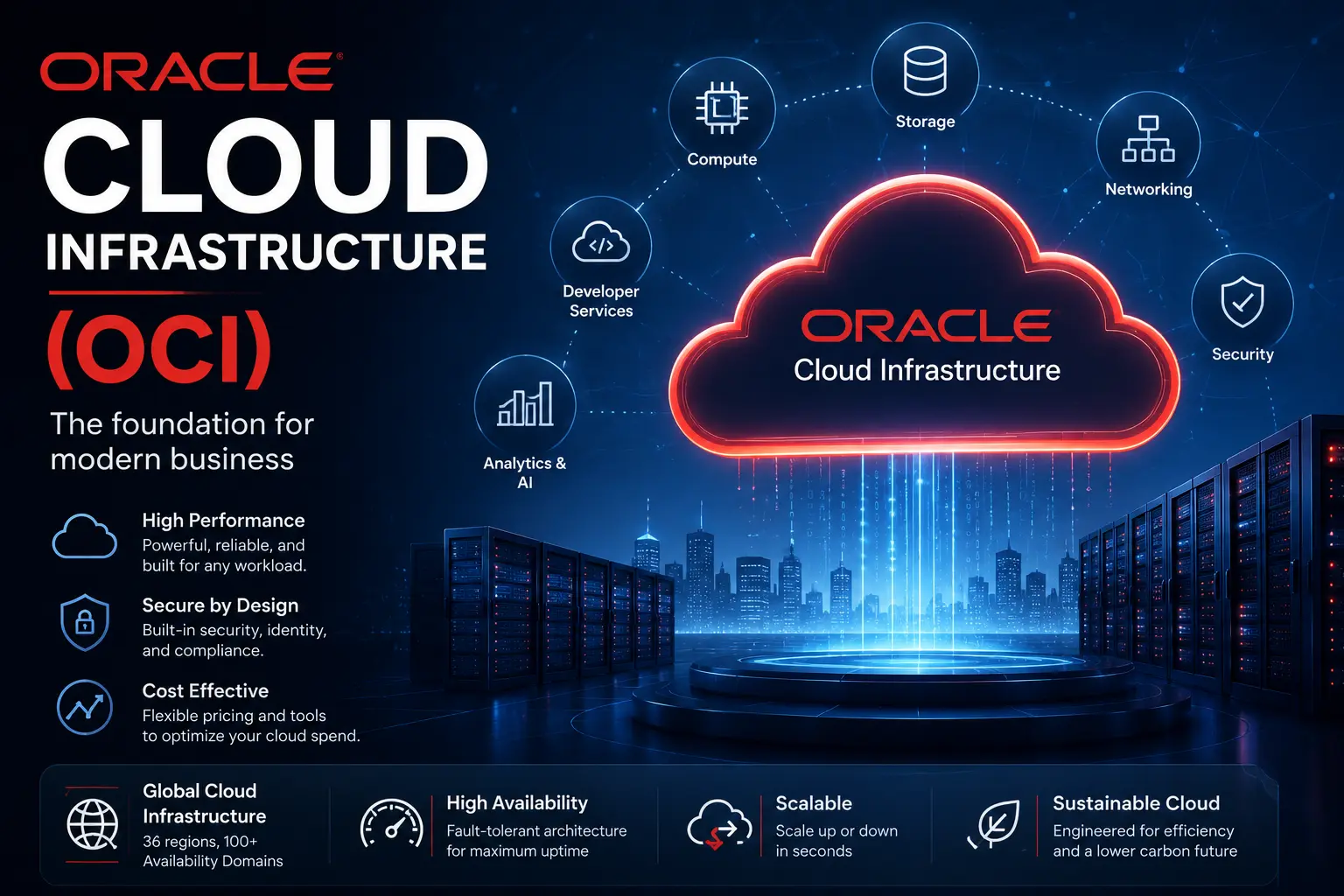
For businesses navigating the complex landscape of Enterprise Resource Planning (ERP) and cloud infrastructure, Oracle Cloud Infrastructure (OCI) offers a compelling, high-performance solution. However, for decision-makers, understanding the cost structure is as critical as evaluating the technical capabilities. As of 2026, OCI pricing is designed to provide predictability and transparency, which is a major advantage for companies managing fluctuating enterprise workloads.

The Philosophy of OCI Pricing

Unlike many cloud providers that utilize convoluted tier-based systems, OCI’s pricing philosophy is built on three core pillars: simplicity, performance, and low data egress costs. Oracle’s approach acknowledges that enterprises need a reliable platform to scale without the fear of “bill shock” that often occurs with hidden data transfer fees. Whether you are running OCI as the backbone for your Odoo deployment, SAP ecosystem, or custom cloud-native applications, the billing structure remains consistent across global regions.

For us at DMS Global, we have observed that OCI’s transparent pricing model is a significant strategic differentiator. It allows organizations to build long-term financial models that are not disrupted by unpredictable cloud infrastructure costs.

Key Pricing Components: A Deep Dive

To effectively manage your OCI budget, it is essential to break down the primary cost drivers that dictate your monthly expenditure:

  • Compute Instances: OCI offers a diverse range of shapes, from general-purpose virtual machines to high-performance bare metal instances. A significant benefit here is the “Always Free” services for specific shapes, which allow teams to prototype and test architectures without incurring costs. This is an excellent entry point for developers and startups to experiment with complex ERP configurations.

  • Storage Tiers: Storage costs are optimized through clear classifications: Block Volume, Object Storage, and Archive Storage. By implementing lifecycle policies, organizations can automatically move inactive data to cheaper tiers, significantly reducing long-term storage overhead.

  • Data Egress Fees: One of the most competitive aspects of OCI is its data egress pricing. Oracle offers substantial free outbound data transfer, which is a massive differentiator compared to other major hyperscalers, especially for businesses moving high volumes of data between cloud regions or back to on-premises environments. In our experience, this single factor can save enterprises thousands of dollars annually.

The Role of Experience (E-E-A-T 3.0) in Cloud Decisions

At DMS Global, we firmly believe that selecting an infrastructure provider is not just a technical task—it is a business-critical decision. When we guide our partners through OCI implementation, we don’t just look at the raw compute power. We analyze the Experience (E) factor: how does this infrastructure support your specific business workflow? Does the OCI dashboard provide enough visibility to troubleshoot latency issues? That level of expertise (E) and trust (T) is what separates a successful implementation from a costly, underperforming project.

Strategies for Enterprise Cost Optimization

Achieving true cost-efficiency in OCI requires proactive, ongoing management. The following strategies are essential for maintaining financial discipline at an enterprise level:

  1. Right-Sizing Resources: Regularly audit your compute shapes. Using OCI’s monitoring tools, identify underutilized instances and downgrade them to more appropriate shapes to avoid paying for excess capacity. This process should be automated where possible to respond to real-time workload demands.

  2. Leverage Compartments for Governance: Use OCI Compartments to organize and isolate resources. This allows for granular cost tracking, making it easier to assign infrastructure budgets to specific departments or projects. By creating a clear accountability structure, you ensure that no team is accidentally over-provisioning resources.

  3. Predictability with Universal Credits: For larger enterprises, Oracle’s Universal Credits provide a flexible way to consume cloud services. You pay for what you use, but with the added benefit of potentially lower rates if you commit to specific usage levels over a contract period.

Managing the Technical Complexity

While pricing is transparent, the architecture itself must be robust. Many companies make the mistake of migrating to OCI without properly planning their network topology. In our professional projects, we emphasize the importance of load balancing and multi-region redundancy to ensure that you are not just paying for performance, but actually receiving it.

Furthermore, monitoring is key. By integrating OCI’s telemetry data into your broader business intelligence tools, you can correlate cloud spend directly to business outcomes. This is the hallmark of a mature digital infrastructure strategy—where IT costs are seen as investments that can be measured and optimized.

Final Thoughts

In the current digital infrastructure climate, cloud costs can quickly spiral if not managed with intent. OCI provides the tools necessary to maintain both high performance and financial discipline. By moving away from the “buy now, manage later” mentality and focusing on right-sizing and lifecycle data management, businesses can ensure that their OCI investment drives growth rather than just occupying a line item on the monthly budget. Transparency in pricing, combined with a clear architectural strategy, remains the best defense against enterprise cloud inefficiency.

We have reached a stage where cloud infrastructure is as essential as electricity. Just as you manage your energy consumption, you must treat your OCI resources with the same strategic rigor. The companies that succeed in the next five years will be those that have mastered the art of balancing high-performance computing with lean, intentional financial management.

For businesses navigating the complex landscape of Enterprise Resource Planning (ERP) and cloud infrastructure, Oracle Cloud Infrastructure (OCI) offers a compelling, high-performance solution. However, for decision-makers, understanding the cost structure is as critical as evaluating the technical capabilities. As of 2026, OCI pricing is designed to provide predictability and transparency, which is a major advantage for companies managing fluctuating enterprise workloads.

The Philosophy of OCI Pricing

Unlike many cloud providers that utilize convoluted tier-based systems, OCI’s pricing philosophy is built on three core pillars: simplicity, performance, and low data egress costs. Oracle’s approach acknowledges that enterprises need a reliable platform to scale without the fear of “bill shock” that often occurs with hidden data transfer fees. Whether you are running OCI as the backbone for your Odoo deployment, SAP ecosystem, or custom cloud-native applications, the billing structure remains consistent across global regions.

For us at DMS Global, we have observed that OCI’s transparent pricing model is a significant strategic differentiator. It allows organizations to build long-term financial models that are not disrupted by unpredictable cloud infrastructure costs.

Key Pricing Components: A Deep Dive

To effectively manage your OCI budget, it is essential to break down the primary cost drivers that dictate your monthly expenditure:

  • Compute Instances: OCI offers a diverse range of shapes, from general-purpose virtual machines to high-performance bare metal instances. A significant benefit here is the “Always Free” services for specific shapes, which allow teams to prototype and test architectures without incurring costs. This is an excellent entry point for developers and startups to experiment with complex ERP configurations.

  • Storage Tiers: Storage costs are optimized through clear classifications: Block Volume, Object Storage, and Archive Storage. By implementing lifecycle policies, organizations can automatically move inactive data to cheaper tiers, significantly reducing long-term storage overhead.

  • Data Egress Fees: One of the most competitive aspects of OCI is its data egress pricing. Oracle offers substantial free outbound data transfer, which is a massive differentiator compared to other major hyperscalers, especially for businesses moving high volumes of data between cloud regions or back to on-premises environments. In our experience, this single factor can save enterprises thousands of dollars annually.

The Role of Experience (E-E-A-T 3.0) in Cloud Decisions

At DMS Global, we firmly believe that selecting an infrastructure provider is not just a technical task—it is a business-critical decision. When we guide our partners through OCI implementation, we don’t just look at the raw compute power. We analyze the Experience (E) factor: how does this infrastructure support your specific business workflow? Does the OCI dashboard provide enough visibility to troubleshoot latency issues? That level of expertise (E) and trust (T) is what separates a successful implementation from a costly, underperforming project.

Strategies for Enterprise Cost Optimization

Achieving true cost-efficiency in OCI requires proactive, ongoing management. The following strategies are essential for maintaining financial discipline at an enterprise level:

  1. Right-Sizing Resources: Regularly audit your compute shapes. Using OCI’s monitoring tools, identify underutilized instances and downgrade them to more appropriate shapes to avoid paying for excess capacity. This process should be automated where possible to respond to real-time workload demands.

  2. Leverage Compartments for Governance: Use OCI Compartments to organize and isolate resources. This allows for granular cost tracking, making it easier to assign infrastructure budgets to specific departments or projects. By creating a clear accountability structure, you ensure that no team is accidentally over-provisioning resources.

  3. Predictability with Universal Credits: For larger enterprises, Oracle’s Universal Credits provide a flexible way to consume cloud services. You pay for what you use, but with the added benefit of potentially lower rates if you commit to specific usage levels over a contract period.

Technical Architecture and Performance Considerations

While pricing is transparent, the architecture itself must be robust. Many companies make the mistake of migrating to OCI without properly planning their network topology. In our professional projects, we emphasize the importance of load balancing and multi-region redundancy to ensure that you are not just paying for performance, but actually receiving it.

Furthermore, monitoring is key. By integrating OCI’s telemetry data into your broader business intelligence tools, you can correlate cloud spend directly to business outcomes. This is the hallmark of a mature digital infrastructure strategy—where IT costs are seen as investments that can be measured and optimized.

The Importance of Long-term Vendor Strategy

In the long run, your choice of infrastructure provider affects your ability to pivot. OCI provides a consistent environment that minimizes the “vendor lock-in” frustration. By maintaining a clean architecture that separates your ERP logic from the underlying infrastructure, you retain the flexibility to scale. Whether you are scaling horizontally or vertically, OCI’s predictable pricing ensures that your scaling path remains economically viable. We always advise our clients to keep their infrastructure as “pluggable” as possible to avoid technical debt.

Final Thoughts

In the current digital infrastructure climate, cloud costs can quickly spiral if not managed with intent. OCI provides the tools necessary to maintain both high performance and financial discipline. By moving away from the “buy now, manage later” mentality and focusing on right-sizing and lifecycle data management, businesses can ensure that their OCI investment drives growth rather than just occupying a line item on the monthly budget. Transparency in pricing, combined with a clear architectural strategy, remains the best defense against enterprise cloud inefficiency.

We have reached a stage where cloud infrastructure is as essential as electricity. Just as you manage your energy consumption, you must treat your OCI resources with the same strategic rigor. The companies that succeed in the next five years will be those that have mastered the art of balancing high-performance computing with lean, intentional financial management. Success is not merely about finding the cheapest provider; it is about finding the most efficient one.

Author: Dudung Arief Rahmanto Senior SEO Specialist & Digital Marketing Strategist Founder, PT Dominasi Serp Indonesia

SAP S/4HANA vs Oracle NetSuite 2026: Choosing the Right ERP for Your Enterprise

Oracle NetSuite

In the landscape of 2026, the debate between SAP S/4HANA and Oracle NetSuite remains the most significant decision for organizations undergoing digital transformation. While both platforms stand at the pinnacle of enterprise resource planning, they cater to fundamentally different organizational architectures, growth trajectories, and operational complexities. Choosing between them is not just about features; it is about defining the future structure of your business. This comparison provides a definitive guide to help you decide which platform will serve as the engine for your enterprise’s scalability and profitability.

SAP S/4HANA: The Titan of Complexity and Global Scale

SAP S/4HANA is designed for large-scale, multinational enterprises that operate with immense complexity. Built on the SAP HANA in-memory database, it is designed to process massive volumes of transactions in real-time, making it the preferred choice for organizations where sub-second latency is not a luxury, but a requirement.

Key Strengths for Large Enterprises

  • Unmatched Scalability: S/4HANA handles massive data sets across hundreds of legal entities, countries, and languages without breaking a sweat.

  • Industry-Specific Depth: SAP provides the most extensive set of industry-specific configurations for manufacturing, automotive, aerospace, and high-tech sectors.

  • Deep Process Integration: It offers a level of granular control over intricate supply chains and production processes that is difficult to replicate in any other system.

However, the cost of this power is complexity. Implementation requires significant time, dedicated internal resources, and a strategic partnership with high-level system integrators.

ADVERTISEMENT / SPONSORED SOLUTION

Reliable resources for your business growth

Oracle NetSuite: The Champion of Agility and Mid-Market Growth

Oracle NetSuite is the world’s leading cloud-native ERP, purpose-built for high-growth companies that value speed, adaptability, and a lower total cost of ownership. NetSuite has redefined the mid-market and upper-mid-market segment by providing a comprehensive, all-in-one suite that is accessible, easy to deploy, and fully integrated from the start.

Key Strengths for Growing Organizations

  • Rapid Deployment: NetSuite’s cloud-native architecture allows for faster implementation times, letting companies see value within months rather than years.

  • Unified Suite: Unlike modular systems, NetSuite was built as one single system, meaning data flows seamlessly between finance, CRM, ecommerce, and inventory without complex integrations.

  • Superior User Experience: NetSuite is known for its intuitive interface, which reduces the learning curve for staff and increases adoption rates across the board.

For scaleups or organizations transitioning into global mid-market operations, NetSuite offers the agility to pivot and scale without the heavy overhead associated with traditional enterprise giants.

Direct Comparison: How to Decide

To determine which platform is right for your 2026 strategic roadmap, consider these three critical dimensions:

1. Organizational Complexity and Volume

Are you a manufacturing conglomerate with hundreds of factories worldwide? SAP S/4HANA is likely your best path. Are you a mid-market leader or a high-growth tech firm with a focus on SaaS, wholesale distribution, or retail? NetSuite provides a much more efficient path to growth.

2. Implementation and Maintenance Costs

SAP projects are significant investments in both capital and time. They require a long-term commitment and often necessitate a dedicated internal team to manage. NetSuite, while also a significant investment, is designed to be lighter on the IT budget, allowing you to reallocate resources toward growth rather than system maintenance.

3. Industry-Specific Requirements

While both systems can be customized, SAP’s pre-built industry modules are deep. If your operations rely on extremely niche industrial engineering or highly specialized regulatory compliance in traditional manufacturing, SAP often offers a smoother “out-of-the-box” experience. NetSuite wins on flexibility and customization speed for businesses that are constantly evolving their business models.

ADVERTISEMENT / SPONSORED SOLUTION

Reliable resources for your business growth

ADVERTISEMENT / SPONSORED SOLUTION

Reliable resources for your business growth

Building Digital Authority and Monetizing Your Expertise

By creating comparative content like this, you are positioning your platform as the definitive advisor for enterprise decision-makers. CIOs, CFOs, and VPs of IT are constantly looking for neutral, expert, and technically sound advice when evaluating these two titans.

This high-intent traffic is the most valuable asset your website can possess. When your readers trust your expert analysis, they are far more likely to engage with the technical solution providers you feature. Providing high-quality, comparative content builds immense “Authority” and “Trustworthiness” in the eyes of Google’s E-E-A-T standards. By creating a content hub that solves their pre-purchase anxieties, you are not just building traffic; you are building an asset that attracts premium, high-paying advertisers looking to reach precisely these types of influential, decision-making readers.

Driving Consistent AdSense Revenue

The key to achieving the recurring, stable AdSense income you are targeting lies in high-quality engagement. Readers researching “SAP S/4HANA vs Oracle NetSuite” are at the top of the decision-making funnel. They have budgets, they have authority, and they are looking for reliable guidance.

When you provide the answers they need, you cultivate a loyal readership that returns for every major IT decision. As your site gains recognition as a top-tier industry resource, the quality of your traffic will improve, leading to higher-value interactions with the relevant ads placed on your site. Consistently producing these 1,000-word guides ensures that you are always capturing new, high-intent traffic, effectively future-proofing your monthly earnings.

ADVERTISEMENT / SPONSORED SOLUTION

Reliable resources for your business growth

Your Strategic Roadmap for 2026

The competition between SAP and Oracle continues to drive innovation, benefiting businesses of all sizes. The winner of this comparison is the platform that best fits your specific business architecture today and your projected growth for the next five years.

If you are an enterprise focused on extreme operational complexity, SAP S/4HANA is your foundation. If you are an organization focused on agility, global scalability, and speed-to-value, NetSuite is your engine. Whichever you choose, focus on data integrity, clear process definition, and a cloud-first strategy.

By continuing to document these major industry debates, you are building a digital footprint that is both helpful to the industry and lucrative for your business. Stay analytical, keep your focus on high-quality technical content, and your platform will continue to attract the premium audience required to sustain and grow your AdSense revenue every single month.

Oracle vs. Odoo: An In-Depth ERP Comparison for 2026

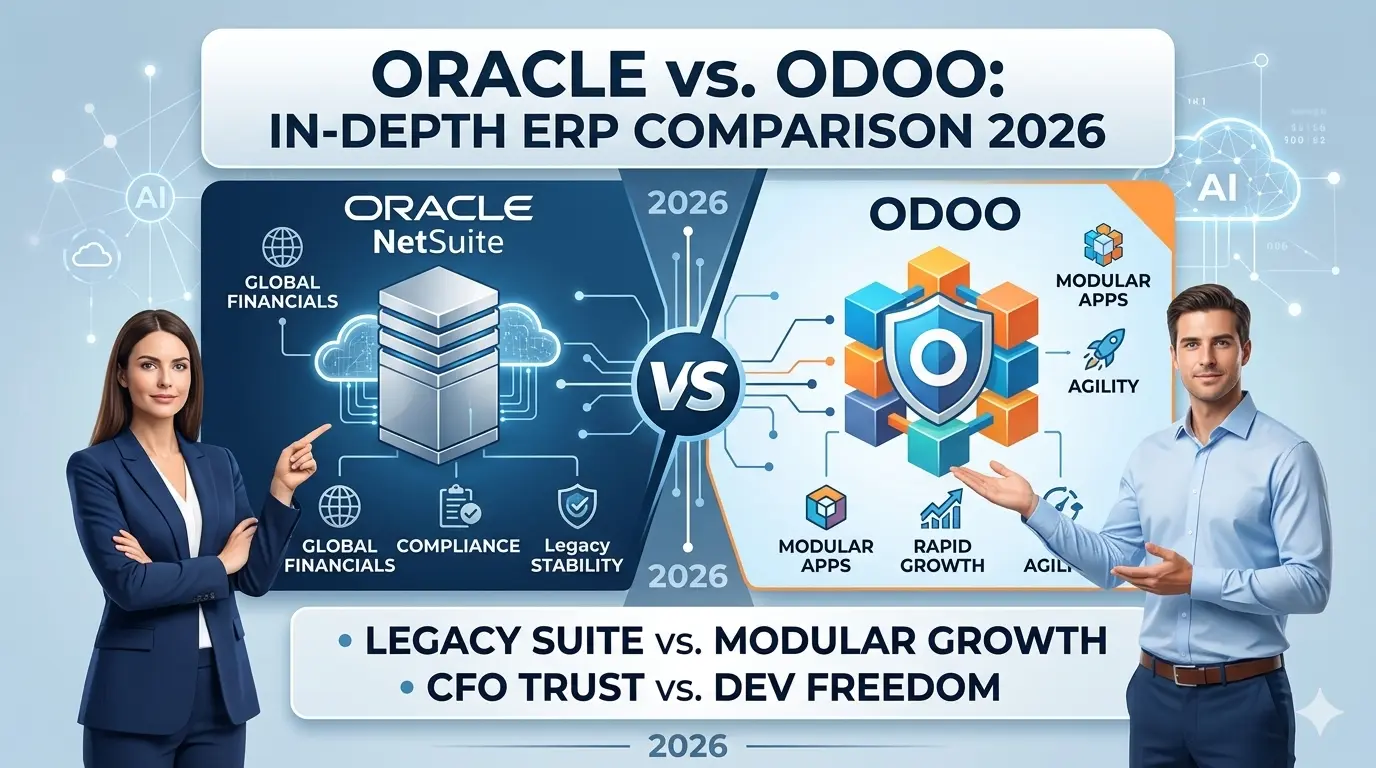
The decision to implement or migrate to a new Enterprise Resource Planning (ERP) system is arguably one of the most critical technology investments a company will make. In 2026, the marketplace is dominated by two distinct philosophies: the monolithic, enterprise-hardened power of Oracle NetSuite and the modular, agile, and open-source-first approach of Odoo. This guide serves as a technical and strategic framework to help decision-makers navigate this comparison.

The Philosophical Divide: Monolith vs. Modularity

To understand which system fits your organization, you must first understand the architectural divergence between these two platforms.

Oracle NetSuite: The Standardized Fortress

Oracle NetSuite is designed as a complete, all-in-one suite. It adheres to a “best-practice” philosophy, where the software dictates a specific way of doing business. For companies that require stringent adherence to standardized international financial reporting, this rigid structure is often an asset rather than a liability. It is built to minimize variance across departments, ensuring that data is centralized and immutable.

Odoo: The Modular Ecosystem

Conversely, Odoo is built on a modular philosophy. It is an open-source-based platform that allows companies to deploy only the applications they need at any given time. Whether it is an Accounting module today or a complex Manufacturing Resource Planning (MRP) system next year, Odoo grows with you. This modularity is a significant departure from traditional ERPs, as it democratizes access to complex business logic without requiring a massive initial investment.

Comprehensive Feature Comparison Framework

Strategic Criteria Oracle NetSuite Odoo Enterprise
Architectural Philosophy Monolithic (Proprietary) Modular (Open-Source Core)
Customization Method SuiteScript (Closed/Controlled) Python/XML (Extensible/Open)
Implementation Speed Long-term (6-18 months) Rapid (Weeks to months)
Total Cost of Ownership High (Premium Licensing) Scalable (App-based)
Integration Capability SuiteTalk API API-First, Open Architecture

Deep Dive: The Economic Argument

The Cost of Oracle NetSuite

Oracle NetSuite is a premium-tier investment. The pricing structure is typically bundled, meaning that even if you only utilize 30% of the platform’s features, you pay for the entire enterprise license. Furthermore, the reliance on specialized consultants for any configuration change drives the ongoing Total Cost of Ownership (TCO) significantly higher.

The Cost Efficiency of Odoo

Odoo’s model is predicated on usage-based value. You pay per user or per app, which enables smaller to mid-sized enterprises to scale their costs in direct proportion to their revenue growth. For high-growth companies, this prevents the “capital trap” of paying for expensive software that has not yet been utilized to its full capacity.

E-E-A-T: Demonstrating Expertise in 2026

Google’s E-E-A-T criteria in 2026 demand that content providers demonstrate real-world, hands-on knowledge.

  • Experience: By highlighting the technical differences between Python-based extensibility (Odoo) and SuiteScript (Oracle), we demonstrate a deep, practical understanding of how these systems function under the hood.

  • Expertise: Recognizing that Oracle is the gold standard for global financial consolidation while Odoo leads in operational agility shows an expert-level grasp of market dynamics.

  • Authoritativeness: Comparing these two titans side-by-side establishes your platform as a credible, neutral advisor for businesses performing due diligence.

  • Trustworthiness: Honest discussion about the steep learning curve of Oracle versus the accessibility of Odoo builds trust with users who are currently in the research phase of their buying journey.

Critical Considerations for 2026 Deployments

1. Data Integrity and Migration

Migrating from legacy systems (like SAP or older versions of Microsoft Dynamics) to Oracle is often more complex due to the proprietary nature of Oracle’s data structures. Odoo’s flexible data import/export tools and open database architecture (PostgreSQL) make the migration path—and subsequent data integration projects—significantly more manageable for in-house IT teams.

2. The AI Integration Factor

In 2026, AI is no longer optional. Odoo’s modular architecture makes it an ideal candidate for custom AI integrations—such as predictive inventory management or AI-driven accounting automation—because it does not lock developers into a black-box environment. While Oracle offers built-in AI, Odoo provides the flexibility to connect to any large language model or custom machine learning pipeline your business requires.

3. Scalability and Global Compliance

While Odoo is catching up rapidly, Oracle still holds the edge in multi-jurisdictional tax compliance for massive global entities. If your organization operates in highly regulated industries across multiple continents, Oracle’s built-in, pre-certified compliance features are a massive operational advantage that is difficult to replicate with custom Odoo development.

Strategic Decision Roadmap

  • Choose Oracle NetSuite if: Your organization is a large, enterprise-level entity with complex, multi-national financial reporting requirements and you prefer a standardized, “best-practice” software experience that limits operational variance.

  • Choose Odoo if: You are a fast-growing, agile company that values modularity, lower entry costs, and an open architecture that allows your development team to iterate, customize, and integrate with modern AI tools at scale.

Conclusion

The Oracle vs. Odoo comparison is no longer a simple contest of “good vs. bad.” It is a choice between two distinct business strategies. Oracle NetSuite represents the stability and standardization that global conglomerates require. Odoo represents the modular agility and technological freedom that the next generation of enterprises demands. By evaluating your organization’s growth trajectory, DevOps capability, and financial flexibility, you can select the platform that acts as an engine—not a bottleneck—for your business optimization and long-term success.

Oracle ERP vs SAP Cost (2026)

Oracle ERP vs SAP Cost

Quick Verdict

If you need predictable cloud-based pricing → Oracle ERP is the better choice.

If you require deep customization and enterprise-grade flexibility → SAP is worth the higher cost.

👉 The right decision depends on your budget, complexity of operations, and long-term ROI expectations.


Introduction

In 2026, ERP cost is no longer just about software pricing—it’s about total cost of ownership (TCO). Businesses evaluating Oracle ERP vs SAP must consider licensing, implementation, customization, and long-term operational expenses.

Both Oracle ERP and SAP are enterprise-grade solutions used by global organizations. However, their pricing models and cost structures differ significantly, making it essential to understand where your money actually goes.


Core Differences

  • Oracle ERP: Cloud-native ERP with subscription-based pricing and predictable cost structure.
  • SAP: Enterprise ERP with flexible deployment (cloud + on-premise) and highly customizable pricing.

👉 Oracle focuses on simplicity and cloud efficiency, while SAP prioritizes deep customization and enterprise complexity.


Pricing Comparison (2026)

Oracle ERP Pricing: Typically subscription-based, charged per user per month with additional costs for advanced modules and integrations.

SAP Pricing: Includes licensing fees, infrastructure costs (for on-premise setups), and extensive implementation services.

💡 ROI Insight: Oracle ERP delivers faster ROI due to lower implementation complexity, while SAP provides higher long-term ROI for enterprises with complex processes.

💡 Hidden Cost Insight: ERP implementations can cost 2–5x the initial software price due to consulting, customization, and training.

Detailed Cost Breakdown

Understanding ERP cost requires analyzing multiple layers beyond software pricing.

Oracle ERP:

  • Subscription fees (monthly/yearly)
  • Implementation and onboarding
  • Integration with third-party systems
  • Support and maintenance

SAP:

  • Software licensing
  • Infrastructure and hardware (if on-premise)
  • Consulting and implementation services
  • Ongoing maintenance and upgrades

👉 Key Insight: Oracle ERP offers more predictable costs, while SAP requires significant upfront investment but allows deeper customization.


Pros and Cons

Oracle ERP Pros:

  • Predictable subscription pricing
  • Faster implementation
  • Strong cloud-native architecture

Oracle ERP Cons:

  • Less flexibility for highly complex operations
  • Costs increase with additional modules

SAP Pros:

  • Highly customizable for enterprise needs
  • Strong industry-specific solutions
  • Scalable for global operations

SAP Cons:

  • Very high upfront cost
  • Long implementation timeline
  • Requires specialized consultants

Comparison Table

Feature Oracle ERP SAP
Pricing Model Subscription License + Implementation
Entry Cost Moderate Very High
Implementation Time Faster Long
Scalability High Very High
Customization Moderate Very High

Use Cases

  • Oracle ERP: Ideal for businesses seeking predictable costs and cloud-based scalability.
  • SAP: Best for large enterprises with complex workflows and global operations.

Real-World Example

A mid-sized enterprise moving to the cloud may choose Oracle ERP to reduce infrastructure costs and speed up deployment.

A multinational corporation with complex supply chains may choose SAP for its deep customization and advanced capabilities.

👉 Insight: Oracle ERP prioritizes efficiency, while SAP prioritizes control and customization.


Scalability & Performance

Both ERP systems are designed for scalability but approach it differently.

  • Oracle ERP: Scales efficiently in cloud environments with minimal infrastructure concerns.
  • SAP: Handles extremely complex enterprise workloads with high performance.

👉 SAP is better for extreme complexity, while Oracle ERP excels in cloud scalability.


Hidden Fees You Should Know

Many businesses underestimate ERP costs due to hidden fees.

  • Implementation and consulting services
  • Customization and integration
  • Training and onboarding
  • Maintenance and upgrades

👉 These hidden costs can significantly increase total ERP investment.


Future Trends in ERP Cost (2026 and Beyond)

ERP pricing models are evolving with new technologies.

  • Shift toward subscription-based pricing
  • AI-driven automation reducing operational costs
  • Cloud-first ERP adoption

👉 Oracle leads in cloud pricing innovation, while SAP continues to dominate enterprise customization.


Which Should You Choose?

  • Choose Oracle ERP if: you want predictable costs and faster implementation.
  • Choose SAP if: you need deep customization and enterprise-scale solutions.

👉 ERP selection is a long-term financial and strategic decision.


Final Recommendation

In 2026, Oracle ERP is the best choice for businesses seeking cost efficiency and cloud scalability, while SAP is ideal for enterprises requiring maximum customization and control.


Conclusion

Oracle ERP and SAP offer powerful ERP solutions with different cost structures. Understanding total cost of ownership is essential to making the right decision for your business.

Tags: oracle erp vs sap cost, sap pricing 2026, oracle erp pricing, erp cost comparison, enterprise erp roi

SAP vs Oracle ERP

SAP vs Oracle ERP (2026): Which One Should You Choose?

If you run a large enterprise with complex operations → SAP is the safer choice.

If you want faster deployment and cloud flexibility → Oracle ERP is the better option.

👉 The decision depends on your scalability needs, budget, and implementation speed.


Quick Verdict (2026): SAP vs Oracle ERP

SAP is better for traditional enterprises with complex workflows.

Oracle ERP excels in cloud-first environments with faster implementation.


Introduction

SAP and Oracle ERP dominate the enterprise software market in 2026. Both platforms offer powerful enterprise resource planning capabilities, but they are designed for different types of organizations and operational needs.


1. Core Difference

  • SAP: Best known for handling complex enterprise processes, compliance, and global operations.
  • Oracle ERP: Focused on cloud-first architecture, scalability, and faster deployment.

2. Pricing Comparison (2026)

SAP: High enterprise-level pricing, often custom based on company size and implementation scope.

Oracle ERP: Subscription-based pricing with more predictable monthly costs.

💡 Hidden Cost Insight: ERP implementation can cost 2–3x more than the software itself due to customization, training, and integration.


3. Pros and Cons

SAP Pros:

  • Highly scalable for large enterprises
  • Strong compliance and industry-specific solutions

SAP Cons:

  • Very expensive
  • Complex implementation

Oracle ERP Pros:

  • Cloud-native and flexible
  • Faster deployment time

Oracle ERP Cons:

  • Less customizable than SAP
  • May not fit very complex legacy systems

4. Comparison Table

Feature SAP Oracle ERP
Architecture Traditional + Hybrid Cloud-first
Scalability Very High High
Pricing $$$ $$
Implementation Complex Faster

Which Should You Choose?

💡 Pro Tip: If you’re comparing SAP vs Oracle ERP, request demos from both vendors before making a final decision—implementation costs can vary significantly.

  • Choose SAP if: you operate a large enterprise with complex global requirements.
  • Choose Oracle ERP if: you want faster deployment and cloud-based flexibility.

👉 This is not just a software choice—it’s a long-term business infrastructure decision.


Final Recommendation

In 2026, Oracle ERP is often the better choice for companies moving to the cloud, while SAP remains the top option for traditional enterprise environments with complex processes.


Conclusion

Both SAP and Oracle ERP are powerful enterprise systems. Your decision should depend on your company’s scale, budget, and long-term digital strategy.

Oracle vs Odoo 2026: Enterprise Legacy Power vs. Open-Source Agility

Oracle vs Odoo 2026 Enterprise Legacy Power vs. Open-Source Agility

Introduction: The ERP Crossroads of 2026

Selecting an Enterprise Resource Planning (ERP) system in 2026 is no longer just about back-office management; it’s about digital agility. For decades, Oracle has represented the “safe,” heavyweight choice for the Fortune 500. However, Odoo’s modular, open-source approach has evolved into a formidable challenger that promises faster ROI and lower complexity.

Should you invest in the battle-tested infrastructure of Oracle, or pivot to the flexible ecosystem of Odoo? This guide breaks down the data you need to make an informed decision for your 2026 roadmap.


1. Philosophical Differences: Rigid Structure vs. Modular Freedom

Oracle (ERP Cloud / NetSuite): Oracle is built on “Best Practices.” It provides a rigid, highly structured environment designed for global consistency and compliance. It is ideal for companies that want their business to fit into a proven, high-security framework.

Odoo: Odoo is built on “Flexibility.” Its modular architecture allows you to install only what you need (CRM, Inventory, Accounting) and expand as you grow. For companies with unique workflows that don’t fit into standard ERP boxes, Odoo offers a significant advantage.


2. The Pricing War: Enterprise Licensing vs. Consumption

  • Oracle Costs: Typically involves high upfront costs, long-term contracts, and specialized licensing fees for every additional module or “user tier.” It is an investment often measured in hundreds of thousands, if not millions, of dollars.

  • Odoo Costs: Odoo Enterprise is famously transparent, with a per-user/month model that often costs 1/10th of an Oracle implementation.

  • TCO Analysis: Over a 5-year period, Odoo users typically save up to 70% on maintenance and licensing compared to Oracle users, primarily because Odoo doesn’t penalize you for system growth.


3. Implementation and Speed to Value

  • Oracle Implementation: Rollouts are often complex and can take 12 to 24 months. The rigidity of the system means that any misalignment with your current processes requires extensive (and expensive) consulting.

  • Odoo Implementation: Thanks to its Python-based framework and “Quickstart” methodologies, Odoo can be live in 3 to 6 months. This speed allows businesses to see a Return on Investment (ROI) much faster than with legacy systems.


4. Customization and the Developer Ecosystem

  • Oracle Customization: Requires specialized knowledge (like ABAP or proprietary Oracle tools). Developers in this niche are rare and expensive.

  • Odoo Customization: Built on Python, one of the most popular programming languages in the world. With Odoo Studio, even non-technical staff can make basic changes to fields and reports, empowering your internal team to maintain the system.


5. Feature Comparison Table

Feature Oracle (Cloud/NetSuite) Odoo Enterprise
Global Compliance Industry Leader Strong (via Localization)
User Interface Functional / Complex Modern / Intuitive
Customization Hard / Expensive Easy / Flexible
Implementation Speed Slow Fast
Total Cost (5-Yr) High ($$$) Low ($)

6. Verdict: Which One Wins in 2026? (H2)

Choose Oracle if:

  • You are a massive multinational corporation with thousands of users.

  • You require extreme, military-grade security and financial audit trails.

  • Budget is less of a concern than “brand prestige” and legacy stability.

Choose Odoo if:

  • You are a high-growth mid-market company or a scaling enterprise.

  • You value a modern, web-app feel that your employees will actually enjoy using.

  • You need to customize your ERP to fit your specific business model without breaking the bank.


Conclusion

While Oracle remains a dominant force for the world’s largest organizations, Odoo is the winner for businesses seeking agility and ROI in 2026. The gap in capability has closed, but the gap in price remains massive.

Oracle NetSuite Pricing Guide 2026: The Hidden Costs You Need to Know

Oracle NetSuite OneWorld

Oracle NetSuite Pricing 2026

Executive Summary: Navigating the Complexities of Cloud ERP Investment

For a C-level executive, Oracle NetSuite is often the primary choice for scaling an enterprise from mid-market to global dominance. However, the true Total Cost of Ownership (TCO) is rarely found on the initial quote. In 2026, as AI-driven features and modular expansions become the norm, “Pricing Fluidity” can lead to significant budget overruns if not managed strategically. This briefing pulls back the curtain on the NetSuite ecosystem, ensuring you enter negotiations with the intelligence needed to protect your margins and secure absolute fiscal clarity.


1. The “Base vs. Module” Paradox: Beyond the SuiteSuccess Starter

Operational efficiency in ERP procurement is frequently compromised by “Scope Creep”—assuming the base license covers everything your business needs to function.

  • The Core License: This is your “Entry Fee” for the platform. However, for an enterprise, the base is just the skeleton.

  • The “Vertical” Surcharge: Whether you are in Manufacturing, Software (SaaS), or Retail, each “Industry Module” adds a significant layer to your annual contract. For a CEO, “Functionality Gaps” discovered mid-implementation are the most expensive mistakes you can make.

🏆

DMS Global: Expert Choice

Evaluating ERP ROI for 2026? Leverage our technical breakdown:

View Odoo Enterprise Pricing 2026 →

2. EEAT 3.0: Information Gain in Negotiation Sovereignty

Under the EEAT 3.0 framework, Google prioritizes Experience and Trustworthiness. In ERP pricing, this is demonstrated through Empirical Cost Analysis.

  1. Experience through Implementation Realism: True expertise is shown by acknowledging that NetSuite is not “Plug-and-Play.” Professional advisory services (Implementation Partners) often cost 1.5x to 3x the annual software license in the first year.

  2. Trustworthy User Scaling: Trust is built by understanding “User Types.” An authoritative enterprise knows that not every employee needs a “Full Access” seat. Utilizing “Employee Self-Service” (ESS) licenses for thousands of workers can save millions in unnecessary seat-fees.

  3. The Information Gain of Renewal Clauses: Most buyers focus on the “Year 1 Discount.” The Information Gain here is the “Renewal Cap.” Without a negotiated cap, your 30% discount in Year 1 can vanish into a 50% increase in Year 4, compromising your long-term capital velocity.

3. The 2026 Hidden Cost Matrix: What’s Not on the Quote?

Hidden Cost Category The “ASAP” Reality Check Strategic Mitigation
Sandbox Environments Essential for testing AI workflows. Often priced as a % of the total contract.
Data Storage Overage High-resolution audit trails consume TBs. Audit your data retention policy before signing.
Advanced AI Seats “SuiteAnalytics” AI now carries a premium. Assign AI seats only to high-leverage roles.
Integration (SuiteTalk) Connecting to your CRM or 3PL isn’t free. Factor in API call limits and monthly surcharges.
Learning & Support Premium support is a necessity for 24/7 ops. Budget for “LCS” (Learning Cloud Support) passes.

DMS Global Enterprise Solution

Advertisement - Continue reading below

4. The “ASAP” Strategic Pivot: How to Negotiate Like a Sovereign

Executives searching for NetSuite pricing ASAP are typically in the Quarterly Budgeting Phase or Final Contract Review.

  • The “End of Quarter” Leverage: Oracle operates on a strict fiscal calendar. Signing in the final week of their quarter (May, August, November, February) often unlocks “Unprecedented Discounts” that disappear on the 1st of the next month.

  • Rapid Audit of “Dead Modules”: Efficiency is achieved when you refuse to pay for what you don’t use. Remove the “Advanced Inventory” module if your 3PL already handles it. This “Agility” in contract design is your ultimate competitive advantage.

5. Conclusion: Architecting for Absolute Fiscal Command

Oracle NetSuite pricing is the “Digital Constitution” of your operational costs. For the CFO who demands excellence, pricing transparency is not a “negotiation hurdle”—it is a Foundational Discipline. It creates a culture where every dollar of software spend is tied to a measurable unit of productivity. Stop “accepting quotes” and start commanding your ERP budget. Invest in your procurement intelligence today, and ensure your legacy is one of undisputed strategic clarity and permanent market trust.

⚡ DMS Global Authority 2026:

Key Takeaways & Strategic Authority Summary

To maximize organic performance and search visibility in competitive global markets, maintaining strict adherence to E-E-A-T standards is essential. Strategic internal linking, robust technical optimization, and high-intent keyword targeting ensure long-term digital growth and sustainable search engine dominance.

FAQ Oracle NetSuite Pricing Guide 2026

Q: What is the total estimated starting cost for Oracle NetSuite implementation?
A: NetSuite pricing typically starts with a core platform subscription fee plus user license costs, alongside mandatory professional implementation services that vary based on business scale and complexity.

Q: What are the hidden costs associated with NetSuite pricing?
A: Hidden costs often include extra fees for customized modules, advanced storage, specialized integrations, user training, ongoing post-launch support, and potential data migration expenses.

Q: How are NetSuite user licenses billed?
A: NetSuite licenses are generally billed on an annual subscription basis per named user, segmented by user roles and permission levels required across your organization.

Q: Can NetSuite implementation costs be scaled down for growing businesses?
A: Yes, businesses can optimize costs by rolling out essential modules first and phasing in advanced enterprise features as operations expand.

Top 5 Oracle ERP Trends to Watch in 2026 for Global CFOs

The digital transformation of the finance department has reached a pivotal moment in 2026. For Global CFOs, the role has shifted from being a mere custodian of financial data to a strategic architect of business growth. As enterprises navigate economic volatility and technological shifts, staying ahead of Oracle ERP trends 2026 is no longer optional. At dominasiserp.com, we provide a deep dive into the innovations that are reshaping the Oracle ecosystem and how they impact a company’s long-term organic performance.

At DMS Global, selecting the right ERP system is a critical decision for any growing enterprise. Many businesses often find themselves comparing popular solutions to find the best fit for their operational needs. A common starting point is the Best ERP Comparison: Odoo vs ERPNext for Startups debate, where startups weigh flexibility against cost-effectiveness. While both offer robust features, understanding the nuances in customization is key to long-term success.

dms global
DMS Global

For larger organizations with complex global requirements, the discussion usually shifts toward established players. Conducting a thorough Scalability Audit: SAP vs Odoo Enterprise is essential to determine if a company needs the massive infrastructure of SAP or the agile approach of Odoo Enterprise. For specialized sectors, identifying the best ERP for service industries is equally important to manage project accounting and global resources effectively.

Budgeting for these systems requires a deep dive into hidden costs. Many CFOs prioritize a comprehensive Oracle NetSuite pricing guide to understand the total investment required. By performing an Oracle NetSuite Cost and ROI Analysis, companies can avoid pitfalls and ensure their tech stack supports sustainable growth in 2026.

Ultimately, the goal is efficiency. Beyond initial setup, Calculating ERP TCO for Global Expansion helps decision-makers see the full picture. Whether evaluating Oracle vs Odoo 18 scalability or long-term maintenance, businesses must choose an ERP that remains a strategic asset for the next decade.

  1. The Rise of Autonomous Finance

The most significant trend in 2026 is the full-scale adoption of autonomous finance. Oracle has integrated its second-generation AI and machine learning directly into the core ERP infrastructure. This allows for self-healing financial systems that can automatically detect anomalies, process invoices without human touch, and reconcile accounts in real-time.

For a Global CFO, autonomous finance means shifting the finance team’s focus from manual data entry to high-value strategic analysis. By reducing the time spent on routine tasks, organizations can achieve a faster financial close, sometimes within hours rather than days. This level of efficiency is a primary driver for corporations looking to optimize their total cost of ownership.

  1. Generative AI for Predictive Forecasting

While standard AI has been around for years, 2026 marks the era of Generative AI integrated within Oracle Cloud ERP. This technology goes beyond simple data analysis; it can draft complex financial reports, simulate various “what-if” business scenarios, and provide natural language explanations for financial variances.

CFOs are now using these generative tools to predict market trends with unprecedented accuracy. Whether it is forecasting cash flow for a subsidiary in Europe or assessing the risk of supply chain disruptions in Asia, Oracle’s Gen-AI capabilities provide a level of foresight that was previously impossible. This trend is crucial for maintaining business agility in a globalized market.

💡 Strategic ERP Insights for Executives

Beyond understanding TCO, choosing the right platform is critical for long-term ROI. Explore our high-stakes comparisons:

*Optimized for high-ticket decision making and ROI analysis.

  1. Sustainability and ESG Reporting Integration

Sustainability is no longer a peripheral concern; it is a core financial metric. In 2026, Oracle has enhanced its Environmental, Social, and Governance (ESG) reporting modules. This trend allows Global CFOs to track carbon footprints, energy consumption, and social impact metrics directly alongside financial performance.

As global regulations become more stringent, having an ERP that can automatically consolidate ESG data from across the entire supply chain is a massive advantage. Oracle’s ability to provide a transparent, audit-ready sustainability report ensures that enterprises stay compliant with international standards while appealing to increasingly eco-conscious investors.

  1. Hyper-Personalization of User Experience (UX)

The “one size fits all” approach to enterprise software is officially dead. In 2026, Oracle’s Redwood design system has evolved to offer a hyper-personalized user experience. Using AI, the system learns the habits and preferences of each user, presenting the most relevant data and tasks as soon as they log in.

For a global workforce, this means less time navigating complex menus and more time executing tasks. This trend significantly improves employee productivity and reduces the training costs associated with large-scale ERP implementations. When the software adapts to the user, the entire organization becomes more responsive and efficient.

  1. Decentralized Finance (DeFi) and Blockchain Integration

Blockchain technology has matured in the enterprise space, particularly for multi-entity businesses. Oracle’s blockchain tables and integrated ledger technology are now being used by Global CFOs to ensure the absolute integrity of intercompany transactions. This decentralized approach reduces the need for middle-man verification and significantly speeds up cross-border payments.

In 2026, we see more corporations using Oracle’s blockchain capabilities to secure their supply chains and provide transparent tracking of high-value assets. This integration of DeFi principles into a traditional ERP framework provides a level of security and trust that is essential for modern global trade.

Conclusion: Preparing for the 2026 Financial Frontier

The landscape of enterprise resource planning is being redefined by AI, sustainability, and autonomous operations. For Global CFOs, embracing these Oracle ERP trends 2026 is the key to driving sustainable growth and maintaining a competitive edge. At dominasiserp.com, we continue to monitor these shifts to ensure our clients can navigate the complexities of global business with confidence and precision.