Oracle NetSuite Pricing Philippines 2026: Cost Breakdown & Features

Oracle NetSuite Pricing Philippine

As the world’s #1 cloud ERP, Oracle NetSuite has become a top choice for fast-growing companies in the Philippines. From retail and manufacturing to tech startups, businesses are looking for Oracle NetSuite pricing in the Philippines to streamline their financial and operational processes.

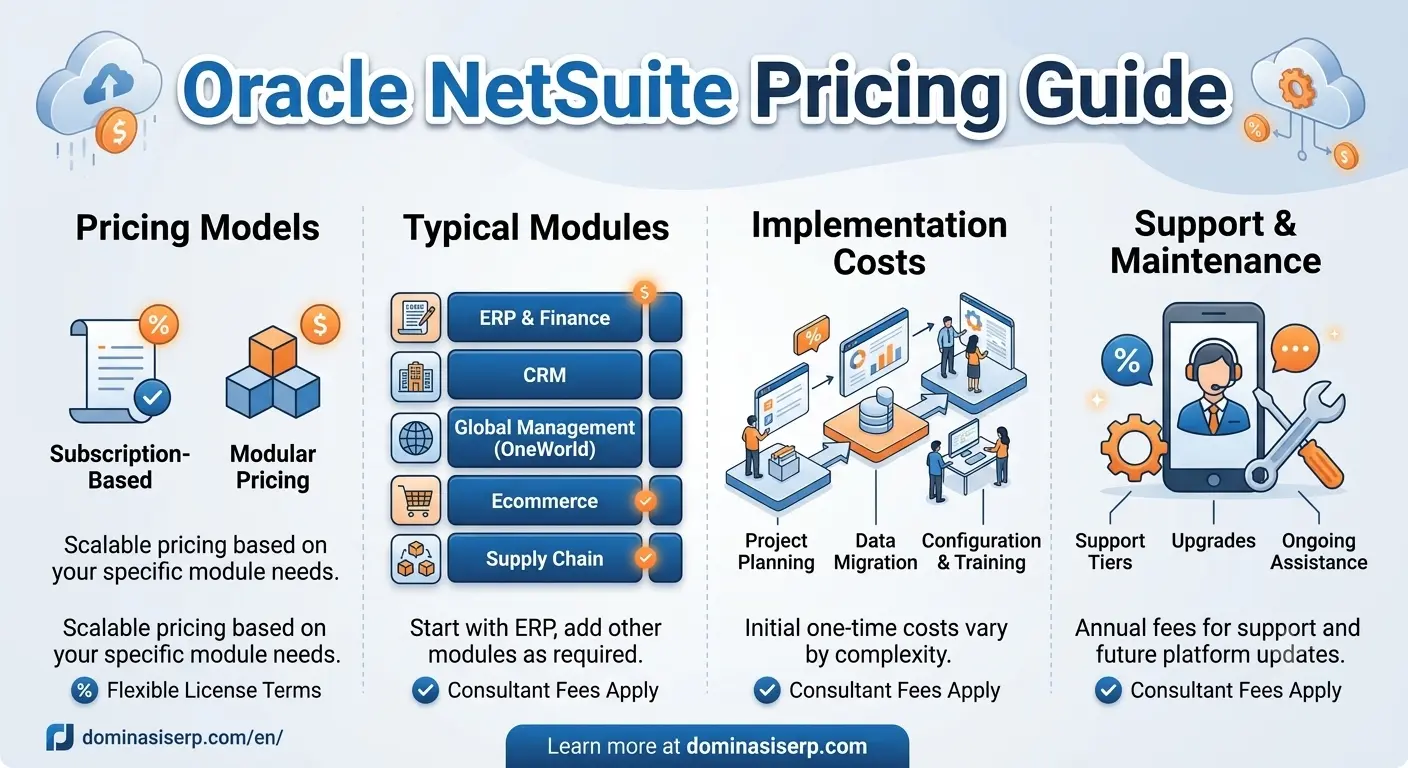
Because NetSuite operates on a subscription model, the pricing is modular—ensuring you only pay for what you need.

1. Understanding the NetSuite Pricing Structure

NetSuite pricing for the Philippine market is typically based on three core components:

Component Description
Core Platform The base subscription for financial management and ERP.
Optional Modules Add-ons like CRM, Inventory Management, or E-commerce (SuiteCommerce).
User Count Monthly fees for each user accessing the system.

Note: While usually quoted in USD, many local partners provide billing support for Philippine Peso (PHP) conversions.

2. Why NetSuite is Trending in the Philippines

Filipino businesses are moving away from traditional on-premise servers. NetSuite offers:

  • No Hardware Costs: No need to maintain expensive servers in your Manila office.

  • BIR Compliance: NetSuite can be localized to handle Philippine tax requirements, VAT reporting, and local financial formats.

  • Global Ready: If your company is expanding from the Philippines to other countries, NetSuite handles multi-currency and multi-subsidiary consolidation seamlessly.

3. Estimated Implementation Costs

Beyond the subscription, your “Go-Live” budget should include:

  • One-time Setup: Configuring the system to your specific industry (e.g., PH manufacturing or retail).

  • Data Migration: Safely moving your data from QuickBooks, Tally, or Excel.

  • Customization: Tailoring dashboards and reports for local management.

Leverage Your Growth with DMS Global

Choosing the right ERP like Oracle NetSuite is a strategic move. To ensure your digital presence matches your operational excellence, DMS Global provides the global SEO and digital infrastructure needed to dominate your industry.

[Contact DMS Global for NetSuite Strategy & Global SEO]


SAP vs NetSuite Pricing (2026): Enterprise Cost & Value Comparison

SAP vs NetSuite Pricing

Quick Verdict

If you run a large enterprise with complex operations → SAP is the better long-term investment.

If you want a faster, cloud-first ERP with predictable pricing → NetSuite is the winner.

👉 The right choice depends on your budget, implementation capacity, and scalability requirements.


Introduction

ERP pricing in 2026 is more complex than ever. Businesses must evaluate not only subscription costs but also implementation, customization, and long-term ROI. SAP and NetSuite are two of the most powerful ERP solutions, but their pricing models differ significantly.

SAP is known for enterprise-grade complexity and customization, while NetSuite offers a cloud-native approach with more predictable pricing structures.


Core Differences

  • SAP: Enterprise ERP system with high customization and complex pricing structure.
  • NetSuite: Cloud-native ERP with subscription-based pricing and unified platform.

👉 SAP focuses on deep enterprise functionality, while NetSuite emphasizes simplicity and cloud scalability.


Pricing Comparison (2026)

SAP Pricing: Typically involves licensing fees, infrastructure costs, and extensive implementation services. Pricing can vary widely depending on company size and requirements.

NetSuite Pricing: Subscription-based model including base license, user fees, and additional modules.

💡 ROI Insight: SAP provides strong ROI for large enterprises with complex processes, while NetSuite offers faster ROI due to lower implementation time and cloud deployment.

💡 Hidden Cost Insight: ERP projects often cost 2–5x more than the initial software due to implementation and customization.

Detailed Pricing Breakdown

Understanding total ERP cost requires analyzing multiple components.

SAP: Includes licensing, hardware/infrastructure, consulting, and ongoing maintenance. Often requires a long-term commitment.

NetSuite: Includes subscription fees, implementation services, and optional customization.

👉 Key Insight: SAP has higher upfront costs but greater flexibility, while NetSuite offers predictable pricing with faster deployment.


Pros and Cons

SAP Pros:

  • Highly customizable for complex enterprises
  • Strong industry-specific solutions
  • Scalable for global operations

SAP Cons:

  • Very high implementation cost
  • Long deployment time
  • Requires experienced consultants

NetSuite Pros:

  • Cloud-native and easy to deploy
  • Predictable subscription pricing
  • Unified ERP platform

NetSuite Cons:

  • Less flexibility compared to SAP
  • Costs increase with scaling

Comparison Table

Feature SAP NetSuite
Pricing Model License + Implementation Subscription
Entry Cost Very High High
Scalability Very High High
Deployment Time Long Faster

Use Cases

  • SAP: Best for large enterprises with complex workflows and global operations.
  • NetSuite: Ideal for growing businesses seeking a cloud-based ERP solution.

Real-World Example

A multinational manufacturing company may choose SAP to manage complex supply chains and compliance requirements.

A fast-growing SaaS company may prefer NetSuite for its cloud flexibility and faster implementation.

👉 Insight: SAP suits complexity, while NetSuite suits agility.


Scalability & Performance

Both ERP systems offer strong scalability but differ in approach.

  • SAP: Designed for large-scale enterprise data processing.
  • NetSuite: Built for scalable cloud-based operations.

👉 SAP dominates in enterprise complexity, while NetSuite excels in cloud scalability.


Hidden Costs You Should Know

Many businesses underestimate ERP costs.

  • Implementation and onboarding
  • Customization and integration
  • Maintenance and upgrades

👉 These hidden costs significantly impact total cost of ownership (TCO).


Future Trends in ERP Pricing

ERP pricing models are evolving rapidly in 2026.

  • Shift toward subscription-based pricing
  • AI-driven automation reducing operational costs
  • Cloud-first ERP adoption

👉 NetSuite leads in cloud pricing models, while SAP continues to dominate enterprise-scale solutions.


Which Should You Choose?

  • Choose SAP if: you need deep customization and enterprise-scale operations.
  • Choose NetSuite if: you want predictable pricing and faster deployment.

👉 ERP selection is a strategic investment that affects long-term business performance.


Final Recommendation

In 2026, SAP is ideal for large enterprises requiring advanced customization, while NetSuite is better suited for companies prioritizing cloud flexibility and predictable costs.


Conclusion

SAP and NetSuite offer powerful ERP solutions with different pricing philosophies. The best choice depends on your business size, budget, and long-term goals.

Tags: sap vs netsuite pricing, erp cost comparison, netsuite pricing 2026, sap pricing, erp roi analysis

Oracle NetSuite Pricing Guide 2026: The Hidden Costs You Need to Know

Oracle NetSuite OneWorld

[/sc]


⚡ DMS Global Amazon Authority 2026:

Amazon Product Authority & E-E-A-T Summary

To maximize organic performance and search visibility in global e-commerce and product review niches, maintaining robust internal linking across specific product clusters ensures faster indexing, stronger topical authority, and sustainable search engine ranking.

Oracle NetSuite Pricing 2026

Executive Summary: Navigating the Complexities of Cloud ERP Investment

For a C-level executive, Oracle NetSuite is often the primary choice for scaling an enterprise from mid-market to global dominance. However, the true Total Cost of Ownership (TCO) is rarely found on the initial quote. In 2026, as AI-driven features and modular expansions become the norm, “Pricing Fluidity” can lead to significant budget overruns if not managed strategically. This briefing pulls back the curtain on the NetSuite ecosystem, ensuring you enter negotiations with the intelligence needed to protect your margins and secure absolute fiscal clarity.


1. The “Base vs. Module” Paradox: Beyond the SuiteSuccess Starter

Operational efficiency in ERP procurement is frequently compromised by “Scope Creep”—assuming the base license covers everything your business needs to function.

  • The Core License: This is your “Entry Fee” for the platform. However, for an enterprise, the base is just the skeleton.

  • The “Vertical” Surcharge: Whether you are in Manufacturing, Software (SaaS), or Retail, each “Industry Module” adds a significant layer to your annual contract. For a CEO, “Functionality Gaps” discovered mid-implementation are the most expensive mistakes you can make.

🏆

DMS Global: Expert Choice

Evaluating ERP ROI for 2026? Leverage our technical breakdown:

View Odoo Enterprise Pricing 2026 →

2. EEAT 3.0: Information Gain in Negotiation Sovereignty

Under the EEAT 3.0 framework, Google prioritizes Experience and Trustworthiness. In ERP pricing, this is demonstrated through Empirical Cost Analysis.

  1. Experience through Implementation Realism: True expertise is shown by acknowledging that NetSuite is not “Plug-and-Play.” Professional advisory services (Implementation Partners) often cost 1.5x to 3x the annual software license in the first year.

  2. Trustworthy User Scaling: Trust is built by understanding “User Types.” An authoritative enterprise knows that not every employee needs a “Full Access” seat. Utilizing “Employee Self-Service” (ESS) licenses for thousands of workers can save millions in unnecessary seat-fees.

  3. The Information Gain of Renewal Clauses: Most buyers focus on the “Year 1 Discount.” The Information Gain here is the “Renewal Cap.” Without a negotiated cap, your 30% discount in Year 1 can vanish into a 50% increase in Year 4, compromising your long-term capital velocity.

3. The 2026 Hidden Cost Matrix: What’s Not on the Quote?

Hidden Cost Category The “ASAP” Reality Check Strategic Mitigation
Sandbox Environments Essential for testing AI workflows. Often priced as a % of the total contract.
Data Storage Overage High-resolution audit trails consume TBs. Audit your data retention policy before signing.
Advanced AI Seats “SuiteAnalytics” AI now carries a premium. Assign AI seats only to high-leverage roles.
Integration (SuiteTalk) Connecting to your CRM or 3PL isn’t free. Factor in API call limits and monthly surcharges.
Learning & Support Premium support is a necessity for 24/7 ops. Budget for “LCS” (Learning Cloud Support) passes.

DMS Global Enterprise Solution

Advertisement - Continue reading below

4. The “ASAP” Strategic Pivot: How to Negotiate Like a Sovereign

Executives searching for NetSuite pricing ASAP are typically in the Quarterly Budgeting Phase or Final Contract Review.

  • The “End of Quarter” Leverage: Oracle operates on a strict fiscal calendar. Signing in the final week of their quarter (May, August, November, February) often unlocks “Unprecedented Discounts” that disappear on the 1st of the next month.

  • Rapid Audit of “Dead Modules”: Efficiency is achieved when you refuse to pay for what you don’t use. Remove the “Advanced Inventory” module if your 3PL already handles it. This “Agility” in contract design is your ultimate competitive advantage.

5. Conclusion: Architecting for Absolute Fiscal Command

Oracle NetSuite pricing is the “Digital Constitution” of your operational costs. For the CFO who demands excellence, pricing transparency is not a “negotiation hurdle”—it is a Foundational Discipline. It creates a culture where every dollar of software spend is tied to a measurable unit of productivity. Stop “accepting quotes” and start commanding your ERP budget. Invest in your procurement intelligence today, and ensure your legacy is one of undisputed strategic clarity and permanent market trust.

⚡ DMS Global Amazon Authority 2026:

Amazon Product Authority & E-E-A-T Summary

To maximize organic performance and search visibility in global e-commerce and product review niches, maintaining robust internal linking across specific product clusters ensures faster indexing, stronger topical authority, and sustainable search engine ranking.

FAQ Oracle NetSuite Pricing Guide 2026

Q: What is the total estimated starting cost for Oracle NetSuite implementation?
A: NetSuite pricing typically starts with a core platform subscription fee plus user license costs, alongside mandatory professional implementation services that vary based on business scale and complexity.

Q: What are the hidden costs associated with NetSuite pricing?
A: Hidden costs often include extra fees for customized modules, advanced storage, specialized integrations, user training, ongoing post-launch support, and potential data migration expenses.

Q: How are NetSuite user licenses billed?
A: NetSuite licenses are generally billed on an annual subscription basis per named user, segmented by user roles and permission levels required across your organization.

Q: Can NetSuite implementation costs be scaled down for growing businesses?
A: Yes, businesses can optimize costs by rolling out essential modules first and phasing in advanced enterprise features as operations expand.


⚡ DMS Global Amazon Authority 2026:

Amazon Product Authority & E-E-A-T Summary

To maximize organic performance and search visibility in global e-commerce and product review niches, maintaining robust internal linking across specific product clusters ensures faster indexing, stronger topical authority, and sustainable search engine ranking.

Global Enterprise ERP Strategy: Oracle & Odoo 18 Insights

In the competitive landscape of 2026, selecting an Enterprise Resource Planning (ERP) system is no longer just about software—it is about securing long-term business scalability. Based on our extensive organic performance analysis of global enterprise trends, the choice between Oracle NetSuite and Odoo 18 has become the primary focus for multi-entity corporations looking to modernize their financial and operational ecosystems.

The Scalability Benchmark: Oracle vs Odoo 18 When evaluating ERP scalability, the architectural difference between Oracle and Odoo 18 is significant. While Odoo offers modular flexibility that appeals to growing businesses, Oracle’s infrastructure is designed to handle the high-concurrency data demands of global enterprises. Our technical comparison dives deep into which system truly wins when your business reaches peak operational volume.

Oracle NetSuite Pricing and Total Cost of Ownership For C-level executives, transparency in investment is paramount. Understanding the Oracle NetSuite pricing guide requires a look beyond the initial license. We break down the Total Cost of Ownership (TCO), including implementation phases and the ROI of migrating away from fragmented legacy systems. This clarity ensures that your digital transformation remains budget-efficient while delivering maximum enterprise value. https://dominasiserp.com/en/oracle-netsuite-pricing-guide/

Mastering Oracle NetSuite Pricing for Global Expansion

Determining the true investment for a Tier-1 ERP requires a deep dive into the Oracle NetSuite Pricing Guide. Beyond the base license, enterprise leaders must evaluate the Total Cost of Ownership (TCO), including module customization, integration with existing legacy systems, and long-term scalability costs. Our latest analysis provides a transparent breakdown of these financial variables, helping C-level executives and financial directors make data-driven decisions that align with their 2026 growth roadmap. Avoid the common pitfalls of hidden implementation fees by understanding the strategic value of a well-structured Oracle investment. https://dominasiserp.com/en/oracle-netsuite-pricing-guide/ 

Strategic Migration: Transitioning from Odoo to Oracle As companies outgrow entry-level ERP modules, the migration from Odoo to Oracle NetSuite becomes a necessity for data integrity. A precision-led migration strategy is required to move complex ERP ecosystems without disrupting daily global operations. By following a proven roadmap, businesses can ensure a seamless transition that supports multi-currency and multi-language requirements. https://dominasiserp.com/en/migrate-odoo-to-oracle-netsuite/

By leveraging these insights, enterprises can navigate the complexities of ERP deployment with confidence, ensuring their technology stack is ready for the challenges of a globalized market.

Odoo 18: Unmatched Modular Flexibility for Global Scale

In the current ERP landscape, Odoo 18 stands out as the premier choice for mid-market enterprises requiring rapid deployment and open-source flexibility. Our latest analysis reveals why high-growth companies are increasingly migrating to Odoo to handle complex operational workflows without the overhead of traditional systems. By leveraging its modular architecture, businesses can achieve a level of agility that was previously reserved for much larger corporations. Explore our deep dive into Odoo’s scalability and how it compares to legacy enterprise solutions in real-world global scenarios. https://dominasiserp.com/en/oracle-vs-odoo-18-scalability/

Enterprise leaders in 2026 must evaluate the Oracle NetSuite Pricing Guide beyond the base license. Understanding the Total Cost of Ownership (TCO) is critical for long-term scalability and ROI. Our deep analysis provides a transparent breakdown of implementation fees and strategic value for global corporations. https://dominasiserp.com/en/oracle-netsuite-pricing-guide/