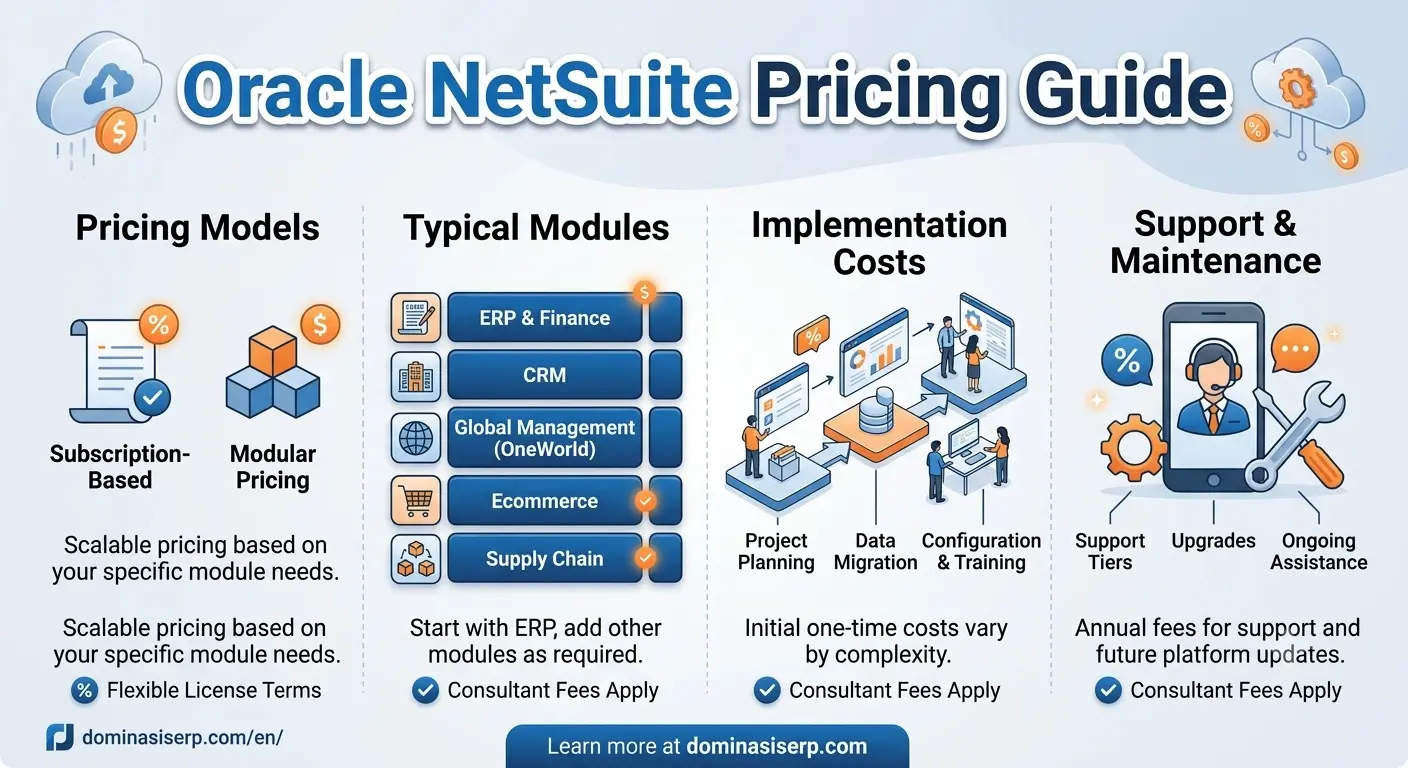
For global enterprises, NetSuite OneWorld Pricing is the most critical factor when scaling operations across multiple borders. This module is designed for businesses managing multiple subsidiaries, diverse currencies, and complex international tax laws.
Why OneWorld is Essential for Global SEO Clients
Managing global finances in a single cloud-based system reduces reporting time and ensures compliance in 100+ countries.
NetSuite OneWorld Pricing Structure
OneWorld is typically added as a module on top of your base NetSuite license. Below is the estimated cost breakdown for 2026:
| Component |
Estimated Monthly Cost |
| OneWorld Module |
$1,900 – $2,500+ |
| Multi-Subsidiary Access |
Included in Module |
| Per User License |
$99 per user/month |
As organizations scale globally, the complexity of managing multiple legal entities, diverse tax regulations, and real-time currency fluctuations becomes a significant bottleneck. NetSuite OneWorld Pricing reflects its position as the world’s leading solution for global business management, offering a unified platform for real-time visibility across every subsidiary.
What Drives NetSuite OneWorld Costs in 2026?
Unlike standard ERP modules, OneWorld is an advanced global infrastructure. The pricing is modular, meaning you pay for the specific global capabilities your enterprise requires. Typically, companies look at a base platform fee plus the OneWorld specialized module.
Estimated 2026 Price Breakdown
| Component |
Estimated Annual Investment |
| OneWorld Base Module |
$24,000 – $30,000 |
| Additional Countries/Subsidiaries |
Tiered based on volume |
| Multi-Currency Engine |
Included in OneWorld |
Core Capabilities of the OneWorld Module
To justify the investment, enterprise leaders focus on four pillars of NetSuite OneWorld:
- Global Financial Consolidation: Close your books faster by automating the roll-up of financial data from regional subsidiaries to the head office.
- Tax Compliance (Indirect Tax): Built-in tax engines for over 100 countries, handling VAT, GST, and Sales Tax automatically.
- Audit & Governance: Maintain a single version of the truth with localized reporting that meets international accounting standards (IFRS, GAAP).
- Currency Management: Automated exchange rate updates for 190+ currencies, eliminating manual conversion errors.
NetSuite OneWorld vs. Competitors
While looking at NetSuite OneWorld Pricing, it is essential to compare it with other enterprise players. For instance, in our Odoo vs SAP analysis, we highlighted that SAP S/4HANA offers similar global depth but often at a higher implementation cost. OneWorld sits in the “Sweet Spot” for mid-market to large enterprises needing rapid global deployment.
How to Optimize Your NetSuite Investment
To get the best ROI, companies should audit their subsidiary structure before purchase. Reducing unnecessary entity licenses can lower your annual recurring cost significantly. Furthermore, integrating your global SEO strategy—as we do here at Dominasi SERP—ensures that your localized ERP presence matches your localized digital footprint.
In the current global economic landscape, scaling a business across borders requires more than just a standard ERP. NetSuite OneWorld Pricing reflects its status as the premier solution for multinational corporations needing to manage multiple subsidiaries, diverse tax jurisdictions, and real-time financial consolidation within a single cloud environment.
The 2026 NetSuite OneWorld Pricing Framework
OneWorld is not sold as a standalone product but as an advanced module that enhances the core NetSuite platform. For enterprise-level planning, you must account for the base license, the OneWorld module itself, and the volume of subsidiaries being managed.
Estimated Annual Investment Breakdown
| Cost Component |
Price Range (Annual) |
Target Segment |
| NetSuite Base License |
$12,000 – $18,000 |
Foundation |
| OneWorld Module |
$24,000 – $32,000 |
Global Core |
| Subsidiary Packs (per 5) |
$10,000 – $15,000 |
Expansion |
Critical Features Driving OneWorld ROI
Investing in OneWorld goes beyond simple accounting. It provides a strategic “Global Command Center” for CFOs and CEOs. Here are the four pillars of the OneWorld module:
1. Real-Time Global Financial Consolidation
OneWorld automates the roll-up of financial data from every regional office. Whether your subsidiary is in Singapore, New York, or London, the data is consolidated at the head office level instantly. This eliminates weeks of manual work in Excel and reduces the risk of reporting errors.
2. Global Indirect Tax Management
One of the biggest hurdles in global expansion is tax compliance. NetSuite OneWorld handles VAT, GST, and Sales Tax across 100+ countries. It automatically calculates taxes based on local laws, ensuring your business stays compliant with regional authorities without hiring local tax experts for every branch.
3. Multi-Currency and Exchange Rate Automation
With support for 190+ currencies, OneWorld provides real-time exchange rate updates. It handles complex currency conversions and revaluations automatically, giving you a clear picture of your global cash flow without manual intervention.
Hidden Costs: Implementation and Support
When calculating NetSuite OneWorld Pricing, do not overlook implementation. A global ERP rollout requires expert configuration to align with your specific subsidiary workflows. Implementation costs typically range from 1x to 2.5x the annual software fee, depending on complexity.
Pro Tip: To maximize ROI, integrate your ERP data with your
global SEO strategy. For example, knowing which subsidiary has the highest margin can dictate where you spend your marketing budget on kueris like
Odoo vs SAP or other enterprise software.
ADVERTISEMENT / SPONSORED SOLUTION
Reliable resources for your business growth
NetSuite OneWorld vs. SAP S/4HANA
Many enterprises compare OneWorld to SAP. While SAP offers immense depth, NetSuite OneWorld is often favored for its “Cloud-First” agility. SAP implementation can take years; OneWorld can often be deployed globally in months. This speed-to-market is a key factor in the overall Total Cost of Ownership (TCO).
Who Should Choose the OneWorld Edition?
- Companies with 2 or more international legal entities.
- Businesses planning a rapid global acquisition strategy.
- Enterprises needing to consolidate multiple regional currencies into one reporting currency.
In the current global economic landscape, scaling a business across borders requires more than just a standard ERP. NetSuite OneWorld Pricing reflects its status as the premier solution for multinational corporations needing to manage multiple subsidiaries, diverse tax jurisdictions, and real-time financial consolidation within a single cloud environment.
The 2026 NetSuite OneWorld Pricing Framework
OneWorld is not sold as a standalone product but as an advanced module that enhances the core NetSuite platform. For enterprise-level planning, you must account for the base license, the OneWorld module itself, and the volume of subsidiaries being managed.
Estimated Annual Investment Breakdown
| Cost Component |
Price Range (Annual) |
Target Segment |
| NetSuite Base License |
$12,000 – $18,000 |
Foundation |
| OneWorld Module |
$24,000 – $32,000 |
Global Core |
| Subsidiary Packs (per 5) |
$10,000 – $15,000 |
Expansion |
Critical Features Driving OneWorld ROI
Investing in OneWorld goes beyond simple accounting. It provides a strategic “Global Command Center” for CFOs and CEOs. Here are the four pillars of the OneWorld module:
1. Real-Time Global Financial Consolidation
OneWorld automates the roll-up of financial data from every regional office. Whether your subsidiary is in Singapore, New York, or London, the data is consolidated at the head office level instantly. This eliminates weeks of manual work in Excel and reduces the risk of reporting errors.
2. Global Indirect Tax Management
One of the biggest hurdles in global expansion is tax compliance. NetSuite OneWorld handles VAT, GST, and Sales Tax across 100+ countries. It automatically calculates taxes based on local laws, ensuring your business stays compliant with regional authorities without hiring local tax experts for every branch.
3. Multi-Currency and Exchange Rate Automation
With support for 190+ currencies, OneWorld provides real-time exchange rate updates. It handles complex currency conversions and revaluations automatically, giving you a clear picture of your global cash flow without manual intervention.
Hidden Costs: Implementation and Support
When calculating NetSuite OneWorld Pricing, do not overlook implementation. A global ERP rollout requires expert configuration to align with your specific subsidiary workflows. Implementation costs typically range from 1x to 2.5x the annual software fee, depending on complexity.
Pro Tip: To maximize ROI, integrate your ERP data with your global SEO strategy. For example, knowing which subsidiary has the highest margin can dictate where you spend your marketing budget on kueris like
Odoo vs SAP or other enterprise software.
NetSuite OneWorld vs. SAP S/4HANA
Many enterprises compare OneWorld to SAP. While SAP offers immense depth, NetSuite OneWorld is often favored for its “Cloud-First” agility. SAP implementation can take years; OneWorld can often be deployed globally in months. This speed-to-market is a key factor in the overall Total Cost of Ownership (TCO).
Who Should Choose the OneWorld Edition?
- Companies with 2 or more international legal entities.
- Businesses planning a rapid global acquisition strategy.
- Enterprises needing to consolidate multiple regional currencies into one reporting currency.
Frequently Asked Questions