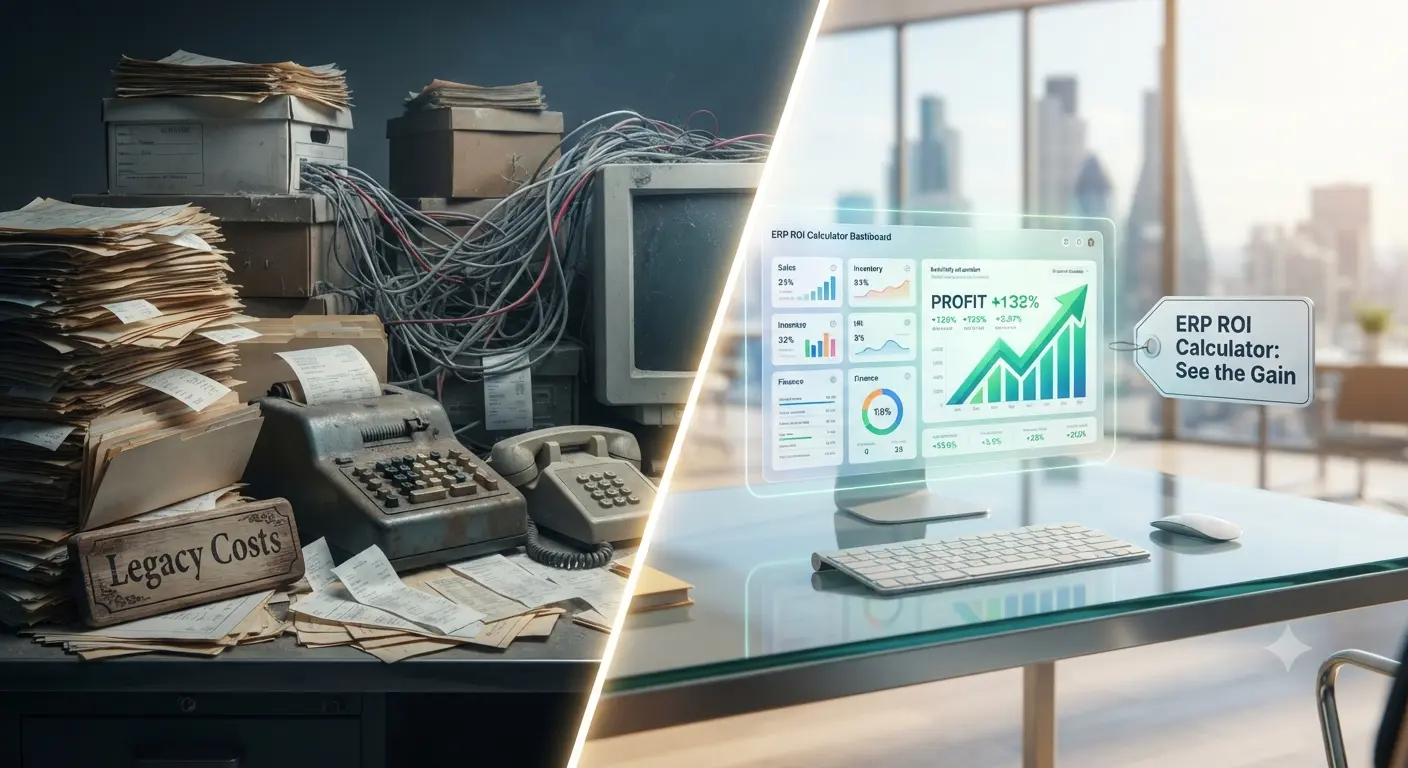
Implementing an ERP system is one of the biggest strategic investments for modern businesses. But in 2026, companies are no longer asking “Do we need ERP?” — they are asking:
“Is this ERP actually worth the investment?”
That is exactly why an ERP ROI Calculator 2026 is critical for decision-making.
📊 What is ERP ROI?
ERP ROI (Return on Investment) is a financial metric that measures how much value an ERP system generates compared to its total cost.
ROI = (Net Benefits – Total Costs) / Total Costs × 100
In simple terms:
- If ROI is positive → ERP creates value
- If ROI is negative → ERP is a financial burden
🧠 Why ERP ROI Matters in 2026
In 2026, ERP systems are no longer just software tools.
They are:
- 💰 Cost optimization engines
- 📦 Supply chain efficiency systems
- 📊 Real-time decision platforms
- 🚀 Growth acceleration tools
Companies that do NOT calculate ROI often:
- overspend on ERP implementation
- choose the wrong vendor
- fail to get measurable business value
💰 Components of ERP ROI Calculation
To calculate ERP ROI properly, you must include both costs and benefits.
1. Total ERP Costs
- Software license (Odoo, SAP, Oracle, NetSuite)
- Implementation & consulting fees
- Customization & integration
- Training & onboarding
- Maintenance & subscription fees
2. ERP Benefits (Value Generated)
- Reduction in manual labor cost
- Faster financial closing process
- Inventory optimization
- Reduced operational errors
- Improved sales conversion efficiency
- Better forecasting and decision-making
🧮 ERP ROI Formula (Standard Model)
ROI = (Total Benefits – Total Costs) / Total Costs × 100
📌 ERP ROI Calculator Example (2026 Scenario)
Let’s assume a mid-sized company:
- Total ERP Cost (5 years): $120,000
- Total Business Benefits: $300,000
Step-by-step:
- Net Benefit = 300,000 – 120,000 = 180,000
- ROI = 180,000 / 120,000 × 100
Final Result: 150% ROI
Every $1 spent on ERP returns $1.5 in value.
⏳ ERP Payback Period (Critical Metric)
ROI alone is not enough. You also need to know how fast ERP pays itself back.
Example:
- ERP cost = $120,000
- Annual savings = $60,000
Payback period = 2 years
This is crucial for CFO-level approval.
⚠️ Common Mistakes in ERP ROI Calculation
- ❌ Overestimating early-stage savings
- ❌ Ignoring hidden costs (downtime, training)
- ❌ No baseline measurement before ERP
- ❌ Using vendor-optimistic ROI claims
- ❌ Not tracking post-implementation metrics
📈 How to Improve ERP ROI in 2026
- Choose scalable ERP (cloud-based preferred)
- Focus on process standardization first
- Avoid heavy customization early
- Train users properly (adoption is key)
- Track KPIs monthly (not yearly)
🧠 Final Insight
ERP ROI is not just a financial calculation—it is a strategic business decision tool.
Companies that measure ROI properly:
- grow faster
- waste less budget
- make smarter IT investments