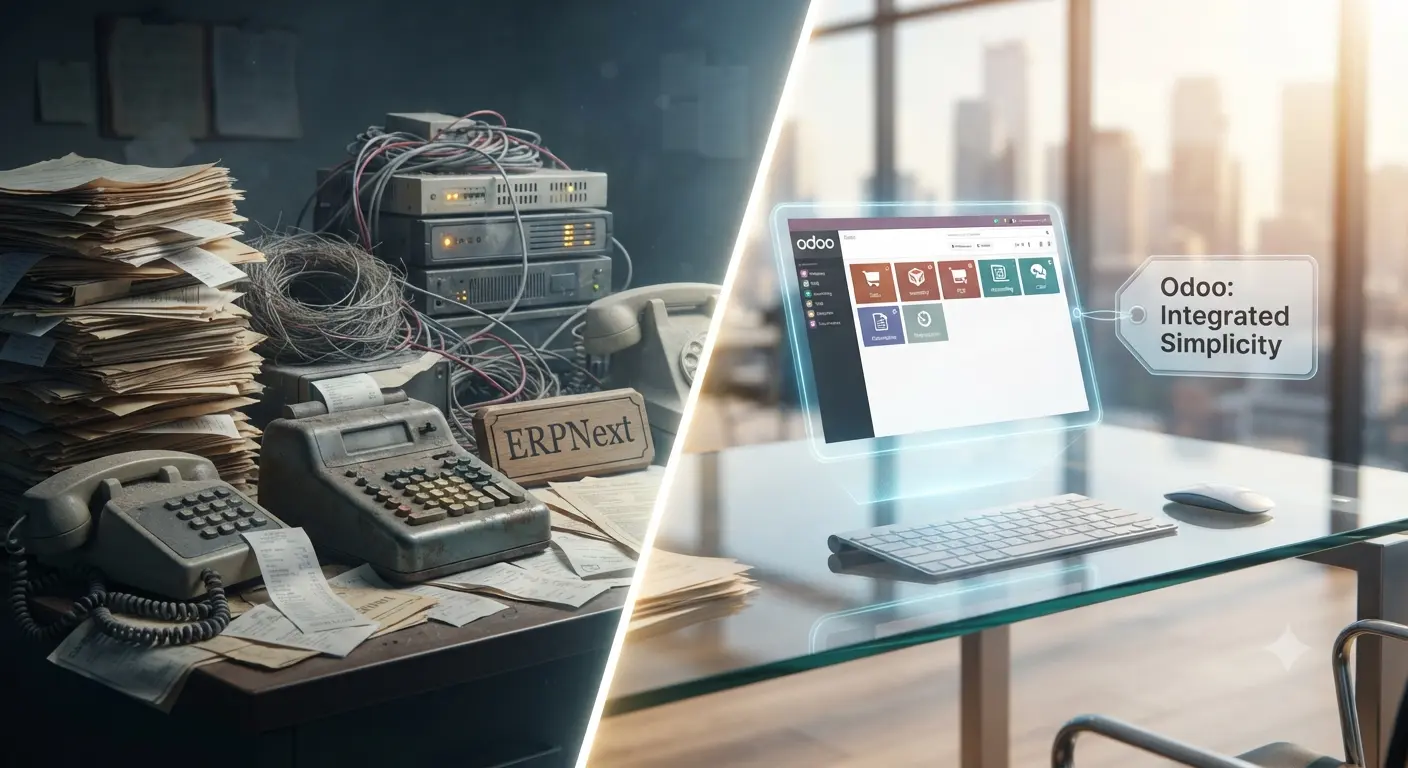
ERPNext vs Odoo
Executive Summary: The Battle for Operational Sovereignty
In 2026, a Small Business (SMB) is no longer defined by its headcount, but by its Digital Velocity. Choosing between ERPNext and Odoo is not merely a software selection; it is a choice of business philosophy. One offers a “Monolithic Powerhouse” of features, while the other champions “Lean Open-Source Agility.” This briefing provides a cold, empirical comparison of both ecosystems, ensuring you invest in a platform that scales your margins without compromising your technical independence.
1. The Monolith vs. The Agile: Understanding the Core Architecture
Operational efficiency begins with how well your “Business Brain” processes data.
-
Odoo: The Modular Ecosystem. Odoo’s strength in 2026 remains its “App-Store” approach. You start with what you need and plug in modules as you grow. However, for a small business, this “Modular Tax” can add up quickly as hidden licensing costs trigger with every new feature.
-
ERPNext: The Unified Core. ERPNext offers a “Batteries-Included” philosophy. Almost every enterprise feature—from Manufacturing (MRP) to HR and CRM—is built into the core for free. For a CEO focused on Capital Efficiency, ERPNext provides a cleaner, unfragmented data flow from Day 1.
2. EEAT 3.0: Trustworthiness in Total Cost of Ownership (TCO)
Under the EEAT 3.0 framework, Google prioritizes Trustworthiness. In ERP selection, this means being honest about the “Hidden Costs.”
-
Experience through Implementation: Odoo often requires specialized (and expensive) consultants to navigate its proprietary “Enterprise” version. ERPNext, being 100% Open Source, allows for a more “Internalized” technical mastery.
-
Trustworthy Scalability: Trust is built when a system doesn’t “Hold your data hostage.” ERPNext’s Frappe framework is more accessible for custom Python development, proving your organizational authoritativeness by maintaining control over your own codebase.
-
The Information Gain of AI Integration: In 2026, both systems have integrated LLMs. However, ERPNext’s “Frappe Drive” and AI assistants offer a more “Sovereign AI” experience—allowing small businesses to use local models rather than being forced into Odoo’s cloud-only AI subscriptions.
3. Feature Showdown: Where the Battle is Won
4. The “ASAP” Strategic Pivot: Which One Should You Deploy Today?
Executives searching for an ERP ASAP are typically dealing with Data Silos, Inventory Chaos, or Accounting Bottlenecks.
-
Choose Odoo if: You have a healthy budget for recurring licenses and you need a “Marketing-First” ERP with a world-class UI that your non-technical staff will love instantly.
-
Choose ERPNext if: You value Data Sovereignty and want to avoid “License Creep.” It is the superior choice for manufacturing and service-based SMBs that want a high-performance system without the “Enterprise Tax.”
5. Conclusion: The Sovereign Verdict
The “Winner” of the 2026 ERP war depends on your definition of Freedom. Odoo wins on “Ease of Entry” but can become a “Golden Cage” of costs. ERPNext wins on “Long-Term Autonomy” and “Cost Control.” For a small business aiming for permanent market leadership, the ability to customize your ERP without a “Paywall” is the ultimate competitive advantage. Stop “subscribing” to your infrastructure and start owning your operational brain.
Related Keywords (Tags)
SMB ERP ROI 2026, ERPNext vs Odoo Comparison, Strategic Business Automation, Open Source Enterprise Governance, Digital Transformation Cost Analysis