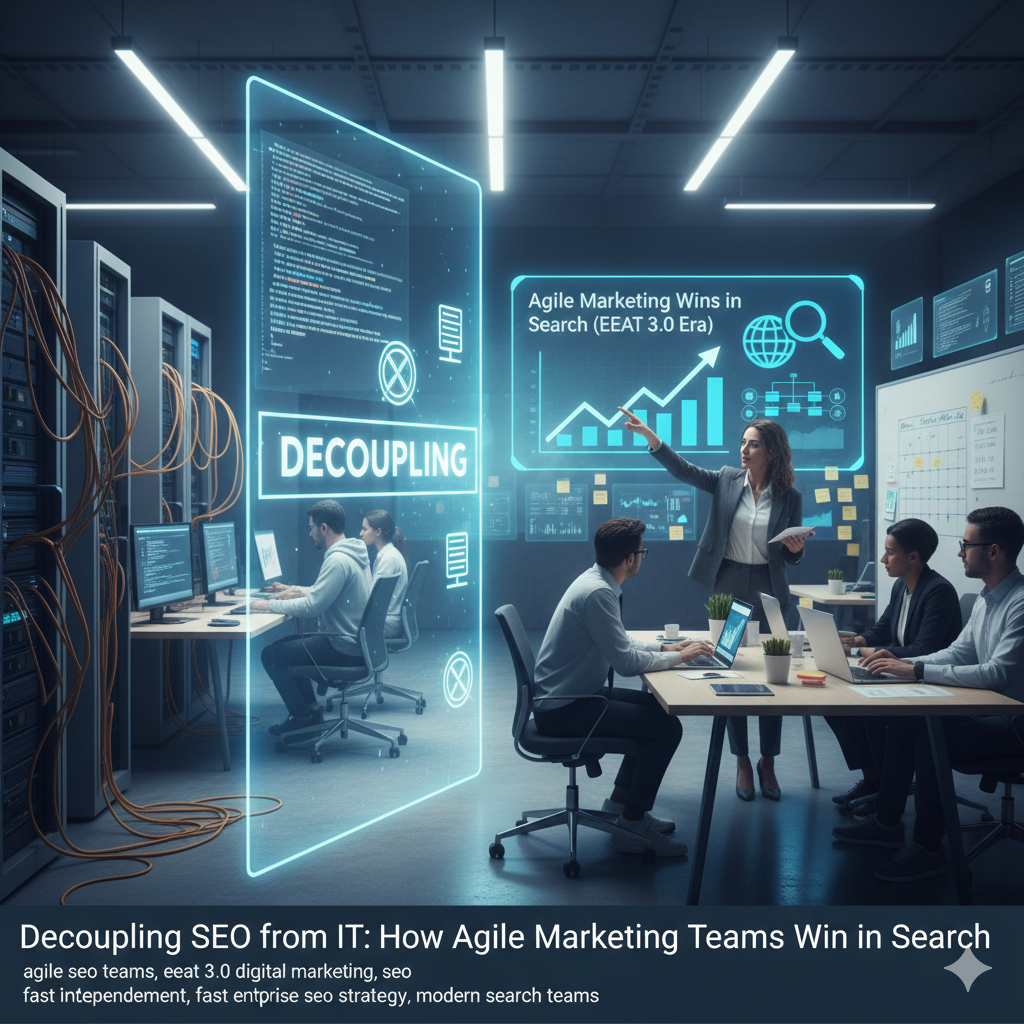
For the modern CEO or CMO, Organic Search (SEO) is often viewed as a paradoxical channel. On one hand, it offers the highest long-term ROI of any marketing activity. On the other, it is frequently cited as the most frustrating to execute. The primary reason? The “IT Bottleneck.”
In many global enterprises, critical SEO updates—ranging from simple metadata changes to complex schema implementations—are buried in a 6-month IT backlog. By the time the technical fix is deployed, the market opportunity has vanished, and competitors have seized the first page of Google.
To win in 2026, forward-thinking enterprises are moving toward SEO Decoupling. This strategic shift involves separating marketing execution from core IT infrastructure, allowing agile marketing teams to move at the speed of search without compromising system integrity.
The C-Suite Urgency: The Opportunity Cost of Waiting
In a high-ticket business environment, “ASAP” is not a preference; it is a competitive necessity. When your VP of Growth identifies a shifting search trend or a new pain point for C-level prospects, the ability to deploy optimized content and technical structures must be instantaneous.
Every day an SEO recommendation sits in a Jira ticket is a day of lost revenue. Decoupling SEO from IT is not just a technical change; it is a Strategic Re-platforming that directly impacts your corporate valuation.
1. The Engineering vs. Marketing Conflict
The fundamental issue is that IT and Marketing have different KPIs.
-
IT Priorities: Stability, security, and minimizing changes to the core codebase.
-
Marketing Priorities: Growth, experimentation, and rapid response to market signals.
When SEO is tethered to the core IT release cycle, Marketing is forced to wait for “Sprint Windows” that are optimized for software engineers, not for search engine crawlers. Decoupling allows IT to focus on the “Engine” of the business while Marketing manages the “Aesthetics and Performance” of the web presence.
2. Edge SEO: The Architecture of Agility
The most effective way to achieve decoupling is through Edge SEO. By leveraging technologies like Cloudflare Workers or Akamai EdgeWorkers, marketing teams can deploy SEO changes at the “Edge” of the network, before the page even reaches the user’s browser.
This allows your team to:
-
Inject Schema Markup: Implement advanced structured data without touching the CMS.
-
Optimize Core Web Vitals: Minify code and optimize images instantly.
-
A/B Test SEO Elements: Test different H1s or Meta-descriptions in real-time to see what drives the highest CTR among wealthy decision-makers.
For a CEO, this means your marketing team can execute 100 experiments in the time it used to take to deploy one.
3. Empowerment Through Headless CMS and API-First Models
Many enterprises are migrating to “Headless” architectures. By separating the front-end (what the user sees) from the back-end (where the data lives), marketing teams can use specialized SEO tools to manage the presentation layer.
This “Best-of-Breed” approach ensures that your SEO strategy is never limited by the technical constraints of a legacy ERP or an outdated CMS. You gain the flexibility to pivot your global strategy across multiple regions and languages simultaneously.
4. Reducing the TCO of Digital Growth
Operating a fragmented, IT-heavy SEO process is incredibly expensive. You are paying high-ticket engineers to do “Marketing chores.”
💡 Strategic ERP Insights for Executives
Beyond understanding TCO, choosing the right platform is critical for long-term ROI. Explore our high-stakes comparisons:
- 🚀 Odoo vs NetSuite: Strategic Comparison for Global Scaling
- 📊 The 2026 ERP Selection Framework: Avoiding Hidden Implementation Costs
*Optimized for high-ticket decision making and ROI analysis.
By decoupling, you lower your Total Cost of Ownership (TCO). Marketing teams use specialized, low-code tools to manage SEO, while IT resources are reallocated to high-value product innovation. This leads to:
-
Faster Time-to-Market: Launching new global landing pages in hours, not months.
-
Higher Data Integrity: Accurate tracking and reporting without constant IT intervention.
-
Scalable Compliance: Instant updates to tax, legal, or VAT disclosures across all international domains.
5. Risk Mitigation for Global Brands
A common fear among CTOs is that giving Marketing control over the site will break things. Decoupling, when done correctly through an “Edge” or “Middleware” layer, actually reduces risk.
The core codebase remains untouched. If a marketing change doesn’t perform as expected, it can be rolled back at the Edge in seconds, without needing a full system redeploy. This safety net allows for the “Fail Fast, Learn Faster” culture that defines the world’s most successful scale-ups.
Conclusion: Lead with Agility, Not Infrastructure
The era of SEO being a “sub-task” of IT is over. For an enterprise to dominate the global SERPs in 2026, SEO must be treated as an independent, agile function.
Decoupling SEO from IT is a hallmark of Digital Maturity. It signals to investors and stakeholders that your organization is built for speed, responsiveness, and relentless growth. As you plan your global strategy, ask yourself: Is your infrastructure supporting your growth, or is it holding your marketing team hostage?
Break the bottleneck. Decouple your SEO, and start winning the race for search dominance.
Related Keywords
SEO Decoupling Strategy, Edge SEO for Enterprise, Agile Marketing Workflows, Marketing vs IT Bottlenecks, Headless CMS SEO Benefits