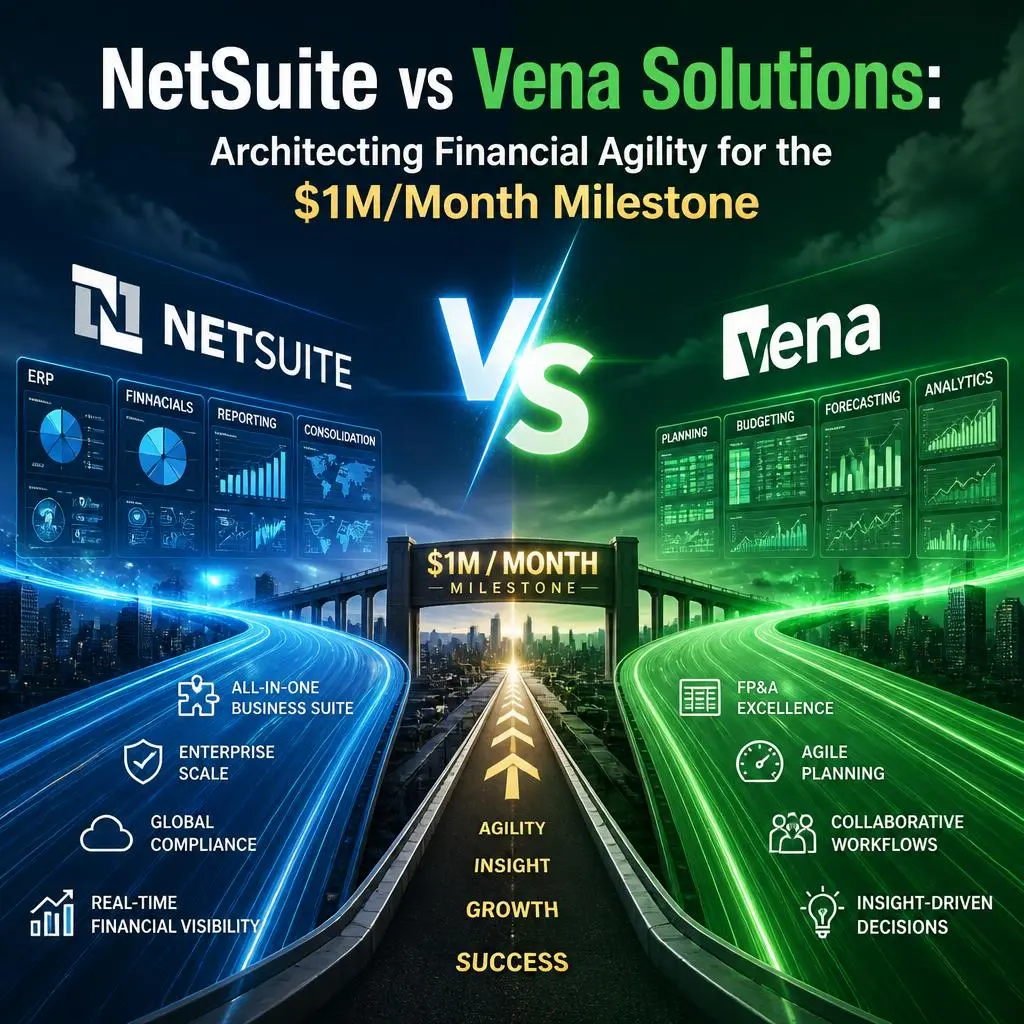
NetSuite vs Vena Solutions
For a global enterprise scaling toward a $1M per month revenue milestone by 2030, the greatest bottleneck isn’t the market—it is the Excel Trap. As a CEO or CFO, you know the symptoms: fragmented spreadsheets, manual version control, and a finance team that spends 80% of their time collecting data instead of analyzing strategy.
If your organization is already anchored in Oracle NetSuite, you face a critical decision to achieve the 2M per month potential: Should you rely on the native NetSuite Planning and Budgeting (NSPB), or should you integrate a dedicated Corporate Performance Management (CPM) platform like Vena Solutions?
This guide provides the urgent, technical, and strategic clarity required to choose the right financial engine for your 2030 vision.
The Strategic Divide: Integrated Suite vs. The Power of Excel
To lead effectively, executives must distinguish between a “Unified Ecosystem” and “Enhanced Familiarity.”
Oracle NetSuite is the world’s leading cloud ERP. Its native planning module (NSPB) is built on the Oracle Hyperion engine, providing a powerful, “within-the-suite” experience. It is designed for those who want to move entirely away from spreadsheets.
Vena Solutions is a “Best-of-Breed” CPM platform that takes a different philosophical approach. It doesn’t try to kill Excel; it embraces it. Vena wraps an enterprise-grade database, workflow engine, and audit trail around the familiar Excel interface.
1. The Learning Curve and User Adoption
In an enterprise environment, a tool is only as good as its adoption rate.
-
Vena Solutions: Vena’s primary advantage is “Zero Friction.” Because it uses the native Excel interface as its front-end, your finance team—who already live in Excel—requires almost no retraining. This leads to immediate Operational Efficiency. You get the power of a centralized database with the flexibility of the world’s most used financial tool.
-
NetSuite Native (NSPB): NSPB uses a more proprietary web-based interface. While highly structured and secure, it requires a shift in mindset. For teams that want to break their “Excel addiction” completely to enforce more rigid corporate standards, the NetSuite ecosystem is the superior choice.
2. Modeling Complexity and Scenario Planning
To hit high-ticket revenue goals, you need to simulate “What-If” scenarios across global markets (US, UK, Southeast Asia) in real-time.
-
Scenario Modeling in Vena: Vena excels in complex, non-linear modeling. If your revenue model involves intricate variables—such as SEO capital expenditure vs. organic performance growth—Vena allows you to build these models in the Excel environment you already trust, but with the data integrity of a cloud database.
-
NetSuite Native: NSPB is exceptionally strong for “Bottom-Up” budgeting. It forces every department to follow a unified structure, which is vital for audit-ready compliance. However, for a CEO who needs to pivot strategy mid-quarter, Vena’s “Scenario Manager” often offers more agility.
3. Data Integration: The “Built for NetSuite” Bridge
For a CIO, the priority is a “Single Source of Truth.” Does adding Vena create a data silo?
-
The Integration: Vena features a robust, bi-directional NetSuite Connector. This is a high-speed data bridge that pulls trial balances, transactional sub-ledgers, and dimensions (Department, Class, Location) directly from NetSuite into Vena.
-
The ROI: NetSuite remains the “Engine of Record” (The Past), while Vena becomes the “Engine of Insight” (The Future). This ensures that the CEO’s strategic dashboard is always backed by audited, real-time figures from the ERP.
4. Scalability: The Road to 2030
Scaling to a $1M/month milestone requires a lean, elite finance team.
-
Vena’s “Growth” Logic: Vena is designed to grow with you. Because it is so flexible, you can start with simple financial budgeting and eventually expand into Workforce Planning, Sales Performance Management, and CapEx Planning—all within the same interface.
-
NetSuite’s “Suite” Logic: NetSuite offers a “one-stop-shop.” If you prefer having your ERP, CRM, and Planning all under one contract with one vendor, staying within the NetSuite ecosystem (NSPB) simplifies your vendor management.
Strategic Verdict: Which Engine Drives Your Vision?
Choose NetSuite Planning & Budgeting (NSPB) if:
-
You want a 100% unified cloud ecosystem with a single vendor.
-
Your goal is to move your team entirely out of Excel to enforce rigid, centralized reporting standards.
-
You prioritize a simplified IT footprint with a tool that is an organic extension of your ERP.
Choose Vena Solutions + NetSuite if:
-
Your finance team is elite in Excel and you want to leverage that expertise without the risk of “broken links” or manual errors.
-
You require a highly flexible modeling environment for rapid “What-If” scenario planning on the road to 2030.
-
You want a best-of-breed CPM that bridges the gap between the familiar front-end and a powerful, audit-ready back-end.
- 🚀 Amazon Review: Bentgo Kids Lunch Box Review
- 📊 Product Comparison: Best Lunch Boxes for Kids
- ⚔️ Gear Selection: Cute Lunch Boxes Aesthetic Choices
- 🏢 Top Insulated: Top Insulated Bento Box
- 💡 Daily Commutes: Insulated Lunch Box Options
- 💰 Brand Alternatives: Lunch Boxes Target Alternatives
- 🔍 Shopping Guide: Bento Boxes Online Deals
- 📈 Food Ideas: Creative Bento Box Lunch Ideas
- ⚙️ Kids Gear: Stylish Lunch Boxes for Girls
Amazon Product Authority & E-E-A-T Summary
To maximize organic performance and search visibility in global e-commerce and product review niches, maintaining robust internal linking across specific product clusters ensures faster indexing, stronger topical authority, and sustainable search engine ranking.
Conclusion for DMS Global
In the pursuit of global digital dominance, your financial tools must be as fast as your SEO strategy. For the C-level visionary, the decision isn’t about which tool is “better”—it’s about which tool your team will actually use to drive the 1M/month milestone. By integrating Vena’s flexibility with NetSuite’s transactional power, you create a foundation that is audit-ready, scalable, and built for the elite tiers of the global market.