How to Deploy Your First Droplet on DigitalOcean for Under $5

How to Deploy Your First Droplet on DigitalOcean for Under $5

In the modern digital era, the ability to launch your own server environment is a fundamental skill for developers, entrepreneurs, and digital enthusiasts. DigitalOcean has revolutionized this process by providing a platform that emphasizes simplicity without sacrificing performance. For many, the journey begins with their most iconic offering: the $5 Droplet.

This article serves as a comprehensive guide to help you deploy your first Linux-based virtual private server (VPS), known as a “Droplet,” for less than $5 per month.

Why Start with a $5 Droplet?

When you are first starting your online project, such as a personal website, a small application, or a learning environment, you do not need enterprise-grade resources. A $5 Droplet provides a balanced starting point:

  • Dedicated Resources: Unlike shared hosting, you have your own dedicated CPU and memory, ensuring consistent performance.

  • Full Root Access: You have complete control over the operating system, allowing you to install custom software, configure firewalls, and manage security settings as you see fit.

  • Cost-Efficiency: It is the most affordable way to host a professional environment that can grow alongside your project.

Step-by-Step Deployment Guide

Deploying a server has never been easier. Follow these steps to get your environment up and running in minutes.

1. Account Creation and Security

After signing up, the first thing you should do is configure security. DigitalOcean highly recommends using SSH (Secure Shell) keys instead of standard passwords. This creates an encrypted connection between your local computer and the server, making it significantly harder for unauthorized users to gain access.

2. Choosing Your Droplet Configuration

Navigate to the “Create” button in your control panel and select “Droplets.” You will be presented with several options:

  • Region: Choose a data center closest to your target audience to minimize latency.

  • Image (OS): Ubuntu is the industry standard for beginners due to its massive community support and extensive documentation.

  • Size: Select the “Basic” plan. Within this plan, you will find the $5/month option (typically featuring 512MB-1GB of RAM depending on current promotions).

3. Networking and Backups

DigitalOcean allows you to enable optional features like automatic backups (for a small additional fee) and VPC (Virtual Private Cloud) networking. While optional, these are best practices for any production application, even for small projects.

4. Finalizing Deployment

Click “Create Droplet.” Within 60 seconds, DigitalOcean will provision your server and provide you with an IP address. You can now log in via your terminal using the SSH key you configured earlier.

Post-Deployment Essentials

Once your Droplet is live, the environment is a blank canvas. To ensure your server is secure and ready for production, follow these initial steps:

  • Update Packages: Run sudo apt update && sudo apt upgrade to ensure all software is at the latest version.

  • Create a User: Never run your services as the “root” user. Create a standard user with sudo privileges.

  • Configure a Firewall: Use ufw (Uncomplicated Firewall) to restrict traffic to only necessary ports (like SSH, HTTP, and HTTPS).

The Path to Growth

Starting with a $5 Droplet is not just about the low cost; it is about learning the architecture of the web. As your project gains traction, DigitalOcean makes it incredibly easy to scale. With a single click, you can resize your Droplet to a larger instance, or integrate it with other services like Managed Databases and Load Balancers.

By taking this first step, you are not just hosting a website; you are building a foundation for your digital future. Whether you are a student, a founder, or a curious developer, the skills you learn in managing your own cloud infrastructure will remain invaluable throughout your professional journey.

related tags: DigitalOcean, Droplet, cloud hosting, VPS for beginners, web server setup
Why DigitalOcean Is the Top Choice for Developers in 2026

DigitalOcean

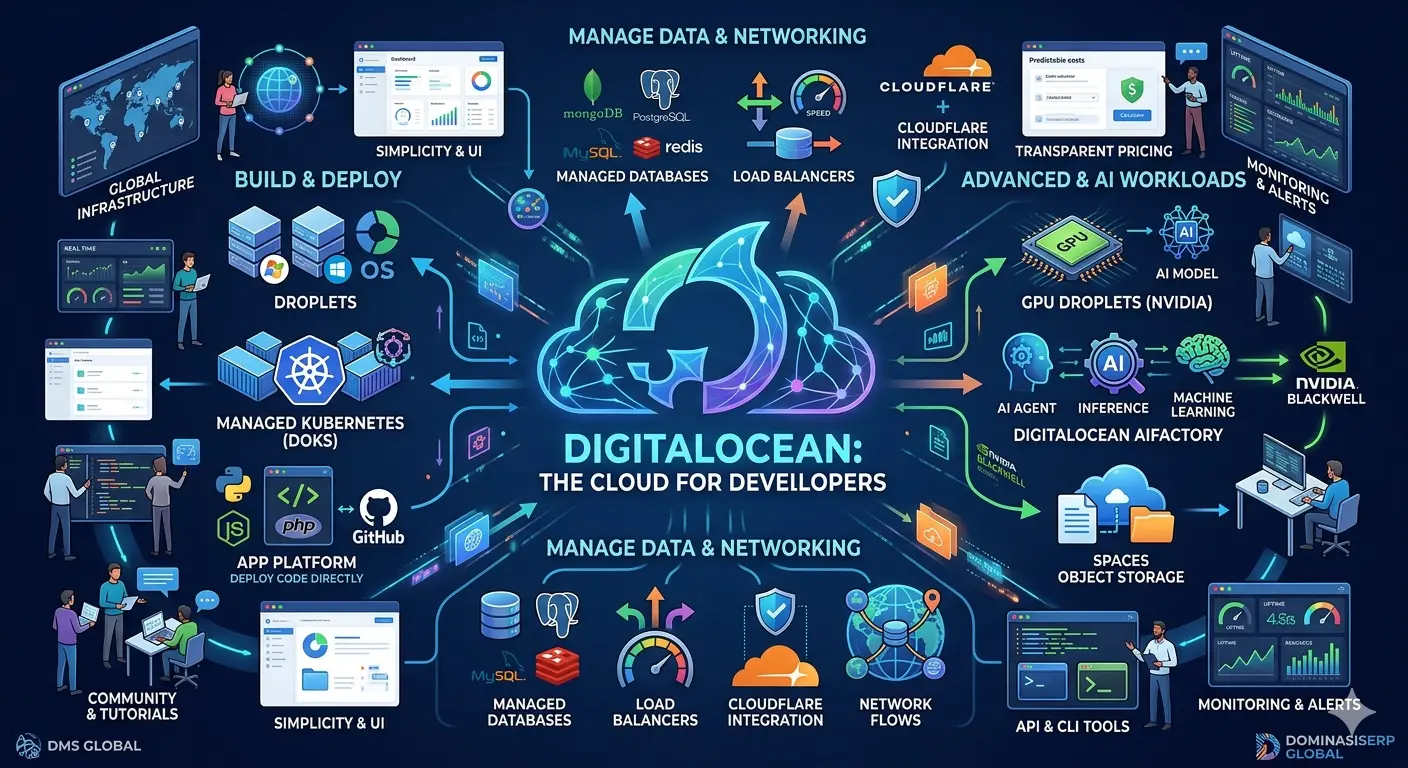
In the fast-paced world of 2026, the cloud infrastructure landscape has matured significantly. While hyperscalers dominate the enterprise market, DigitalOcean continues to stand out as a preferred destination for developers, bootstrapped SaaS founders, and small-to-medium-sized agencies. By focusing on a developer-first philosophy that emphasizes simplicity, transparent pricing, and robust performance, DigitalOcean remains a cornerstone for builders who want to avoid the “enterprise complexity” often found elsewhere.

A Developer-First Ecosystem

DigitalOcean’s core appeal lies in its ability to strip away the unnecessary layers of complexity that often plague cloud management. For developers, this means a clean UI, intuitive API, and fast provisioning that allows them to go from an idea to a live application in minutes.

The platform’s ecosystem has expanded well beyond its iconic $5 “Droplets”. Today, it offers a comprehensive suite of integrated services:

  • Managed Databases: Developers can offload the maintenance of MongoDB, PostgreSQL, MySQL, and Redis to DigitalOcean, which handles backups, updates, and point-in-time recovery.

  • Managed Kubernetes (DOKS): DigitalOcean provides a simplified experience for orchestrating containerized applications, complete with a free control plane, making it accessible even for those who are not Kubernetes experts.

  • App Platform: This fully managed solution allows developers to deploy code directly from GitHub or GitLab, with the underlying infrastructure—runtimes, dependencies, and SSL—handled automatically.

Leading the Charge in AI-Native Infrastructure

As of 2026, AI has become central to business strategy, with over 52% of companies actively implementing AI solutions. DigitalOcean has positioned itself as an “AI-Native Cloud,” providing an “AI Factory” that integrates traditional cloud primitives with high-performance inference capabilities.

DigitalOcean enables developers to build and scale AI applications without the friction of stitching together fragmented services from multiple vendors:

  • GPU Droplets: Access to modern NVIDIA hardware (H100, H200, Blackwell) allows for both vertical and horizontal scaling of AI workloads.

  • Serverless and Dedicated Inference: The platform offers flexible inference options, from batch processing to real-time, high-throughput model hosting.

  • Unified AI Workflow: Through partnerships with NVIDIA and integrations with popular tools like LangGraph and CrewAI, developers can prototype and deploy AI agents seamlessly within the same environment where their data and apps live.

Performance and Cost-Effectiveness

For many developers and small teams, the “hyperscaler tax”—hidden costs around egress, complex networking, and storage—can be prohibitive. DigitalOcean’s pricing is famously transparent, with predictable costs that help companies control spending as they grow.

Performance remains a top priority, with a global data center network and NVMe SSD storage ensuring fast, reliable service. Whether it is reducing latency for mobile frontends or achieving higher inference throughput for AI agents, DigitalOcean’s performance is proven in production environments.

Reliability and Community Support

A major driver of DigitalOcean’s success has always been its “developer-first” identity, supported by extensive documentation and an active community. With a public knowledge base and a program that rewards technical content creation, the platform offers a wealth of resources for troubleshooting and learning.

While some users point out that managing highly available infrastructure on DigitalOcean may require more manual engineering effort compared to enterprise hyperscalers, the platform is perfect for the 89.5% of its customer base that consists of teams with fewer than 50 employees. For these builders, the trade-off is clear: they gain a platform that is feature-rich, easy to manage, and tailored to the needs of modern software development.

DigitalOcean continues to thrive not by trying to be everything to everyone, but by being exactly what the developer community needs: a reliable, high-performance home for the next generation of digital-native companies.