Hostinger Review: Can Cheap Hosting Really Deliver Pro Performance?

Shared Hosting

In the evolving landscape of 2026, finding a hosting provider that balances affordability with “pro” performance is a common challenge for businesses and developers. Hostinger has emerged as a major player by positioning itself in a “middle ground”—offering performance-focused features typically found in premium tiers at competitive price points. But can a budget-friendly host truly support professional-grade projects?

The Performance Foundation: LiteSpeed and NVMe

At the core of Hostinger’s performance-focused offering is the use of LiteSpeed Enterprise web servers. Unlike standard Apache setups often found in basic shared hosting, LiteSpeed is engineered for high concurrency and speed, which significantly boosts page load times.

  • LiteSpeed Web Servers: This technology allows for faster response times and improved handling of high traffic without requiring complex plugin configurations.

  • NVMe SSD Storage: By moving from traditional SSDs to NVMe (Non-Volatile Memory express) storage, Hostinger provides faster read/write speeds, which is essential for database-heavy applications and eCommerce stores.

  • In-house Optimization: Features like ObjectCache and code minification are built directly into the infrastructure to deliver a “blazing-fast” browsing experience right out of the box.

Ease of Use: The hPanel Advantage

One of Hostinger’s most significant differentiators for professionals and beginners alike is its custom control panel, hPanel.

  • Clean Interface: Designed to replace the industry-standard cPanel, hPanel provides a modern, intuitive dashboard where managing domains, emails, databases, and files is simplified.

  • Agency-Ready Features: For professionals managing multiple projects, Hostinger Pro offers an “all-in-one” dashboard to monitor security and performance across up to 300 sites, making it easier to collaborate with clients and team members.

  • One-Click Management: From website cloning to staging environments and 1-click WordPress installs, the infrastructure is built to streamline the development workflow.

Is It Ready for Business-Critical Workloads?

Hostinger’s suitability depends heavily on the scale and nature of your project.

  • For Small to Medium Businesses: Hostinger is highly effective for business sites, affiliate marketing blogs, and growing online stores. Its uptime guarantee (99.9%) and reliable performance track record make it a strong value-for-money choice.

  • For High-Traffic/Complex Projects: While Hostinger offers VPS and Cloud hosting plans for scalability, extremely high-traffic eCommerce stores or sites requiring dedicated server-level resources might eventually require specialized infrastructure like Cloudways or high-end dedicated VPS.

  • Security Standards: Security is a major focus, with free SSL certificates, DDoS protection, malware scanning, and automatic daily backups available on higher-tier plans.

Important Considerations Before Choosing

While Hostinger provides pro-level features, users should be aware of certain trade-offs:

  1. Renewal Pricing: The most common point of friction is the jump between the low promotional entry price and the standard renewal rate. It is essential to calculate your long-term costs across the full duration of your contract.

  2. Support Channels: Support is provided 24/7 via live chat and ticketing, but there is no phone support. For those who prefer immediate voice-based assistance, this may be a limitation.

  3. Plan Tiers: While basic shared plans are excellent for beginners, professional-grade requirements—such as daily backups, staging environments, and advanced security—often necessitate moving up to the “Business” or “Cloud” tiers.

Conclusion

Hostinger effectively proves that “cheap” does not always mean “low-quality.” By leveraging modern technologies like LiteSpeed, NVMe storage, and a polished user interface, it provides a professional-grade environment for the vast majority of web projects. For startups, agencies, and content creators, it offers an excellent balance of scalability and simplicity. However, as with any infrastructure decision, it is vital to match the specific tier of service to your traffic demands and technical requirements to ensure long-term stability.

related tags: Hostinger, web hosting, cloud hosting, WordPress performance, professional web hosting
Why DigitalOcean Is the Top Choice for Developers in 2026

DigitalOcean

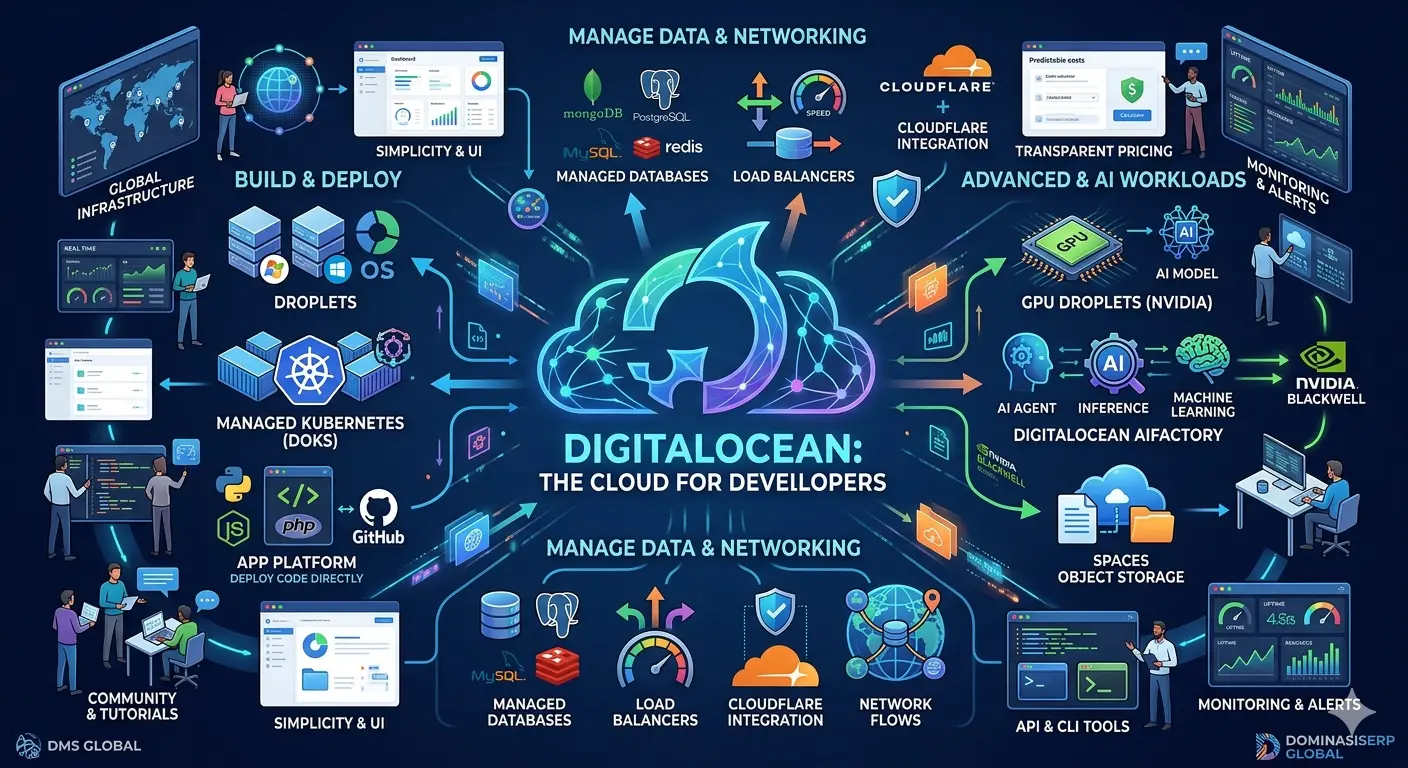
In the fast-paced world of 2026, the cloud infrastructure landscape has matured significantly. While hyperscalers dominate the enterprise market, DigitalOcean continues to stand out as a preferred destination for developers, bootstrapped SaaS founders, and small-to-medium-sized agencies. By focusing on a developer-first philosophy that emphasizes simplicity, transparent pricing, and robust performance, DigitalOcean remains a cornerstone for builders who want to avoid the “enterprise complexity” often found elsewhere.

A Developer-First Ecosystem

DigitalOcean’s core appeal lies in its ability to strip away the unnecessary layers of complexity that often plague cloud management. For developers, this means a clean UI, intuitive API, and fast provisioning that allows them to go from an idea to a live application in minutes.

The platform’s ecosystem has expanded well beyond its iconic $5 “Droplets”. Today, it offers a comprehensive suite of integrated services:

  • Managed Databases: Developers can offload the maintenance of MongoDB, PostgreSQL, MySQL, and Redis to DigitalOcean, which handles backups, updates, and point-in-time recovery.

  • Managed Kubernetes (DOKS): DigitalOcean provides a simplified experience for orchestrating containerized applications, complete with a free control plane, making it accessible even for those who are not Kubernetes experts.

  • App Platform: This fully managed solution allows developers to deploy code directly from GitHub or GitLab, with the underlying infrastructure—runtimes, dependencies, and SSL—handled automatically.

Leading the Charge in AI-Native Infrastructure

As of 2026, AI has become central to business strategy, with over 52% of companies actively implementing AI solutions. DigitalOcean has positioned itself as an “AI-Native Cloud,” providing an “AI Factory” that integrates traditional cloud primitives with high-performance inference capabilities.

DigitalOcean enables developers to build and scale AI applications without the friction of stitching together fragmented services from multiple vendors:

  • GPU Droplets: Access to modern NVIDIA hardware (H100, H200, Blackwell) allows for both vertical and horizontal scaling of AI workloads.

  • Serverless and Dedicated Inference: The platform offers flexible inference options, from batch processing to real-time, high-throughput model hosting.

  • Unified AI Workflow: Through partnerships with NVIDIA and integrations with popular tools like LangGraph and CrewAI, developers can prototype and deploy AI agents seamlessly within the same environment where their data and apps live.

Performance and Cost-Effectiveness

For many developers and small teams, the “hyperscaler tax”—hidden costs around egress, complex networking, and storage—can be prohibitive. DigitalOcean’s pricing is famously transparent, with predictable costs that help companies control spending as they grow.

Performance remains a top priority, with a global data center network and NVMe SSD storage ensuring fast, reliable service. Whether it is reducing latency for mobile frontends or achieving higher inference throughput for AI agents, DigitalOcean’s performance is proven in production environments.

Reliability and Community Support

A major driver of DigitalOcean’s success has always been its “developer-first” identity, supported by extensive documentation and an active community. With a public knowledge base and a program that rewards technical content creation, the platform offers a wealth of resources for troubleshooting and learning.

While some users point out that managing highly available infrastructure on DigitalOcean may require more manual engineering effort compared to enterprise hyperscalers, the platform is perfect for the 89.5% of its customer base that consists of teams with fewer than 50 employees. For these builders, the trade-off is clear: they gain a platform that is feature-rich, easy to manage, and tailored to the needs of modern software development.

DigitalOcean continues to thrive not by trying to be everything to everyone, but by being exactly what the developer community needs: a reliable, high-performance home for the next generation of digital-native companies.

Why Cloud Hosting Is the Future of Scalable Web Architecture

Cloud Hosting

In the digital landscape of 2026, the demand for high-performance, resilient, and globally accessible web applications is at an all-time high. Businesses are moving away from traditional, rigid infrastructure in favor of solutions that can adapt to rapid growth and fluctuating traffic patterns. As DMS Global continues its expansion toward 2030, the strategic decision to adopt cloud hosting has proven to be the cornerstone of scalable web architecture.

The Evolution of Web Infrastructure

Traditionally, website hosting relied on physical hardware—either shared servers or dedicated machines. While these solutions served their purpose for years, they were inherently limited by physical boundaries. If your traffic spiked beyond the server’s capacity, your site would crash; if your hardware failed, your site went offline until repairs were made.

Cloud hosting flips this model. By abstracting the physical hardware through virtualization, cloud hosting allows infrastructure to behave like a fluid, on-demand utility. This shift is not just a trend; it is the fundamental architecture of modern enterprise success.

Key Pillars of Cloud Scalability

1. Elasticity and On-Demand Resource Allocation

The defining feature of cloud hosting is its elasticity. Unlike traditional hosting, where you are tied to the physical limits of a specific server, cloud environments allow you to scale CPU, RAM, and storage resources instantly. If a marketing campaign triggers a massive influx of traffic, cloud systems can automatically scale resources to maintain site speed and availability, ensuring that every user has a premium experience.

2. Built-in Redundancy and High Availability

Cloud architecture is designed with failure in mind. In a cloud cluster, your data and applications are often distributed across multiple physical nodes. If one hardware component fails, the system automatically redirects traffic to healthy nodes within the cluster. For a global business like DMS Global, this redundancy is critical to maintaining the 99.99% uptime required for enterprise-level trust.

3. Global Reach Through Edge Distribution

Cloud hosting seamlessly integrates with content delivery networks (CDNs) and multi-region deployment strategies. By hosting your application across different geographic zones, you reduce latency for users regardless of their location. This localized performance is a key factor in improving search engine rankings and user retention, directly contributing to your brand’s authority.

The Strategic Advantage of Cloud for DMS Global

For DMS Global, the transition to a global /en/ site structure was more than just a linguistic change—it was an infrastructure change. Cloud hosting provides the flexibility to manage these complex international requirements.

  • Agility in Deployment: Cloud platforms offer staging environments and automated pipelines, allowing the DMS Global technical team to deploy updates and localized versions without risking production stability.

  • Operational Efficiency: By offloading hardware management and redundancy planning to cloud providers, teams can focus their expertise on optimization and growth rather than firefighting hardware issues.

  • Cost Efficiency at Scale: Through a pay-as-you-go model, you pay only for the resources you consume, which allows for lean scaling as your traffic grows organically.

E-E-A-T and Infrastructure Authority

Search engines recognize websites that are consistently available, fast, and secure. Cloud hosting enhances these core aspects of E-E-A-T (Experience, Expertise, Authoritativeness, and Trustworthiness) by:

  • Ensuring Consistent Speed: Regardless of user volume, cloud-hosted sites maintain performance, which is a major signal of professional quality.

  • Securing Data: Advanced cloud platforms offer enterprise-grade firewalls and automated security tools that protect user data more effectively than localized solutions.

  • Building Trustworthiness: Uptime is the silent foundation of trust; cloud hosting minimizes downtime, signaling to your audience that your brand is reliable and professional.

Why Cloud Is the Future

The shift toward cloud hosting is not merely about hosting files; it is about building a platform that can survive and thrive in an unpredictable global market. As business architectures become more data-intensive and global, the physical constraints of traditional hosting will become an increasing liability.

For scaling businesses, cloud hosting offers the only architecture capable of sustaining exponential growth through 2030 and beyond. By adopting this flexible, redundant, and high-performance infrastructure today, you are future-proofing your business and ensuring that your website remains a powerful, reliable asset for your global audience.

related tags: cloud hosting, scalable web architecture, enterprise hosting, high availability, web performance

Best Managed Cloud Hosting for Odoo & ERPNext in 2026

Why Cloudways is the Gold Standard for Odoo Hosting in 2026

When implementing an Enterprise Resource Planning (ERP) system like Odoo, the infrastructure is just as critical as the software itself. At DMS Global, we’ve seen countless ERP projects fail not because of poor coding, but due to sluggish, unoptimized servers.

If you are transitioning from SAP to Odoo or starting your ERP journey, choosing the right hosting is your first step toward operational excellence. Here is why we exclusively recommend Cloudways for our enterprise clients.

1. The Performance Gap: Why Shared Hosting Fails Odoo

Odoo is a resource-intensive Python-based application. Running it on standard shared hosting is a recipe for disaster—slow database queries and frequent timeouts. Cloudways provides Dedicated Resources. With their NGINX, Varnish, and Redis stack, we’ve recorded up to 40% faster page loads compared to traditional VPS setups.

2. One-Click Odoo Deployment

Time is money for C-Level executives. Cloudways eliminates the need for complex terminal commands. Through their platform, we can deploy a clean, optimized Odoo instance in under 5 minutes. This allows our consultancy team at DMS to focus on your business logic rather than server maintenance.

3. Vertical Scaling for Growing Enterprises

One of the core reasons DMS Global partners with Cloudways is Scalability. During peak seasons or rapid company expansion, you can scale your server RAM and CPU with a single click—no downtime, no data migration risks. It grows as your business grows.

4. Ironclad Security (E-E-A-T Standards)

Your ERP holds your company’s “crown jewels”—financials, HR data, and client secrets. Cloudways offers:

  • Dedicated Firewalls to block malicious traffic.

  • Automated Backups (Offsite) to ensure data recovery in minutes.

  • Free SSL Certificates for encrypted data transmission.


DMS Global Expert Opinion: The ROI of Managed Hosting

“As a consultant in Kedundung specializing in Enterprise SEO and ERP, I prioritize stability. A $100/month investment in high-quality hosting like Cloudways can save a company thousands of dollars in lost productivity and technical debt.” — Dudung, Founder of DMS Global.


How to Get Started with Cloudways & DMS

To ensure your Odoo environment is perfectly tuned, follow these steps:

  1. Register via DMS Link: Use our [Affiliate Link – Nanti masukkan link Pak Dudung di sini] to get a special starting credit.

  2. Select Your Provider: Choose DigitalOcean or AWS through the Cloudways dashboard.

  3. Choose Odoo: Select the Odoo application from the dropdown menu.

  4. Consult with Us: Once your server is live, contact info@dominasiserp.com for a strategic SEO and ERP audit.

🚀 Cloudways Managed Hosting

Exclusive Offer for DMS Global Readers

"The same infrastructure we use to dominate international search landscapes."