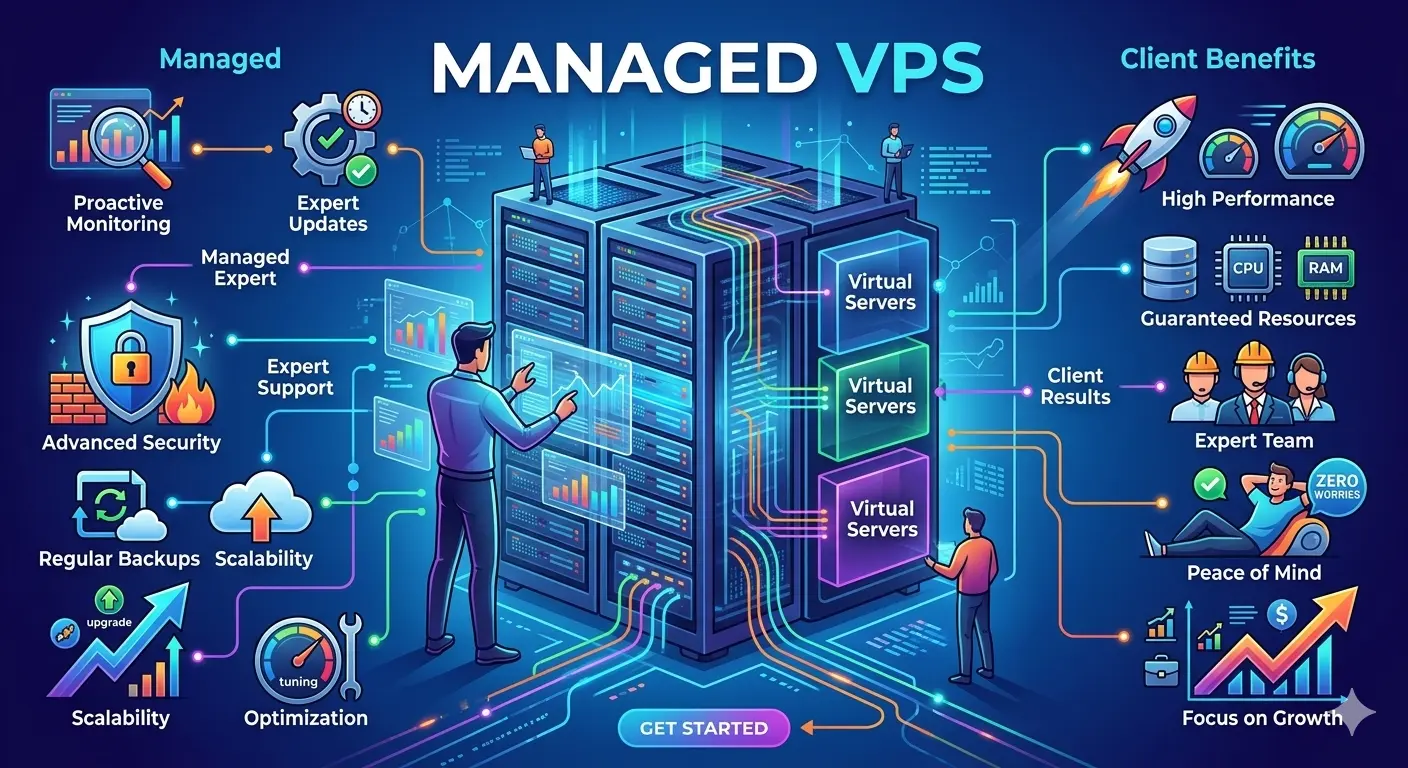
Managed VPS vs Shared: A Detailed Guide for Web Developers

Managed VPS

For web developers, the choice of hosting environment is one of the most critical architectural decisions made at the start of a project. While shared hosting is often the default choice for hobbyists or simple landing pages, web developers frequently find that it imposes significant limitations on their workflow, deployment capabilities, and application performance.

As you move toward professional-grade projects—such as the global expansion of DominasiSerp—the distinction between a Shared Hosting environment and a Managed Virtual Private Server (VPS) becomes stark. This guide explores why Managed VPS is the preferred environment for serious web development and how it empowers developers to build, deploy, and scale with greater efficiency.

The Shared Hosting Constraint: Why Developers Outgrow It

Shared hosting is designed for simplicity, not technical flexibility. In a shared environment, hundreds of websites often reside on the same hardware, relying on the same pool of resources and a unified configuration.

  • Limited Customization: Developers on shared hosting typically lack root access. If your application requires a specific version of PHP, a unique Apache module, or a custom caching engine like Redis, you are at the mercy of the hosting provider’s global settings.

  • Environment Drift: Because shared servers are multi-tenant, you cannot easily replicate your local development environment to the server. This often leads to the infamous “it works on my machine” phenomenon.

  • Performance Bottlenecks: In a shared environment, you are susceptible to the “noisy neighbor” effect. If another site on the same server experiences a traffic spike, your application performance suffers, regardless of your code quality.

Managed VPS: The Developer’s Playground

Managed VPS hosting provides a middle ground: you receive the isolation and control of a virtualized server, paired with the professional support that removes the burden of low-level infrastructure management.

1. Root Access and Environment Control

The most immediate benefit of a VPS is the ability to configure the server environment to match your application requirements. Whether you are deploying a custom Laravel application, a headless CMS, or a complex e-commerce stack, you have the freedom to install the exact software stack required for optimal performance.

2. Predictable Performance

Because your resources (CPU, RAM, and SSD storage) are dedicated to your instance, your application behaves predictably. This allows developers to conduct accurate load testing and performance tuning, ensuring that the site remains responsive under high concurrency—a critical requirement for global, enterprise-level projects.

3. Workflow Integration

Modern Managed VPS platforms, such as those integrated with Cloudways or similar managed layers, allow developers to streamline their workflows. Features like staging environments, Git integration, and one-click backups transform the deployment process, reducing the time from “code push” to “live production”.

Security and Compliance for Web Applications

Security is a primary concern for developers managing professional applications. In a shared environment, you are only as secure as the weakest site on the server. A compromised neighbor could potentially lead to cross-site contamination.

Managed VPS environments offer:

  • Dedicated Firewall Configuration: Developers can implement custom firewall rules, IP blocking, and secure SSH keys to harden their environment.

  • Proactive Patching: While you manage the application, a managed provider typically monitors the OS and core server software for vulnerabilities, applying security patches that keep the environment compliant with modern standards.

The Strategic Decision: Why DMS Global Chooses Managed VPS

For projects like DMS Global, which are focused on global, long-term authority and scalability, infrastructure is an extension of the brand’s quality.

  • Reliability as a Trust Signal: Professional developers understand that downtime destroys user trust. Managed VPS provides the uptime guarantees that are necessary for high-ticket projects targeting C-level managers and enterprise clients.

  • Scaling for Growth: As a project expands, the ability to upgrade resources vertically (adding more RAM/CPU) without migrating to a new server architecture is invaluable. It allows for seamless growth that matches your traffic increases.

Conclusion

For the web developer, the shift from shared hosting to Managed VPS is a move toward professional empowerment. It replaces the limitations of a rigid, shared environment with a flexible, high-performance platform that is built to support complex applications. By investing in Managed VPS, you are not just hosting a website; you are building a robust infrastructure that supports your code, protects your users, and facilitates your long-term growth.

When you choose a Managed VPS provider, you gain a partner that handles the technical maintenance, allowing you to focus on what you do best: building exceptional web experiences.

related tags: managed vps, web development, hosting infrastructure, server architecture, application deployment

How Managed VPS Saves Time on Server Maintenance and Security

Managed VPS

For any business owner, time is the ultimate currency. Every hour spent troubleshooting a server configuration, patching a vulnerability, or manually backing up files is an hour taken away from your core business strategy, content creation, or customer engagement. When your website grows, the “do-it-yourself” approach to infrastructure quickly becomes a liability. This is where Managed Virtual Private Server (VPS) hosting transforms from a technical choice into a strategic business asset.

The Hidden Costs of Unmanaged Infrastructure

Many businesses start with unmanaged hosting because it is inexpensive. However, unmanaged hosting requires you to be your own system administrator. You are responsible for the entire technical stack. For non-technical owners or even busy developers, this involves several time-intensive obligations:

  • Kernel and OS Updates: You must manually track, test, and deploy operating system updates to ensure your server is stable.

  • Security Hardening: From configuring firewalls to monitoring for brute-force attacks, the burden of defense rests entirely on you.

  • Monitoring and Response: If your server crashes at 2 AM, you are the one who needs to wake up and resolve it.

How Managed VPS Reclaims Your Schedule

Managed VPS hosting is defined by the offloading of these tasks to professional teams. By leveraging the expertise of your hosting provider, you effectively buy back your time while simultaneously improving your infrastructure.

1. Automated Security Patching

Security is an ongoing process, not a one-time setup. Managed providers automatically scan for vulnerabilities and apply security patches as soon as they are identified. This protects your business from zero-day exploits without requiring you to monitor security news feeds or manually update your server software.

2. Proactive Monitoring and Incident Resolution

Managed services often include 24/7 proactive monitoring. Unlike unmanaged hosting, where you wait until a visitor reports a problem, managed providers often detect and resolve hardware or resource bottlenecks before they lead to downtime. This level of oversight ensures your business remains online even when you are focused elsewhere.

3. Simplified Database and Software Optimization

Performance is a core component of E-E-A-T. Managed VPS providers handle the heavy lifting of server-side optimization, including database indexing and caching configurations. Because the provider’s team has deep experience in the specific environment they host, they can fine-tune these settings far more efficiently than a generalist user, saving you hours of trial-and-error experimentation.

4. Reliable Backups and Disaster Recovery

Manual backups are prone to human error and are often forgotten until a crisis hits. Managed VPS hosting incorporates automated, redundant backup schedules. If a critical update goes wrong or your site experiences a failure, restoration is handled by the experts, ensuring your business continuity is maintained with minimal downtime.

The Strategic Impact on Business Focus

At DMS Global, we view infrastructure not as a utility, but as a catalyst for growth. When you stop worrying about maintenance, your team can pivot to high-value activities:

  • Focus on Content and User Experience: You gain the freedom to prioritize the features and content that directly serve your customers.

  • Faster Time-to-Market: With a professional managed environment, you can deploy new updates or localized site versions significantly faster because you aren’t bottlenecked by infrastructure configuration.

  • Scaling with Confidence: Managed providers handle the technical aspects of scaling resources, meaning your infrastructure grows in tandem with your business demands without requiring you to master new server management skills.

Ensuring Your Site Meets Global Standards

Search engines like Google prioritize sites that are secure, fast, and consistently available. By shifting the burden of maintenance to a Managed VPS provider, you ensure that your site always meets these high standards. It is a proactive approach to maintaining the trust of both your users and search engines.

Ultimately, Managed VPS is an investment in professional efficiency. It replaces the unpredictable, time-consuming requirements of manual server maintenance with a stable, expert-led partnership. For a scaling business, this is not just about saving time—it is about securing the stability required for long-term growth and digital dominance.

related tags: managed vps, server maintenance, website security, business efficiency, web infrastructure

Comparing Top Managed VPS Providers for High-Speed Performance

Managed VPS

In the digital era, speed is not just a feature—it is a competitive necessity. For businesses scaling their operations, the infrastructure underpinning their website acts as the engine of their success. When you move beyond entry-level hosting, a Managed Virtual Private Server (VPS) becomes the premier choice for achieving high-speed performance, reliability, and security. However, with a crowded market of providers, choosing the right partner requires a deep understanding of what truly drives server performance.

Why Performance Drives Business Success

At DMS Global, we consistently emphasize that site speed is a foundational element of E-E-A-T (Experience, Expertise, Authoritativeness, and Trustworthiness). Users expect pages to load in under two seconds, and search engines prioritize sites that deliver a seamless experience.

A high-performance Managed VPS offers more than just raw speed. It provides:

  • Resource Dedication: Unlike shared hosting, where resources are split, a Managed VPS guarantees your site its own CPU and RAM.

  • Optimized Stacks: Managed providers configure the server environment (e.g., using LiteSpeed or Nginx) to extract maximum efficiency from your application.

  • Proactive Maintenance: A true managed service includes continuous monitoring and performance tuning to prevent bottlenecks before they happen.

Evaluating the Top Contenders

When comparing top Managed VPS providers, focus on these critical performance indicators: hardware speed (NVMe storage), network latency (data center locations), and the quality of the management layer.

1. Cloudways

Cloudways is widely regarded as a top-tier choice for scaling businesses because it acts as a managed layer on top of premium cloud infrastructure like DigitalOcean, Vultr, and Linode.

  • Performance: By giving you access to high-frequency Vultr and DigitalOcean droplets, Cloudways delivers industry-leading read/write speeds.

  • The “Managed” Advantage: They provide automated backups, 24/7 security patching, and an intuitive dashboard that simplifies complex server tasks.

  • Best For: Businesses that want professional-grade cloud infrastructure without the need to be a Linux system administrator.

2. A2 Hosting

A2 Hosting differentiates itself through its “Turbo” servers, which are built specifically for speed.

  • Performance: Their Turbo plans utilize NVMe storage and LiteSpeed server software, which significantly outperforms traditional configurations in handling high-concurrency traffic.

  • The “Managed” Advantage: A2 offers managed support where they handle the technical aspects of your server environment, allowing you to focus on growth.

  • Best For: Sites that are heavy on WordPress or other PHP-based applications that benefit from LiteSpeed optimization.

3. Liquid Web

Liquid Web is often considered the “gold standard” for fully managed enterprise-level VPS hosting.

  • Performance: They invest heavily in high-performance hardware and guarantee extreme reliability.

  • The “Managed” Advantage: Their management is exhaustive. They handle almost everything, including proactive monitoring, software updates, and advanced security configurations.

  • Best For: Established businesses that need a “hands-off” approach and require guaranteed uptime and enterprise-grade support.

4. KnownHost

KnownHost has built a reputation for high-speed VPS hosting that is exceptionally stable and well-supported.

  • Performance: Their infrastructure is designed for speed and reliability, with excellent network connectivity that keeps latency low.

  • The “Managed” Advantage: They are known for having one of the most responsive support teams in the industry, making them a perfect fit for non-technical website owners who need quick, expert help.

  • Best For: Businesses that value high-touch support alongside robust server performance.

How to Choose the Right Provider for Your Growth

Choosing between these providers is not just about the monthly price—it is about the return on investment. Consider these factors when making your decision:

Hardware and Storage

Always prioritize providers that offer NVMe SSD storage. This is significantly faster than traditional SSDs and is a primary driver of database performance and overall page load times.

Global Data Center Presence

Latency is the enemy of speed. If your audience is international, ensure your provider has data centers in or near your target markets. For DMS Global, we always advise clients to choose locations that minimize the physical distance to their primary visitors.

The “Managed” Depth

Understand exactly what “managed” includes. Does it cover security patches? Is there proactive monitoring of your site’s uptime? Does the provider help with database optimization? A “fully managed” plan should allow you to offload all server-side maintenance to their team.

Final Thoughts: Investing in Your Infrastructure

Upgrading to a high-speed Managed VPS is one of the most strategic decisions a scaling business can make. It removes the technical “ceiling” that prevents your site from growing. By choosing a provider that prioritizes performance and provides a deep level of management, you are investing in a foundation that will support your traffic spikes, international expansion, and long-term search engine dominance.

The right provider will function as a silent, powerful partner in your business, ensuring that every visitor to your site receives a fast, secure, and professional experience—every time.

related tags: managed vps, high performance hosting, web hosting comparison, website speed, scaling infrastructure

Top Benefits of Managed VPS for Non-Technical Website Owners

Managed VPS

For many business owners, the technical demands of managing a website can feel like an unnecessary distraction from their core mission. While shared hosting is often touted as the “simple” option, it frequently forces non-technical owners to deal with performance issues, security patches, and complex server configurations once their site starts to grow.

Managed VPS hosting changes this dynamic entirely. It provides the power and reliability of a private server environment without requiring the owner to have a degree in systems administration. For a scaling business, moving to a Managed VPS is the best way to regain focus on growth while ensuring your website remains a professional, high-performance asset.

Bridging the Gap: What “Managed” Really Means

When you opt for a Managed VPS, you are essentially outsourcing your technical infrastructure to a team of experts. In a non-managed environment, you are responsible for everything: the operating system, server security, software updates, and troubleshooting. In a Managed VPS environment, the hosting provider takes ownership of these critical tasks.

For non-technical owners, this transition removes the fear of “breaking” the site during an update. It turns the server into a reliable utility—like electricity or water—that simply works in the background, allowing you to focus on your content, marketing, and customer relationships.

Key Benefits for the Non-Technical Entrepreneur

1. Zero-Stress Security Management

Security is the most significant concern for any website owner. In a shared environment, one security vulnerability can compromise your site through no fault of your own. On a Managed VPS, your server is isolated. Furthermore, your managed provider proactively monitors for threats, installs security patches, and configures firewalls on your behalf. You gain professional-grade security without needing to understand the intricacies of server hardening.

2. Automatic Updates and Backups

Technical owners often dread updates because they know that one wrong move can cause a site to go offline. Managed VPS providers handle these updates systematically. They manage core software updates, plugin compatibility, and operating system patches to ensure your site stays current and stable. Additionally, they implement automated, regular backups, providing a crucial safety net if an error ever occurs.

3. Professional-Grade Performance Tuning

Non-technical owners often struggle to understand why a site is slow. Is it the code? The database? The server configuration? On a Managed VPS, performance optimization is part of the service. Providers use advanced caching, server-level optimizations, and load balancing to ensure your site is fast. They handle the “under-the-hood” adjustments that would otherwise require deep technical knowledge to implement.

4. Expert Support on Demand

The greatest benefit of a Managed VPS is having a partner. When a technical issue arises—whether it is a site-wide error or a question about a configuration—you have access to a support team that knows your server environment intimately. You no longer have to navigate generic, unhelpful support forums or worry about resolving complex technical hurdles on your own.

5. Seamless Scalability

Growth often catches non-technical owners off guard. When traffic spikes, shared servers often crash, leaving you scrambling for solutions. A Managed VPS allows you to scale your resources—RAM, CPU, and storage—seamlessly as your business expands. Your provider can manage these transitions for you, ensuring your infrastructure is always ready for your next phase of success without any technical intervention on your part.

Why This Matters for Your Business Growth

At DMS Global, we believe that your time is your most valuable asset. Every hour spent debugging a server or trying to understand a complex hosting error is an hour not spent serving your customers or refining your product.

The E-E-A-T Approach to Managed Hosting

By using a Managed VPS, you are demonstrating your Experience and Trustworthiness by providing a stable, secure, and fast environment for your users. Search engines prioritize websites that demonstrate these qualities. When your infrastructure is handled by professionals, your site is consistently available and responsive, which builds the long-term authority required to rank well in competitive search results.

Focus on What Matters

As a non-technical owner, your expertise lies in your business, your niche, and your value proposition. Managed VPS hosting is the technical foundation that supports that expertise. It frees you from the complexities of infrastructure management and provides the confidence that your website is being looked after by professionals who understand the nuances of global performance and security.

Making the Shift

If you find yourself spending more time managing your hosting environment than you do managing your business, it is time to consider the Managed VPS transition. It is the most professional move you can make for your brand. By investing in a managed environment, you are choosing to prioritize reliability, speed, and security—the three pillars of a successful online business.

The transition to a Managed VPS is not just an infrastructure change; it is a business strategy. It positions your website to handle the rigors of modern web traffic while giving you the peace of mind to focus entirely on your vision for the future.

related tags: managed vps, non-technical hosting, web hosting for business, website management, business growth infrastructure