The Role of Silver in Green Energy: Why EV Batteries Matter

silver

In the global race to transition away from fossil fuels, much of the conversation has centered on lithium, cobalt, and nickel. However, there is a quieter, more conductive giant playing a mission-critical role in the green energy revolution: silver. As we look toward the technological landscape of 2026, it is becoming increasingly clear that silver is not just a precious metal—it is the backbone of modern electrification. Nowhere is this more evident than in the rapid evolution of Electric Vehicle (EV) batteries and their supporting power infrastructure.

Silver: The Unsung Hero of Conductivity

To understand why silver is indispensable to the green economy, one must first understand its physical properties. Silver possesses the highest electrical and thermal conductivity of all metals. While copper is the standard for general wiring, silver’s superior efficiency makes it the essential component in high-performance applications where heat management and energy loss are critical factors.

In an Electric Vehicle, the goal is to maximize range while minimizing weight and energy waste. This is where silver’s unique properties come into play.

The Intersection of EVs and Battery Technology

While silver is not used in the “bulk” of an EV battery’s cathode in the same way lithium is, it is critical in the battery’s Power Management Systems (PMS) and the conductive additives that improve charge efficiency.

1. Enhancing Charge Efficiency

Modern EV manufacturers are constantly seeking ways to increase “fast-charging” capabilities. Silver-based contact points and conductive pastes allow for higher current throughput during the charging process. By reducing electrical resistance, silver helps minimize the heat generated during rapid charging, which in turn extends the overall lifespan of the battery pack.

2. Contact and Connection Reliability

Electric Vehicles contain miles of circuitry and hundreds of sensitive electronic connections. Silver-coated contacts are used to prevent corrosion and ensure stable connectivity in the harsh, high-vibration environment of an EV. Without these high-performance materials, the complex “brain” of the EV—which manages power delivery from the battery to the drivetrain—would be significantly less efficient.

The Scalability Challenge

As we push toward 2027, the demand for EVs is scaling globally. This brings us to the “silver loading” dilemma. Historically, engineers have tried to reduce the amount of silver used in electronics to save on costs. However, in the realm of high-performance EV batteries and autonomous driving sensors, the trend is reversing.

The industry is finding that as power requirements increase, you simply cannot “engineer away” the need for silver. The efficiency gains provided by silver-based components are too valuable to sacrifice, meaning that every new EV on the road is becoming an increasingly “silver-intensive” product.

The Synergy: EVs and Renewable Energy Grids

The role of silver in green energy is a two-part story. Not only is silver essential for the EV itself, but it is also critical for the power grid that charges it.

  • Solar-to-EV Pipeline: Photovoltaic (PV) solar panels use silver pastes to convert sunlight into electricity. As solar arrays expand to charge growing fleets of electric vehicles, the demand for silver rises at two distinct points: the generation of the power (solar) and the storage/consumption of that power (EVs).

  • Grid Infrastructure: The charging infrastructure—the massive “supercharger” stations being built across highways—relies on high-voltage silver-contact relays to handle the immense power loads required to charge a battery in minutes rather than hours.

Why This Matters for Investors

For the forward-thinking investor, the industrial demand for silver is a structural shift that is independent of short-term market speculation.

  1. Supply Inelasticity: As we discussed in previous analyses, silver supply is largely a by-product of base metal mining. It cannot be “turned on” simply because EV demand increases. This structural mismatch between rising demand and rigid supply creates a fundamental floor for silver prices.

  2. The “Green” Premium: As consumers and governments prioritize “green” technologies, the carbon footprint of manufacturing becomes a key metric. Because silver increases the efficiency of solar panels and EV batteries, it inherently helps manufacturers meet carbon reduction targets, making it a “green-certified” input that is highly resistant to being replaced by less efficient alternatives.

Conclusion: The Element of Electrification

In 2026, the narrative of silver is shifting from a passive monetary asset to an active industrial necessity. Electric Vehicles are the most significant technological pivot of our generation, and silver is the material that makes that pivot efficient, reliable, and scalable.

As the world continues to electrify its transportation sector, silver will likely move from the periphery of the green energy discussion to its very center. For those invested in physical silver, this represents more than just a hedge against inflation; it is a direct stake in the success of the global transition to sustainable energy.
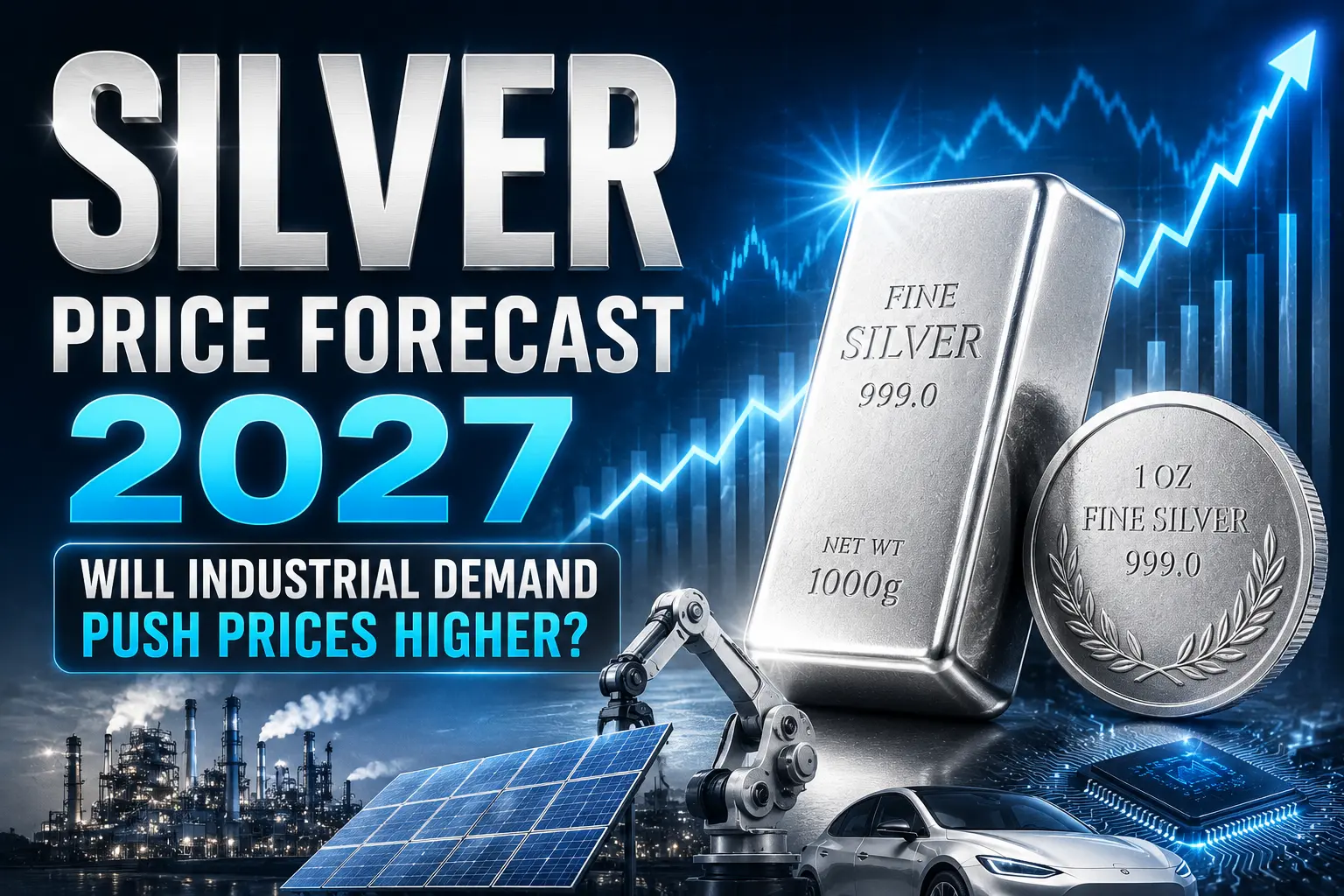
Silver Price Forecast 2027: Will Industrial Demand Push Prices Higher?

As we move toward 2027, the global silver market finds itself at a fascinating crossroads. For years, silver was primarily viewed through the lens of monetary policy—a hedge against inflation or a play on interest rates. However, as we look toward the 2027 horizon, the narrative is shifting fundamentally toward industrial necessity. The question on every investor’s mind is whether the unrelenting appetite for silver in the technology and green energy sectors will finally decouple the metal from its historic tether to gold and drive prices to new structural highs.

The Industrial Engine: The Green Revolution

The primary catalyst for the 2027 silver forecast is the global transition to sustainable energy. Silver is arguably the most critical component in the manufacturing of photovoltaic (PV) solar cells. Unlike many other commodities, there is no viable substitute for silver that offers the same level of electrical conductivity and efficiency in solar applications.

Photovoltaic Projections

By 2027, the global installation of solar capacity is expected to reach record levels. Countries that have committed to net-zero targets are rapidly accelerating their transition, and this infrastructure build-out requires tens of millions of ounces of silver annually. We are witnessing a fundamental shift where industrial demand is no longer just a “side factor”—it is becoming the primary driver of market liquidity.

The AI and Tech Hardware Surge

Beyond the solar sector, the artificial intelligence (AI) and high-performance computing revolution is creating a new tier of demand for silver. Modern data centers, high-end consumer electronics, and complex circuitry in electric vehicles (EVs) all utilize silver in significant quantities.

In 2027, the “AI-driven hardware cycle” will be in full swing. As hardware becomes more efficient and more integrated, the intensity of silver use per device—or “silver loading”—is increasing rather than decreasing. This creates a supply-demand imbalance that traditional mining output is struggling to meet.

The Mining Supply Gap: A Looming Reality

If demand is surging, why aren’t prices already exponentially higher? The answer lies in the structural rigidity of silver supply.

Most silver is produced as a by-product of base metal mining (copper, lead, and zinc). Mining companies do not open a “silver mine” in response to higher silver prices; they open a mine based on the economic viability of the primary base metal.

Current mining data for 2026 suggests that while silver demand is climbing, the global pipeline for new primary silver projects is historically thin. The lead time to bring a new mine to production is often a decade or more. Therefore, in 2027, we are likely to face a structural deficit—a state where the world consumes more silver than it can pull from the ground, regardless of the price.

Price Discovery: The 2027 Scenario

When analyzing the potential price action for 2027, three scenarios emerge:

  1. The Supply Crunch (Bullish): If industrial demand continues to grow at current rates while base metal mining remains steady, the physical market will experience a squeeze. Premiums on physical bullion could reach extreme highs as manufacturers compete with retail investors for the same limited supply of 999 fine silver.

  2. The Substitution Scramble (Neutral): Should silver prices hit levels that make it prohibitive for manufacturers, the industry may accelerate efforts to substitute silver with cheaper alternatives like copper or nickel. While this would temper price growth, it would also likely lead to a drop in solar panel efficiency.

  3. The Monetary Catalyst (Macro-Bullish): If 2027 also sees a shift in central bank policy—specifically, a weakening of the dollar or a return to aggressive stimulus—silver will benefit from both its industrial and monetary “roles” simultaneously. This is the “perfect storm” scenario that many long-term bulls are betting on.

Risk Factors to Consider

No forecast is complete without acknowledging the risks. The 2027 silver outlook depends heavily on:

  • Macroeconomic Stability: A global recession could dampen consumer electronics demand, temporarily slowing silver consumption.

  • Technological Breakthroughs: Any major breakthrough in material science that significantly reduces the amount of silver needed in solar cells would be a bearish factor for the long-term price.

  • Geopolitical Mining Issues: A large portion of global mining occurs in regions that can experience rapid regulatory or political changes, which could disrupt the global supply chain overnight.

The Bottom Line for 2027

The forecast for 2027 suggests that silver is moving from a speculative asset to an industrial essential. While short-term volatility remains a certainty, the structural foundations of the market—rising industrial demand, a rigid mining supply, and the global push for renewable energy—are all pointing toward a tighter, more supply-constrained environment.

Investors should view silver not just as a hedge against inflation, but as a strategic stake in the future of the global technological infrastructure. In 2027, the price of silver will likely reflect this transition, rewarding those who recognize the metal’s role as the “element of the future.”