For decades, the financial hierarchy of precious metals has been clearly defined: Gold is the king of monetary assets, the refuge of central banks and institutional wealth. Silver, by contrast, has long been labeled the “poor man’s gold.” It was the asset for the retail investor who wanted the hedge of precious metals but couldn’t afford the multi-thousand-dollar entry price of a gold bar. However, in 2026, this moniker is not just outdated—it is fundamentally inaccurate. Silver has undergone a metamorphosis, evolving from a secondary monetary play into one of the most critical industrial inputs in the global economy.
The Origin of the Label
The term “poor man’s gold” was never intended as a compliment, but it served a practical function. For generations, gold and silver moved in relative tandem. Because silver is significantly cheaper per ounce, it allowed investors with smaller capital bases to build a “stack” that provided the same inflation-hedging properties as gold, just at a different scale.
Historically, this nickname stuck because silver’s utility was largely limited to jewelry, silverware, and minor photographic applications. When it wasn’t being used as money, it was seen as a decorative, less valuable “cousin” to gold. But the 21st-century economy is built on a different foundation—one that demands the unique physical properties of silver, not just its aesthetic or monetary history.
The Catalyst for Change: Industrial Utility
The primary reason the “poor man’s gold” label is fading is the explosion of industrial demand. Silver possesses a unique set of physical characteristics: it is the most electrically conductive metal, the most thermally conductive, and the most reflective.
As we move through 2026, these properties have made silver indispensable to the “New Economy”:
-
The Green Revolution: Photovoltaic (solar) cells require silver to function at peak efficiency. As nations rush to meet net-zero carbon targets, the demand for solar panels—and thus silver—has become a structural driver of the market.
-
AI and Connectivity: High-performance computing, data centers, and AI infrastructure require vast amounts of conductive circuitry. Silver is the secret ingredient that ensures the reliability and speed of the hardware that powers our digital future.
-
Automotive Electrification: EVs are far more “tech-heavy” than internal combustion vehicles. From sensor arrays to power management systems, the silver loading in a modern EV is significantly higher than in a traditional car.
Silver vs. Gold: Decoupling the Narrative
The old view held that if gold rose, silver must eventually follow. While the two metals still share a correlation, the drivers of their value are decoupling. Gold remains primarily a monetary asset, reacting to interest rates, central bank purchases, and geopolitical tension.
Silver, however, is now a “hybrid” asset. It reacts to monetary signals, but it also reacts to industrial purchasing managers’ indices (PMIs), solar capacity reports, and semiconductor manufacturing data. Smart investors in 2026 have stopped treating silver as “low-cost gold” and started treating it as a “high-growth industrial commodity.” This fundamental shift in perception is why silver is increasingly being held by sophisticated institutional funds, not just retail “stackers.”
Supply Dynamics: The Hidden Strength
Another factor shattering the “poor man’s gold” perception is the supply-side reality. Gold is mined for its value. Silver, however, is rarely mined for its own sake. It is almost always a by-product of mining base metals like copper, lead, and zinc.
This makes the silver supply incredibly rigid. You cannot simply mine more silver to meet the demand of solar panel manufacturers; you must wait for the copper market to justify a new mine. In 2026, this structural supply deficit is creating a “scarcity premium” that gold does not share. Investors are waking up to the fact that silver is not just abundant, low-cost gold—it is a scarce, vital resource that the modern world is struggling to source in sufficient quantities.
Managing the Volatility
Because silver is a hybrid asset, it experiences a different kind of volatility than gold. It carries the “fear premium” of a monetary asset and the “cycle premium” of an industrial commodity.
For the investor, this means:
-
Higher Beta: Silver typically moves with more violence than gold. In a bull market, it often doubles the gains of gold; in a correction, it often falls faster.
-
Market Sensitivity: Silver is much more sensitive to the state of the global economy. A recession that halts construction or industrial manufacturing will have a more direct impact on silver demand than it will on gold.
The Strategy for the Modern Investor
If you are still looking at silver as the “poor man’s gold,” you are missing the opportunity to capture the industrial upside. The strategy for 2026 is to treat silver as a “growth-oriented hedge.”
-
Differentiate your stack: Understand that you are holding an asset that benefits from both the “fear trade” (monetary hedge) and the “industrial trade” (technological growth).
-
Focus on Structural Trends: Pay attention to renewable energy policies and semiconductor manufacturing data. These are your true price indicators.
-
Reject the Stigma: Don’t be ashamed of buying “cheaper” silver. You aren’t buying the “poor” version of gold; you are buying the most technologically essential metal on the planet.
Why Is Gold Crashing? Understanding Recent Market Volatility
Gold has long been considered the ultimate “safe-haven” asset, acting as a hedge against inflation and geopolitical instability. However, when investors observe a sharp decline in gold prices, it often triggers widespread concern. Understanding why gold is crashing requires looking beyond daily price fluctuations and analyzing the complex interplay of macroeconomic drivers.
1. The Real Interest Rate Correlation
The most significant driver of gold’s recent performance is the relationship between gold and real interest rates. When central banks, such as the Federal Reserve, hike interest rates to combat inflation, the yield on non-yielding assets like gold becomes less attractive. Investors often rotate their capital into government bonds or high-yield savings accounts, exerting downward pressure on gold prices.
2. Strengthening of the US Dollar (USD)
Gold is priced in US Dollars globally. An inverse correlation exists between the two: when the USD strengthens against a basket of foreign currencies, gold becomes more expensive for international buyers. This reduced purchasing power often leads to a drop in demand, which can precipitate a “crash” or significant correction in market pricing.
3. Shift in Risk Appetite
Gold thrives in environments of “fear” and extreme market uncertainty. When market sentiment shifts toward “risk-on”—driven by strong corporate earnings, technological breakthroughs, or positive economic data—investors move capital out of defensive assets like gold and into equities or growth sectors. This reallocation is a normal market correction rather than a fundamental failure of the asset itself.
4. The Impact of Digital Assets
We are also seeing a shift in how newer generations perceive “store of value” assets. Increased institutional adoption of digital currencies has introduced competition for gold’s traditional role as a portfolio diversifier.
Strategic Outlook
While short-term volatility can be unsettling, gold remains a cornerstone for long-term wealth preservation. If you are analyzing why gold is crashing, view it through the lens of shifting global liquidity and interest rate policies. For professional investors, these corrections often represent strategic entry points rather than a signal to exit the market.
other interesting topics
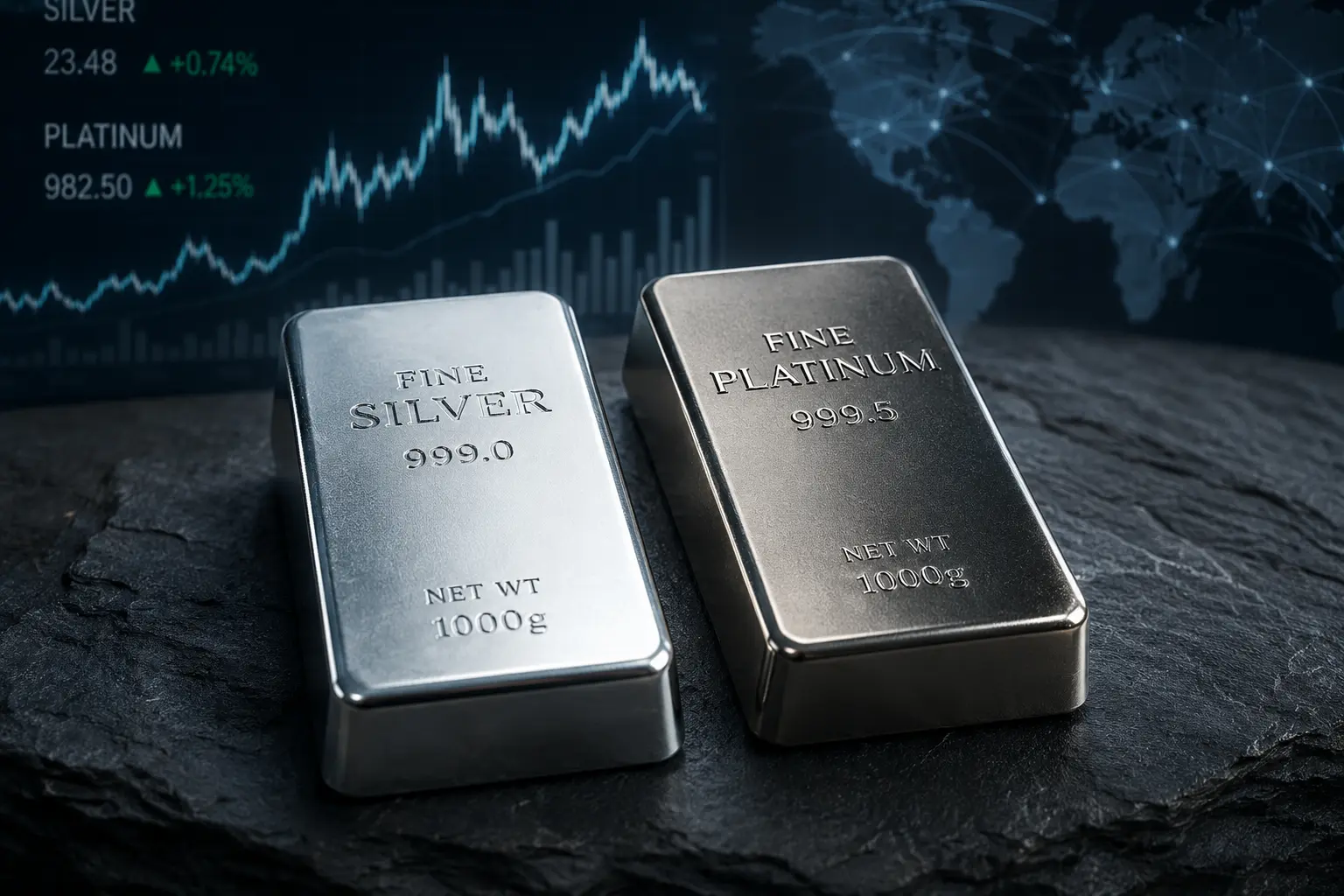
Silver vs Platinum: Strategic Insights for Diversified Portfolios
When analyzing precious metals for portfolio diversification, investors often face a choice between the historic stability of silver and the industrial rarity of platinum. While both are considered “white metals,” their market drivers, industrial applications, and sensitivity to economic shifts differ significantly, impacting how they behave during market volatility.
1. Industrial Demand Drivers
Silver holds a dual identity as both a precious metal and a critical industrial commodity. It is indispensable in the production of solar panels, electronics, and medical devices. Because of this, silver prices are highly sensitive to global manufacturing output. In contrast, platinum is primarily utilized in the automotive industry, specifically for catalytic converters to reduce emissions in internal combustion engines. As the world shifts toward electric vehicles (EVs), platinum’s industrial demand faces structural changes, whereas silver’s role in the green energy transition remains highly robust.
2. Market Liquidity and Volatility
Silver is known for its high volatility and speculative appeal, often outperforming other metals during economic recoveries but suffering steeper declines during contractions. Platinum, being significantly rarer than both silver and gold, often experiences supply-side shocks that create localized price spikes. Because platinum is primarily mined in concentrated regions like South Africa, geopolitical instability in these areas can have an outsized impact on global supply.
3. Investment Strategy
Investors choosing between silver and platinum should consider their risk appetite and investment horizon:
-
Silver serves as an affordable entry point for retail investors and acts as a high-beta asset that amplifies market sentiment.
-
Platinum is often viewed as a “luxury” industrial metal, offering higher scarcity value but requiring a more nuanced understanding of automotive and heavy-industry supply chains.
Conclusion
In the current macroeconomic climate, neither metal is inherently “better”—they serve different strategic functions. If you are tracking silver vs platinum performance, focus on tracking industrial manufacturing indices and automotive production data. These metrics provide the most accurate signal for where the next cycle of price movement will likely originate.
The Bottom Line
The label “poor man’s gold” is a relic of the 20th century. In 2026, silver has graduated. It is a strategic asset with a unique supply-demand profile that gold cannot replicate. By shedding the old, dismissive stereotypes and embracing the reality of silver as an industrial powerhouse, investors can better position themselves to benefit from the profound energy and technological transformations currently unfolding. Silver isn’t a substitute for gold; it is the vital component of the modern machine.