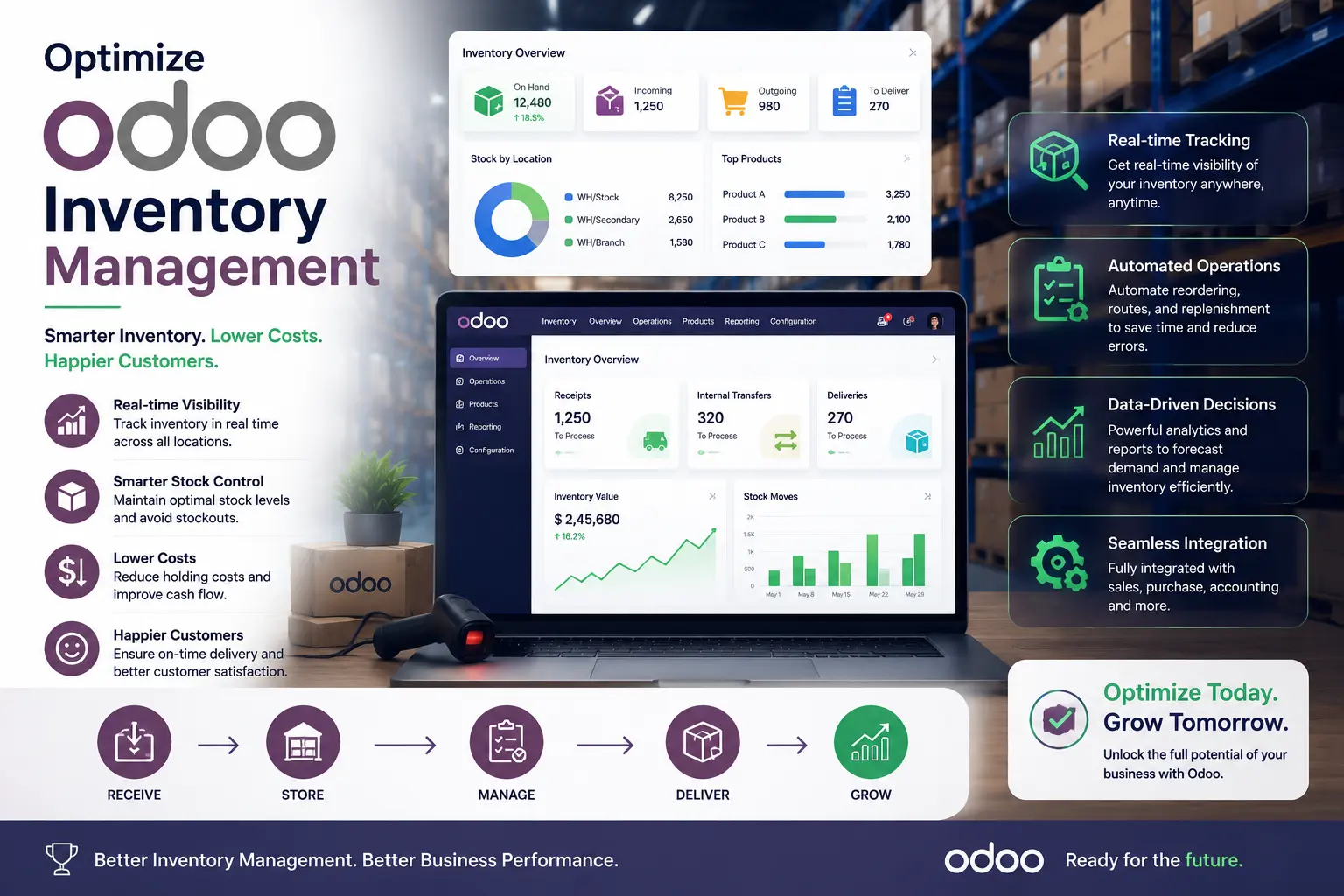
Odoo Inventory Management
Effective inventory management is the lifeblood of any product-based business. For many organizations, bloated stock levels tie up precious capital, while stockouts lead to lost revenue and damaged customer trust. Utilizing Odoo’s advanced inventory management capabilities allows businesses to transition from reactive stock tracking to a proactive, data-driven strategy. By optimizing these workflows, companies can significantly improve their Return on Investment (ROI) and operational efficiency.
1. Leverage Automated Reordering Rules One of the most powerful features in Odoo is the ability to set automated reordering rules. Instead of relying on manual counts or spreadsheets, Odoo monitors your stock levels in real-time. When a product reaches a defined minimum threshold, the system automatically triggers a purchase order or manufacturing request. This automation prevents overstocking—which incurs unnecessary holding costs—and ensures you always have the right amount of inventory to meet demand.
2. Implement Multi-Warehouse Management If your business operates across multiple locations, managing stock consistency can be a logistical nightmare. Odoo allows you to centralize management across multiple warehouses, enabling you to track inventory transfers, view stock availability across different sites, and optimize logistics. By having a unified view of your entire supply chain, you reduce the risk of redundant purchasing and improve the speed of order fulfillment, both of which are critical drivers of improved ROI.
3. Utilize Barcode Integration for Accuracy Human error is the leading cause of inventory discrepancies. Integrating Odoo with barcode scanning hardware transforms your warehouse operations. Every movement of goods—from receipt to internal transfer and final shipment—is recorded instantly. This granular level of accuracy ensures that your digital inventory matches your physical stock, allowing you to trust your system data when making high-stakes procurement decisions.
Reliable resources for your business growth
4. Master Product Traceability and Expiry Management For businesses dealing with perishable goods or high-value items, traceability is not just a feature; it is a necessity. Odoo provides robust lot and serial number tracking. By closely monitoring expiry dates and batches, businesses can implement “First-In, First-Out” (FIFO) or “First-Expired, First-Out” (FEFO) strategies. This minimizes waste and obsolescence, ensuring that inventory value is preserved and directly contributing to a healthier bottom line.
5. Data-Driven Insights with Advanced Reporting Odoo’s integrated reporting tools turn raw inventory data into actionable intelligence. By analyzing inventory turnover ratios, lead times, and demand patterns, leadership teams can identify slow-moving products and pivot their sales strategy accordingly. These insights allow you to prune underperforming stock and invest resources into high-margin items, creating a leaner and more profitable inventory footprint.
The Role of Integration in Warehouse Efficiency A key factor in successful Odoo inventory management is the seamless integration between your inventory and sales modules. By linking real-time stock data directly to your sales orders, you eliminate the risk of overselling and improve order fulfillment speed. This connectivity ensures that your team always has the most accurate information at their fingertips, reducing manual interventions and streamlining your overall supply chain process for maximum profitability.
Finalizing Your Strategy
Ultimately, the goal of refining your Odoo inventory management is to build a resilient supply chain that supports long-term profitability. By consistently monitoring your system data and adapting your workflows to meet changing market demands, you ensure that your business remains agile and competitive. Investing the time to properly configure and optimize your ERP today will pay dividends in operational efficiency, reduced overhead, and a significantly higher ROI for years to come.
Conclusion: Maximizing Value Through Odoo Optimizing inventory management within Odoo is a continuous process of refinement. By automating routine tasks, ensuring data accuracy, and leveraging real-time analytics, businesses can reduce operational costs and significantly improve their ROI. When your inventory system is correctly configured, it ceases to be a cost center and becomes a strategic asset that fuels scalable business growth.