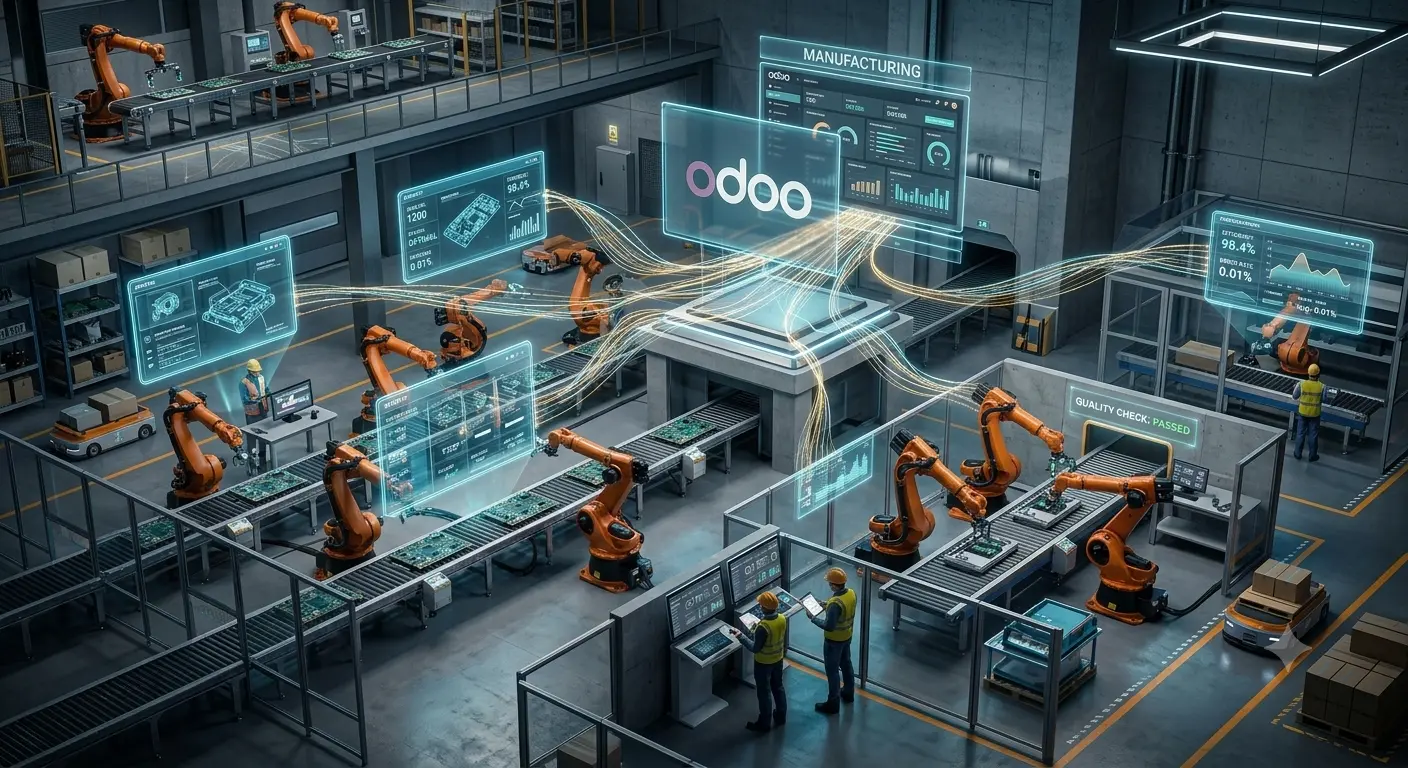
The Role of Odoo in Automating Your Manufacturing Workflow is a critical topic for modern businesses looking to optimize their production efficiency.
In today’s hyper-competitive industrial landscape, manufacturers are constantly challenged to produce more, faster, and with higher quality, all while keeping operational costs in check. The traditional reliance on fragmented systems—where production planning, shop floor management, and supply chain logistics operate as isolated silos—is a significant barrier to scalability. The true potential of a modern factory lies in its ability to synchronize these complex processes seamlessly. Automating your manufacturing workflow with Odoo transforms your production floor from a disconnected set of operations into a unified, data-driven engine, ensuring that every movement, from raw material procurement to final product delivery, is optimized for maximum efficiency.
Achieving Seamless Integration Across the Shop Floor
The core strength of the Odoo manufacturing ecosystem is its native integration. Unlike legacy manufacturing execution systems (MES) that require complex middleware to talk to inventory or accounting software, Odoo is designed as a single, cohesive platform. When a customer confirms a sales order, the system can automatically trigger a Manufacturing Order (MO) if the stock is insufficient. This, in turn, cascades down to the procurement module to generate requests for quotes (RFQs) for the necessary raw materials. By centralizing this flow, Odoo eliminates the “information lag” that typically leads to production delays, stockouts, or the costly over-ordering of raw components. This level of synchronization is the backbone of a truly automated workflow.
Precision Through Real-Time Shop Floor Control
Automation is not just about moving tasks from paper to digital; it is about providing workers with the right data at the right time. Odoo’s Work Center Control Panel provides a digital interface for operators on the shop floor. Instead of deciphering physical blueprints or manual instructions, operators receive real-time updates regarding specific work steps, quality checklists, and required material consumption. Because the system tracks production time and output in real-time, management gains unprecedented visibility into Overall Equipment Effectiveness (OEE). Identifying bottlenecks becomes a proactive process rather than a retrospective investigation. You can pinpoint exactly which work center is lagging, allowing for immediate reallocation of resources to maintain your production schedule.
Advanced Planning and Smart Scheduling
One of the most complex aspects of manufacturing is the balancing act of scheduling. You must account for machine availability, labor shifts, and material lead times simultaneously. Odoo’s Master Production Schedule (MPS) leverages advanced algorithms to forecast demand and automate the planning of production cycles. By inputting your production constraints and delivery deadlines, the system generates a realistic schedule that minimizes idle time and optimizes throughput. This intelligent automation removes the guesswork from capacity planning, enabling managers to commit to delivery dates with high confidence while maintaining lean inventory levels.
Data-Driven Quality Assurance and Compliance
Consistency is the hallmark of a successful manufacturer. Odoo automates quality management by integrating checks directly into the production process. You can configure automatic quality alerts at specific stages of production—such as during sub-assembly or before final packaging. If a product fails a test, the system can immediately halt the workflow and notify the relevant team, preventing defective products from reaching the customer. Furthermore, Odoo maintains a complete audit trail for every batch produced. This capability is vital for industries requiring strict compliance, such as pharmaceuticals, food and beverage, or automotive, as it allows for rapid traceability and accountability throughout the production lifecycle.
Scaling Your Factory with Modularity
The beauty of adopting Odoo for your manufacturing workflow is its scalability. You do not need to implement a massive, rigid ERP overnight. You can start by automating your Bill of Materials (BoM) and routing, then gradually integrate advanced features like PLM (Product Lifecycle Management), maintenance management (preventive and corrective), and complex analytical accounting. This modularity allows your factory to grow at its own pace, minimizing implementation risk and ensuring that your team has time to adapt to new digital workflows. By choosing to automate with Odoo, you are not just purchasing software; you are investing in a future-proof foundation that will support your manufacturing excellence for years to come.