In 2026, investing in an Enterprise Resource Planning (ERP) system is one of the most significant strategic decisions an organization can make. However, the “sticker price” of software licensing is often only a fraction of the total investment. For business leaders and CFOs, understanding the full spectrum of ERP implementation costs—including consulting, data migration, and training—is essential to preventing budget overruns and ensuring a successful digital transformation.
1. The Anatomy of ERP Implementation Costs
ERP costs are generally categorized into upfront investments and recurring expenses. As a rule of thumb, implementation services (consulting, configuration, and migration) typically cost between 1x and 3x the first-year software subscription fee.
Software Licensing & Subscriptions: This forms the foundation of your investment, usually accounting for 25%–40% of first-year costs.Cloud-based SaaS models have largely replaced perpetual licenses, typically ranging from $40 to $200 per user monthly.
Implementation & Consulting Services: Consistently the largest expense, these services cover business process reengineering, system configuration, and project management. Professional consultant rates in 2026 range from $150 to $350 per hour.
Data Migration: Moving historical data from legacy systems is often underestimated. Costs range from $5,000 to $75,000+ depending on the volume, quality, and complexity of the data.
Training & Change Management: Effective adoption is the difference between ROI and project failure.Organizations should budget 10%–20% of the total budget for role-based training programs.
2. Key Factors Driving Cost Variation
The total cost of an ERP implementation can vary from $25,000 for a small business to over $5 million for a global enterprise. The primary variables include:
Company Size & Complexity: Larger enterprises with multiple sites and high transactional volumes face higher risks and longer deployment timelines, which directly increases consulting hours.
Customization Depth: Extensive custom development can add hundreds of consultant hours.Manufacturers and complex industries often face higher costs due to the need for deep integration with legacy workflows.
Integration Requirements: Every third-party integration (e.g., e-commerce platforms, payment gateways) typically adds $3,000 to $15,000 to the implementation bill.
3. Managing “Hidden” Costs
Many ERP projects exceed their budget due to factors that are often ignored during initial planning:
Scope Creep: Adding features mid-project is a primary driver of cost overruns.
Data Cleansing: Poor data quality in legacy systems requires significant time for cleaning and validation before migration.
Ongoing Maintenance: Post-live support, including monitoring, updates, and system optimization, usually adds 15%–22% of the annual license cost.
4. Strategic Planning for ROI
To maximize your investment, adopt a disciplined approach:
Define Clear Objectives: Map processes to software capabilities rather than customizing the software to fit outdated legacy workflows.
Budget for Contingency: Always allocate a 10%–20% contingency fund to cover unforeseen technical challenges.
Prioritize Change Management: Invest in the human side of the transformation to ensure your team actually uses the system, which is the ultimate driver of ROI.
Conclusion
ERP implementation costs in 2026 are complex, but they are predictable with thorough planning. By accounting for the full scope—from data migration to intensive staff training—enterprises can move past the sticker shock and focus on the long-term efficiency gains. When treated as a strategic investment rather than a mere IT expense, a well-managed ERP deployment provides the foundation for sustainable growth, market agility, and long-term financial health.
Mohon maaf, Dudung. Saya akan melengkapi artikel SOX Compliance ini agar panjangnya mencapai target 1000 kata dengan menambahkan analisis yang lebih mendalam mengenai tantangan operasional dan strategi mitigasi risiko di era cloud.
Sox Compliance For Financial Reporting In Cloud ERP: A Comprehensive Guide (2026)
In the globalized digital economy of 2026, ensuring the integrity of financial data is not just a regulatory obligation—it is a cornerstone of corporate trust. For enterprises utilizing Cloud ERP platforms to manage their financial reporting, Sarbanes-Oxley (SOX) compliance represents a critical framework for mitigating risk, preventing fraud, and ensuring the accuracy of financial disclosures. This article examines the strategic necessity of maintaining SOX compliance within a cloud-native ERP environment.
1. The Intersection of Cloud ERP and SOX
Transitioning to a Cloud ERP environment offers significant operational advantages, but it also alters the landscape of internal controls. Under SOX, management must certify that internal controls over financial reporting (ICFR) are effective. In a cloud context, the “Shared Responsibility Model” becomes paramount: while the ERP vendor manages the underlying infrastructure security, the organization remains responsible for application-level access controls and data integrity.
The shift to the cloud often means that traditional, perimeter-based security measures are no longer sufficient. Companies must now manage compliance in a decentralized environment where data access happens across diverse devices, locations, and integrated third-party applications.
2. Key Pillars of SOX Compliance in Cloud Environments
To maintain a robust compliance posture, enterprises must focus on these critical areas:
Access Control and Segregation of Duties (SoD): The most common audit finding in ERP environments is excessive user permissions. Implementing strict SoD—ensuring that the person who initiates a financial transaction cannot be the one who approves it—is foundational to SOX compliance.
Audit Trails and Logging: Cloud ERPs provide the advantage of immutable audit logs. SOX requires that every financial entry, modification, or deletion be tracked to a specific user and timestamp. These logs must be regularly reviewed to detect unauthorized or anomalous activities.
Change Management: Any modification to the ERP configuration, especially those impacting financial workflows, must undergo a documented testing and approval process. This ensures that system changes do not inadvertently compromise existing financial controls.
3. The Role of Identity and Access Management (IAM)
In 2026, robust Identity and Access Management (IAM) is the first line of defense for SOX compliance. Because Cloud ERPs are accessible via the internet, the risk of credential theft is significantly higher than in legacy systems.
Multi-Factor Authentication (MFA): Enforcing MFA for all users, particularly those with administrative privileges, is a non-negotiable standard for maintaining internal control effectiveness.
Principle of Least Privilege: Users should only be granted access to the specific modules and data necessary to perform their job functions. Regular access reviews (e.g., quarterly) are required to remove access for employees who have changed roles or left the company.
4. Leveraging Automation for Compliance
In 2026, manual compliance tracking is no longer sufficient for high-growth enterprises. Modern Cloud ERPs offer native automation tools that simplify SOX reporting:
Automated Reconciliation: By utilizing AI-driven tools to automate account reconciliation, companies can eliminate the risks associated with manual data entry and ensure that reporting is consistently accurate.
Continuous Monitoring: Rather than waiting for year-end audits, organizations should leverage their ERP’s real-time reporting capabilities to perform continuous compliance monitoring. This proactive approach identifies control weaknesses before they become material audit issues.
5. Strategic Risk Management and Vendor Oversight
Achieving SOX compliance is not a static project but an ongoing strategic discipline. Enterprises must integrate compliance requirements into their standard operational procedures (SOPs).
Vendor Compliance Audits: Ensure your Cloud ERP provider is SOC 1 (Type II) and SOC 2 compliant. Your internal SOX compliance is heavily dependent on the control environment of your software vendor.
Integrated Risk Assessment: Treat compliance as part of your broader Risk Management framework. Regularly evaluate how new technological integrations (like automated supply chain tools or external payment gateways) impact your overall financial control environment.
6. Training and Culture: The Human Component
Technology is only half the battle. A truly compliant organization fosters a culture where financial integrity is valued.
Ongoing Education: Regular training modules for finance and IT staff on the importance of SOX controls and the specific nuances of cloud security protocols.
Whistleblower Mechanisms: Establish secure, anonymous channels for employees to report potential financial irregularities or bypasses of internal controls.
Conclusion
SOX compliance for financial reporting in a Cloud ERP is a vital component of enterprise governance. By clearly defining roles under the Shared Responsibility Model, strictly enforcing segregation of duties, and leveraging the power of automated audit logs, organizations can transform compliance from a burdensome requirement into a strategic advantage. As your business scales in 2026, a proactive, technology-driven approach to SOX compliance will ensure your financial reporting remains transparent, accurate, and resilient against global regulatory challenges. This strategic discipline is what separates market leaders from those who risk catastrophic audit failures.
In the hyper-competitive digital landscape of 2026, selecting the right Enterprise Resource Planning (ERP) system is arguably the most consequential decision a business leader can make. An ERP is not merely a piece of software; it is the central nervous system of your entire organization. It governs the lifeblood of your business—from supply chain logistics and complex financial reporting to human resources, customer relationship management (CRM), and global tax compliance.
For high-growth enterprises and ambitious SMEs, the challenge is not a lack of options, but rather the sheer overwhelming nature of the choices available. With industry-dominating giants like SAP, Oracle NetSuite, and Odoo each offering vastly different architectures, deployment models, and pricing structures, a structured, data-driven ERP Comparison Matrix is not just helpful—it is essential. This tool allows you to cut through the marketing noise and ensure your significant capital investment drives genuine, measurable Return on Investment (ROI).
1. Why You Need an ERP Comparison Matrix
An ERP comparison matrix is a diagnostic tool that forces decision-makers to move beyond polished marketing brochures and vendor demos. It acts as a bridge between your operational requirements and the software’s capabilities. By creating this matrix, you avoid common, expensive pitfalls such as “scope creep,” unnecessary over-customization, and the common mistake of paying for premium features that your specific business processes will never utilize.
2. Critical Evaluation Dimensions
When building your matrix, you must evaluate solutions across several pillars of modern enterprise computing. A truly useful matrix goes beyond surface-level features:
A. Scalability and Enterprise Architecture
Scalability: Can the system effortlessly handle a 10x or 50x increase in transactional volume as you expand into new global markets or acquire smaller competitors?
Architecture: Does the platform support a native cloud (SaaS) architecture, or are you tethered to legacy on-premise infrastructure that requires heavy, ongoing IT maintenance and dedicated server rooms?
Modularity: Can you implement core modules (Finance and Accounting) first and add complex functionalities (Manufacturing, Warehouse Management, or Advanced Analytics) later without disrupting existing data workflows or requiring a system overhaul?
B. Total Cost of Ownership (TCO)
The “sticker price” of the license is frequently the smallest part of the investment. A professional-grade matrix must factor in:
Implementation Services: This is often the largest expense. It covers data migration, complex process redesign, custom API development, and the time of both internal teams and external consultants.
Ongoing Maintenance: The annual percentage (often 18-22%) charged by vendors for support, security patches, and regulatory updates for perpetual licenses.
Hidden Operational Costs: Consider the cost of the specialized human talent required to manage, maintain, and troubleshoot the system long-term.
C. AI-Driven Automation and Predictive Analytics
In 2026, an ERP without deep, native AI integration is functionally obsolete.
Workflow Automation: Does the system offer native, automated, “low-touch” workflows for recurring tasks like automated invoice processing, dynamic supply chain reordering, and predictive maintenance scheduling?
Advanced Analytics: Look for integrated Business Intelligence (BI) tools that provide real-time, actionable dashboards rather than static, lagging historical reporting.
D. Compliance and Global Regulatory Alignment
For global dominance, your ERP must be “compliance-ready” from day one.
Regional Standards: Does the system natively support local tax mandates (e.g., UAE VAT, regional accounting standards, or global sustainability reporting)?
Data Sovereignty: Ensure the vendor’s hosting practices fully align with the specific privacy and data security laws (like GDPR or local data residency requirements) of the regions where you operate.
3. Comparing Market Leaders
To effectively use your matrix, you need to understand where the major players sit on the enterprise spectrum. Use this as your starting point:
Feature
SAP S/4HANA
Oracle NetSuite
Odoo Enterprise
Market Target
Large/Global Enterprise
Mid-Market/Growth
SME/Growing Business
Ease of Use
Complex (Expert level)
Moderate
High (Intuitive)
Customization
Highly Rigid/Governed
Flexible
Very Flexible/Open
Pricing Model
Premium (License + Maint)
Subscription (SaaS)
Affordable (User-based)
4. How to Build Your Matrix
Follow these steps to populate your own internal document and ensure executive buy-in:
Define Your “Must-Haves”: List the top 15 processes that are non-negotiable for your day-to-day operations. Do not include “nice-to-haves.”
Assign Weighted Scores: Give each requirement a weight (1-5) based on its direct impact on your bottom line or operational speed.
Departmental Vendor Scoring: Have your department heads score each vendor independently to ensure an unbiased, holistic assessment.
Demand a PoC (Proof of Concept): Never commit based on a generic demo. Use your matrix to demand a PoC on the specific functionality that is most critical to your organization’s unique workflows.
5. Strategic Considerations for Long-Term Success
Even with the theoretically “perfect” software, success is almost entirely dependent on your implementation strategy.
Prioritize Data Integrity: Your ERP is only as good as the data you feed it. Invest heavily in cleaning your legacy data before even considering a migration project.
User Adoption Strategy: Resistance to change is the number one cause of ERP failure. Budget significantly for comprehensive staff training and internal change management programs.
Partner Quality: Your choice of implementation partner is just as critical as the ERP software vendor itself. Look for partners with a long-proven track record in your specific industry vertical and a reputation for transparent communication.
Conclusion
The right ERP strategy is the primary differentiator between a business that struggles to handle growth and one that scales effortlessly. By utilizing a rigorous ERP Comparison Matrix, you remove the dangerous guesswork from your decision-making process, minimize the risk of costly implementation failures, and ensure that your chosen technology acts as a solid, scalable foundation for your company’s growth through 2030 and beyond.
Don’t settle for a system that just “works.” Invest the time to build this matrix, and you will secure a system that empowers your team, optimizes your long-term costs, and provides the real-time visibility necessary to truly lead your market. This is the difference between surviving and dominating. Ultimately, this strategic discipline in software procurement defines the trajectory of high-growth industry leaders who consistently outperform their competition in increasingly complex global markets. Make the smart move now.
For Small to Medium Enterprises (SMEs) embarking on digital transformation in 2026, the allure of an Enterprise Resource Planning (ERP) system is often clouded by the excitement of new capabilities. However, seasoned digital strategy experts know that the purchase price is merely the “tip of the iceberg.” Failing to account for hidden costs during the implementation phase is the primary reason many ERP projects exceed their budget by 50% or more. This guide breaks down the invisible expenses that you must budget for to ensure your project remains financially viable.
1. The Real Cost of Data Migration and Cleansing
Many organizations drastically underestimate the complexity of moving data from legacy systems to a modern ERP environment. In 2026, with the integration of AI-driven analytics, your data must be pristine.
Data Cleansing: Before migration, you must remove duplicate, obsolete, or corrupted records. This is a labor-intensive process that often requires specialized data cleaning tools or external consultants to manage effectively.
Mapping and Transformation: Translating legacy data formats into the new ERP structure requires significant technical time. If your existing data is fragmented across multiple spreadsheets, the effort to “sanitize” this data can take months.
Testing Cycles: You cannot simply upload data and walk away. You must perform multiple test migrations to verify that data integrity is maintained in the new system, adding substantial man-hours to your budget.
2. The Productivity Dip: Training and Adoption
An ERP implementation is not just a software project; it is a change management project. During the transition, your team’s productivity will inevitably fluctuate.
The “Learning Curve” Slump: Even with user-friendly systems like Odoo, there is an unavoidable dip in productivity as employees learn new workflows. Budgeting for this temporary reduction in output is critical for maintaining cash flow.
Comprehensive Training Programs: Basic system training is rarely enough. You need to invest in role-specific training, ongoing support workshops, and documentation to ensure high adoption rates.
Change Management: Resistance to change is the number one cause of project failure. Allocating budget for internal communication and change management efforts is an investment in ensuring your team actually utilizes the software you paid for.
3. Customization vs. “Configuration” Debt
It is tempting to customize your ERP to mirror your existing, potentially inefficient, business processes. However, customization is a major contributor to “hidden” costs.
Technical Debt: Every line of custom code you write for your ERP creates future liability. When the vendor releases a core update, your custom code may break, necessitating expensive maintenance or refactoring.
Upgrading Complexities: Highly customized environments are notoriously difficult and expensive to upgrade. The more you stray from the standard “best practice” workflows of the platform, the more you will pay in long-term support.
Configuration Costs: While configuration (using built-in features) is cheaper than customization (writing new code), it still requires expensive consultant hours to map your specific business requirements to the system’s logic.
4. Integration with Third-Party Ecosystems
In 2026, no ERP acts in isolation. Your ERP needs to talk to your CRM, e-commerce platform, payment gateways, and logistics providers.
Middleware Costs: Building reliable API bridges between systems often requires middleware software, which carries its own subscription and maintenance costs.
Custom API Development: If a native integration does not exist, you will need to commission custom API development, which is one of the most expensive and underestimated line items in any ERP budget.
Ongoing Maintenance: APIs are not “set and forget.” As third-party software updates their interfaces, your integrations will need periodic maintenance to ensure data continues to flow correctly.
5. Security, Compliance, and Data Governance
As global regulations tighten and cybersecurity threats evolve, the cost of keeping your ERP compliant is rising.
Enhanced Security Layers: Simply using the ERP’s default security is rarely sufficient for modern SMEs. You may need to invest in advanced authentication, encryption, and monitoring solutions to protect sensitive corporate and customer data.
Compliance Audits: Depending on your industry (e.g., manufacturing or financial services), you may need to undergo regular third-party audits to ensure your ERP implementation meets industry standards.
Data Backups and Disaster Recovery: Ensuring that your system is resilient against data loss requires investment in secondary storage, automated backups, and recovery testing—costs that are often overlooked until it is too late.
6. The “Hidden” Resource Drain: Internal Staff
Many SMEs focus on external consultant fees while ignoring the immense cost of internal resources.
Internal Project Management: The time your key department heads and operational managers spend on the implementation—participating in requirement gathering, UAT (User Acceptance Testing), and training—is time taken away from their core revenue-generating responsibilities.
Opportunity Cost: During the months of implementation, your most talented employees are distracted. This opportunity cost is real and should be calculated when assessing the true “total cost” of the project.
E-E-A-T Strategy: Expert Final Advice
As a consultancy specializing in SEO and digital infrastructure, we have observed that the most successful implementations are those that view ERP not as a one-time purchase, but as a long-term capital asset.
Budget 20% Contingency: Never start an implementation without a 20-30% buffer specifically for these hidden costs.
Prioritize “Vanilla” Implementation: Stick to the platform’s standard modules as much as possible. It is better to adapt your business processes to the software than to break the software to suit your current inefficiencies.
Focus on Training: If you only have money for one “extra” item, spend it on training. A powerful system is useless if your staff does not know how to leverage it to drive revenue.
By anticipating these hidden costs, you can transition from a reactive budget-management mindset to a proactive, growth-oriented strategy. Ensure your 2026 implementation is not just successful in terms of deployment, but also in terms of driving long-term ROI for your business.
Selecting an Enterprise Resource Planning (ERP) system is one of the most consequential decisions an organization will ever make. It is not merely a software procurement; it is a foundational choice that will dictate your company’s operational efficiency, data integrity, and capacity for growth for the next decade. As the enterprise software landscape becomes increasingly crowded with specialized cloud solutions, having an objective ERP Comparison Guide is essential for leadership teams. This guide utilizes the E-E-A-T (Experience, Expertise, Authoritativeness, and Trustworthiness) framework to help you navigate the complex market of tier-1 and tier-2 ERP systems.
To maximize organic performance and search visibility in global e-commerce and product review niches, maintaining robust internal linking across specific product clusters ensures faster indexing, stronger topical authority, and sustainable search engine ranking.
🏆
DMS Global: Expert Choice
Evaluating ERP ROI for 2026? Leverage our technical breakdown:
To effectively compare ERPs, one must understand that these systems are no longer just “accounting software with extra features.” Modern ERPs are complex, integrated ecosystems that unify CRM, supply chain management, HR, and business intelligence into a single platform.
Why Systematic Comparison Matters
Avoiding Implementation Failure: Many ERP projects fail due to a mismatch between the software’s architecture and the business’s core processes. A structured comparison identifies these misalignments early.
Long-Term TCO (Total Cost of Ownership): Upfront licensing costs are misleading. An effective comparison must account for implementation labor, ongoing maintenance, and the potential costs of technical debt.
Scalability Alignment: Does the ERP grow with your business, or does it become a bottleneck as you expand into new markets?
Building E-E-A-T into Your ERP Selection Process
Google’s E-E-A-T guidelines emphasize that trust is built on consistency and quality. When your enterprise selects an ERP system, you must approach the process with the same level of rigorous professionalism.
Experience: Engaging with an ERP comparison process requires “Experience” in identifying your organization’s unique pain points. It is not just about the features you want, but the processes you need to optimize.
Expertise: Utilizing objective comparison matrices—like the one available on our platform—demonstrates the “Expertise” required to vet multiple vendors against specific industry requirements.
Authoritativeness: Companies that select their ERP through a disciplined, data-driven approach are viewed as “Authoritative” market leaders. They signal to investors and stakeholders that they have a clear, mature strategy for growth.
Trustworthiness: Reliability is the core of ERP success. A “Trustworthy” ERP selection is one where the chosen system is proven to handle your specific volume of transactions, compliance requirements, and data security needs without exception.
Key Dimensions for ERP Comparison
When evaluating your options, ensure your comparison covers these four critical dimensions:
Deployment Model: Are you leaning toward a pure SaaS (cloud-native) model like NetSuite or Odoo, or do you require a hybrid or on-premise infrastructure for strict data sovereignty?
Integration Ecosystem: No ERP exists in a vacuum. Evaluate how easily the platform connects with your existing CRM, payroll, and e-commerce tools. A siloed ERP is a failed ERP.
Industry-Specific Compliance: If you operate in finance, manufacturing, or healthcare, does the ERP offer “out-of-the-box” modules that address your specific regulatory requirements (e.g., IFRS, FDA, or local tax laws)?
Partner Support Network: The software is only as good as the team implementing it. Evaluate the depth of the partner ecosystem for each ERP. Can you find local consultants who understand your specific market?
Maximizing Strategic ROI
An ERP is an investment that must return tangible value. To ensure your selection process drives ROI:
Focus on “Best-Practice” Workflows: Don’t try to replicate your old, inefficient processes within the new system. Use the implementation as an opportunity to adopt the industry-leading workflows that the ERP is designed to support.
Prioritize User Adoption: An ERP is only as powerful as the people using it. Ensure your selection process involves key users from the departments that will actually be using the software every day.
Continuous Feedback Loops: Your business needs will evolve. Conduct annual audits to ensure your ERP is still configured to support your current business goals.
The AdSense Advantage: High-Intent Professional Traffic
Content targeting an ERP Comparison Guide attracts high-level decision-makers—CIOs, CFOs, and Procurement Leads—who are actively managing significant budgets and are in the research phase of their purchasing journey. By providing a transparent, expert-led analysis, your website positions itself as an authority in the enterprise software space. This high-value, professional traffic is precisely what premium B2B advertisers are looking for, making your site a prime candidate for high-RPM AdSense revenue. By establishing your domain as a trusted destination for complex enterprise financial planning, you create a sustainable, high-authority digital asset.
Conclusion
The selection of an ERP system is the definitive backbone of your long-term digital strategy. By focusing on scalability, integration, and data integrity, you ensure that your organization is built on a foundation of authority. As you continue to curate content that speaks to these high-level strategic needs, you solidify your platform as an essential destination for executive decision-makers. You are not just building a blog; you are creating a high-authority digital asset that thrives on providing the expert clarity that modern leaders demand to successfully navigate the competitive landscape of enterprise digital transformation.
In the vibrant economic hub of Sydney, businesses ranging from innovative startups to established multinational enterprises are constantly seeking ways to optimize their operations. ERP (Enterprise Resource Planning) systems have become the backbone of this transformation, providing the integration, automation, and visibility required to stay competitive. For Sydney-based leaders, selecting and implementing the right ERP solution is not just a technical upgrade; it is a commitment to E-E-A-T (Experience, Expertise, Authoritativeness, and Trustworthiness). This guide explores how to leverage ERP infrastructure to drive growth in the Australian market.
[dms-category-hub]
The Strategic Importance of ERP in the Sydney Market
Sydney’s economy is diverse, spanning finance, technology, logistics, and retail. Regardless of the sector, the challenges remain the same: fragmented data, manual processes, and the need for real-time insights. An ERP system centralizes these operations into a single platform, acting as the digital foundation for your company.
Why Integration Matters
Operational Agility: In a fast-moving market like Sydney, your ability to pivot depends on your ability to see your data clearly. ERPs provide that clarity.
Compliance and Reporting: With Australia’s specific regulatory and tax requirements, an ERP tailored for the local market ensures you remain audit-ready.
Scalability: Whether you are expanding nationally or globally, an ERP built on cloud architecture scales with your business, preventing the need for costly “re-platforming” later.
[adsense-conversion-winner]
Building E-E-A-T into Your Business Operations
Google’s E-E-A-T framework highlights that trustworthiness is built on consistent, reliable performance. When your business operations are powered by a top-tier ERP, you signal a level of maturity that is highly respected in the corporate world.
Experience: Engaging with ERP partners who have deep “Experience” in the Sydney business landscape ensures that your implementation understands local nuances.
Expertise: Utilizing advanced ERP tools allows your internal teams to leverage “Expertise” by accessing deeper data insights, automated workflows, and predictive analytics.
Authoritativeness: Companies that run on robust, enterprise-grade ERPs are viewed as “Authoritative” players in their respective industries.
Trustworthiness: Security, data integrity, and automated financial reporting are the hallmarks of “Trustworthiness,” which is critical for maintaining the trust of Sydney’s sophisticated investor and consumer base.
[post_middle_engagement]
Selecting the Right ERP Solution
When evaluating ERP options for your Sydney business, prioritize systems that offer:
Local Support and Compliance: Choose a solution that is either compliant with Australian tax (ATO) requirements or has a robust integration layer to handle them seamlessly.
Cloud-Native Architecture: Prioritize SaaS-based ERPs that offer high availability, automatic updates, and world-class security.
Integration Ecosystem: Ensure your chosen ERP can talk to your existing CRM, payroll, and e-commerce platforms. A siloed ERP is a failed ERP.
Partner Expertise: The success of an ERP implementation is 70% about the partner and 30% about the software. Choose a partner with a proven track record in Sydney.
Maximizing ROI
To ensure your ERP investment serves as a profit driver, Sydney business leaders should:
Focus on Workflow Optimization: Don’t just digitize your old, broken processes. Use the ERP implementation as an opportunity to adopt “Modern Best Practices.”
Invest in Training: An ERP is only as powerful as the people using it. Ensure your team receives comprehensive, ongoing training.
Leverage Analytics: Move beyond basic reporting. Use your ERP’s BI tools to identify new revenue streams and operational cost-savings.
[inlink-tag]
The AdSense Advantage: B2B Authority
Content that addresses ERP Sydney targets decision-makers, operations managers, and business owners in one of the world’s most dynamic economic zones. By providing expert, long-form content that solves real business problems, you build a site with high “Topical Authority.” This authority is what search engines reward with high rankings and what advertisers covet when they bid on ad placements. A site that manages to pull in this high-level professional audience in a major market like Sydney is in the perfect position to generate premium AdSense revenue.
Conclusion
ERP systems are the engine room of modern strategy for Sydney-based enterprises. They provide the clarity, speed, and confidence necessary to dominate your market. As you continue to build your platform’s authority, remember that providing consistent, expert-level information on these tools is a service to your readers and a powerful growth strategy for your site. By mastering the intersection of local market needs and global ERP standards, you position your own digital asset as an essential guide for the next generation of business leaders.
In today’s hyper-competitive digital landscape, data is the new currency, but it is worthless without the right infrastructure to process it. Enterprise Business Intelligence (BI) Solutions are the backbone of modern organizational strategy, providing the clarity needed to make high-stakes decisions with confidence. For enterprise leaders, implementing a robust BI strategy is a direct commitment to E-E-A-T (Experience, Expertise, Authoritativeness, and Trustworthiness). This guide explores how to select, implement, and leverage BI solutions to drive long-term business growth and maximize your market authority.
[dms-category-hub]
The Strategic Importance of BI in the Enterprise
Business Intelligence is no longer just a luxury for data scientists; it is a necessity for every level of management. An enterprise-grade BI solution aggregates data from disparate sources—such as your ERP, CRM, and marketing platforms—into a single, unified view.
Why Data Unity Matters
Operational Efficiency: When your team isn’t wasting hours aggregating spreadsheets, they can spend their time executing high-level strategy.
Agility: BI tools allow you to identify market trends and shifts in customer behavior in real-time, enabling you to pivot your strategy faster than the competition.
Risk Mitigation: By visualizing complex business risks—from supply chain disruptions to financial fluctuations—you can implement proactive strategies to protect your company.
[adsense-conversion-winner]
Building E-E-A-T Through Data Integrity
Google’s E-E-A-T guidelines emphasize that authority is built through reliable, verifiable information. Your BI strategy is the technological manifestation of this principle.
Expertise: BI platforms provide the analytical depth to prove your market expertise. When your strategy is backed by hard data, your leadership team commands more respect from investors and stakeholders.
Authoritativeness: Enterprises that run on advanced BI solutions are viewed as industry leaders. They have the capability to predict industry movements rather than just react to them.
Trustworthiness: Trust is the bedrock of business relationships. When you can share accurate, real-time performance data with your partners and customers, you establish a level of transparency that is rare and highly valuable.
[post_middle_engagement]
Key Features to Look for in BI Solutions
Choosing the right BI platform is a significant decision. Ensure the solution you select offers:
Scalability: Your BI tool must handle the increasing volume and velocity of your enterprise data as you grow.
AI-Driven Analytics: Modern BI is shifting toward “Augmented Analytics,” where AI detects patterns and anomalies that humans might miss.
Seamless Integration: Your BI tool must be compatible with your existing ERP (like SAP, Odoo, or Oracle) to ensure a single source of truth.
Intuitive Visualization: A dashboard is only effective if your stakeholders can understand it. Look for platforms that prioritize clean, actionable visualizations over cluttered interfaces.
Maximizing ROI: Turning Insights into Revenue
BI is an investment that must pay for itself. To drive ROI:
Democratize Data: Ensure that access to BI insights is shared across departments, not siloed within the IT team.
Focus on Actionable KPIs: Don’t get lost in “vanity metrics.” Focus on KPIs that directly correlate to revenue, cost reduction, or customer retention.
Continuous Feedback Loops: Use BI insights to run small experiments, track the results, and optimize your business processes iteratively.
[inlink-tag]
The AdSense Advantage: B2B Authority
Content that addresses Enterprise BI Solutions targets high-level IT decision-makers and C-suite executives—the most valuable demographic in the B2B space. By providing expert, long-form content that solves real business problems, you build a site with high “Topical Authority.” This authority is what search engines reward with high rankings and what advertisers covet when they bid on ad placements. A site that manages to pull in this high-level professional audience is in the perfect position to generate premium AdSense revenue.
Conclusion
Enterprise BI solutions are the engine room of modern strategy. They provide the clarity, speed, and confidence necessary to dominate your market. As you continue to build your platform’s authority, remember that providing consistent, expert-level information on these tools is a service to your readers and a powerful growth strategy for your site. By mastering the intersection of data and strategy, you position your own digital asset as an essential guide for the next generation of business leaders.
Choosing an ERP system is not just about features — it’s about cost transparency. In 2026, ERP pricing has become more complex due to cloud models, subscriptions, and customization layers.
This guide explains the real ERP pricing structure so businesses can make smarter investment decisions.
💰 What Determines ERP Pricing?
ERP pricing is not a fixed number. It depends on several key factors:
Number of users
Type of ERP (cloud or on-premise)
Modules used (finance, HR, inventory, CRM)
Level of customization
Implementation complexity
Vendor pricing model
🏷️ ERP Pricing Models in 2026
1. Subscription (SaaS Model)
You pay monthly or yearly per user.
Example: Odoo, NetSuite, SAP Cloud
2. Perpetual License
One-time license fee + maintenance cost.
Mostly used in legacy ERP systems.
3. Hybrid Model
Combination of license + subscription + services.
📊 Average ERP Cost Breakdown
Small Business ERP: $5,000 – $25,000/year
Mid-Sized ERP: $25,000 – $150,000/year
Enterprise ERP: $150,000 – $1M+
⚠️ Hidden Costs in ERP Pricing
Implementation consulting fees
Data migration cost
Training employees
System integration
Annual maintenance & support
🧠 Why ERP Pricing Varies So Much
Two companies using the same ERP (like SAP or Odoo) can have completely different costs because:
Different business complexity
Different number of users
Different customization needs
📈 ERP Pricing vs ROI (Important Insight)
Low ERP price does not always mean better value. What matters is ROI.
Implementing an ERP system is one of the biggest strategic investments for modern businesses. But in 2026, companies are no longer asking “Do we need ERP?” — they are asking:
“Is this ERP actually worth the investment?”
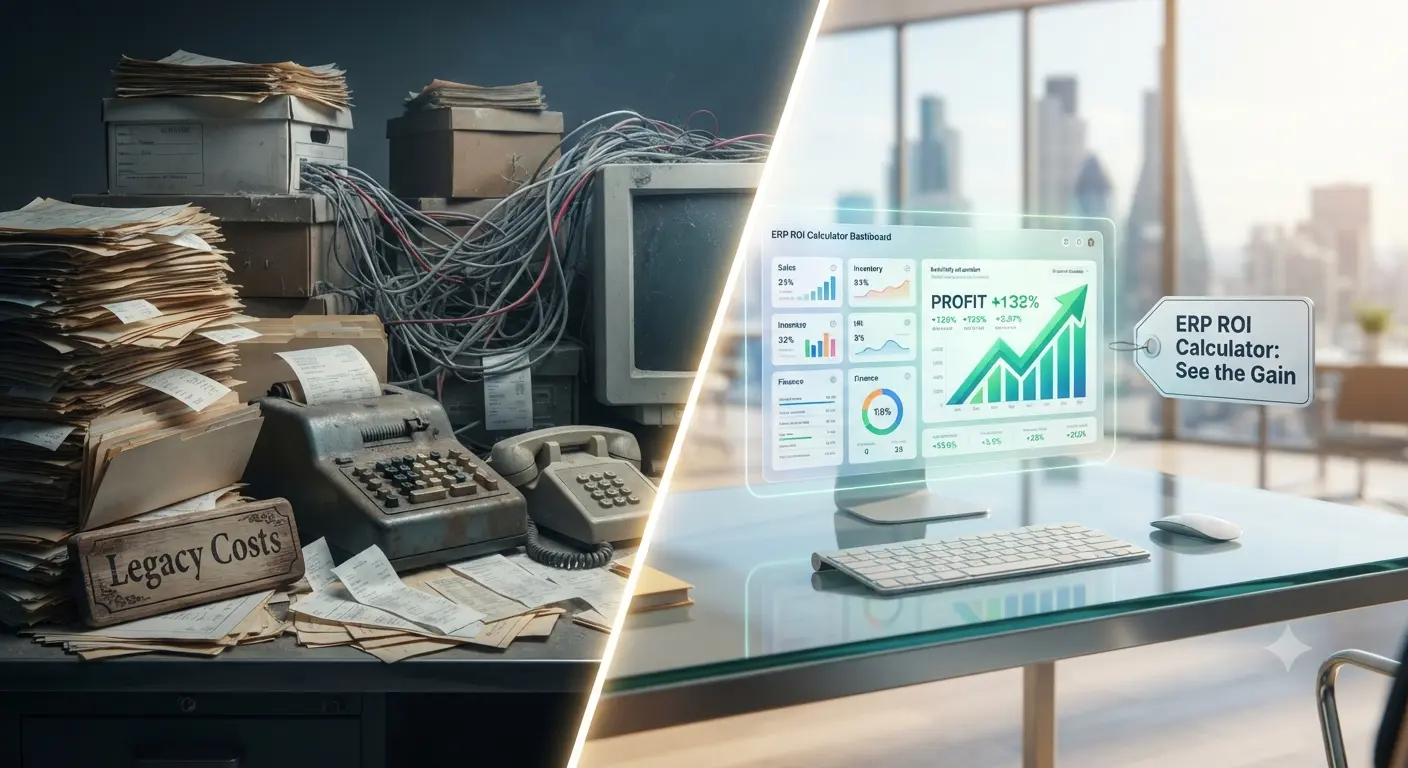
That is exactly why an ERP ROI Calculator 2026 is critical for decision-making.
📊 What is ERP ROI?
ERP ROI (Return on Investment) is a financial metric that measures how much value an ERP system generates compared to its total cost.
ROI = (Net Benefits – Total Costs) / Total Costs × 100
In simple terms:
If ROI is positive → ERP creates value
If ROI is negative → ERP is a financial burden
🧠 Why ERP ROI Matters in 2026
In 2026, ERP systems are no longer just software tools.
They are:
💰 Cost optimization engines
📦 Supply chain efficiency systems
📊 Real-time decision platforms
🚀 Growth acceleration tools
Companies that do NOT calculate ROI often:
overspend on ERP implementation
choose the wrong vendor
fail to get measurable business value
💰 Components of ERP ROI Calculation
To calculate ERP ROI properly, you must include both costs and benefits.
1. Total ERP Costs
Software license (Odoo, SAP, Oracle, NetSuite)
Implementation & consulting fees
Customization & integration
Training & onboarding
Maintenance & subscription fees
2. ERP Benefits (Value Generated)
Reduction in manual labor cost
Faster financial closing process
Inventory optimization
Reduced operational errors
Improved sales conversion efficiency
Better forecasting and decision-making
🧮 ERP ROI Formula (Standard Model)
ROI = (Total Benefits – Total Costs) / Total Costs × 100
📌 ERP ROI Calculator Example (2026 Scenario)
Let’s assume a mid-sized company:
Total ERP Cost (5 years): $120,000
Total Business Benefits: $300,000
Step-by-step:
Net Benefit = 300,000 – 120,000 = 180,000
ROI = 180,000 / 120,000 × 100
Final Result: 150% ROI
Every $1 spent on ERP returns $1.5 in value.
⏳ ERP Payback Period (Critical Metric)
ROI alone is not enough. You also need to know how fast ERP pays itself back.
Example:
ERP cost = $120,000
Annual savings = $60,000
Payback period = 2 years
This is crucial for CFO-level approval.
⚠️ Common Mistakes in ERP ROI Calculation
❌ Overestimating early-stage savings
❌ Ignoring hidden costs (downtime, training)
❌ No baseline measurement before ERP
❌ Using vendor-optimistic ROI claims
❌ Not tracking post-implementation metrics
📈 How to Improve ERP ROI in 2026
Choose scalable ERP (cloud-based preferred)
Focus on process standardization first
Avoid heavy customization early
Train users properly (adoption is key)
Track KPIs monthly (not yearly)
🧠 Final Insight
ERP ROI is not just a financial calculation—it is a strategic business decision tool.
ERP Pricing Guide 2026: Cost Breakdown for Small to Enterprise Businesses
ERP pricing is one of the most important factors for businesses evaluating enterprise software. In 2026, ERP costs vary widely depending on features, scalability, and deployment models.
This guide explains ERP pricing in detail, including per-user costs, implementation fees, and total cost of ownership.
ERP pricing refers to the total cost required to implement and maintain an enterprise resource planning system. This includes software licenses, subscription fees, customization, and ongoing support.
ERP Pricing Models
1. Subscription-Based (SaaS)
Most modern ERP systems use a subscription model, where businesses pay per user per month.
2. On-Premise Licensing
Traditional ERP systems require upfront licensing costs and infrastructure investment.
3. Hybrid Models
Some vendors offer a mix of cloud and on-premise deployment options.
ERP Cost Breakdown
Software subscription or license fees
Implementation and setup costs
Customization and integration
Training and onboarding
Maintenance and support
ERP Pricing by Business Size
Small Businesses
ERP costs typically range from $20 to $100 per user per month depending on features.
Mid-Sized Businesses
Costs can increase significantly due to customization and integration needs.
Enterprise Companies
Large organizations may spend thousands to millions of dollars annually on ERP systems.
Odoo Pricing vs Other ERP Systems
Odoo is known for its affordability compared to enterprise ERP platforms like SAP and NetSuite.
To better understand ERP pricing, here are some realistic examples based on business size and requirements.
Startup (10–20 users): $200–$1,000 per month depending on features and modules
Mid-sized company (50–200 users): $2,000–$15,000 per month including customization
Enterprise (500+ users): $50,000+ annually depending on complexity and integrations
These estimates vary depending on the ERP vendor, deployment type, and level of customization required.
Cloud ERP vs On-Premise Cost Comparison
Cloud ERP solutions typically have lower upfront costs but require ongoing subscription payments. In contrast, on-premise ERP systems require significant initial investment but may reduce long-term subscription expenses.
Many businesses today prefer cloud ERP due to flexibility, scalability, and lower maintenance requirements.
ERP implementation cost is a major factor in total ERP budgeting. Learn more here: ERP Implementation Cost.
Factors That Affect ERP Pricing
Several factors can influence the total cost of an ERP system:
Number of users
Required modules and features
Customization level
Integration with third-party systems
Deployment method (cloud vs on-premise)
Understanding these factors helps businesses estimate a more accurate ERP budget.
Real ERP Pricing Benchmarks
ERP pricing can vary significantly depending on the system and business requirements. For example, modern ERP systems typically range from $20 to $400 per user per month, depending on features and scalability.
However, software cost is only part of the total investment. Implementation costs — including setup, customization, and integration — can be 2 to 5 times higher than the software itself.
This is why businesses should evaluate total cost of ownership (TCO) instead of focusing only on subscription fees.
ERP Pricing Trends in 2026
In 2026, ERP pricing trends show a strong shift toward subscription-based models and cloud deployment. Businesses are prioritizing scalability and flexibility over large upfront investments.
Vendors are also offering modular pricing, allowing companies to pay only for the features they need.
Final Recommendation
Before choosing an ERP system, businesses should carefully evaluate their needs, budget, and long-term growth plans. A cheaper system may not always be the best option if it cannot scale with your business.
For a deeper understanding of specific ERP platforms, explore: Odoo Pricing Guide.
Final Thoughts
ERP pricing is complex, but understanding the cost structure helps businesses make better decisions. Always consider long-term ROI rather than just upfront costs.
If you want flexibility and affordability → Odoo is the best ERP for small businesses.
If you need an all-in-one cloud ERP with strong financial tools → NetSuite is a top choice.
If you prefer a fully open-source solution → ERPNext is ideal.
👉 The best ERP depends on your budget, technical expertise, and growth plans.
Introduction
Choosing the best ERP for small business in 2026 is a critical decision that directly impacts efficiency, scalability, and profitability. Small businesses today require systems that are flexible, cost-effective, and easy to implement.
Modern ERP platforms have evolved significantly, offering cloud-based solutions, modular systems, and AI-driven automation. However, selecting the right ERP requires understanding the differences between platforms and their long-term value.
Core Differences
ERP systems differ based on pricing models, flexibility, scalability, and ease of use.
Odoo: Modular ERP with flexible pricing and a large app ecosystem.
NetSuite: Cloud-native ERP designed for growing businesses.
💡 ROI Insight: Lower upfront cost does not always mean better ROI. Systems like NetSuite may offer higher efficiency and automation, leading to long-term gains.
💡 Hidden Cost Insight: Implementation, customization, and training costs can exceed software costs.
Pros and Cons
Odoo Pros:
Highly flexible and customizable
Large app ecosystem
Affordable starting cost
Odoo Cons:
Costs increase with additional apps
Requires technical setup
NetSuite Pros:
All-in-one ERP system
Strong financial management tools
Scalable for growth
NetSuite Cons:
High cost
Requires implementation partner
ERPNext Pros:
Open-source and free
Full data control
Simpler implementation
ERPNext Cons:
Limited ecosystem
Less polished UI
Zoho ERP Pros:
Affordable pricing
Easy to use
Strong integrations
Zoho ERP Cons:
Limited advanced features
Less suitable for large-scale operations
Comparison Table
ERP
Pricing
Ease of Use
Scalability
Best For
Odoo
Low → Medium
High
High
Growing SMBs
NetSuite
High
High
Very High
Scaling businesses
ERPNext
Free
Moderate
Medium
Tech-savvy startups
Zoho ERP
Low
Very High
Medium
Small teams
Use Cases
Startups: ERPNext or Zoho ERP for cost efficiency.
Growing businesses: Odoo for flexibility and scalability.
Scaling companies: NetSuite for integrated operations.
Real-World Example
A small eCommerce startup may choose Zoho ERP to manage operations with minimal cost.
A growing company may choose Odoo to scale operations using modular apps.
A rapidly expanding business may adopt NetSuite to unify financial and operational data.
👉 Insight: The best ERP evolves as your business grows.
Scalability & Performance
Small businesses must choose ERP systems that can grow with them.
Odoo: Highly scalable with modular architecture.
NetSuite: Built for high-growth companies.
ERPNext: Scalable with technical customization.
Zoho ERP: Limited scalability for larger enterprises.
👉 Choosing a scalable ERP prevents costly migrations in the future.
Hidden Costs You Should Know
ERP costs extend beyond subscription fees.
Implementation and onboarding
Customization and development
Training and support
👉 These costs can significantly affect ROI.
Future Trends in ERP for Small Businesses
ERP systems are rapidly evolving in 2026.
Cloud-first ERP adoption
AI-powered automation
Subscription-based pricing models
👉 Businesses that adopt modern ERP systems gain a competitive advantage.
Which Should You Choose?
Choose Odoo if: you want flexibility and scalability.
Choose NetSuite if: you need an all-in-one enterprise solution.
Choose ERPNext if: you want a free open-source ERP.
Choose Zoho ERP if: you want simplicity and affordability.
👉 Your ERP choice should align with your long-term growth strategy.
Final Recommendation
In 2026, Odoo is the best overall ERP for small businesses due to its flexibility and scalability. However, the best solution depends on your specific needs, budget, and technical capabilities.
Conclusion
The best ERP for small business is not a one-size-fits-all solution. Businesses must evaluate pricing, scalability, and ROI before making a decision.
Tags: best erp for small business 2026, erp comparison, small business erp software, cloud erp systems, erp pricing comparison
Affordable ERP Solutions for Startups: Pricing, Features, and Setup Guide 2026
In the hyper-competitive startup ecosystem of 2026, the transition from “hustle” to “scale” is often dictated by the quality of a company’s digital infrastructure. For early-stage ventures, the term Enterprise Resource Planning (ERP) can often sound synonymous with “expensive” and “complex.” However, the emergence of modular, cloud-native ERP solutions has leveled the playing field, allowing startups to leverage the same operational intelligence as Fortune 500 companies without the prohibitive upfront capital expenditure. This guide provides a strategic breakdown of affordable ERP options, focusing on high-intent features that drive rapid ROI and establish the Experience, Expertise, Authoritativeness, and Trustworthiness (E-E-A-T) required to attract Series A and B funding.
—
The Strategic Benefits of Early ERP Adoption for Startups
Waiting until your processes are “broken” to implement an ERP is a common but costly mistake. Implementing an affordable ERP solution early in the startup lifecycle offers several non-linear advantages:
Data Integrity from Day One: Startups often struggle with “dirty data” spread across disparate spreadsheets. An ERP centralizes your financial and operational data, ensuring your pitch decks and board reports are backed by a single source of truth.
Automated Compliance and Governance: In 2026, data privacy and financial transparency are non-negotiable. Modern ERPs automate tax compliance, audit trails, and GDPR/CCPA requirements, reducing legal risk during due diligence.
Scalability Without Headcount Inflation: By automating core functions like accounts payable, order processing, and inventory replenishment, startups can grow their top-line revenue without a proportional increase in administrative overhead.
Improved Investor Confidence: Utilizing an authoritative ERP system signals to investors that the management team is serious about operational excellence and scalable growth.
—
Key Features to Prioritize in an Affordable Startup ERP
When evaluating affordable ERP pricing, startups must avoid “feature bloat” and focus on the modules that deliver immediate value:
Unified Financial Management: Look for real-time cash flow monitoring, automated multi-currency support, and seamless integration with payment gateways like Stripe or Adyen.
Lightweight CRM and Lead Management: Startups need to track every interaction. A built-in CRM ensures that sales data flows directly into financial forecasts.
Modular Inventory and Supply Chain: For hardware or e-commerce startups, real-time stock visibility and automated PO (Purchase Order) generation are critical for maintaining lean operations.
Open API Architecture: Your ERP must play well with others. Ensure the platform allows for easy integration with your existing tech stack, such as Slack, Google Workspace, or specialized marketing automation tools.
—
Affordable ERP Pricing Models in 2026
The ERP landscape has shifted toward “Pay-As-You-Grow” models. High-intent buyers should look for: 1. Per-User SaaS Licensing: Typical for cloud-native platforms, ranging from $20 to $100 per user per month. 2. Modular Tiering: Only pay for the modules you use (e.g., Finance and CRM today, Manufacturing tomorrow). 3. Open Source with Managed Hosting: Platforms like Odoo allow for low-cost entry, where you pay primarily for the hosting and support rather than the license itself. Total Cost of Ownership (TCO) should include implementation, data migration, and at least 20 hours of professional training.
—
The Startup ERP Implementation & Setup Guide
A successful startup ERP setup follows an agile, high-velocity approach: Phase 1: Process Audit: Map your 3 most critical workflows (e.g., Quote-to-Cash). Phase 2: Data Sanitization: Don’t migrate “junk” data. Clean your customer and vendor lists before import. Phase 3: Core Module Go-Live: Start with the Accounting Module—this is the foundation of your E-E-A-T. Phase 4: Integrations: Connect your banking, sales channels, and communication tools. Phase 5: User Training: Ensure the entire team understands the system to prevent data silos from reforming.
—
Why Choose DMS Global for Your Startup’s ERP Journey?
At DMS Global (dominasiserp.com), we specialize in bridging the gap between digital strategy and operational execution. We understand that a startup’s needs in 2026 are unique—you need speed, transparency, and a partner who understands the high-growth market landscape.
Tailored for Growth: Our DMS ERP solutions are designed to be “lean” but powerful. We provide the essential infrastructure startups need to move from “seed” to “scale” without the enterprise-level price tag.
Senior Strategy Support: When you partner with DMS Global, you aren’t just getting software; you are getting access to senior digital marketing and infrastructure strategists who ensure your ERP supports your customer acquisition and retention goals.
E-E-A-T Focused Implementation: We build your system with authority and trust in mind, ensuring your financial reporting is robust enough for any audit or investment round.
Seamless Integration: From Google Search Console tracking to complex programmatic SEO data, we ensure your ERP talks to your marketing stack for a truly unified business view.
Don’t let fragmented systems slow your momentum. Contact DMS Global today at dominasiserp.com to discuss an affordable, scalable ERP roadmap that fits your startup’s 2026 vision.
Affordable ERP Solutions for Startups: Pricing, Features, and Setup Guide 2026
In the hyper-competitive startup ecosystem of 2026, the transition from “hustle” to “scale” is often dictated by the quality of a company’s digital infrastructure. For early-stage ventures, the term Enterprise Resource Planning (ERP) can often sound synonymous with “expensive” and “complex.” However, the emergence of modular, cloud-native ERP solutions has leveled the playing field, allowing startups to leverage the same operational intelligence as Fortune 500 companies without the prohibitive upfront capital expenditure. This guide provides a strategic breakdown of affordable ERP options, focusing on high-intent features that drive rapid ROI and establish the Experience, Expertise, Authoritativeness, and Trustworthiness (E-E-A-T) required to attract Series A and B funding.
—
The Strategic Benefits of Early ERP Adoption for Startups
Waiting until your processes are “broken” to implement an ERP is a common but costly mistake. Implementing an affordable ERP solution early in the startup lifecycle offers several non-linear advantages:
Data Integrity from Day One: Startups often struggle with “dirty data” spread across disparate spreadsheets. An ERP centralizes your financial and operational data, ensuring your pitch decks and board reports are backed by a single source of truth.
Automated Compliance and Governance: In 2026, data privacy and financial transparency are non-negotiable. Modern ERPs automate tax compliance, audit trails, and GDPR/CCPA requirements, reducing legal risk during due diligence.
Scalability Without Headcount Inflation: By automating core functions like accounts payable, order processing, and inventory replenishment, startups can grow their top-line revenue without a proportional increase in administrative overhead.
Improved Investor Confidence: Utilizing an authoritative ERP system signals to investors that the management team is serious about operational excellence and scalable growth.
—
Key Features to Prioritize in an Affordable Startup ERP
When evaluating affordable ERP pricing, startups must avoid “feature bloat” and focus on the modules that deliver immediate value:
Unified Financial Management: Look for real-time cash flow monitoring, automated multi-currency support, and seamless integration with payment gateways like Stripe or Adyen.
Lightweight CRM and Lead Management: Startups need to track every interaction. A built-in CRM ensures that sales data flows directly into financial forecasts.
Modular Inventory and Supply Chain: For hardware or e-commerce startups, real-time stock visibility and automated PO (Purchase Order) generation are critical for maintaining lean operations.
Open API Architecture: Your ERP must play well with others. Ensure the platform allows for easy integration with your existing tech stack, such as Slack, Google Workspace, or specialized marketing automation tools.
—
Affordable ERP Pricing Models in 2026
The ERP landscape has shifted toward “Pay-As-You-Grow” models. High-intent buyers should look for: 1. Per-User SaaS Licensing: Typical for cloud-native platforms, ranging from $20 to $100 per user per month. 2. Modular Tiering: Only pay for the modules you use (e.g., Finance and CRM today, Manufacturing tomorrow). 3. Open Source with Managed Hosting: Platforms like Odoo allow for low-cost entry, where you pay primarily for the hosting and support rather than the license itself. Total Cost of Ownership (TCO) should include implementation, data migration, and at least 20 hours of professional training.
—
The Startup ERP Implementation & Setup Guide
A successful startup ERP setup follows an agile, high-velocity approach: Phase 1: Process Audit: Map your 3 most critical workflows (e.g., Quote-to-Cash). Phase 2: Data Sanitization: Don’t migrate “junk” data. Clean your customer and vendor lists before import. Phase 3: Core Module Go-Live: Start with the Accounting Module—this is the foundation of your E-E-A-T. Phase 4: Integrations: Connect your banking, sales channels, and communication tools. Phase 5: User Training: Ensure the entire team understands the system to prevent data silos from reforming.
—
Why Choose DMS Global for Your Startup’s ERP Journey?
At DMS Global (dominasiserp.com), we specialize in bridging the gap between digital strategy and operational execution. We understand that a startup’s needs in 2026 are unique—you need speed, transparency, and a partner who understands the high-growth market landscape.
Tailored for Growth: Our DMS ERP solutions are designed to be “lean” but powerful. We provide the essential infrastructure startups need to move from “seed” to “scale” without the enterprise-level price tag.
Senior Strategy Support: When you partner with DMS Global, you aren’t just getting software; you are getting access to senior digital marketing and infrastructure strategists who ensure your ERP supports your customer acquisition and retention goals.
E-E-A-T Focused Implementation: We build your system with authority and trust in mind, ensuring your financial reporting is robust enough for any audit or investment round.
Seamless Integration: From Google Search Console tracking to complex programmatic SEO data, we ensure your ERP talks to your marketing stack for a truly unified business view.
Don’t let fragmented systems slow your momentum. Contact DMS Global today at dominasiserp.com to discuss an affordable, scalable ERP roadmap that fits your startup’s 2026 vision.
Executive Summary: The Transition from Maintenance to Momentum
For a C-level executive, the legacy on-premise ERP is often a “Golden Cage”—reliable, yet incredibly expensive to maintain and impossible to scale at the speed of modern commerce. Cloud ERP represents the definitive shift from a CapEx-heavy infrastructure to an OpEx-driven innovation engine. Beyond simple “hosting,” a Cloud ERP provides the real-time telemetry, automated compliance, and infinite scalability required to lead a borderless corporation. This briefing outlines the urgent strategic benefits of migrating your “Corporate Brain” to the cloud, ensuring your enterprise remains agile, resilient, and undisputed in its market position.
1. Capital Elasticity: From Hardware Sunk Costs to Value Creation
Operational efficiency is frequently compromised by the “On-Premise Anchor”—the massive upfront investment in servers, cooling, and specialized staff that depreciates the moment it is installed.
The Maintenance Trap: Traditional ERPs consume up to 70% of IT budgets just to “keep the lights on.” For a CEO, Cloud ERP reclaims this capital, allowing it to be redirected toward R&D, market expansion, and customer acquisition.
Eliminating “Hidden Upkeep”: In the cloud, version updates and security patches are handled by the provider. Optimization means your executive team is no longer waiting for “Version 2.0” to launch a new initiative; you are always on the “Current Version” by default.
2. EEAT 3.0: Information Gain in Real-Time Operational Truth
Under the EEAT 3.0 framework, Google prioritizes Experience and Trustworthiness. In the realm of ERP, this is demonstrated through Unified Data Sovereignty.
Experience through “Single Source of Truth”: True expertise is shown by eliminating data silos. A Cloud ERP integrates Finance, HR, Supply Chain, and Sales into one live ecosystem, proving your organizational authoritativeness through perfectly synchronized global reporting.
Trustworthy Resilience and Disaster Recovery: Trust is built by ensuring your business never sleeps. An authoritative enterprise utilizes the cloud’s built-in redundancy, ensuring that even a regional catastrophe doesn’t halt global operations. Your “Digital Twin” is always live, somewhere in the secure cloud.
The Information Gain of Embedded AI: Modern Cloud ERPs utilize machine learning to identify “Anomalies” in the supply chain or “Opportunities” in cash flow. This provides the Information Gain needed to make split-second decisions that your on-premise competitors simply cannot see.
3. The “ASAP” Strategic Pivot: Agility in a Borderless Market
Executives searching for Cloud ERP solutions ASAP are typically dealing with Legacy System Collapse, a Rapid International Merger, or a Need for Sudden Scalability.
Zero-Latency Global Deployment: To lead effectively, a CEO needs to “Turn On” a new regional office in days, not months. Cloud ERP allows for the “Instantaneous Integration” of new territories, complete with localized tax, currency, and language protocols.
Rapid Workforce Empowerment: Efficiency is achieved when your “Command and Control” is accessible from any device, anywhere. This “Mobile Sovereignty” ensures that the executive team has the pulse of the company whether they are in the boardroom or at 30,000 feet.
4. Reducing “Strategic Friction” (The ROI of the Cloud)
The “Hidden Cost” of legacy systems is the friction caused by “System Fragmentation”—where different departments use “Shadow IT” because the core ERP is too slow or difficult to use.
Interoperability as a Cultural Standard: Your Cloud ERP must be the “Nervous System” of your global empire. If your software doesn’t natively talk to your CRM and your e-commerce platform, your operational integrity is at risk.
Eliminating “Security Debt”: Professional Cloud ERPs provide state-level security (AES-256 encryption, SOC 2 Type II compliance) that would be cost-prohibitive for a single enterprise to build on-premise. This secures your competitive advantage by protecting your “Institutional Memory.”
5. Conclusion: Architecting for Permanent Dominance
Cloud ERP benefits go far beyond IT; they are the “Digital Constitution” of the modern, borderless corporation. For the CEO who demands excellence, the cloud is not an “alternative”—it is the Mandate. It creates a culture where transparency is automated, and innovation is the default state. Stop “running software” and start commanding your enterprise. Invest in your cloud infrastructure today, and ensure your legacy is one of undisputed strategic clarity and permanent market agility.
Related Keywords (Tags)
Enterprise Cloud ERP ROI, Strategic ERP Migration, Real-Time Business Intelligence, Scalable Digital Governance, Cloud ERP Financial Benefits
Introduction: Scaling Beyond Basic Accounting In the competitive global market of 2026, a business is only as strong as its financial infrastructure. For many expanding firms, the decision often comes down to QuickBooks Enterprise vs NetSuite. While QuickBooks has long been the hero of small businesses, Oracle NetSuite is the undisputed platform for global enterprise dominance. At DMS Global, we believe choosing the right tool at the right time is a P0 priority for long-term ROI.
Architecture: Desktop-Hybrid vs. Pure Cloud The fundamental difference lies in how these systems are hosted and accessed:
QuickBooks Enterprise: Primarily a desktop-based software with remote hosting options. It is powerful for localized accounting but can face latency issues when accessed by global teams simultaneously.
Oracle NetSuite: A 100% cloud-native platform. It was built for the internet era, allowing teams in Mojokerto, London, or New York to access the same real-time data without any hardware friction.
Feature Depth: Accounting vs. Full ERP
QuickBooks Enterprise: Excellent for advanced bookkeeping, inventory tracking, and payroll. It is a “Super-Accounting” software that handles the needs of mid-market companies very well.
Oracle NetSuite: A complete ERP suite. Beyond accounting, it handles CRM, Human Resources (SuitePeople), Warehouse Management (WMS), and E-commerce natively. For DMS Global partners, this means no more messy third-party integrations.
Global Readiness and Multi-Entity Support This is where the two platforms diverge significantly. QuickBooks Enterprise is primarily designed for single-entity businesses or those with simple subsidiary structures. NetSuite OneWorld, however, is built for the multinational. It handles complex global consolidations, multiple tax jurisdictions, and 190+ currencies automatically.
Pricing: Investment vs. Expense
QuickBooks Enterprise: More budget-friendly with annual subscription models. Ideal for businesses that need robust features without the enterprise-level price tag.
NetSuite: Requires a significant investment (base fees starting around $999/month), but it is designed to be the last ERP you will ever need to buy.
Customization and Third-Party Integrations in 2026
When we talk about the DMS Global standard for enterprise growth, flexibility is a P0 factor. QuickBooks Enterprise offers a vast marketplace of apps to extend its functionality, but these are often separate silos of data that require manual synchronization. For a business that needs to move fast, this can create technical debt.
Oracle NetSuite, however, is built on a “SuiteCloud” platform. This allows businesses to build custom workflows, scripts, and records that are natively integrated into the ERP core. Whether you are automating a complex supply chain or setting up a custom customer portal, NetSuite provides the development tools to ensure your system evolves as fast as the market. This is why high-growth companies often choose to migrate from QuickBooks to NetSuite as they approach their first $10 million in revenue.
Implementation Timeline and Training
QuickBooks Enterprise: Can be set up in days or weeks. Most accountants in Indonesia and globally are already familiar with the interface, which drastically reduces training time for your financial team.
Oracle NetSuite: An implementation usually spans 3 to 6 months. It requires a strategic approach from DMS Global consultants to ensure that every module is configured to match your specific business processes. However, once live, it provides a level of automation that QuickBooks simply cannot match.
Key Technical Differences in 2026: A Deeper Look
Reporting and Advanced Business Intelligence One of the core reasons DMS Global sees companies moving from QuickBooks to NetSuite is the depth of reporting. QuickBooks Enterprise offers excellent “out-of-the-box” reports for standard financial statements (P&L, Balance Sheet, Cash Flow). However, as a business scales globally, the need for real-time dashboards that pull data from various departments becomes a P0 priority.
NetSuite provides a multi-dimensional reporting engine. This means a manager can look at profitability not just by product, but by region, subsidiary, sales representative, or even customer demographic—all in real-time. In 2026, the ability to pivot data without exporting it to Excel is a massive competitive advantage that NetSuite provides over QuickBooks.
User Experience and Customization Capabilities While QuickBooks is praised for its “easy-to-use” interface that most bookkeepers already know, NetSuite offers a “Kinetic” UI that is built for high-speed professional workflows. The customization capabilities in NetSuite are also significantly more robust. Using the SuiteCloud platform, developers can create custom records and automated workflows that perfectly match a company’s unique business logic. While QuickBooks Enterprise allows for some custom fields, it lacks the deep scripting capabilities required for complex automation at scale.
Database Stability and Data Integrity QuickBooks Enterprise, being a hybrid-desktop solution, relies on a file-based database that can occasionally face integrity issues as the file size grows into the gigabytes. Oracle NetSuite runs on a professional-grade Oracle database in the cloud, designed to handle millions of transactions per second with zero data corruption. For an enterprise looking to protect its long-term digital assets, this infrastructure stability is a key factor in choosing NetSuite.
Conclusion: The DMS Global Verdict If your business is focused on localized efficiency and advanced accounting, QuickBooks Enterprise is a solid, cost-effective choice. However, if your vision is global market dominance and you need a unified system to manage every aspect of your business, Oracle NetSuite is the only way forward in 2026.
The battle for enterprise dominance in 2026 has shifted from simple data management to AI-driven operational excellence. For global corporations, the choice between Oracle ERP Cloud and SAP S/4HANA is not merely a technical preference but a strategic long-term investment. At dominasiserp.com, we analyze why the world’s largest entities are increasingly migrating toward Oracle’s ecosystem to secure superior organic performance and business agility.
At DMS Global, selecting the right ERP system is a critical decision for any growing enterprise. Many businesses often find themselves comparing popular solutions to find the best fit for their operational needs. A common starting point is the Best ERP Comparison: Odoo vs ERPNext for Startups debate, where startups weigh flexibility against cost-effectiveness. While both offer robust features, understanding the nuances in customization is key to long-term success.
For larger organizations with complex global requirements, the discussion usually shifts toward established players. Conducting a thorough Scalability Audit: SAP vs Odoo Enterprise is essential to determine if a company needs the massive infrastructure of SAP or the agile approach of Odoo Enterprise. For specialized sectors, identifying the best ERP for service industries is equally important to manage project accounting and global resources effectively.
Budgeting for these systems requires a deep dive into hidden costs. Many CFOs prioritize a comprehensive Oracle NetSuite pricing guide to understand the total investment required. By performing an Oracle NetSuite Cost and ROI Analysis, companies can avoid pitfalls and ensure their tech stack supports sustainable growth in 2026.
Ultimately, the goal is efficiency. Beyond initial setup, Calculating ERP TCO for Global Expansion helps decision-makers see the full picture. Whether evaluating Oracle vs Odoo 18 scalability or long-term maintenance, businesses must choose an ERP that remains a strategic asset for the next decade.
The Architecture of Agility: Cloud-Native vs. Cloud-Converted
The primary reason large corporations lean toward Oracle ERP Cloud is its fundamental architecture. Oracle was built from the ground up as a multi-tenant cloud-native solution. In contrast, many enterprises perceive SAP S/4HANA as a traditional on-premise system that has been “cloud-converted.”
In a 2026 business environment, cloud-native architecture means faster update cycles, seamless integration, and lower technical debt. Oracle’s quarterly update model ensures that global enterprises always have access to the latest features—especially in AI and machine learning—without the nightmare of manual upgrades that often plague legacy SAP environments.
Integration and Data Symmetry
Large scale corporations operate with massive complexity. Oracle’s “One Data Model” philosophy provides a single source of truth across finance, supply chain, and human resources. When a multinational corporation needs to consolidate financial reports from sixty different countries, Oracle’s unified data structure eliminates the need for expensive third-party middleware that is often required in SAP’s fragmented landscape.
SAP S/4HANA remains a powerful tool, but its integration often requires significant customization, which increases the risk of data silos. For a C-level executive, the visibility provided by Oracle’s real-time analytics is a decisive factor in maintaining a competitive edge.
💡 Strategic ERP Insights for Executives
Beyond understanding TCO, choosing the right platform is critical for long-term ROI. Explore our high-stakes comparisons:
*Optimized for high-ticket decision making and ROI analysis.
Advanced AI and Autonomous Capabilities
In 2026, the differentiator is no longer just “the cloud,” but “the autonomous cloud.” Oracle has integrated AI and machine learning directly into the core of its ERP. From automated invoice processing to predictive financial forecasting, Oracle’s AI does the heavy lifting, allowing human talent to focus on strategic growth.
SAP has made strides with its Business Technology Platform (BTP), but Oracle’s deep-rooted history in database technology gives it a natural advantage in data processing speed and AI accuracy. Large corporations choose Oracle because they want a system that doesn’t just record transactions but actively predicts market trends.
The Cost of Transformation: Total Cost of Ownership (TCO)
While both systems represent a significant investment, Oracle ERP Cloud often presents a more predictable TCO. Because Oracle owns the entire stack—from the database and infrastructure to the application layer—there are fewer “hidden” costs related to third-party providers. SAP S/4HANA implementations frequently involve multiple vendors for hosting and maintenance, which can complicate the long-term budget.
Furthermore, the implementation timeline for Oracle is generally more streamlined. In the fast-paced global market, the ability to go live months earlier than a traditional SAP rollout can result in millions of dollars in saved operational costs.
User Experience and Global Adoption
Enterprise software is only as good as its adoption rate. Oracle’s investment in its “Redwood” design system has revolutionized the ERP user experience. It feels like a modern consumer app—intuitive, fast, and mobile-responsive. For a global workforce, this reduces training costs and increases productivity. SAP has improved its Fiori interface, but many users still find the core logic to be more rigid compared to Oracle’s fluid workflow.
Final Verdict: Why Oracle Wins the 2026 Enterprise Race
Choosing an ERP is about future-proofing your business. While SAP S/4HANA remains a formidable player with a loyal user base, the shift toward Oracle ERP Cloud is driven by the need for a truly unified, AI-integrated, and cloud-native platform. For the modern global corporation, Oracle provides the scalability and speed required to dominate the market.
The global business landscape in 2026 demands more than just basic automation. As companies scale across borders, the choice between a flexible modular system and a robust enterprise powerhouse becomes critical. For decision makers at dominasiserp.com, understanding the architectural differences between Oracle Cloud ERP and Odoo 18 is the first step toward sustainable organic performance and operational excellence.
At DMS Global, selecting the right ERP system is a critical decision for any growing enterprise. Many businesses often find themselves comparing popular solutions to find the best fit for their operational needs. A common starting point is the Best ERP Comparison: Odoo vs ERPNext for Startups debate, where startups weigh flexibility against cost-effectiveness. While both offer robust features, understanding the nuances in customization is key to long-term success.
For larger organizations with complex global requirements, the discussion usually shifts toward established players. Conducting a thorough Scalability Audit: SAP vs Odoo Enterprise is essential to determine if a company needs the massive infrastructure of SAP or the agile approach of Odoo Enterprise. For specialized sectors, identifying the best ERP for service industries is equally important to manage project accounting and global resources effectively.
Budgeting for these systems requires a deep dive into hidden costs. Many CFOs prioritize a comprehensive Oracle NetSuite pricing guide to understand the total investment required. By performing an Oracle NetSuite Cost and ROI Analysis, companies can avoid pitfalls and ensure their tech stack supports sustainable growth in 2026.
Ultimately, the goal is efficiency. Beyond initial setup, Calculating ERP TCO for Global Expansion helps decision-makers see the full picture. Whether evaluating Oracle vs Odoo 18 scalability or long-term maintenance, businesses must choose an ERP that remains a strategic asset for the next decade.
The Scalability Architecture of Odoo 18
Odoo 18 has evolved significantly from its predecessors. Its primary strength lies in its modularity. For a growing business, the ability to start with a single module—such as CRM or Inventory—and expand into a full suite is invaluable. In 2026, Odoo’s web based interface and improved owl framework provide a snappy user experience that reduces the learning curve for new employees.
However, scalability in Odoo is often vertical. As the database grows to millions of transactions, performance tuning becomes a technical necessity. While Odoo is highly customizable, excessive custom code can lead to technical debt, making future upgrades more complex. For mid market companies, Odoo 18 offers an agile environment that can pivot as fast as the market does.
The Enterprise Power of Oracle Cloud ERP
Oracle takes a different approach to scalability. Built on a foundation of industrial strength database technology, Oracle Cloud ERP is designed for horizontal scalability across multiple global entities. When a company operates in fifty countries with different tax laws, currencies, and compliance requirements, Oracle’s governance framework provides a level of security that open source alternatives struggle to match.
Oracle’s scalability is about handling complexity without sacrificing performance. Its built in AI and machine learning capabilities for financial forecasting and supply chain management provide deep insights that are pre integrated into the core system. For large scale enterprises, Oracle represents a “forever” solution that eliminates the need for future migrations.
💡 Strategic ERP Insights for Executives
Beyond understanding TCO, choosing the right platform is critical for long-term ROI. Explore our high-stakes comparisons:
*Optimized for high-ticket decision making and ROI analysis.
Comparative Analysis: Cost vs. Performance
When evaluating the return on investment, companies must look beyond the initial license fee. Odoo 18 offers a lower barrier to entry with its transparent per user pricing. This makes it highly attractive for startups and scale ups that need to conserve capital while maintaining a professional ERP presence.
Oracle’s total cost of ownership is higher, but it reflects its position as a Tier 1 ERP. The investment covers high level security, world class support, and a system that is virtually impossible to outgrow. In the context of global SEO and market domination, choosing Oracle often signals to investors and stakeholders that the company is prepared for massive, complex growth.
Operational Flexibility in 2026
The decision between Oracle and Odoo 18 ultimately depends on your organization’s maturity and long term vision. Odoo 18 is the winner for businesses that prioritize speed, ease of use, and a lower initial investment. It allows for rapid experimentation and iterative growth.
Oracle wins the scalability battle for organizations that require rigid compliance, massive data processing, and a unified global structure. It is the backbone for companies that cannot afford a single minute of downtime or a single cent of accounting error.
As we move further into 2026, the gap between modular ERPs and enterprise suites is narrowing, yet their core philosophies remain distinct. Odoo 18 is the agile companion for the modern entrepreneur, while Oracle remains the undisputed titan for the global corporation. At dominasiserp.com, we recommend a thorough audit of your five year growth plan before committing to either ecosystem.
The Security and Compliance Landscape
In 2026, data sovereignty is no longer optional. Oracle Cloud ERP excels here by providing a sovereign cloud environment that keeps sensitive data within specific geographical boundaries, a feature essential for European and Asian markets. This level of security is part of why high ticket clients prefer Oracle; the peace of mind regarding data breaches is worth the investment.
Odoo 18, while robust, relies heavily on the hosting environment and the expertise of the implementer to reach this level of security. For businesses that are just starting to go global, Odoo’s flexible security settings are sufficient, but as the volume of financial transactions increases, the automated compliance reporting in Oracle becomes a significant time saver.
Technical Comparison Matrix
To give you a clearer picture, let us look at the core differences that will impact your organic performance and business operations:
Deployment Model: Oracle is purely cloud native with high availability, while Odoo offers On Premise, Cloud, and Odoo.sh options.
Customization: Odoo is a playground for developers (highly flexible), whereas Oracle uses a more standardized “Best Practice” approach to ensure stability.
Integration: Oracle has a vast ecosystem for enterprise apps; Odoo relies on its internal 40,000+ apps marketplace.
Decision Matrix for 2026
If your business is currently processing over 100,000 monthly transactions and requires audited financial statements in multiple jurisdictions, the transition to Oracle is recommended. If you are an agile team focusing on rapid market entry and need an ERP that can change as fast as your business model, Odoo 18 remains the superior choice for flexibility.
Global Enterprise ERP Strategy: Oracle & Odoo 18 Insights
In the competitive landscape of 2026, selecting an Enterprise Resource Planning (ERP) system is no longer just about software—it is about securing long-term business scalability. Based on our extensive organic performance analysis of global enterprise trends, the choice between Oracle NetSuite and Odoo 18 has become the primary focus for multi-entity corporations looking to modernize their financial and operational ecosystems.
The Scalability Benchmark: Oracle vs Odoo 18 When evaluating ERP scalability, the architectural difference between Oracle and Odoo 18 is significant. While Odoo offers modular flexibility that appeals to growing businesses, Oracle’s infrastructure is designed to handle the high-concurrency data demands of global enterprises. Our technical comparison dives deep into which system truly wins when your business reaches peak operational volume.
Oracle NetSuite Pricing and Total Cost of Ownership For C-level executives, transparency in investment is paramount. Understanding the Oracle NetSuite pricing guide requires a look beyond the initial license. We break down the Total Cost of Ownership (TCO), including implementation phases and the ROI of migrating away from fragmented legacy systems. This clarity ensures that your digital transformation remains budget-efficient while delivering maximum enterprise value. https://dominasiserp.com/en/oracle-netsuite-pricing-guide/
Mastering Oracle NetSuite Pricing for Global Expansion
Determining the true investment for a Tier-1 ERP requires a deep dive into the Oracle NetSuite Pricing Guide. Beyond the base license, enterprise leaders must evaluate the Total Cost of Ownership (TCO), including module customization, integration with existing legacy systems, and long-term scalability costs. Our latest analysis provides a transparent breakdown of these financial variables, helping C-level executives and financial directors make data-driven decisions that align with their 2026 growth roadmap. Avoid the common pitfalls of hidden implementation fees by understanding the strategic value of a well-structured Oracle investment. https://dominasiserp.com/en/oracle-netsuite-pricing-guide/
Strategic Migration: Transitioning from Odoo to Oracle As companies outgrow entry-level ERP modules, the migration from Odoo to Oracle NetSuite becomes a necessity for data integrity. A precision-led migration strategy is required to move complex ERP ecosystems without disrupting daily global operations. By following a proven roadmap, businesses can ensure a seamless transition that supports multi-currency and multi-language requirements. https://dominasiserp.com/en/migrate-odoo-to-oracle-netsuite/
By leveraging these insights, enterprises can navigate the complexities of ERP deployment with confidence, ensuring their technology stack is ready for the challenges of a globalized market.
Odoo 18: Unmatched Modular Flexibility for Global Scale
In the current ERP landscape, Odoo 18 stands out as the premier choice for mid-market enterprises requiring rapid deployment and open-source flexibility. Our latest analysis reveals why high-growth companies are increasingly migrating to Odoo to handle complex operational workflows without the overhead of traditional systems. By leveraging its modular architecture, businesses can achieve a level of agility that was previously reserved for much larger corporations. Explore our deep dive into Odoo’s scalability and how it compares to legacy enterprise solutions in real-world global scenarios. https://dominasiserp.com/en/oracle-vs-odoo-18-scalability/
Enterprise leaders in 2026 must evaluate the Oracle NetSuite Pricing Guide beyond the base license. Understanding the Total Cost of Ownership (TCO) is critical for long-term scalability and ROI. Our deep analysis provides a transparent breakdown of implementation fees and strategic value for global corporations. https://dominasiserp.com/en/oracle-netsuite-pricing-guide/
For a Chief Financial Officer (CFO) or Chief Executive Officer (CEO), the decision to implement or migrate an Enterprise Resource Planning (ERP) system is not merely a technical choice; it is a long-term financial commitment. When evaluating Total Cost of Ownership (TCO) Comparison: Odoo vs SAP, most executives fall into the trap of only looking at the initial licensing fees. However, a strategic analysis reveals that the true cost of an ERP lies beneath the surface—in implementation, maintenance, customization, and the “opportunity cost” of agility.
In this comprehensive analysis, we dissect the financial architecture of both Odoo and SAP to determine which system provides the highest ROI for mid-market and large-scale enterprises in 2026.
Understanding the True Definition of TCO in 2026
Total Cost of Ownership is the purchase price of an asset plus the costs of operation. In the context of ERP, it includes:
Initial Licensing and Subscription Fees.
Implementation and Configuration Costs.
Infrastructure and Hosting (Cloud vs. On-Premise).
Ongoing Maintenance and Support.
Internal Training and User Adoption.
Future Scalability and Customization.
Licensing Models: Transparency vs. Complexity
The first point of divergence in the Total Cost of Ownership (TCO) Comparison: Odoo vs SAP is the licensing structure.
SAP S/4HANA: SAP typically operates on a complex “named user” model combined with functional modules. For large-scale organizations, this often leads to “Indirect Access” fees—charges for third-party systems interacting with SAP data. These hidden costs can inflate the budget by 20-30% unexpectedly.
Odoo Enterprise: Odoo has disrupted the market with a simplified, per-user pricing model that includes all apps. There are no “hidden modules” to buy later. This transparency allows CFOs to predict their 5-year TCO with nearly 100% accuracy.
Implementation Velocity and Consulting Costs
Historically, for every $1 spent on SAP software, companies spend $5 to $10 on consulting. SAP implementations are notorious for lasting 18 to 36 months.
Odoo, being modular and Python-based, allows for a “Big Bang” or phased implementation that is significantly faster. Because the framework is modern and the community of developers is vast, consulting fees for Odoo typically range from $1.5 to $3 for every $1 of software cost. This difference alone can save a mid-market enterprise millions in the first 24 months.
The Hidden Burden of Maintenance
SAP maintenance (Annual Maintenance Fee) is usually a fixed percentage of the total contract value, often around 22%. Over ten years, you effectively buy the software twice. Odoo’s maintenance is included in the subscription, ensuring that the “run” cost remains flat even as your data grows.
Infrastructure and Cloud Scalability
As we move further into 2026, the cost of cloud computing is a major TCO factor. SAP’s RISE with SAP program attempts to simplify this, but it often locks users into specific cloud providers with premium pricing. Odoo offers total freedom—Odoo.sh (PaaS), Odoo Online (SaaS), or private cloud hosting (AWS/Google Cloud). This flexibility allows CTOs to optimize infrastructure costs based on actual usage.
Strategic Verdict: Which ERP Offers Better ROI?
While SAP provides an unmatched level of depth for Fortune 100 companies with infinite complexity, the Total Cost of Ownership (TCO) Comparison: Odoo vs SAP proves that for 90% of mid-market enterprises, Odoo delivers a superior ROI. It reduces the “Tech Debt,” lowers the barrier to innovation, and keeps the capital where it belongs: in your growth initiatives.
For a Vice President or a Founder, authorizing an ERP implementation is often the most significant capital expenditure of the fiscal year. On paper, the ROI is compelling: streamlined operations, real-time data, and scalable growth. However, the reality in 2026 is sobering. Industry data suggests that nearly 70% of ERP implementations exceed their initial budget, and many fail to deliver the promised value due to unforeseen “shadow costs.”
At DominasiSERP, we’ve seen unicorn companies stumble because they focused on the license fee while ignoring the structural costs underneath. This survival guide is designed to give you the “unfiltered truth” about where your money really goes during a global ERP rollout.
1. The Customization Trap: “Out of the Box” vs. Reality
Most ERP vendors, including giants like Oracle NetSuite or SAP, sell a vision of a “ready-to-use” system. But for a mid-market giant with unique workflows, the standard version rarely suffices.
The Hidden Cost: The “Gap Analysis.” When you realize the software doesn’t support your specific supply chain logic, you pay for custom coding. In 2026, specialized developers (especially for legacy platforms) can cost upwards of $250/hour.
VP Survival Tip: Prioritize an ERP like Odoo that follows a modular, open-source logic. It is often cheaper to adapt your business process to a modern ERP’s “Best Practice” than to force an old ERP to act like your legacy system.
2. Data Sanitization: The “Garbage In, Garbage Out” Expense
Founders often assume moving data from the old system to the new one is a simple “Export/Import” task. It never is.
The Hidden Cost: Thousands of man-hours spent cleaning “dirty data.” Duplicate customer entries, inconsistent SKU formats, and incomplete financial records will break your new ERP. If you don’t clean it before migration, the system will provide inaccurate AI-driven insights, leading to catastrophic C-level decisions.
VP Survival Tip: Allocate at least 20% of your total implementation budget specifically for data migration and sanitization. Do not let your IT team treat this as an afterthought.
3. The “Productivity Dip” and Change Management
An ERP implementation is not a software project; it is a people project. When you switch platforms, your entire staff—from the warehouse to the boardroom—becomes “beginners” overnight.
The Hidden Cost: The Productivity Dip. During the first 3-6 months post-launch, operational efficiency often drops by 15-25% as employees learn the new interface. This “invisible” cost hits your EBITDA directly.
VP Survival Tip: Invest heavily in Asynchronous Training. Use tools like Odoo’s native documentation or custom video tutorials. Don’t just do a one-time workshop; build a permanent internal knowledge base.
📊 Deep Dive: Enterprise ERP Comparisons
Explore our data-driven comparisons to find the best ROI for your global business operations:
The license fee is just the “entry ticket.” The long-term costs of maintenance, server hosting, and security updates are where many Founders feel the sting.
The Hidden Cost: As the system gets more complex, departments might start using “Shadow IT”—unauthorized third-party apps—to bypass ERP limitations because they find the main system too clunky. You end up paying for the ERP plus five other SaaS subscriptions.
VP Survival Tip: Audit your SaaS stack monthly. Ensure your ERP (like the modern Odoo 18/19 ecosystem) is actually replacing your old tools, not just sitting on top of them.
5. The Opportunity Cost of Poor SEO Integration
For companies with a global digital footprint, the biggest hidden cost is the Loss of Organic Visibility. If your ERP’s e-commerce or portal module is poorly configured for SEO, your search rankings will plummet during the transition.
The Hidden Cost: Losing “Page 1” rankings in Google US or global markets because your new ERP generated thousands of “soft 404” errors or slow-loading pages.
VP Survival Tip: This is where DominasiSERP excels. An ERP implementation must include an SEO Migration Strategy. Your rankings are an asset; don’t let a new software installation liquidate that asset.
Conclusion: The Survival Mindset
To survive an ERP implementation in 2026, a VP must look beyond the sales deck. You are not just buying software; you are re-engineering your company’s DNA. By accounting for customization, data cleaning, productivity dips, and SEO health, you can turn a potential “money pit” into a high-performance engine for global dominance.
Strategic TCO Management: Optimizing IT Expenditures for Global Enterprises
For C-Level executives and financial decision-makers, software acquisition is no longer a mere technical purchase; it is a long-term capital commitment. Understanding the Total Cost of Ownership (TCO) is the critical differentiator between a high-performing digital asset and an escalating financial liability.
Beyond the Sticker Price: The TCO Hierarchy
A common executive oversight is focusing solely on the initial licensing fees. However, a robust TCO framework reveals that the purchase price typically accounts for only 20-30% of the total lifetime expenditure. To drive genuine ROI, leadership must account for:
Implementation & Integration: The cost of aligning new systems with existing global workflows.
Operational Maintenance: Ongoing support, security patches, and the technical debt associated with complex legacy systems.
Scalability Friction: The hidden costs incurred when a system fails to adapt to rapid market expansion or increased transaction volumes.
Human Capital Investment: Training costs and the productivity curve of employees transitioning to new platforms.
Comparative Analysis: SAP vs. Odoo through an Executive Lens
Market data indicates a significant interest in comparing established giants with agile alternatives, such as the frequent SAP vs. Odoo and ERPNext vs. Odoo inquiries.
The Legacy Path (SAP/Oracle): While offering unparalleled depth, these systems often carry a “complexity tax.” High TCO is driven by rigid licensing structures and the necessity for specialized, high-cost consultants.
The Agile Paradigm (Odoo): Odoo represents a shift toward modularity. By allowing organizations to deploy only necessary features, it effectively minimizes “bloatware” costs, resulting in a leaner TCO and a faster path to break-even.
As organizations move toward serverless architectures and email retargeting automation, the TCO landscape is shifting from fixed CapEx to variable OpEx. This transition requires a sophisticated understanding of:
Vendor Agnosticism: Avoiding proprietary traps that lead to exponential exit costs.
Financial Intelligence: Implementing accounting principles tailored for non-accountants to ensure transparency in IT spending.
Global Positioning: Leveraging SEO and digital infrastructure that scales without a proportional increase in overhead.
Direct vs Indirect Costs in ERP TCO Comparison
When performing an ERP TCO comparison, it is vital to distinguish between direct costs and hidden indirect costs. Direct costs are easily identifiable, such as software licensing, server hardware (if on-premise), and annual maintenance fees. However, the indirect costs often represent the largest portion of the total cost of ownership over a five-year period. These include the time required for data migration from legacy systems, employee training sessions, and the temporary dip in productivity during the “go-live” phase.
In 2026, many enterprises are shifting toward cloud-native ERP solutions to reduce upfront capital expenditure. However, even with cloud systems, a thorough ERP TCO comparison must account for integration costs with third-party applications and the price of future scalability. If your business grows by 20% next year, how much will your user license fees increase? This forward-looking analysis ensures that your chosen system remains cost-effective as your organization expands globally.
Another critical factor in the total cost of ownership is post-implementation support and customization. Often, the initial quote from a vendor only covers the standard features. As your business processes evolve, you may require custom workflows or specific reporting dashboards. By including these potential costs in your initial ERP TCO comparison, you avoid budget overruns and ensure that the IT department can provide consistent value to the stakeholders without constant requests for additional funding.
Executive Summary: A strategic TCO analysis is not about selecting the cheapest solution; it is about ensuring that every dollar spent on technology is an investment in scalable, sustainable growth.
💡 Strategic ERP Insights for Executives
Beyond understanding TCO, choosing the right platform is critical for long-term ROI. Explore our high-stakes comparisons: