As global trade becomes more interconnected in 2026, managing a multi-entity business structure requires more than just standard accounting software. For growing enterprises with various subsidiaries, international branches, and diverse tax requirements, the complexity of financial consolidation can be a major bottleneck. Implementing Oracle NetSuite for multi-entity businesses is no longer just an IT project; it is a strategic necessity for long-term scalability and data integrity.
At DMS Global, selecting the right ERP system is a critical decision for any growing enterprise. Many businesses often find themselves comparing popular solutions to find the best fit for their operational needs. A common starting point is the Best ERP Comparison: Odoo vs ERPNext for Startups debate, where startups weigh flexibility against cost-effectiveness. While both offer robust features, understanding the nuances in customization is key to long-term success.

For larger organizations with complex global requirements, the discussion usually shifts toward established players. Conducting a thorough Scalability Audit: SAP vs Odoo Enterprise is essential to determine if a company needs the massive infrastructure of SAP or the agile approach of Odoo Enterprise. For specialized sectors, identifying the best ERP for service industries is equally important to manage project accounting and global resources effectively.
Budgeting for these systems requires a deep dive into hidden costs. Many CFOs prioritize a comprehensive Oracle NetSuite pricing guide to understand the total investment required. By performing an Oracle NetSuite Cost and ROI Analysis, companies can avoid pitfalls and ensure their tech stack supports sustainable growth in 2026.
Ultimately, the goal is efficiency. Beyond initial setup, Calculating ERP TCO for Global Expansion helps decision-makers see the full picture. Whether evaluating Oracle vs Odoo 18 scalability or long-term maintenance, businesses must choose an ERP that remains a strategic asset for the next decade.
The Core Foundation: NetSuite OneWorld
The journey toward a unified global operation begins with NetSuite OneWorld. This specific module is designed to handle the intricate needs of multi-entity organizations. It allows businesses to maintain separate books for different legal entities while providing a “top-down” view for the parent company. When implementing Oracle NetSuite for multi-entity businesses, the ability to automate intercompany eliminations and real-time currency conversions is what separates market leaders from those struggling with manual spreadsheets.
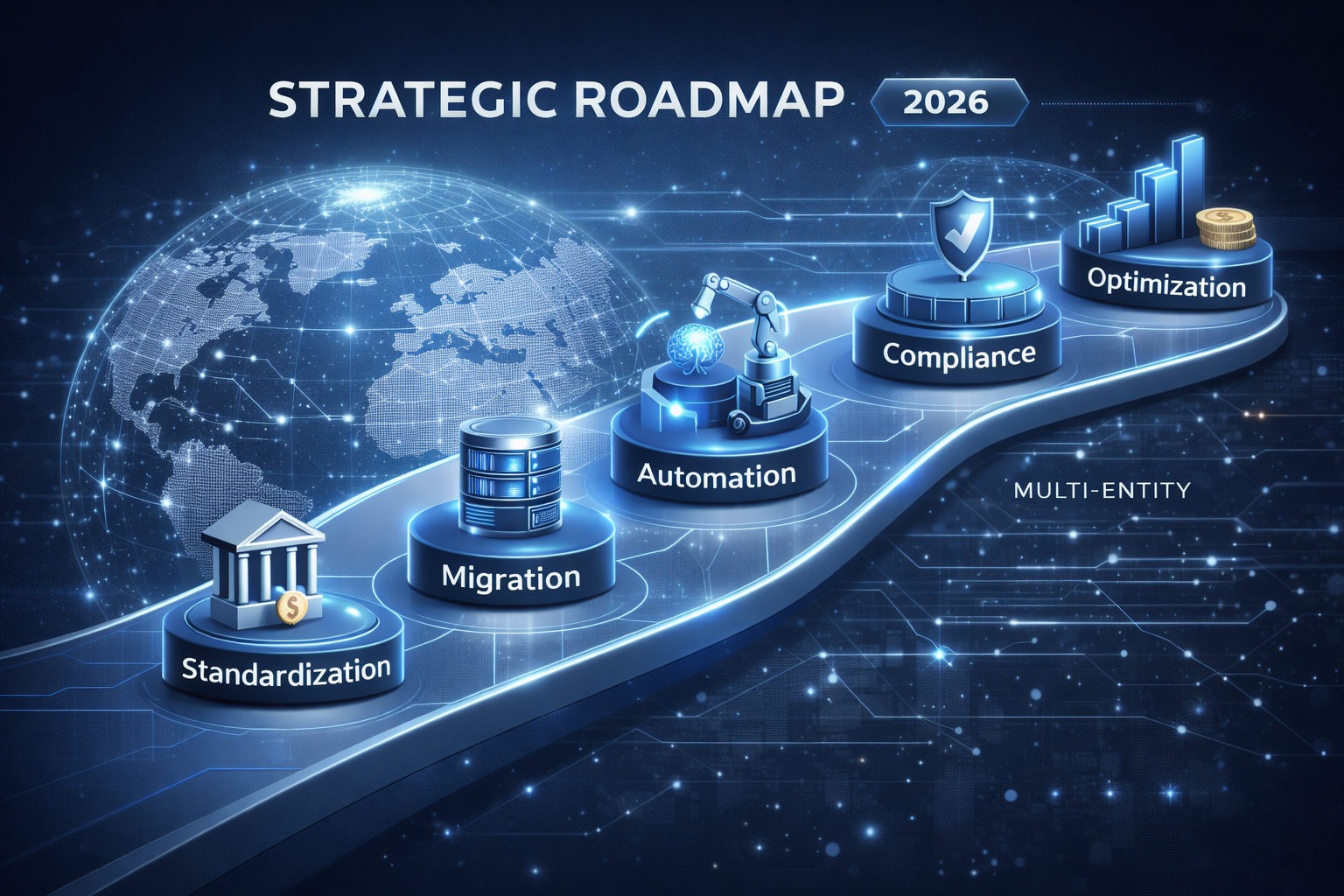
Phase 1: Global Process Standardization
The first step in our strategic roadmap is standardizing processes across all entities. One common mistake during implementation is allowing every subsidiary to maintain its own unique workflow. To achieve maximum ROI, a global template should be established. This template defines common chart of accounts, standardized financial periods, and uniform reporting standards. By centralizing these core functions, a multi-entity business can reduce administrative overhead and ensure that data flowing into the consolidated reports is accurate and consistent.
Phase 2: Data Migration and Governance
Data is the lifeblood of any ERP. For multi-entity businesses, migrating legacy data from multiple fragmented systems into NetSuite requires a rigorous governance framework. It is essential to clean and map data according to the global template. During this phase, businesses must decide on the level of historical data needed. In 2026, leveraging AI-driven data mapping tools can significantly speed up this process, ensuring that the transition to Oracle NetSuite does not disrupt daily operations.
💡 Strategic ERP Insights for Executives
Beyond understanding TCO, choosing the right platform is critical for long-term ROI. Explore our high-stakes comparisons:
- 🚀 Odoo vs NetSuite: Strategic Comparison for Global Scaling
- 📊 The 2026 ERP Selection Framework: Avoiding Hidden Implementation Costs
*Optimized for high-ticket decision making and ROI analysis.
Phase 3: Automated Intercompany Management
One of the most significant advantages of NetSuite for multi-entity structures is the automation of intercompany transactions. In a traditional setup, reconciling sales between a parent company and its subsidiaries can take days. With NetSuite, these transactions are recorded simultaneously in both books, with automated elimination entries generated at the end of the period. This automation not only reduces the risk of human error but also provides the CFO with real-time visibility into the consolidated financial health of the entire organization.
Phase 4: Global Tax and Compliance Localization
Operating in multiple countries means dealing with multiple tax jurisdictions. Whether it is VAT in Europe, GST in Asia, or Sales Tax in the US, Oracle NetSuite’s “Tax Engine” automatically applies the correct tax rules based on the location of the entity. This localized compliance is a critical part of the strategic roadmap, ensuring that the business remains audit-ready in every region it operates.
Phase 5: Continuous Optimization and AI Integration
Implementation is not a “one-and-done” event. In 2026, a strategic roadmap must include a phase for continuous optimization. This involves leveraging NetSuite’s embedded AI to analyze multi-entity performance trends. By identifying high-performing subsidiaries and pinpointing operational inefficiencies in others, management can make informed decisions about resource allocation and global expansion.
Conclusion: Achieving Global Synergy
Implementing Oracle NetSuite for multi-entity businesses is a transformative journey that leads to global synergy. By consolidating multiple systems into a single cloud-native platform, organizations gain the agility needed to thrive in the 2026 marketplace. At dominasiserp.com, we emphasize that the success of this roadmap depends on a balance between global standardization and local flexibility.