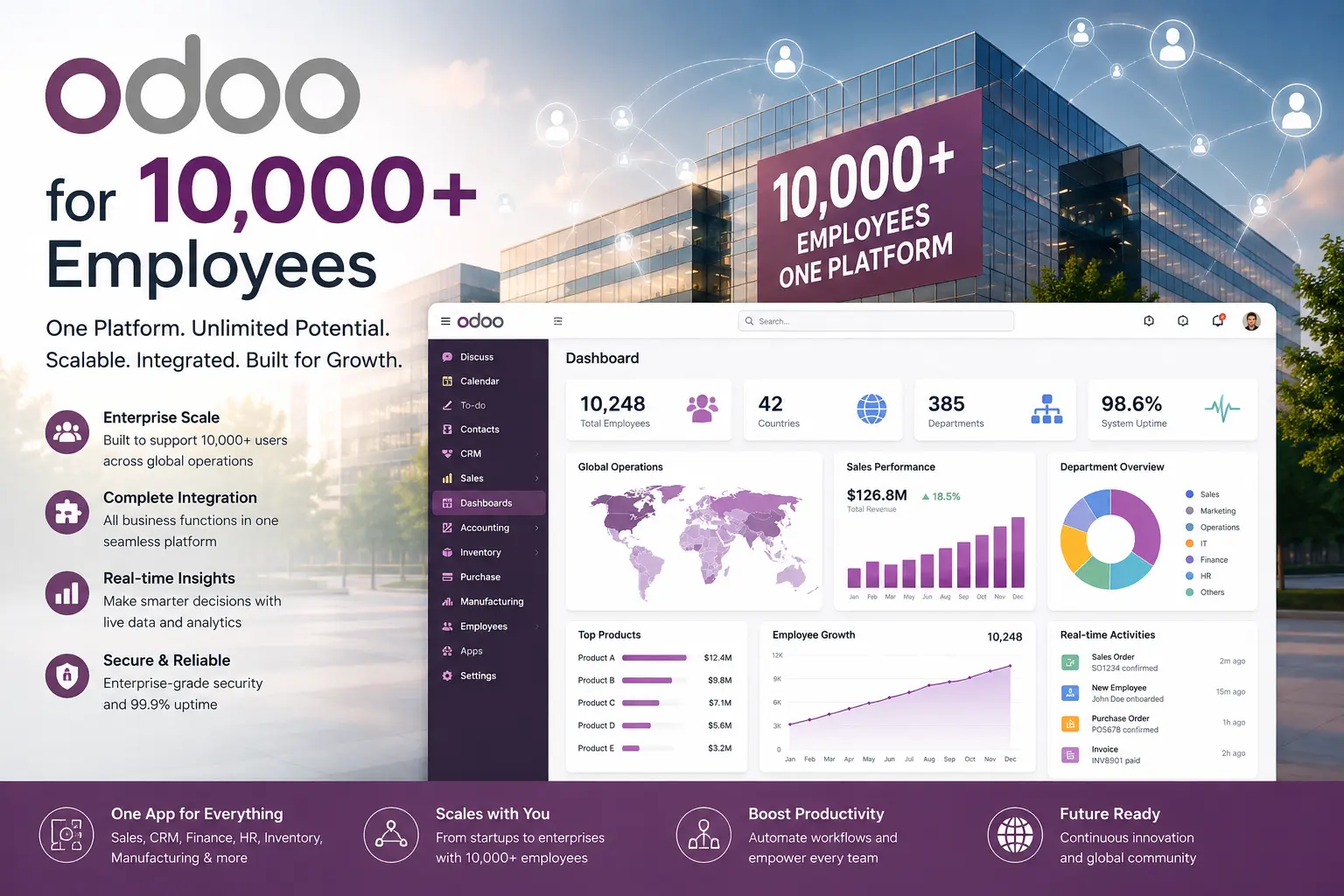
Odoo for Enterprises with 10,000+ Employees: Scalability, Infrastructure, and Cost Considerations
Odoo can scale to support enterprises with 10,000+ employees. However, scaling an ERP system to this level is not simply about installing software — it requires careful planning of infrastructure, architecture design, governance, and long-term cost strategy.
This guide explores how Odoo performs at enterprise scale, what challenges appear when managing large organizations, and what decision-makers should consider before deploying ERP at this level.
🏢 Why ERP Matters for 10,000+ Employee Organizations
When a company grows beyond 10,000 employees, operational complexity increases exponentially. Departments become distributed across regions, workflows become fragmented, and data consistency becomes a major challenge.
At this scale, ERP systems like Odoo are not optional — they become the backbone of business operations.
Key reasons enterprises adopt ERP at this scale include:
- Centralized financial control across multiple subsidiaries
- Standardized business processes across departments
- Real-time visibility of operations and performance
- Reduced dependency on manual reporting systems
- Improved compliance and governance
⚙️ Can Odoo Really Handle 10,000+ Employees?
Yes — Odoo can handle enterprise-scale deployments, but performance depends heavily on system architecture and implementation quality.
Odoo is modular and highly scalable when properly configured with:
- Load-balanced server architecture
- PostgreSQL optimization
- Cloud or hybrid infrastructure setup
- Caching mechanisms (Redis or similar)
- Proper database indexing strategy
Without proper architecture, even powerful ERP systems can experience performance bottlenecks under heavy enterprise load.
🧠 Key Infrastructure Requirements for Enterprise Odoo
Scaling Odoo for 10,000+ employees requires enterprise-grade infrastructure planning.
1. Server Architecture
- Multi-server deployment (application + database separation)
- Load balancer to distribute traffic
- Failover system for high availability
2. Database Optimization
- Partitioning large datasets
- Query optimization for heavy transactions
- Regular database maintenance and indexing
3. Cloud Scalability
- Auto-scaling cloud infrastructure (AWS, Azure, GCP)
- Disaster recovery setup
- Multi-region deployment for global companies
💰 Cost Considerations for Enterprise Odoo Deployment
ERP cost at enterprise scale is significantly different from SME implementations. Costs increase not only due to licensing, but also infrastructure, customization, and ongoing maintenance.
Main cost components include:
- Software licensing (Enterprise Odoo subscription)
- Infrastructure and cloud hosting
- ERP implementation partner fees
- Customization and module development
- Training for large employee base
- Ongoing support and maintenance
For enterprises with 10,000+ employees, ERP cost is typically driven more by complexity than software pricing itself.
📊 Performance Challenges at Enterprise Scale
While Odoo is scalable, enterprise deployments may face several challenges:
- High transaction volume causing database load spikes
- Complex approval workflows slowing processes
- Integration with legacy systems
- Data synchronization across multiple regions
- User access control complexity
These challenges are not limitations of Odoo itself, but rather design and architecture issues in large deployments.
🔐 Governance and Security in Large ERP Systems
At 10,000+ employee scale, security and governance become critical.
Enterprises must implement:
- Role-based access control (RBAC)
- Audit trails for financial transactions
- Data encryption at rest and in transit
- Strict approval workflows
- Compliance with industry regulations (ISO, GDPR, etc.)
📈 Business Impact of Odoo at Enterprise Level
When properly implemented, Odoo delivers significant value to large organizations:
- Faster financial consolidation across subsidiaries
- Reduced operational redundancy
- Improved decision-making speed for executives
- Better visibility into global operations
- Higher productivity across departments
🧠 Final Insight
Odoo can scale to support enterprises with 10,000+ employees, but success depends on architecture, governance, and implementation strategy — not just software capability.
In enterprise environments, ERP is not just a tool. It becomes a strategic backbone that determines how efficiently a company operates at global scale.
Scalability is not about software limits — it is about system design.
ADVERTISEMENT / SPONSORED SOLUTIONReliable resources for your business growth
🚀 Deep Dive Enterprise Resources
If you're evaluating Enterprise Resource Planning, leverage our technical ROI breakdowns and performance benchmarks:
- 👉 Odoo Enterprise Pricing 2026: The Ultimate Guide
- 👉 SAP to Odoo Migration: Risks & Benefits
- 👉 Maximizing ROI with Oracle NetSuite Implementation
*Verified for 2026 Enterprise Standards.
DMS Global AuthorityADVERTISEMENT / SPONSORED SOLUTIONReliable resources for your business growth
ADVERTISEMENT / SPONSORED SOLUTIONReliable resources for your business growth